

 Audio 2G
- “The Dark Side of the Moon” came about by revisiting some existing ideas and music and adding new compositions. The band developed the material between late 1971 and early 1972, working first in the rehearsal room at Decca Studios and later in the Rolling Stones’ rehearsal room on Bermondsey Street in London.
- The themes of the album were discussed in the kitchen of the Mason home on St. Augustine’s Road in Camden Town. Waters recalled suggesting an album focused on the pressures of modern life and everything that prevents people from focusing on the positive aspects of existence.
- The recordings took place at EMI Studios on Abbey Road in several sessions between late May 1972 and February 9, 1973. The album took full advantage of the capabilities of 16-track recording, although the complexity of the overdubs made it necessary in several cases to bounce tracks to other tracks. Alan Parsons was the lead sound engineer, assisted by Peter James, while Chris Thomas oversaw the final mix.
- In the early versions of “Speak To Me,” Nick Mason used the bass drum to reproduce the heartbeat that would become one of the album’s symbolic elements. An early version of the material also appears in the studio footage included in the film “Pink Floyd Live At Pompeii.”
- “Breathe (In The Air)” is linked to “Breathe,” a song composed by Waters and Ron Geesin for the soundtrack of the 1970 film *The Body*. Richard Wright recalled the influence that jazz harmonies had on him, particularly Miles Davis’s “Kind Of Blue.” Gilmour also used the pedal steel guitar, an instrument that played a key role in creating the song’s ethereal atmosphere.
- The central theme of “On The Run” is, above all, the anxiety associated with travel and the fear of flying. In the 1972 performances, it was replaced by “The Travel Sequence,” a long instrumental section that was very different. In the studio, the track was completely transformed using the EMS Synthi AKS synthesizer. Among the effects are airport announcements and specially recorded sounds; Alan Parsons also had his assistant, Peter James, run through Studio 2 to achieve the famous footsteps effect.
- “Time” opens with the famous collage of clocks and alarm clocks recorded by Alan Parsons in a London antique shop for a quadraphonic recording demonstration. Nick Mason, on the other hand, recorded the long introduction on the Rototom drums. The song addresses one of the album’s central themes: the perception of time and the realization—often too late—that a significant portion of it has slipped away.
- “Breathe (Reprise)”—also referred to as “Home Again” during the 1972 concerts—serves as the musical coda to “Time,” while drawing on material from “Breathe.” The lyrics revisit the relationship between the individual, everyday life, religion, and the need to find a place—whether physical or mental—to which one belongs.
- The future “The Great Gig in the Sky” originated from the instrumental piece “The Mortality Sequence,” which, when performed live, included recordings of speeches on the topics of religion and death. Alan Parsons suggested calling Clare Torry, who recorded her vocal improvisation on January 21, 1973, and was initially paid 30 pounds. In 2004, Torry filed a lawsuit claiming that her contribution was compositional. The dispute was settled out of court in 2005, and since then the song has been credited to Richard Wright and Clare Torry.
- “Money” was built around the famous 7/4 loop of a cash register, coins, and other sounds, which Waters created using recordings he made at home. The piece then shifts to 4/4 time during the guitar solo. The saxophone is played by Dick Parry, an old friend of Gilmour’s from his days at Cambridge.
- “Us And Them” is derived from “The Violent Sequence,” an instrumental composition by Richard Wright written in 1969 for Michelangelo Antonioni’s “Zabriskie Point” but not used in the film. Waters later added lyrics, transforming it into a reflection on war, social divisions, and the contrast between “us” and “them.”
- The title “Any Color You Like” is generally linked to an expression used by roadie Chris Adamson and to the concept of a choice that is seemingly free but actually limited. The most famous reference is to the phrase attributed to Henry Ford regarding the Model T: “Any color, as long as it’s black.” It was not, therefore—as is sometimes reported—the Ford T-Bird. During its development, the song was also known as “Scat” or “Dave’s Scat Section.”
- Waters explained “Brain Damage” using the image of a society that lays down rule after rule and considers anyone who decides to break them to be “crazy.” The reference to flower beds also evokes Cambridge. The song is inevitably associated with Syd Barrett and the theme of mental illness, one of the central themes of the entire album.
- “Eclipse” was added to the suite in 1972 and became its definitive finale. Among the recorded voices, one can recognize the laughter of Peter Watts—Pink Floyd’s road manager and father of actress Naomi Watts—and the closing line spoken by Abbey Road doorman Gerry O’Driscoll. In some editions, immediately after his words, you can hear—at a very low volume—an orchestral version of the Beatles’ “Ticket to Ride,” which was likely accidentally left on the tape used.
- In 1972, Medicine Head released an album titled “Dark Side Of The Moon.” Pink Floyd, who had already considered the same title, temporarily abandoned it in favor of “Eclipse – A Piece For Assorted Lunatics.” The lack of commercial success of Medicine Head’s album then convinced the band to revert to the original title.
- Alan Parsons was a young EMI engineer who had already worked with Pink Floyd as an assistant on “Atom Heart Mother.” His work on “The Dark Side of the Moon” earned him a Grammy nomination as a sound engineer. However, the Grammy in that category went to Stevie Wonder’s “Innervisions.”
- “The Dark Side of the Moon” featured a particularly significant number of guest musicians. Among them were saxophonist Dick Parry and singers Doris Troy, Lesley Duncan, Liza Strike, and Barry St. John, who contributed primarily to “Time,” “Us and Them,” and “Brain Damage/Eclipse.”
- During their recording sessions at Abbey Road, the band members would often take breaks to watch soccer games or Monty Python on television. The connection wasn’t just sentimental: in 1974–75, Pink Floyd was among those who contributed financially to the production of *Monty Python and the Holy Grail*.
- On October 16 and 17, 1972, director Adrian Maben filmed additional footage at Abbey Road for the extended version of “Pink Floyd Live At Pompeii.” The film shows the band working on “The Dark Side Of The Moon” and includes the famous interviews conducted in the studio cafeteria.
- Before the final mix, there were different versions of some tracks and of the album as a whole. Alan Parsons’ work offers a different perspective from the final master supervised by Chris Thomas. An alternate mix of the album was later released in the 2011 “Immersion” box set.
- Pink Floyd made extensive use of the EMS VCS3 and Synthi AKS synthesizers, British instruments designed by Electronic Music Studios, a company founded by Peter Zinovieff, David Cockerell, and Tristram Cary. These machines played a key role, particularly on *On The Run* and *Any Colour You Like*.
- Chris Thomas was brought in for the final mix as an outside consultant capable of mediating between the band members’ differing sonic preferences. Thomas had previously worked with George Martin and the Beatles and had participated in the sessions for the “White Album.”
- To make the album’s themes universal, Waters prepared a series of questions and had people at Abbey Road interviewed. Voices featured on the album include Chris Adamson, Roger “The Hat” Manifold, Peter and Patricia Watts, Gerry O’Driscoll, and Wings guitarist Henry McCullough. Paul and Linda McCartney were also interviewed, but their responses were not used on the album.
- The album was completed in February 1973. Gilmour recalled the feeling of having created something particularly important, while Waters took a copy home to play for his wife, Judy Trim: according to his account, she was in tears by the time it was over.
- After the master was completed, the material was quickly shipped to the United States so that Capitol could prepare for the American release. The U.S. label immediately recognized the album’s commercial potential and launched a promotional campaign that was far more extensive than those for Pink Floyd’s previous albums.
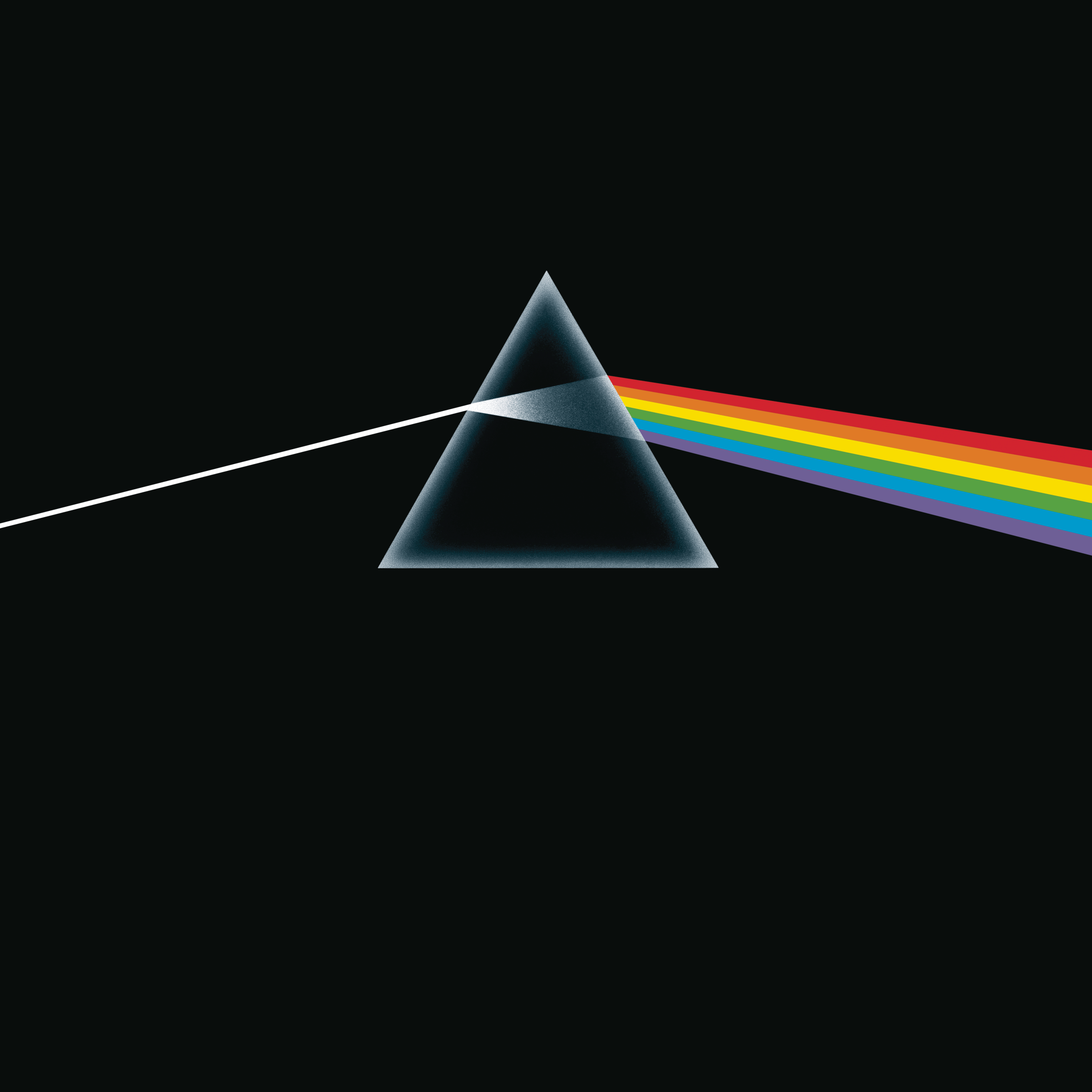
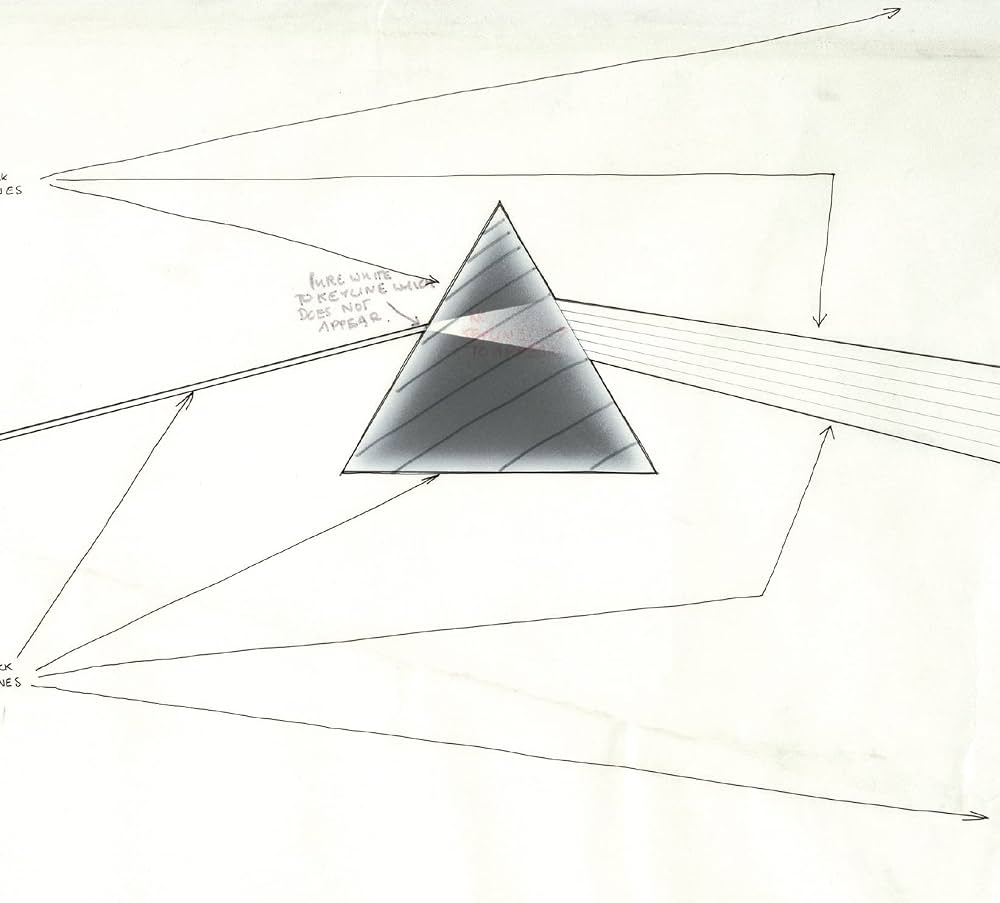
- The famous cover was created by George Hardie for Hipgnosis based on an idea developed by Storm Thorgerson and Aubrey Powell. The prism stemmed from the band’s interest in a simple, instantly recognizable image and their desire to graphically represent the lighting of Pink Floyd’s live shows. Among the rejected proposals were much more elaborate images, in the style typical of earlier Hipgnosis covers.
- Their previous album, “Obscured By Clouds,” released in 1972, had achieved greater success in the United States than most of Pink Floyd’s earlier work, laying the groundwork in part for the commercial breakthrough that would come with “The Dark Side of the Moon.”
- Bhaskar Menon, president of Capitol Records, was particularly impressed by the album and spearheaded a very aggressive promotional campaign in the United States. It was one of the factors that transformed Pink Floyd—which, until then, had been a cult band in the United States—into one of the biggest bands on the American music scene.
- The suite that would become “The Dark Side of the Moon” was performed live long before the album’s release. The first complete performance took place in January 1972, and for much of that year, audiences were able to hear and follow the evolution of the compositions before a recorded version existed.
- There is no known complete professional video recording of a full performance of “The Dark Side of the Moon” by Pink Floyd from the period 1972–1975. There are clips and audio recordings from numerous concerts, but no complete video recording comparable to the live recordings from later periods.
- EMI organized promotional events and album listening sessions in the run-up to the release. “The Dark Side of the Moon” benefited from a much more structured promotional strategy than the band’s previous works, especially in the United States.
- The quadraphonic version was supposed to be the highlight of the press presentation at the London Planetarium on February 27, 1973, but it wasn’t ready yet. The stereo version was therefore played through a sound system that did not satisfy the band. Irritated, Waters, Gilmour, and Mason did not attend the event in person; Wright was the only member present.
- In their live performances of the suite, Pink Floyd used prerecorded tapes to reproduce effects and vocals that were impossible to recreate on stage. As their success grew, so did their production scale: on their American tours in the following years, the band ended up transporting tons of audio equipment, lighting, and special effects.
- Even before the album’s release, the famous bootleg “The Best Of Tour ’72” began circulating, taken from one of the London performances at the Rainbow Theatre in February 1972. Estimates at the time put the sales at over 100,000 copies—an exceptional figure for a bootleg and even more surprising considering that it contained music that had not yet been officially released.
- “The Dark Side of the Moon” was released in the United States in March 1973 and in the United Kingdom on March 23, according to Pink Floyd’s official chronology. In the UK, it peaked at number 2, never reaching the top spot. Its success, however, was far more enduring than that of most of the albums that occupied the top spots on the charts during those weeks.
- In the United States, “The Dark Side of the Moon” reached No. 1 on the Billboard chart on April 28, 1973, remaining there for just one week. The fact that it held the top spot for just seven days is one of the great paradoxes of its history, considering its unprecedented overall run on the U.S. charts.
- Gilmour said he had made a bet with manager Steve O’Rourke that “The Dark Side of the Moon” wouldn’t make it into the U.S. Top Ten. The prediction turned out to be spectacularly wrong: the album actually reached number 1 and permanently transformed Pink Floyd’s commercial success.
- In the United States, “Money” was released as a single in May 1973 with “Any Color You Like” as the B-side and reached No. 13 on the Billboard Hot 100, becoming Pink Floyd’s first real American hit. For radio broadcasts, the word “bullshit” was censored.
- In 1979, Mobile Fidelity Sound Lab released one of the album’s most famous audiophile editions, produced using half-speed mastering. Special security precautions were taken during the transport and storage of the original masters, reflecting the value those reels had come to hold.
- The title “The Dark Side Of The Moon” also appears in earlier works and therefore did not originate in 1973. “The Dark Side of the Moon” is, among other things, the title of a chapter in “Moonchild,” a novel by Aleister Crowley published in 1917. However, there is no evidence that Waters chose the album title as a direct reference to Crowley.
- The album’s quadraphonic mix, produced by Alan Parsons, was released in 1973–74 on the Quadraphonic LP format and later on other formats. Parsons received a Grammy nomination for his technical work on the album; the award went to Stevie Wonder’s “Innervisions.”
- The transition to the digital age helped give the record a second—and then a third—commercial lease on life. On July 6, 1989, David Gilmour and Nick Mason visited the EMI plant in Swindon to mark the production of the 550,000th British CD copy of “The Dark Side of the Moon.”
- Starting in the 1990s, the theory of the so-called “Dark Side of the Rainbow” gained popularity: if you play the album while watching the 1939 film *The Wizard of Oz*, numerous coincidences between the music, lyrics, and images are said to occur. Pink Floyd has always denied that they intentionally synchronized the album with the film.
- In 2003, to mark its 30th anniversary, “The Dark Side of the Moon” was released on hybrid SACD with a new 5.1 multichannel mix by James Guthrie. The release propelled the album back to the top of the charts and made it one of the best-known and best-selling SACDs in the entire history of the format.
- In 2013, to mark the 40th anniversary, playwright Tom Stoppard created “Darkside” for BBC Radio 2, a philosophical radio drama based on the music from “The Dark Side of the Moon.” It aired on August 26, 2013, and was later released on physical media as well.
- In 2003, Matthew Longfellow produced the documentary “The Making of The Dark Side of the Moon” for the “Classic Albums” series, featuring separate interviews with Waters, Gilmour, Wright, and Mason, as well as contributions from Alan Parsons and other key figures involved in the sessions. It remains one of the most important audiovisual records of the album’s creation to this day.
- On July 2, 2005, Waters, Gilmour, Wright, and Mason reunited to perform together at Live 8 in Hyde Park, marking the first performance by the classic Pink Floyd lineup in over twenty years. From the “Dark Side” album, they performed “Breathe/Breathe Reprise” and “Money” as part of a short setlist that also included “Wish You Were Here” and “Comfortably Numb.”
- In 2023, to mark the 50th anniversary, Pink Floyd released a new edition of “The Dark Side of the Moon.” The box set included the 2023 remaster of the album, the 5.1 mix, a new Dolby Atmos mix, and “The Dark Side of the Moon – Live at Wembley Empire Pool, London, 1974.” The new Atmos mix was created by James Guthrie and brought the album, half a century after its release, fully into the era of immersive audio.
- The figure of 723 weeks on the Billboard 200—which is still often cited—has now been far surpassed. After Billboard changed its rules in 2009 to allow back-catalog albums to re-enter the main chart, “The Dark Side of the Moon” has returned to the Billboard 200 several times. By January 2026, it had reached a total of 996 weeks on the Billboard 200, an all-time record for an album. The famous figure of 593 consecutive weeks, however, refers to its extraordinary uninterrupted run between December 1976 and April 1988.
- What was still just a rumor in 2023 is now a reality in the music industry: Roger Waters has completely re-recorded the album, releasing “The Dark Side of the Moon Redux” on October 6, 2023. Waters, who had already performed the entire “Dark Side” during his 2006–2007 tour, reinterpreted the album fifty years after the original with radically different arrangements, a more expansive tempo, and a strong narrative element. Waters produced the album alongside Gus Seyffert. “Redux” neither replaces nor alters the Pink Floyd album; it is a standalone reinterpretation of the 1973 work.






GIPHY App Key not set. Please check settings