

 Audio 2G
Following the Verse DAC/preamp/headphone amp, LAiV’s Crescendo series now includes a power amplifier: the Chorus. It is a stereo amplifier featuring GaN (gallium nitride) technology, directly derived from the Harmony GaNM monoblock amplifiers, designed to bring the expertise the Singapore-based company has developed in the field of next-generation Class D amplification to a significantly more affordable price point. It features a notable highlight: the ability to operate in bridge mode, transforming it into a true balanced monaural amplifier.
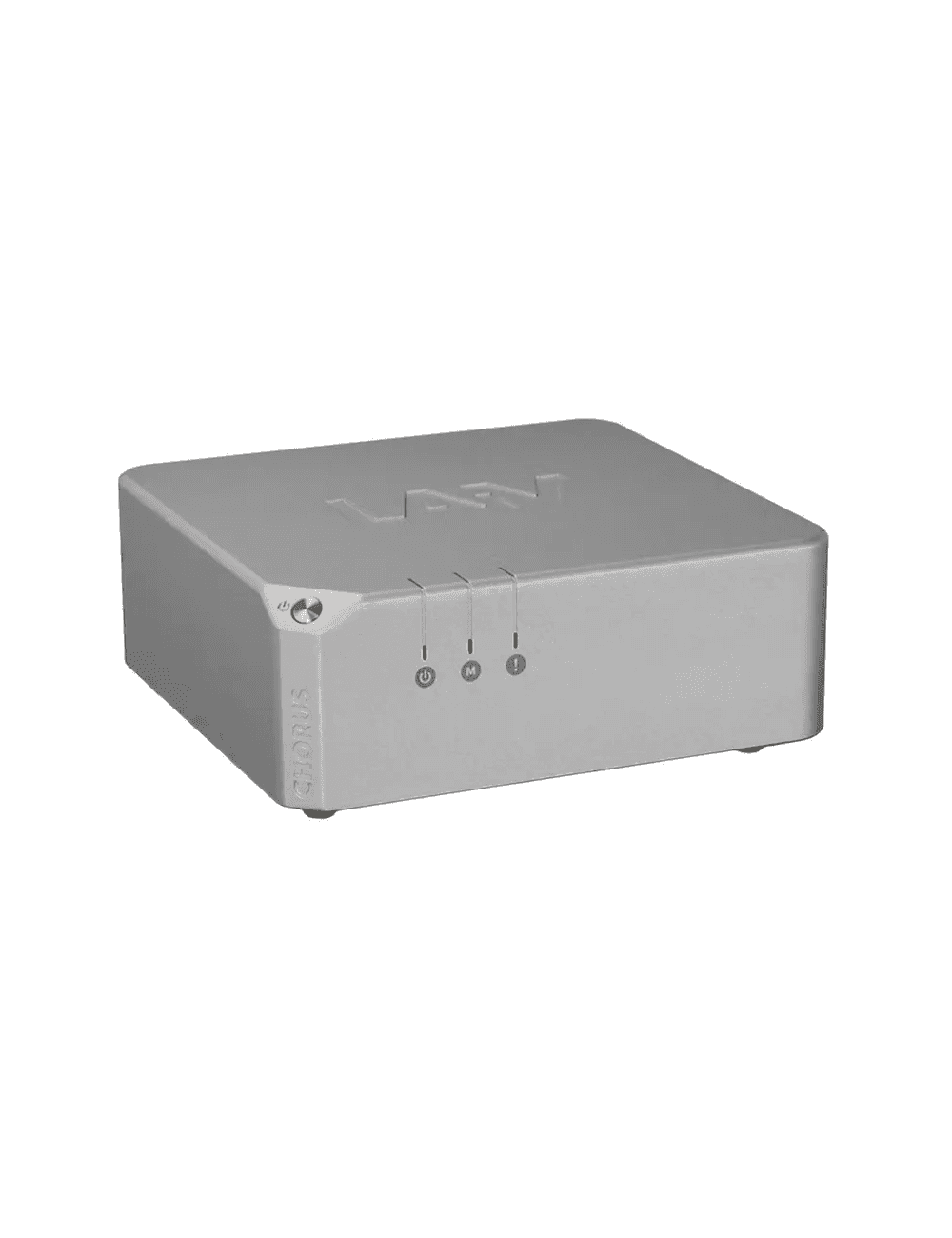
Anyone who has read our review of the Crescendo Verse will remember how LAiV places particular emphasis on the so-called “family feeling”, and the Chorus is no exception. The compact, square-shaped cabinet features the unified design of the Crescendo series and is made of anodized aluminum, available in black/gold and silver/gold finishes. It weighs just 1.5 kg—a figure that, until a few years ago, we would have associated more with a preamplifier than with a power amplifier. The front panel is as minimalist as you can imagine. The power button works with a short press to turn it on and a long press to switch it to standby. Three LEDs provide all the necessary information: the first indicates the operating status (red in standby, white when active); the second indicates the operating mode (off in stereo, white in mono with RCA input, blue in mono with XLR input); finally, the third is dedicated to error messages and flashes once, twice, or three times, respectively, in the event of overheating, overcurrent, or activation of the DC output protection.
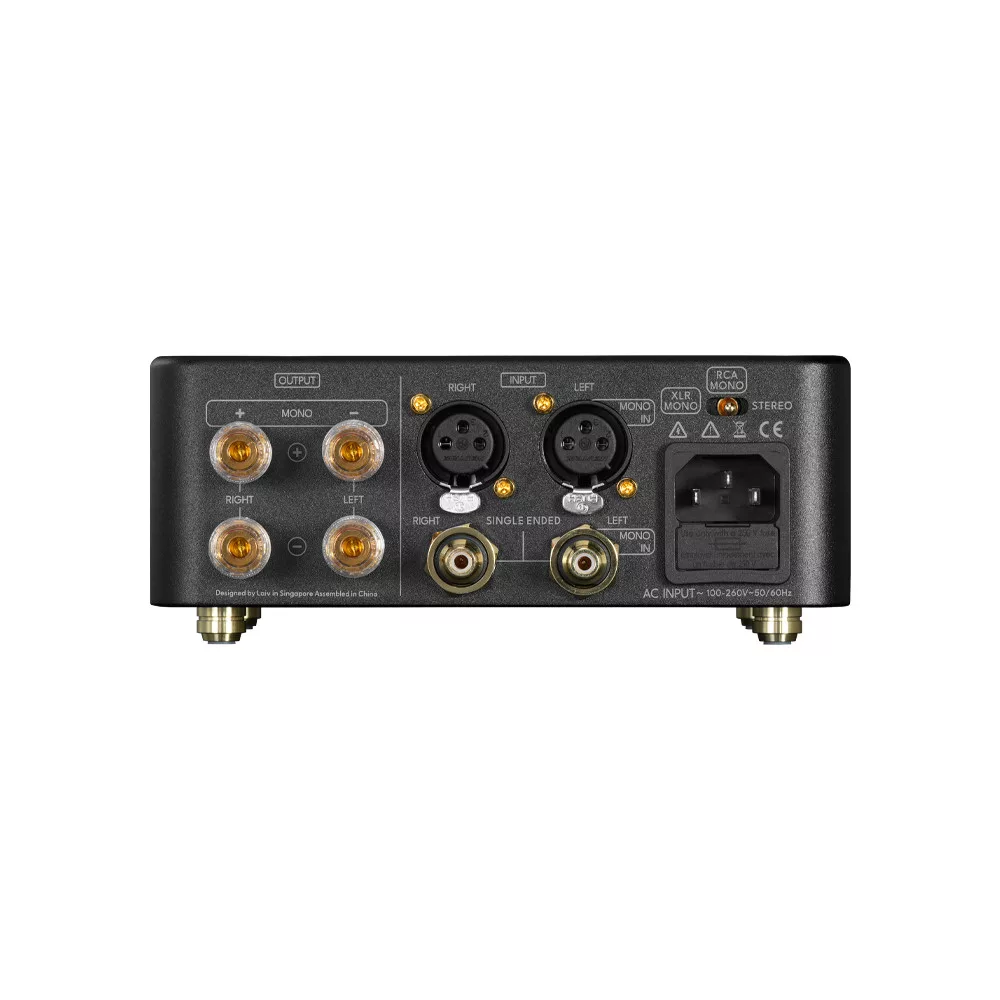
On the rear panel, you’ll find balanced XLR inputs and unbalanced RCA inputs, the operating mode selector (Stereo, RCA Mono, and XLR Mono), the speaker terminals, and the IEC power socket with its fuse. As with the Verse, firmware updates are performed using a microSD card inserted into the dedicated reader located on the bottom of the unit.
One detail that speaks volumes about the efficiency of the technology used: there is no fan or active cooling system, and the chassis itself acts as a heat sink; during our listening sessions, the cabinet remained little more than lukewarm. After all, the manufacturer designed the Chorus to stay on at all times: the stated power consumption is less than 0.5 W in standby mode and 20 W when idle. The only recommendation is to follow the correct power-on sequence: turn on the DAC or preamplifier first, then the Chorus, and reverse the order when turning them off.
The Technique
At the heart of the Chorus are gallium nitride power transistors—the same ones used in the Harmony GaNM monophonic amplifiers. Compared to traditional silicon MOSFETs, GaN FETs are capable of switching at much higher speeds: this allows the switching frequency to be pushed well beyond the audio band, with clear benefits in terms of distortion, frequency response extension, and overall efficiency. The manufacturer emphasizes that it has paid particular attention to the modulators and driver stages, which were fine-tuned with the stated goal of combining transparency, resolution, and musicality.
The differences compared to its bigger brother mainly concern the chassis—which is made of die-cast aluminum rather than machined from solid—and the switching power supply, rated at 160 W compared to the GaNM’s 250 W. This is therefore not a “simplified” version in the pejorative sense of the term, but rather a rationalization of resources that keeps the core technology intact.
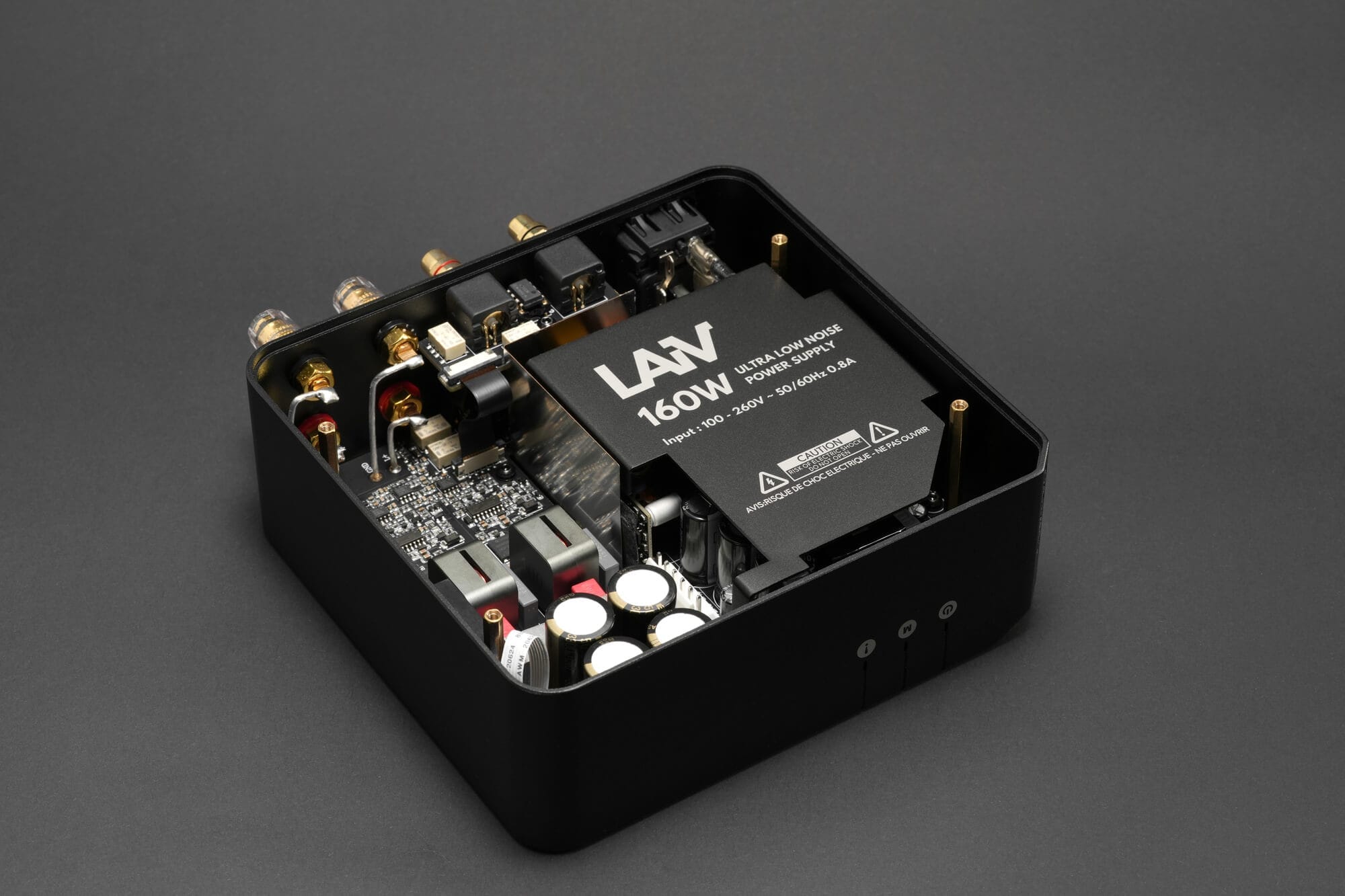
The most interesting feature, however, is the amplifier’s dual-mode operation. In stereo mode, the Chorus functions as a two-channel amplifier with independent channels, capable of delivering 50 W per channel into 8 ohms and 80 W into 4 ohms. In this configuration, both the XLR and RCA inputs can be used. By switching the rear selector to mono mode, the unit transforms into a fully differential bridge-wired amplifier: the input signal is internally converted to balanced (even if it comes from the RCA input) and drives both channels in bridge configuration. Power output thus increases to 120 W at both 8 and 4 ohms, with rated stability down to 2 ohms and instantaneous peaks of 165 W. The configuration recommended by LAiV for maximum performance is clearly two Chorus units in mono, one per channel.
It is interesting to note that the gain varies significantly depending on the mode and the input used: it ranges from 22 dB in stereo with an XLR input to 34 dB in mono with an RCA input, with the other two combinations yielding 28 dB. The input impedance is approximately 94 kohm on XLR and 47 kohm on RCA, while the specified damping factor is approximately 200 at 1 kHz into 8 ohms. Total harmonic distortion plus noise is less than 0.005% at 5 W into 8 ohms; the signal-to-noise ratio and dynamic range are both greater than 100 dB; and the frequency response extends from 20 Hz to 80 kHz within ±3 dB.
Rounding out the system is a three-part protection system (DC output voltage, overcurrent, and overtemperature) managed by a microcontroller that, every time the unit is turned on, performs a complete circuit check before connecting the speakers.
Listening
As we all know, a powerful amplifier never sounds good on its own: much of what you hear depends on what’s connected upstream. That’s why we wanted to test the Chorus in three different configurations. The first is the most obvious—the “family” setup—with the Crescendo Verse serving as the DAC/preamplifier. In the second, we used the Eversolo DMP-A8 Gen 2 as both the source and preamplifier. Finally, in the third configuration, we used the Aqua La Scala as the DAC, followed by a unity-gain (1:1) buffer based on a design by Nelson Pass, and the speakers were the Davis Olympia One Master 35.
With the Verse driving it, the Chorus comes across as a fast, clean, and essentially neutral amplifier, free of the colorations that are sometimes used to make the initial listening experience more appealing. Anyone expecting the classic “Class D” sound from a few years ago—dry and a bit anemic in the high frequencies—will be surprised. The pairing is coherent and pleasant, but it leaves the impression that the power amp has something more to offer.
And in fact, all it took was changing the upstream components to realize this. Whether paired with the Eversolo or, even more so, with the Aqua La Scala chain and Pass buffer, the Chorus revealed a decidedly more mature sound: greater body and tonal naturalness, freer dynamics, and a wider, deeper soundstage. The conclusion is as simple as it is significant: in this setup, it is not the power amplifier that sets the limit, but the preamp section of the Verse—which, even so, remains a more than respectable solution considering how many functions it packs into a single chassis.
In the best setup, the low end is well-controlled, articulate, and responsive, and this is where the high damping factor really makes a difference: the double bass never turns into an indistinct mass, and the various layers of the low register remain clearly discernible. Don’t expect, however, much micro-contrast or the authority of a traditional amplifier with far greater power and size: in stereo mode, when the music gets demanding and the volume rises, you can tell that the 50 W per channel has its limits, especially with less-efficient speakers.
The midrange is this speaker’s strong point: vocals are well-centered and natural, acoustic instruments have precise contours, and the soundstage appears coherent. In the high frequencies, the Chorus is detailed and expansive, without any harshness, and faithfully reproduces the character of the source: with the Aqua, for example, the softness and three-dimensionality that characterize the Italian DAC come to the fore.
Conclusions
The LAiV Crescendo Chorus is a power amplifier that manages to pack GaN FET technology—until recently the exclusive domain of much more expensive units—into a chassis of almost negligible size and weight. It achieves this through meticulous construction, a full suite of protection features, and a flexibility of use rarely found in this price range, thanks to its ability to operate in both stereo and balanced mono modes.
The sound is fast, clean, and transparent, with well-controlled bass and a midrange that sounds convincingly natural. In stereo, it shows some limitations in power handling with more demanding speakers.
The Chorus is therefore appreciated as the ideal complement to the Verse, but that’s not all: it can be paired with most DACs and preamplifiers on the market and appeals both to those seeking a high-end desktop system and to those who want a compact, efficient, and musically rewarding traditional setup, with the potential to expand over time.
Technical Specifications:
- Technology: Gallium Nitride FET (GaN), Class D
- Inputs:
- 1 x XLR (stereo/mono), approx. 94 kohm
- 1 x RCA (stereo/mono), approx. 47 kohm
- Input Sensitivity: 1.414 Vrms (XLR stereo), 1.1 Vrms (XLR mono), 0.707 Vrms (RCA stereo), 0.55 Vrms (RCA mono)
- Gain: 22 dB (XLR stereo), 28 dB (XLR mono), 28 dB (RCA stereo), 34 dB (RCA mono)
- Power:
- 50 W per channel into 8 ohms (stereo)
- 80 W per channel into 4 ohms (stereo)
- 120 W into 8/4 ohms (mono), stable down to 2 ohms
- Damping factor: approximately 200 at 1 kHz into 8 ohms
- Frequency response: 20 Hz – 80 kHz, ± 3 dB
- THD+N distortion: < 0.005% at 5 W into 8 ohms
- Signal-to-noise ratio: ≥ 100 dB
- Dynamic range: ≥ 100 dB
- Protections: DC, overcurrent, overtemperature
- Power supply: 100–260 VAC, 50/60 Hz
- Power Consumption: ≤ 0.5 W in standby, ≤ 20 W at idle, ≤ 160 W at maximum power
- Weight: 1.5 kg
- Dimensions: [TO BE VERIFIED]
Price: 999€
Manufacturer: LAiV, 24 Sin Ming Lane, Singapore 573970
Distributor: Polaris Audio, Via Matteo Babini 28, 00139 Rome




GIPHY App Key not set. Please check settings