

 Audio 2G
The Timeless Pleasure of the Silver Disc
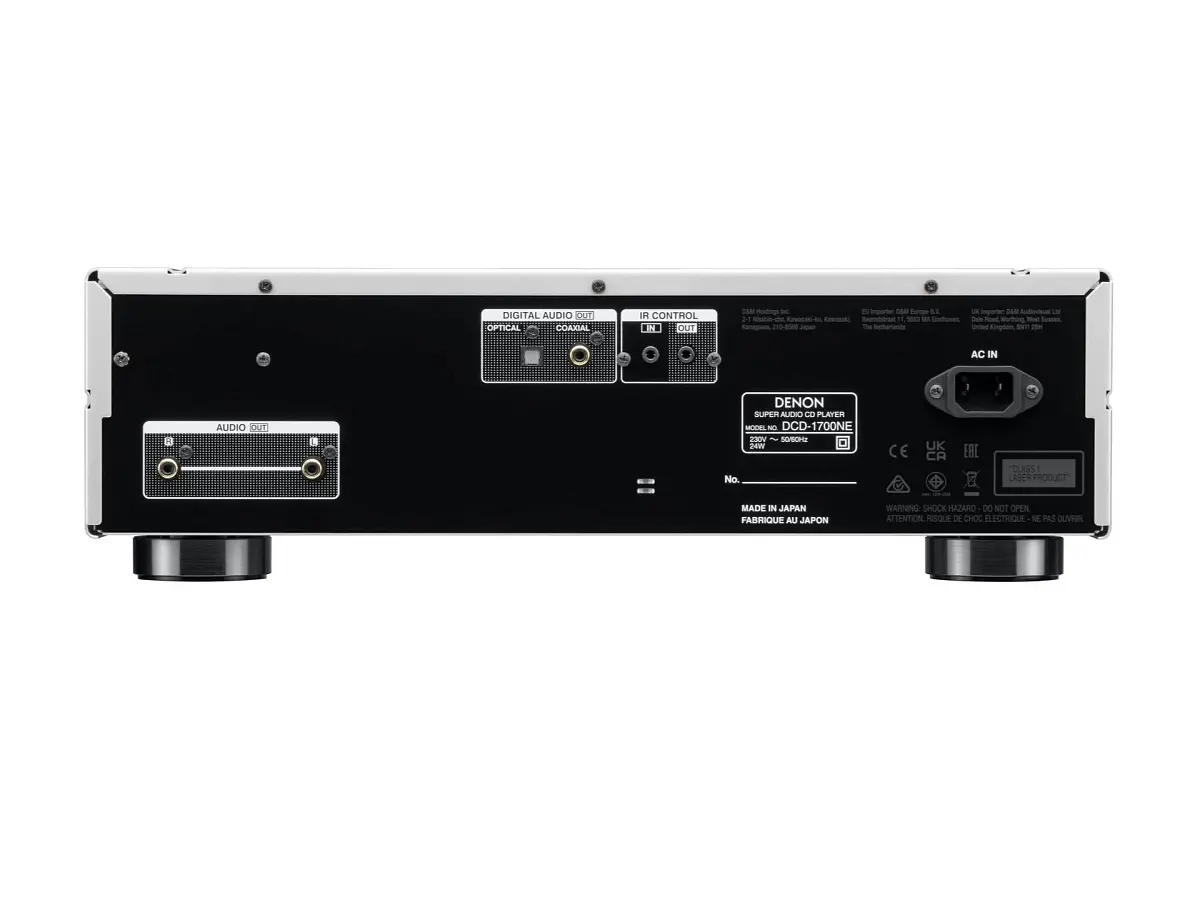
In today’s world, where music seems to be available only online, fewer and fewer enthusiasts appear to need a CD player. In reality, physical media continues to have a loyal following. In fact, many audiophiles own hundreds or thousands of CD and SACD albums, while younger people are rediscovering the charm of owning a physical item—one they can hunt down in stores or at flea markets—to listen to whenever they want, without paying a monthly subscription fee. Thus, a well-designed player can still be an attractive source—especially if it’s reasonably priced, like the Denon DCD-1700NE, currently the most affordable SACD player on the market. It’s not a universal device like the ones we’ve become accustomed to seeing lately—capable, for example, of functioning as both a DAC and a streamer at the same time. Instead, it’s a pure player, with no inputs whatsoever, featuring digital outputs for use with an external converter if desired, and analog outputs strictly via RCA, just like in the good old days. Let’s take a closer look at its design.
Construction and Design: The Substance of a Traditional Hi-Fi Component
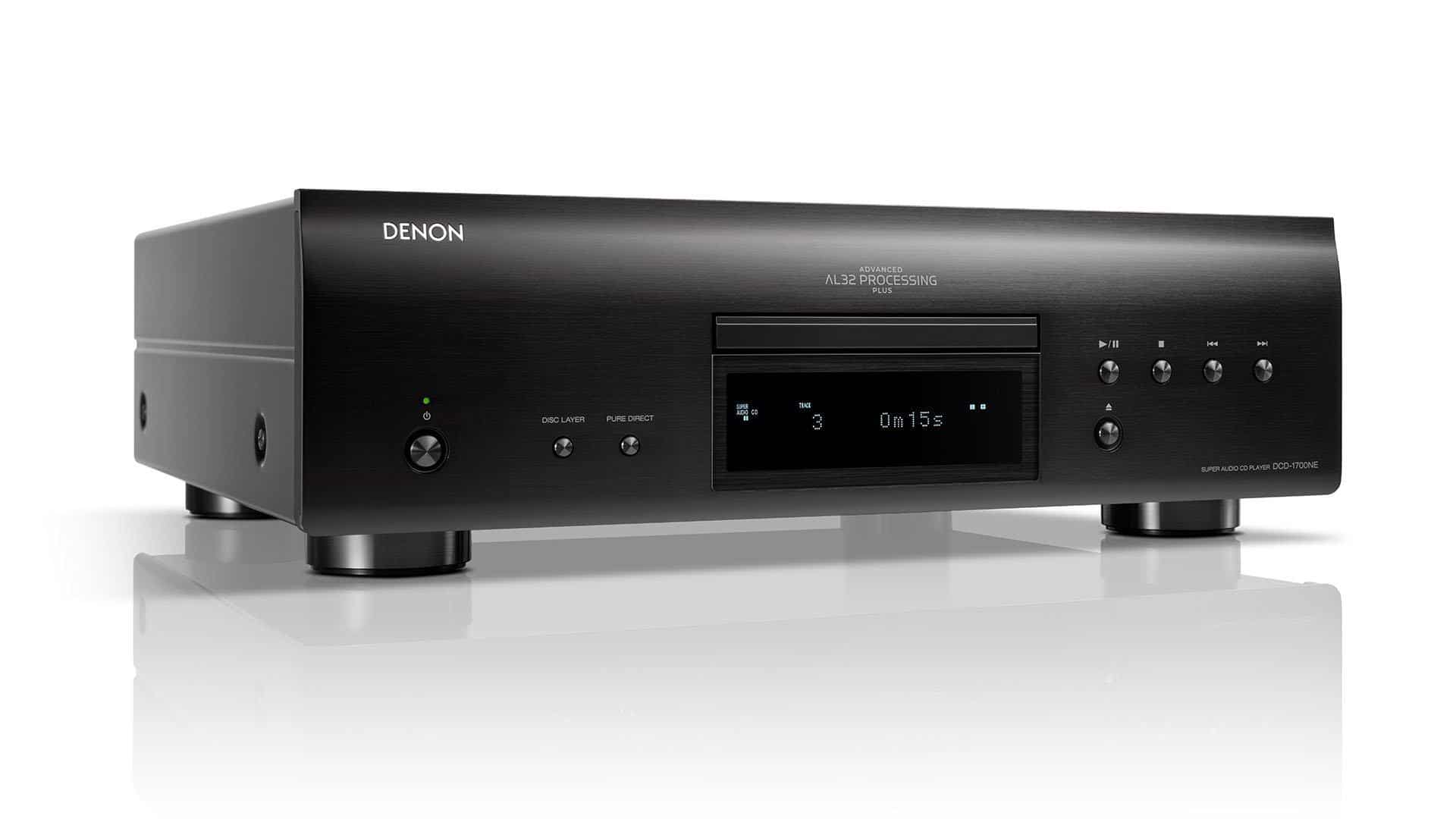
The DCD-1700NE is a full-size component that is both imposing and elegant. The front panel is made of aluminum—specifically, “laminated” aluminum, meaning it is not machined from a solid block but rather a profile designed to be cut into sections. The display and loading compartment are centered, with the essential physical controls located on the right. It’s available in black or a premium silver finish—the review unit in this finish is truly captivating. Weighing in at nine kilograms, it’s fairly substantial, more so than the consumer-grade chassis construction would suggest.
The lid features reinforcing ribs along the sides and on the top, but there are no additional vibration-damping measures—as is typical in this category. However, attention is paid to vibration distribution by positioning components—such as the mechanical parts and transformer—at strategic points on the chassis using a technique called Direct Mechanical Ground Construction. The feet are made of plastic; they’re a bit stiff, but their finish makes them look much more high-end.
The DCD-1700NE’s design features a center-mounted tray with S.V.H. (Suppress Vibration Hybrid) mechanics, a proprietary Denon playback system designed to minimize vibrations and enhance the stability of the playback mechanism. The tray is made of plastic but is covered with a vibration-absorbing rubber layer. The mechanism operates fairly smoothly, though it isn’t exceptionally rigid.
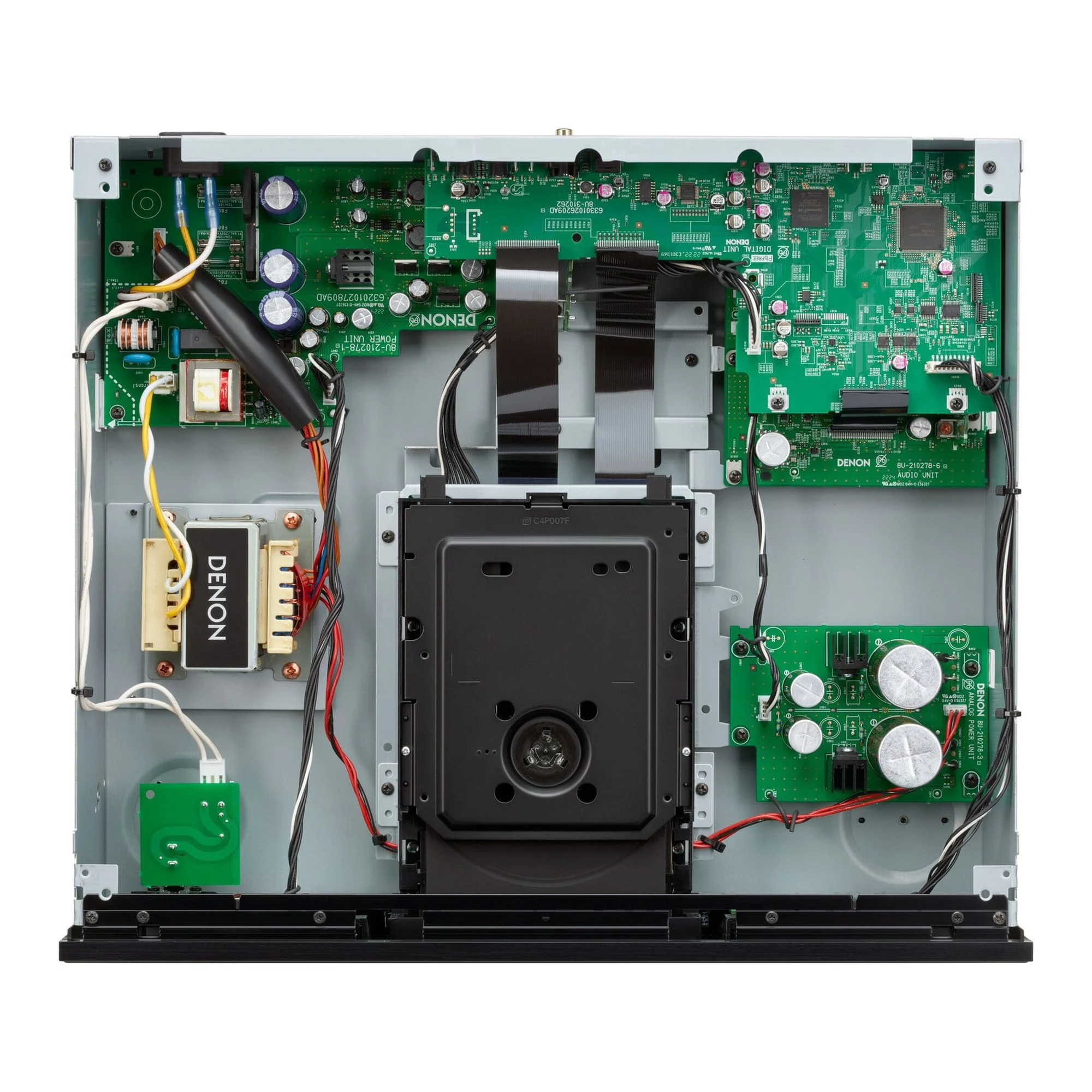
The electronics are designed with separate conversion and power supply circuits, positioned at a safe distance from one another. The main power supplies are linear, as evidenced by the fine laminated-core transformer—of a respectable size and proudly marked “Denon.” It is mounted on a reinforced section of the chassis, as is the transport mechanism, to increase the overall rigidity of the unit. On the circuit board near the AC power input, you can also see two integrated rectifier bridges, a sign that the power lines have been split into multiple stages. The analog power supply is located further away, next to the transport mechanism. It includes a discrete diode bridge and a filtering section with substantial capacitors (3,300 microfarads at 50 volts, 105°C, specifically designed for audio) and regulators mounted on heat sinks.
The signal section is arranged on two levels; the upper level houses the digital circuits, where we can see the widely used, all-purpose PCM9211 encoder IC from Texas Instruments, while the lower level handles the analog output. The actual audio board is on the lower level. Here you can see the DAC, Soundplus OPA1688 operational amplifiers, and many through-hole discrete components, such as various types of electrolytic capacitors—some from Elma and others bearing the Denon brand.
The DAC used is a PCM1795, a classic from the Burr-Brown family; while certainly not a latest-generation chip, it has certainly proven its worth given its more than twenty-year presence on the market. It has a specified resolution of up to 32 bits and 192 kHz, which, as is well known, is useful for taking advantage of oversampling—a technique that improves the conversion of audio streams at resolutions such as the traditional 16-bit, 44.1 kHz of CDs. For years, Denon has been implementing its own oversampling algorithm called Advanced AL32 Processing Plus, which increases the signal’s bit depth up to 32 bits and then applies proprietary interpolation filters to increase the sampling rate. Another area Denon has paid close attention to is the clock. The DCD-1700NE employs a solution called DAC Master Clock Design to reduce jitter, one of the most critical aspects of conversion, especially when combined with optical reading. Essentially, the signal is synchronized with the DAC rather than with the transport mechanism, significantly improving sample timing.
Features: No to the unnecessary!
Take a CD from the shelf, open the case, and place the disc in the tray. A ritual we’ve lovingly performed for years, and one that’s now just a faded memory for many. With the DCD-1700NE, you can bring it back to life—and that’s exactly what I did during my enjoyable trial period. This Japanese player offers no features beyond basic playback, which is perhaps what makes it all the more appealing. Once the disc is spinning, you can use the physical controls on the panel or the remote control. The remote is designed to work with a wide range of Denon devices, so it’s packed with buttons, but here it’s essentially used only for the classic PLAY-PAUSE-SKIP-STOP functions, selecting tracks by number, and a few other things, such as specifying the playback layer on SACDs. There’s also no remote tray opening—a feature that’s actually unnecessary since you have to get up to change the disc anyway, but one I was personally used to. Instead, there’s a function Pure Direct turns off the display and digital outputs to minimize sources of potential electronic noise.
Come to think of it, the fact that there aren’t many “distractions” in the settings might actually be an advantage. You can’t change the digital filters, for example, which means we don’t have to waste time trying to find the one we (maybe…) could guess correctly a significant number of times. Denon has already taken care of optimizing everything with the Advanced AL32 Processing Plus filter—period.
The single-line display allows you to view text content from SACDs that support it. The rear analog outputs are RCA only and have a fixed level of 2 volts. The volume is therefore not adjustable, as was the case with first-generation digital players.
However, if you wish, you can listen to high-resolution formats in addition to the standard CD and SACD formats (including multichannel formats, whose tracks are downmixed to stereo). The drive reads recordable media such as CD-R/RW and DVD-R/-RW/+R/+RW, and through these you can access ALAC, FLAC, or WAV files up to 24-bit/192 kHz, as well as DSD at 2.8 MHz and 5.6 MHz, and even MP3 files.
Listening Test: Without Inferiority Complexes
The DCD-1700NE is, therefore, a no-nonsense player, like the ones we would have encountered in the early days of digital audio. It is, however, a much more modern machine that benefits from decades of technological evolution in the field of conversion. I’d like to point out that the obvious flaws of early digital audio weren’t solely attributable to the format—which was, admittedly, a bit “cramped”—but also to the D/A conversion technology. DAC chips produced over the past fifteen years or so have effectively eliminated nearly every problem related to processing CD-resolution audio streams. Playing a disc today with an optical drive can deliver the same performance as a streaming stream, assuming the data source is identical. Furthermore, the DCD-1700NE is an SACD player capable of reading the high-resolution bitstream format—a format that might have enjoyed greater success if only Philips and Sony had made some concessions regarding their anti-piracy protection measures (such as allowing output to external DACs). From a technical and sonic standpoint, one could discuss the superiority of DSD over the old, inferior 16-bit 44 kHz format or over Hi-Res PCM. Personally, even in this case, I return to the argument centered on the quality of D/A conversion, which, as things stand, has helped narrow the gap.
This introduction serves to highlight the performance of the DCD-1700NE, which is, in fact, very satisfying. The first impression is one of excellent detail, with sound contours rendered with precision. The transparency is remarkable—not uncommon in modern digital systems—and you get the distinct sensation of perceiving virtual sound sources on the soundstage, clear and well-placed. The cymbals, for example, come from a precise location, and you can even easily follow the decay of their vibrations. At the same time, we don’t lose focus on a vocal, a double bass, or the woodwinds, which remain spaced at the appropriate distances from one another. Ambient sounds are always clearly prominent, and the reverberation of the recording environment—where present—is clearly audible. The musical attacks are decisive, capable of reproducing the piano with a good degree of credibility and clarity. The high-frequency extension is convincing—a rigorous yet non-fatiguing presentation. It’s not a “warm” player in the broad sense, but rather a digital source that has now reached maturity. In essence, the DCD-1700NE is neutral, honest to the point of being “harsh” when it makes you realize that many older discs were, in fact, a bit tiring to listen to.
In the low-frequency range, the Japanese player manages to go deep and sound appropriately powerful. While I did notice a bit of a “rubbery” quality at times—particularly with less carefully produced recordings—or wished for a bit more body in others, this is probably not solely the fault of our player. If it were, logic tells us that this is precisely why Denon offers a higher-end model in its lineup: the stunning DCD-3000NE.
Conclusions
For those who view music as a heritage worth preserving—rather than an invisible digital stream—there are still opportunities to choose high-quality players like the DCD-1700NE. Denon/Marantz is one of the last manufacturers to produce optical drive mechanisms, the availability of which to other manufacturers and customers will become increasingly limited in the future. From this perspective, this SACD player holds even greater value than its list price alone. It is a thoughtfully engineered machine, essential in its functions yet generous in its sound performance. The sound it produces does not disappoint and can deliver satisfaction without feeling inferior to streamers and DACs—to which it should be considered not so much an alternative as a complement in a modern, high-end audio system.
Technical characteristics:
- Main formats: CD, CD-R/RW, SACD.
- Mechanism: Denon S.V.H.
- D/A converter: TI/Burr-Brown PCM1795.
- Digital processing: Advanced AL32 Processing Plus.
- Clock: DAC Master Clock Design.
- CD frequency response: 2 Hz–20 kHz, ±0.5 dB.
- SACD frequency response: 2 Hz–50 kHz, −3 dB.
- CD signal-to-noise ratio: 117 dB.
- SACD signal-to-noise ratio: 119 dB.
- CD harmonic distortion: 0.0016% at 1 kHz.
- SACD harmonic distortion: 0.0010% at 1 kHz.
- Analog output level: 2.0 volts RMS.
- Analog outputs: Stereo RCA.
- Digital outputs: Optical and coaxial.
- Dimensions (W × H × D): 434 × 135 × 384 mm.
- Weight: 9 kg.
- Rated power consumption: 24 watts.
Manufacturer: D&M Holdings Inc. (Denon) 2-1 Nisshin-cho, Kawasaki-ku, Kanagawa 210-8569 Japan
Distributor: Marantz Italy S.r.l. Via Giuseppe Manfredi, 98 29122 Piacenza (PC)




GIPHY App Key not set. Please check settings