



 Audio 2G
Founded in Toronto in 1982 by Jerry VanderMarel and Scott Bagby, Paradigm has built its reputation on a simple principle: measure a lot, listen even more, and charge a fair price. From the very beginning, the Canadian brand has worked closely with the National Research Council, the research center where Floyd Toole developed the double-blind tests and off-axis measurements that are still the gold standard today.
The Premier series has always been at the heart of the catalog: ambitious enough to appeal to audiophiles, yet accessible enough not to scare them off. With the second generation, unveiled at AXPONA 2026, the company chose not to settle for a mere tweak. The six Premier v2 models incorporate much of the technology developed for the Founder series (see our review of the 40bhere ), the premium line launched in 2021 following Bagby’s return to lead the company.
The smallest member of the family, the Premier 120B v2, is the one that benefits the most from this redesign. It costs 990 euros for a pair, just like the 100B it replaces, but it hides an additional speaker behind the grille.
The Founders' DNA
Just remove the magnetic grille to see where the 120B v2 gets its power from. The tweeter is a 25-mm dome dubbed AL-MAC: aluminum and magnesium with a ceramic coating, damped and cooled with ferrofluid. It’s the same type of driver found in all Founder models, from the small 40B to the flagship hybrid 120H, and it replaces the pure aluminum X-PAL driver found on the 100B. The combination of materials with different densities and internal damping serves to attenuate the break-up peak typical of metal diaphragms, resulting in a cleaner and less fatiguing high-frequency response.
The most noticeable new feature is found around the dome: the Oblate Spheroid Waveguide, a flattened spheroid waveguide that the old Premier did not have.
Paradigm introduced this feature on the Founder series with today’s homes in mind—spaces that are spacious, open, and full of reflective surfaces. Its purpose is twofold: on the one hand, it directs sound energy toward the listening position and reduces early reflections from the ceiling and side walls; on the other hand, it increases the acoustic load in the lower part of the tweeter’s frequency range, allowing it to extend down in frequency with less distortion. This is the key to the entire design. The crossover—a second-order design, as is the company’s tradition—has been shifted from 2.0 to 1.2 kHz. The dome therefore takes on a substantial portion of the upper midrange—precisely where the ear is most sensitive—while the woofer hands off the signal before its dispersion pattern begins to narrow. The two sound fields blend with similar directivity, and the result, as we’ll see, is audible.
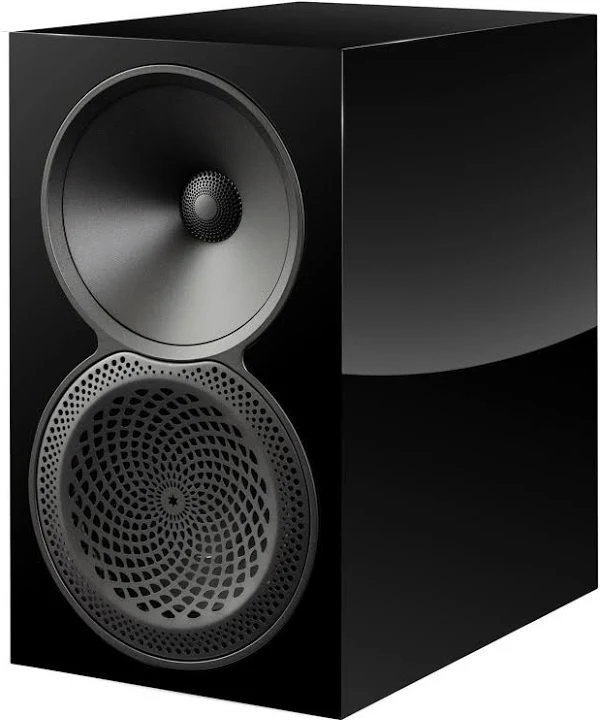
In front of the tweeter, integrated into the waveguide, is the Perforated Phase-Aligning Lens—the perforated grille that Paradigm has been using since the Persona series. It functions as an advanced phase plug: it blocks out-of-phase components generated by different areas of the diaphragm and smooths out the response, while also protecting the tweeter from accidental impacts. The 100B already had this feature; what has changed is its integration with the waveguide, which is identical to that of its larger siblings.
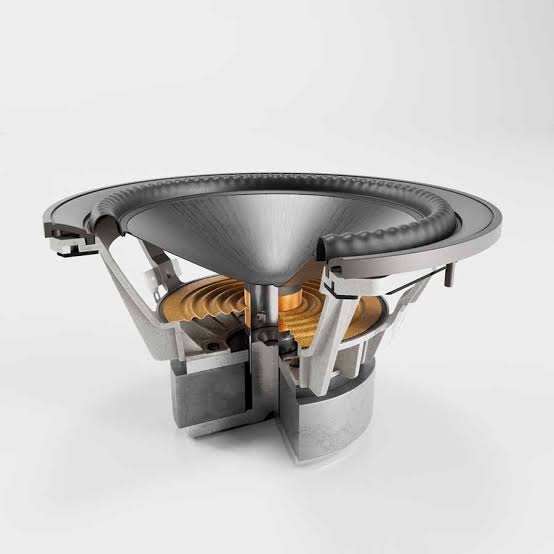
The 140-mm mid-bass driver is also all-new. The carbon-filled polypropylene cone has been replaced by one made of an AL-MAG aluminum-magnesium alloy—a material originally developed for the midrange in the Founder series and already used by the 40B in its 150 mm woofer. Compared to plastic, metal provides greater rigidity for the same mass and thus a more extended piston-like motion; the downside is pronounced break-up at high frequencies, which is another reason why the 1.2 kHz crossover frequency is appropriate.
The unit is rated for very high excursion (we noticed this when we took it apart) and features a 25-mm multilayer voice coil designed to withstand high temperatures. It is wound on an Apical polyimide bobbin, featuring ventilation openings that facilitate heat dissipation and limit dynamic compression at high volume levels. Rounding out the package is the third-generation Active Ridge Technology suspension, the same used in the Founder series: a factory-molded corrugated edge that allows for wide excursion without sacrificing linearity, paired with the new Vertical Mounting System.
On the rear panel, next to the reflex port, there are two pairs of terminals for bi-wiring and bi-amping, which were absent from the previous version. The grille is magnetic, and on the white model, it is gray instead of black: an aesthetic detail that speaks to the manufacturer’s attention to detail. The finishes have also changed: Piano Black lacquer, two real wood veneers—Walnut and Black Walnut—and a Satin White finish exclusive to this model and the 520LCR v2.




GIPHY App Key not set. Please check settings