in

Marantz 60n Network Amplifier

Marantz is a “rather” well-known company in our world. It has signed the dreams of many enthusiasts, riding entire generations, from our grandparents, up to the present day, albeit with ups and downs, changes of ownership, various vicissitudes that, however, have not affected the polish of the brand, for several years now owned by the D&M (Denon&Marantz) group, which includes another excellent name, such as Bowers & Wilkins.

The Model 2500 was a receiver that made legend. It was born in the early 1980s and was the most powerful on the market, with its 250W per channel and an oscilloscope that allowed the best tuning. Today it has tremendous value on the used market.

Over time Marantz has never lost its sound-feeling, first entrusted to the late Ken Ishiwata who signed off on many achievements, from that CD63 MKII KIS, at the time in which Marantz was owned by Philips and the player was derived from a model of the Dutch company, but it sounded totally different, and at an extremely affordable price, so much so that it became an undisputed best-buy. But this is just one example. Sadly, in November 2019 Ken left us, and Marantz promptly replaced him with Yoshinori Ogata the brand’s new Sound Master. Ogata is collaborating on many projects, including this new 60n that takes the place of the PM7000N.

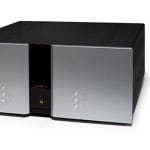
The aesthetics are now classic for Marantz products, with splendid classically shaped front panel that “floats” on a finely shaped counter-panel. In the center is the usual high-resolution circular OLED display showing the main information.

New philosophy

Model 60n is part of a new type of amplifiers, those that in addition to fulfilling the “classic” functions, also contain a streamer and consequently a DAC that allow you to be able to connect to major on-demand music services, as well as enjoy your music on NAS, listen to Internet radio, and so on. In short, well-known story. In the Marantz catalog there are three models with a network module, theM1 we tested some time ago, which is very compact, this 60n and finally the more expensive 40n. Many are the improvements over the 7000N that it retires, after all the price increase is quite considerable (500€ more) but it corresponds to actual improvements or complete redesigns that justify the new pricing.

Yoshinori Ogata is Marantz's new Sound Master and takes over from the late Ken Ishiwata. Many were the interventions he made within this Model 60n.

The fine-tuning done by Y. Ogata involved many parts, including the preamplifier/power amplifier circuit, first of all achieving a decrease in THD + N distortion by 33%, a goal also achieved through better component selection and the addition of a transformer base. New power transistors were chosen, which although did not increase the power figure compared to the 7000N, significantly increased the instantaneous deliverable current capability so that a wide range of loudspeakers could be driven with ease, and this was also achieved through the improved current feedback circuit (HDAM-SA3).

The primitive HDAM circuitry, Hyper Dynamic Amplifier Module, from 1992, which you have since undergone numerous modifications to the current HDAM3. Pictured is the output board that equipped the CD-15, the first CD player that was equipped with it.

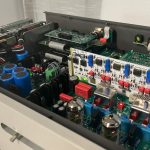
The layout is now divided into three distinct sections, on the left the power supplies, in the middle the power section, on the right the now-shielded HEOS module, and below it the preamp part. All this is done to limit the influence of radio frequencies as much as possible and to shorten the signal path and power branches.

The three sections into which the Model 60n is divided are clearly visible. On the left is the power supply, below linear and above switching for digital and services, the middle section with the large fin that doubles as a screen, and on the right the HEOS module above, while below it the preamplifier circuits

The on-board DAC is a 32-bit ESS (it is not stated, however, which chip), while Volume and tone controls (excludable) are done via high-precision rotary encoder. Power, we remind you, is 60W per channel on 8Ω, analog inputs are 3 in addition to a Phono MM, an HDMI with ARC, optical and coaxial, pre and subwoofer output with fixed cutoff at 150Hz. There is no USB-B input for computers, but then again, network connectivity makes this unnecessary. Obviously Bluetooth, which shares the same antenna as Wi-Fi, flanked by Ethernet input (always advisable). Compatibility is guaranteed with Airplay 2, Roon Ready, Spotify Connect, Tidal Connect, and not yet with Qobuz, although from rumors it seems to be implemented soon. Beautiful binding posts, they are the Marantz SPKT-1 and provide a very stable power connection.

The binding-posts used for this Model 60n are the same ones aboard the brand's more expensive products. They accommodate any type of termination very effectively

An interesting listen

Whatever Marantz product you buy, you are guaranteed to always have, even with different scales, the same sound-feeling. And this is a great added value. A single line that connects all of the company’s products, and that allows the enthusiast to be able to grow while maintaining the same stylistic signature. We heard the same approach with Model 30 first, with M1 then, and finally with this 60n. It belongs to a new generation of products, those destined to become the multimedia entertainment center of the family, thanks on the one hand to the network function and on the other hand to HDMI connectivity with ARC, which allows connection to the TV with the convenience of conveying with a single cable both the audio signal from the TV to the amplifier and the volume control of the latter, which will be controlled from the TV remote. Not forgetting BT, which although not the best when you want quality, is undoubtedly the easiest and most immediate means of listening to music. These multimedia products, of which the 60n is a part, are playing the important role of bringing to quality listening a public that is probably completely unaware of the world of HiFi. And in this Marantz’s product is perfectly centered, thanks in part to its excellent driving ability, which sees it paired with a pair of not too load-bearing and fairly efficient floorstanding speakers, perhaps even putting in a subwoofer. The sound we heard is considerable relative to the purchase price, 60n is capable of revealing detail and detail, sonic planes, being energetic and rhythmic, in short, it is an “audiophile” product, in the sense that it winks at all-around quality listening, and should not be taken as yet another network amplifier that does everything well enough, 60n is first and foremost a very good stereo amplifier. The sound-feeling is typical Marantz, euphonious, smooth, not too aggressive. Do not expect a hair-brained product but rather a machine that is able to do excellent synthesis of the musical message, making listening relaxed and pleasant.

Technical characteristics:

  • Power: 60/80W on 8/4Ω
  • Highest resolution accepted:
  • Frequency response: 5Hz-100kHz
  • Total harmonic distortion: 0.02%
  • Damping factor: <100
  • MM sensitivity: 1.9mV/47kΩ
  • Phono signal-to-noise ratio: 87dB
  • Line input sensitivity: 190mV/20kΩ
  • Signal-to-noise ratio line: 113dB
  • Stby/ON consumption: 0.3/220W
  • Dimensions: 442X431X129
  • Power supply: 230VCA/50Hz

Price: 1500€

Distributor: Marantz Italy, Via Manfredi 98 – 29122 – Piacenza. www.marantzitaly.it

Written by Audio 2G

Leave a Reply

Your email address will not be published. Required fields are marked *

GIPHY App Key not set. Please check settings

    Vitus RI 101 MKII

    Testing the Vitus Audio RI 101 MKII – Integrated Amplifier

    Aqua La Scala MkIII: an important evolution of the La Scala DAC.