



 Audio 2G
TheAO300 Pro is the integrated amplifier with DAC that SMSL has made for those who want a product that is inexpensive, simple, reliable, and capable of solving any need, whether in desktop, traditional Hi-Fi, or TV: it is, in short, an object that contains much more than one might expect.
The project
SMSL is certainly no stranger to the idea of condensing what would traditionally require several separate products into a single chassis. With the AO300 Pro, however, the Chinese brand has definitely outdone itself: this is not simply an amplifier with DAC, but a true audio hub ready for any home scenario. Inside we find a DAC with a Cirrus Logic CS43131 chip, capable of decoding PCM up to 32 bit/768 kHz, DSD256 (DoP) and MQA; the USB interface is entrusted to the third-generation XMOS XU-316 processor; the digital volume control is signed JRC

(the excellent NJW1194) and, finally, a Class D power amplifier based on the Infineon MA5332MS chip, the same high-efficiency module already found in many even decidedly more expensive realizations. Declared power is 165 watts per channel into 4 ohms and 85 watts into 8 ohms, although it is fair to expect a few real watts less; we believe that about 65W may be a realistic figure, given the size of the power supply as well. Bluetooth is in 5.3 version with LDAC and aptX HD support, allowing you to use your smartphone as a wireless source without sacrificing quality that is fairly close to wired. Inputs cover virtually every need: USB-C, optical, coaxial, RCA and, new to the Pro version, HDMI with eARC
Design and construction
The chassis echoes the language introduced with the DO400: front with a color IPS display seemingly “suspended” on the left side, volume knob off-center to the right, and headphone outputs (one 6.3 mm and one balanced 4.4 mm) on the front panel. The aesthetics are neat, modern without being flashy, suitable for both desk and living room. The display is legible and responsive, although the lettering is not particularly refined; the knob offers just the right amount of resistance, and the remote control, made of plastic, does its job unpretentiously. It is perhaps the only reminder of the device’s price.

Advanced connectivity and functionality
The HDMI eARC input is probably the feature that most distinguishes this Pro version from the standard AO300. Connected to a compatible TV, the amplifier receives the audio signal at the highest quality available, turns on and off in sync via HDMI-CEC, and responds to volume commands from the TV remote control. In practice, it eliminates the need for a second remote control, greatly simplifying utlilization.

The subwoofer output on RCA is a practical addition: it allows a stereo system to be turned into a 2.1 by connecting an active subwoofer, without the need for a separate pre-processor. However, it lacks a high-pass filter for the main speakers: these continue to reproduce the full spectrum, making integration less efficient. It is therefore a useful feature, but not a particularly refined one. It should also be made clear that there is no real .1 channel processing: the “2.1” is simply the ability to connect a subwoofer. On the DAC front, the AO300 Pro offers eight equalization presets and five selectable roll-off filters, a rare flexibility in this range. The SDB function, inspired by Fletcher-Munson curves, compensates for the perception of bass at low volume-a sort of evolved loudness that maintains tonal balance.

The Polk Audio XT15
The Polk Audio XT15 are bookshelf speakers that fit into the brand’s entry-level range, and offer a surprisingly complete listening experience for their price. This is a model designed for a wide audience, ranging from those new to the world of quality audio to those looking to set up a high-end desktop system, to those looking for a compact solution for a secondary system or home theater system.
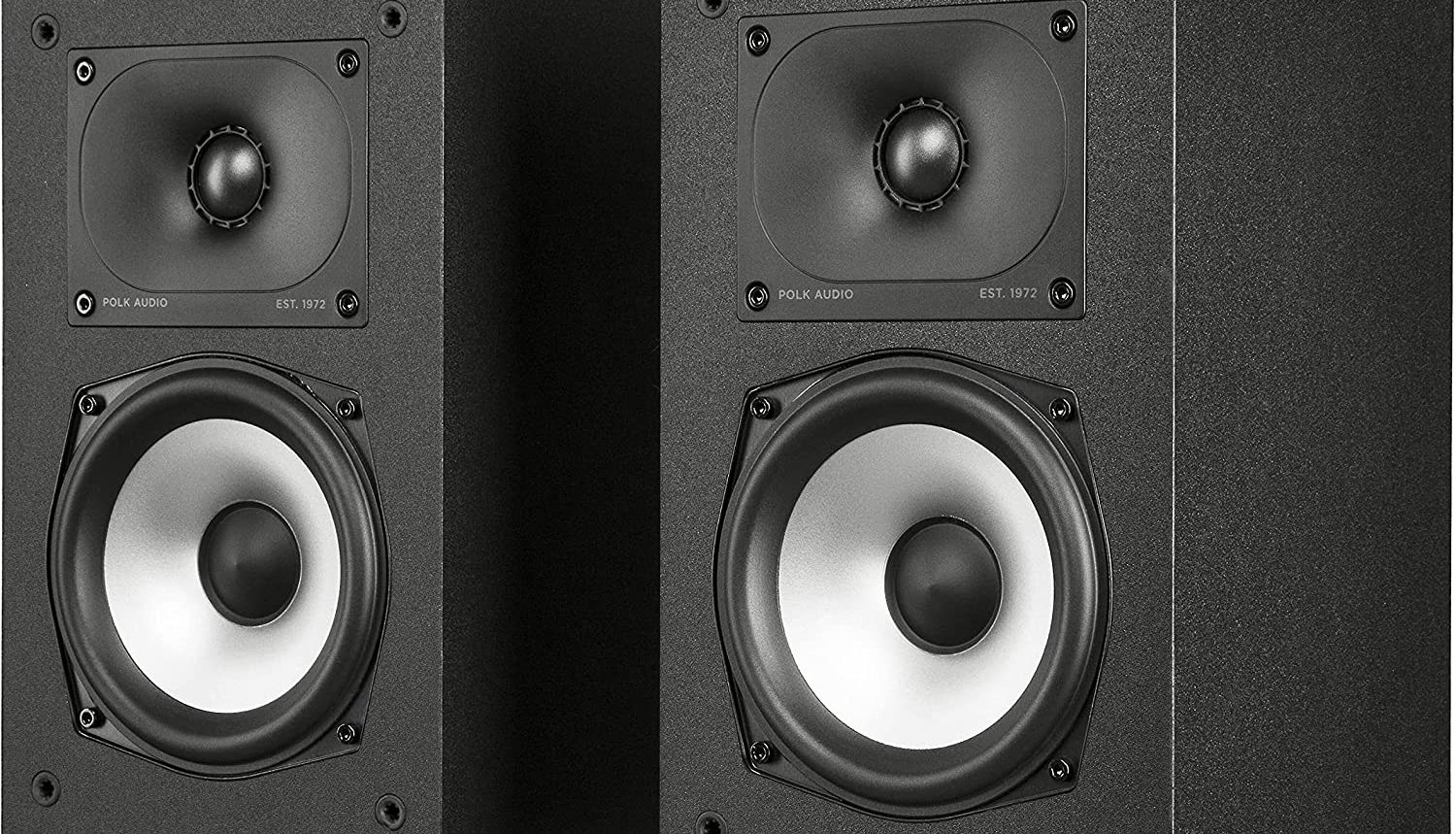
Aesthetically, they focus on a simple, clean design with modern but discreet lines. They are not speakers that seek to be noticed at all costs, but precisely because of this they are easy to fit into any home environment, from the living room to the bedroom. XT15 are two-way speakers with a classic configuration, but well optimized to maximize performance in a compact chassis. They adopt a 13-cm woofer made of bi-laminated paper, a precise technical choice since this material maintains a good balance between rigidity and lightness, allowing fast transient response and low distortion even at medium-high volumes. The result is a bass that aims not so much for extreme depth, for purely physical matters it could not, but for precision and control.

The slightly horn-loaded 1-inch Terylene tweeter is another key element. Often used in modern entry- and mid-level loudspeakers, it enables very extended high-frequency reproduction, reaching up to about 40 kHz. An interesting aspect is the crossover, positioned around 2200 Hz, a transition actually quite common in two-way speakers, but here it is calibrated to achieve a smooth transition between woofer and tweeter. Electrically, the XT15s have a sensitivity of about 86 dB and 8Ω impedance, which means they are not particularly “easy” speakers to drive compared to more efficient models, but they still remain manageable by most amplifiers, certainly for the SMSL.
How SMSL AO300Pro Sounds
The AO300 Pro’s tonal signature is what Anglo-Saxon reviewers call “dead neutral”: it adds no color, subtracts no detail, and privileges no frequency range. The soundstage is wide, with precise imaging and convincing left/right balance. Transients are fast, bass controlled, vocals well present, and high frequencies airy without being aggressive. Compared with its predecessor AO200 MKII, this generation gains in dynamics and punch, moving away from the tendency toward sonic flatness of some older SMSL designs. The internal DAC, used via USB, outperforms many external DACs connected via RCA for cleanliness, thanks to a very quiet black bottom end. The USB input is the most transparent, followed by the Bluetooth LDAC, then optical and coaxial. The RCA input, while good, has a slightly higher noise level, noticeable with very sensitive headphones. The headphone output, handled by CS43131, is good in context: quiet, sufficiently powerful and tonally consistent. It is not the absolute strong point – those looking for a dedicated headphone amplifier will find better solutions – but as a built-in feature it is more than adequate.
The system with the Polk XT15s
The Polk Audio Monitor XT15s were chosen as a testbed because they are versatile: suitable for both a desktop and a small living room system. The AO300 Pro drives them smoothly, offering neutrality, good extension in the top end, and more bass presence than would be expected from a compact speaker. The Terylene tweeter returns a smooth but not veiled sound, while the bass is surprisingly full for its size and category. The amplifier manages to handle them with ease. The only limitation emerges at high volumes: approaching the limit of the Infineon chip, there is a certain stiffening of the sound. With more demanding loudspeakers, such as the Indiana Line Diva 6, this behavior becomes even more noticeable, clearly highlighting the limitations-obviously-of a product, the SMSL, that is little more than palm-sized and from which one cannot expect the impossible.
Conclusions
The SMSL AO300 Pro is one of those devices that challenge the logic of the segment: it integrates the functions of four or five separate devices in a minimal space, with more than good overall quality. The eARC makes it particularly attractive for use with TV, while Bluetooth LDAC and USB DAC make it a complete solution for any digital source. The limitations are there – non-reference headphone output, cheap remote control, improvable RCA input – but they are easily acceptable considering the price. Indeed, in many cases they may not even be perceived, especially in systems consistent with the product’s price range. And, after all, when you consider that about €269 buys an amplifier, DAC and headphone amplifier in a single chassis, the result is truly remarkable. For those looking for a unique nerve center for their system, without sacrificing quality and compactness, the AO300 Pro is an almost must-have choice.
Technical characteristics:
SMSL AO300Pro
- Inputs: HDMI(eARC), RCA, BT, USB, Optical, coaxial
- Distortion THD: 0.003%
- Signal-to-noise ratio: 107dB
- Separation: 98dB
- Input sensitivity: 280mV
- Conversion: 32/768, DSD 11.2 MHz
- Power consumption: 40W
- Dimensions: 219X42X185
- Weight: 1.5kg
Price: €269
Polk Audio XT15
- 2.5cm dome tweeter
- 13cm bi-laminated paper woofer
- Impedance 8Ω
- Frequency response: 48Hz-40kHz
- Sensitivity: 86dB
- Crossover frequency: 2200Hz
- Power: 30-150W
- Dimensions: 16X18X19
- Weight: 4kg
Price: €169
Manufacturer: SMSL
Distributor: Aoshida Audio
Manufacturer: Polk Audio
Distributor: Marantz Italy
To buy SMSL AO300Pro
To buy Polk Audio XT15




GIPHY App Key not set. Please check settings