



 Audio 2G
The landscape of integrated amplifiers with network functions is becoming increasingly crowded, and in this plethora of products the Yamaha R-N1000A occupies a position of particular interest. Yamaha is a manufacturer of great tradition (you can read about the manufacturer’s history here) and significantly above theR-N800A, with which it shares some technical solutions but from which it differs in more careful mechanical construction and superior components.
ToP-ART construction philosophy
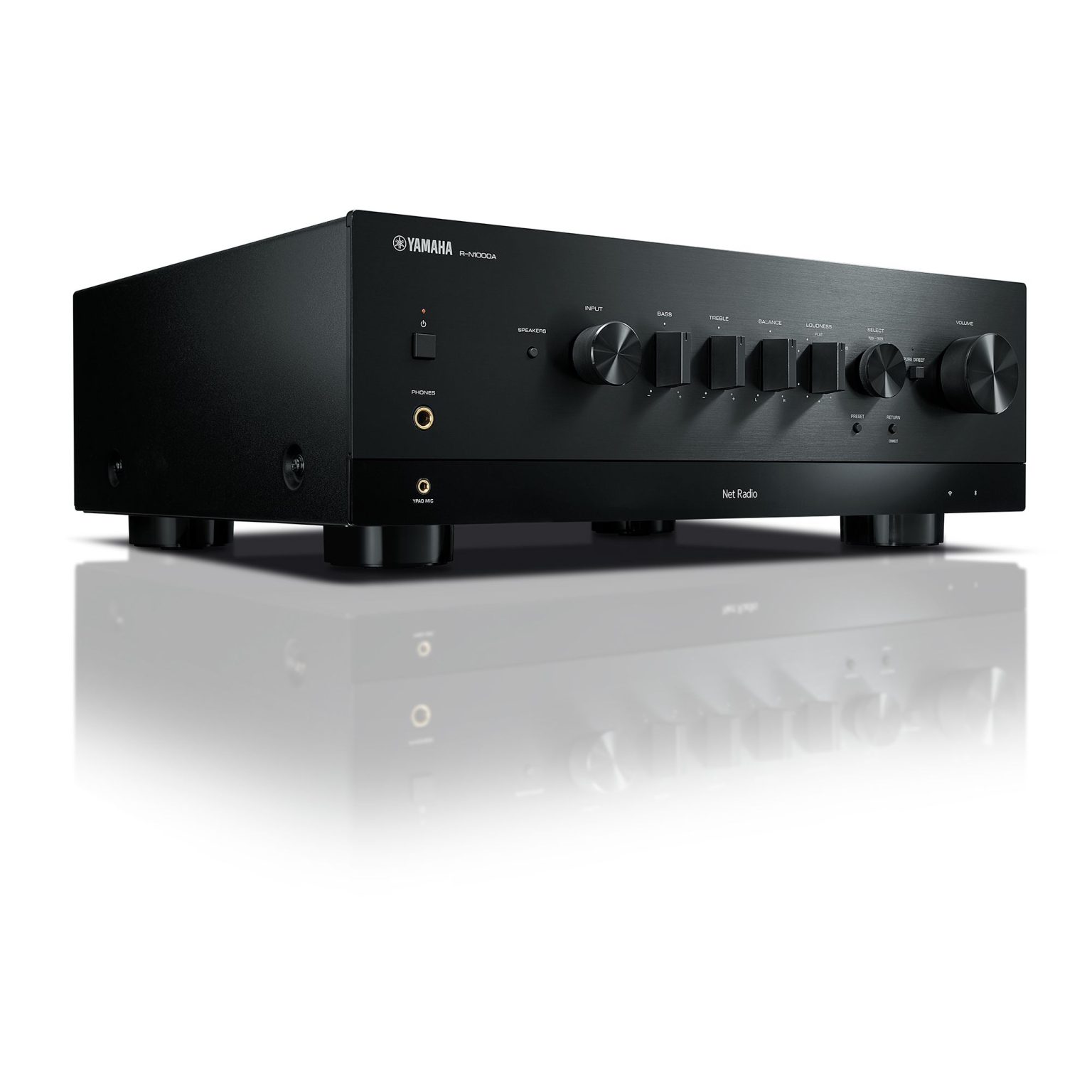
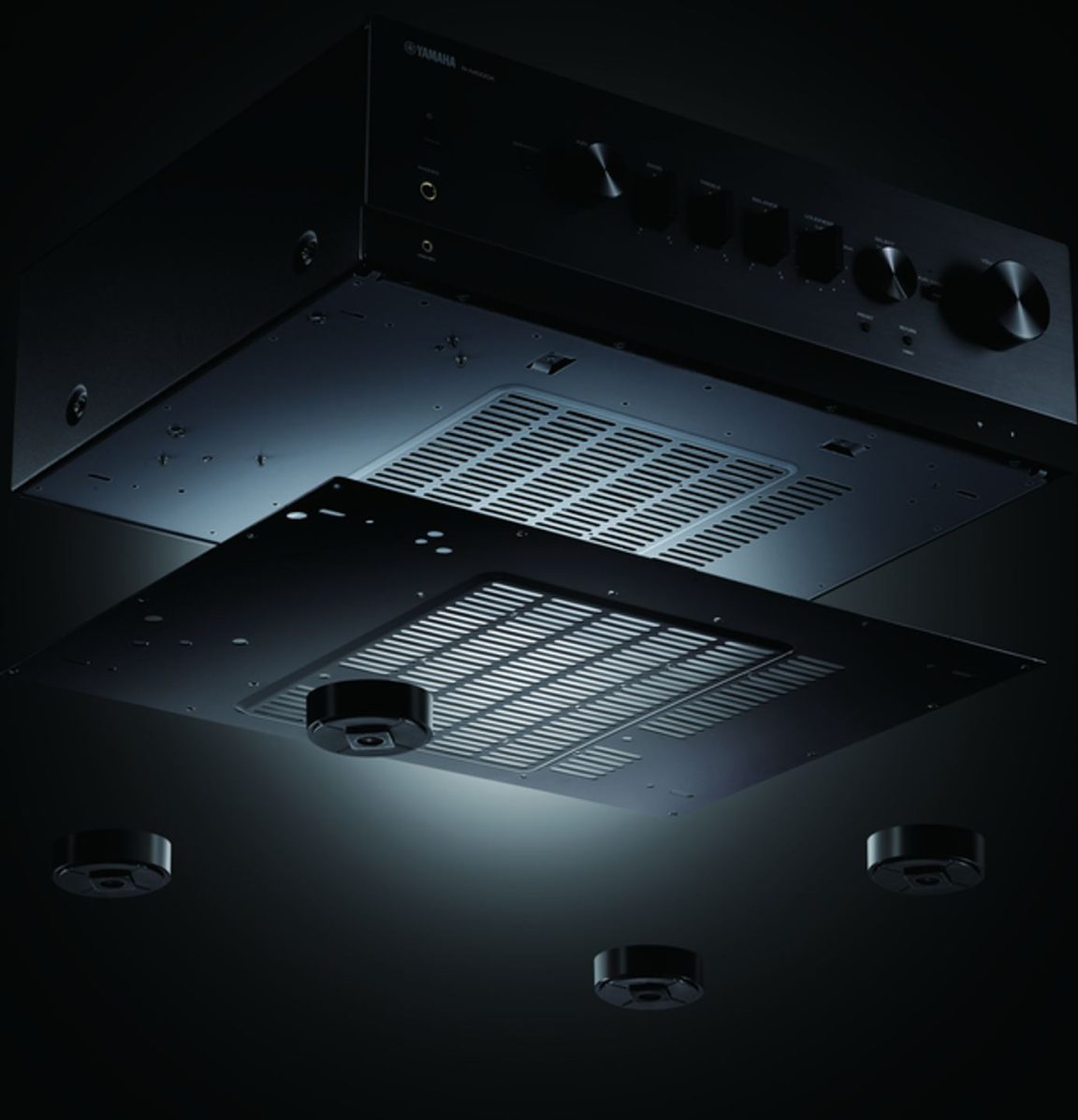
To truly understand what the R-N1000A represents, we need to start with the design philosophy that guides every construction choice. Yamaha calls this approach “ToP-ART,” an acronym for Total Purity Audio Reproduction Technology, which involves a symmetrical circuit configuration for the left and right channels, a shorter and more direct signal path, and a very rigid, low-distortion chassis with Art Base structure made of anti-vibration resin. This is a design of amplification that puts the purity of the signal at the center, seeking to minimize interference throughout its path. The R-N1000A goes a step further than the lower-range models with a double-bottom chassis reinforced by a thick one-millimeter iron damping plate added at the bottom, along with anti-vibration feet, with the aim of lowering mechanical resonances. Among the elements that distinguish it from the R-N800A lies the choice of internal components, including Amtrans resistors and Toshin Kogyo coupling capacitors.
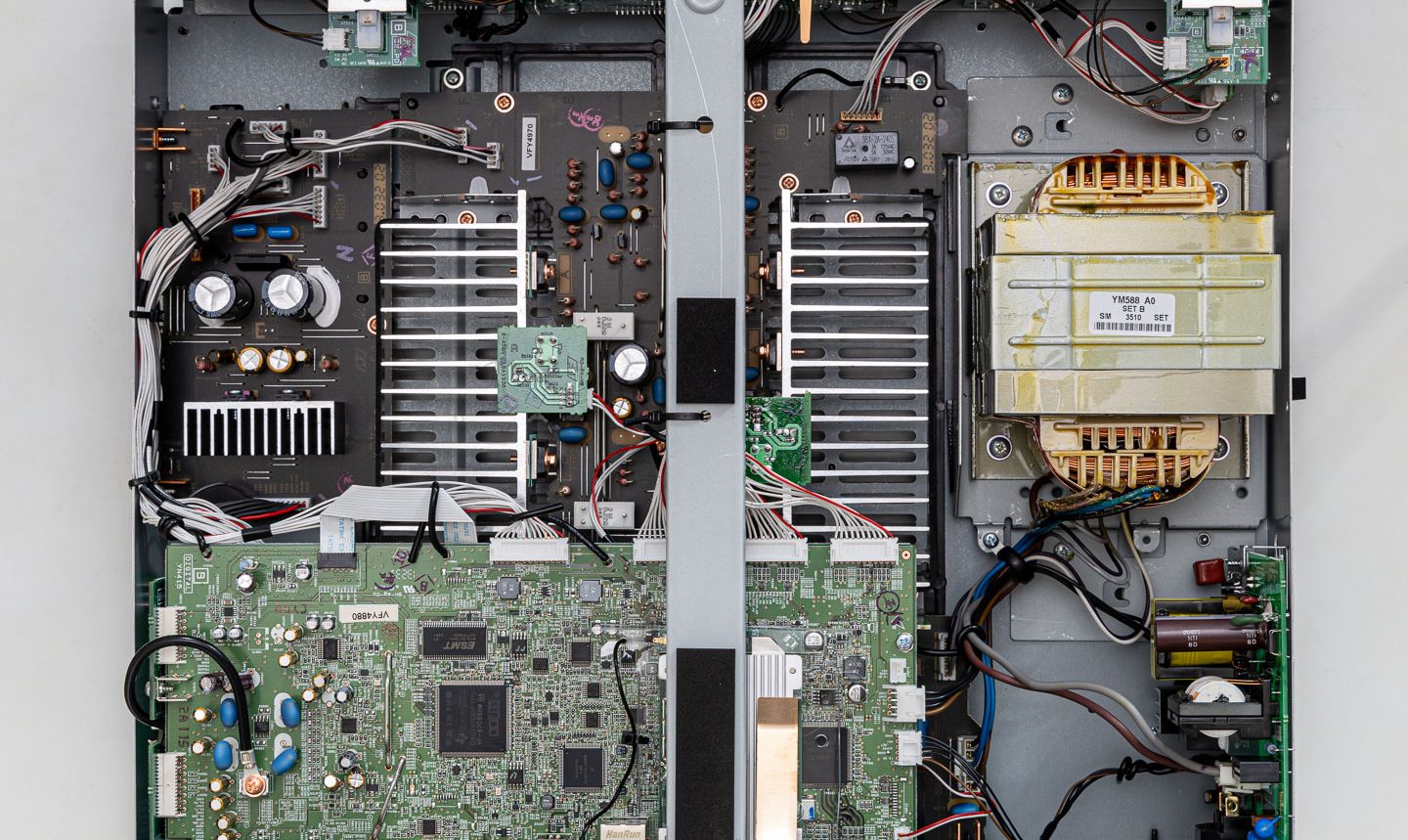
Although the R-N1000A does not adopt a toroidal transformer, it employs a robust traditional laminated element with solid copper film shielding. Grounding of all circuits is accomplished with large-section cables and through copper screws and slots, so as to decrease resistance and lower noise accordingly. On the digital-to-analog conversion side, the device uses a 384-kHz, 32-bit SABRE ES9080Q DAC coupled with Yamaha’s original network module, which also implements MusicCast. The maximum resolution supported is 32 bits/384 kHz with native DSD up to DSD256. The amplifier section delivers 100 watts per channel into 8 ohms, with a claimed maximum dynamic power of 190 watts per channel, delivered through four final transistors per channel, a testament to the R-N1000A’s good current delivery capability.
The YPAO system of room acoustic correction.
One of the most innovative aspects of the R-N1000A, and probably the one that most distinguishes it from traditional integrated amplifiers, is the presence of the automatic acoustic calibration system YPAO, which stands for Yamaha Parametric Room Acoustic Optimizer, which works to compensate for the influence of room size, shape and décor on speaker output. The version implemented is YPAO R.S.C., or Reflected Sound Control: it acts to actively control early and critical reflected sounds, automatically adjusting and optimizing reproduction according to the type of walls and speaker position.

Very interestingly, the system also includes the subwoofer, if present, adjusting its level, phase and cutoff frequency, thus making a valuable contribution to the overall output of the system. These room correction tools are really effective and extraordinarily useful, because they allow installation even in less than ideal conditions: how often one speaker is next to a wall and the other next to a curtain, or the subwoofer cannot be placed anywhere else but in a problematic position from a phase point of view. YPAO harmonizes, without working miracles-if the deficiency on a certain portion of the spectrum is too pronounced it can be corrected by a few dB, but not reset to zero. The supplied microphone is placed at the listening point, and the system takes a series of measurements to build an acoustic profile of the room, then intervenes on the frequency response, time delays, and levels of each channel-and the subwoofer if present-to return the most linear output possible.
Analog and digital connectivity
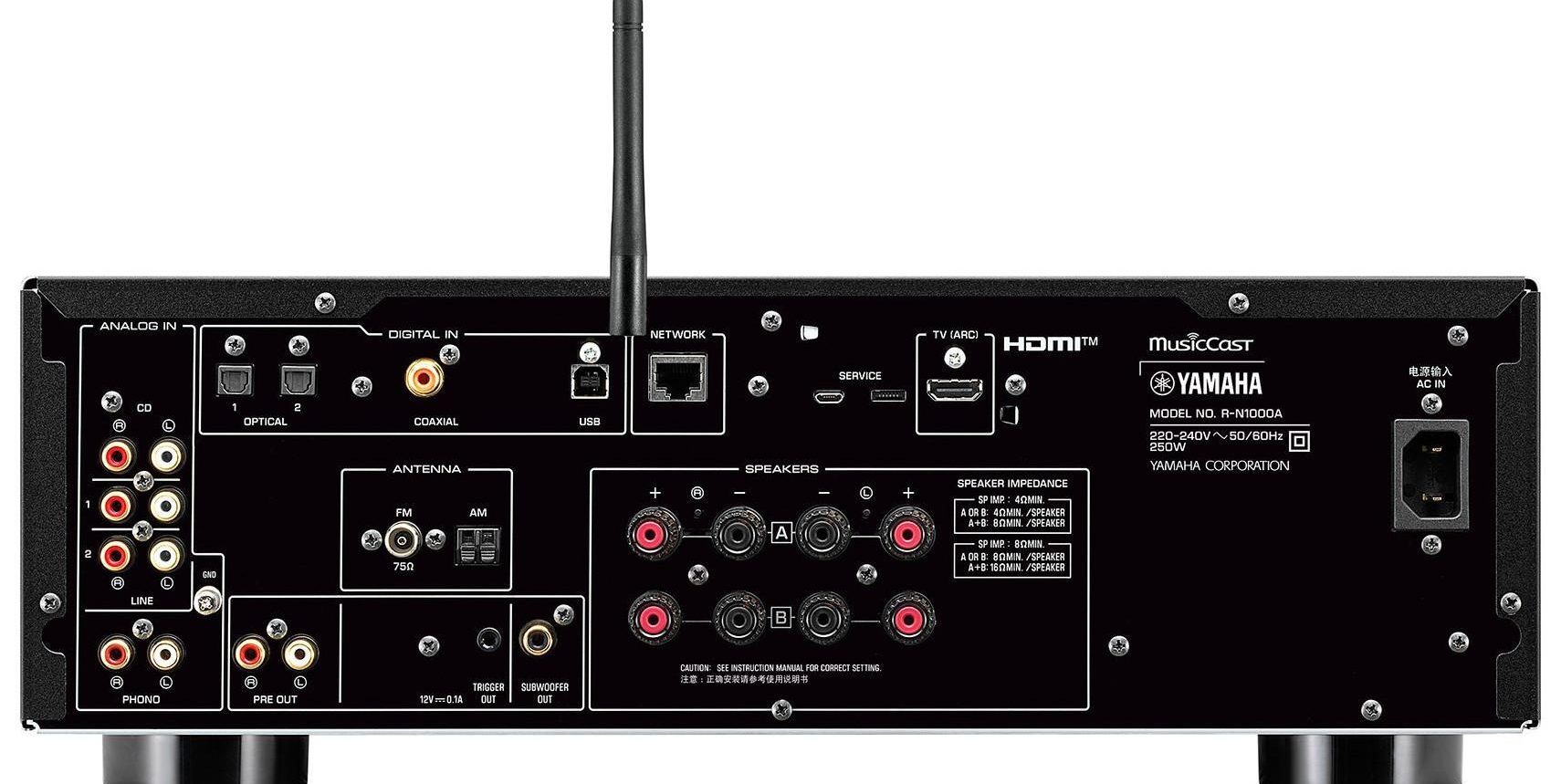
The array of inputs and outputs is generous and designed to meet any need. Physical connections include four analog inputs on RCA connectors, including a MM phono stage, pre-out and subwoofer outputs, as well as six digital inputs divided between two coaxial, two optical, an HDMI input with eARC support, and a USB type B port for PCs and Macs. With the latter, it is possible to connect a state-of-the-art TV and receive the audio signal directly via HDMI cable, eliminating the need for additional connections and using the TV remote control to adjust the volume of the R-N1000A.
The MusicCast ecosystem and streaming functions.
On the network connectivity side, the R-N1000A integrates everything that can be expected from a modern product of this level. Streaming capabilities are entrusted to the MusicCast platform, which allows playback via DLNA and access to major services with support for Spotify Connect, Tidal Connect, Qobuz Connect, Roon Ready, AirPlay 2 and DAB/DAB+ radio, to which are added Amazon Music HD, Deezer and others, making the device compatible with almost all music platforms available today. MusicCast is not just access to streaming services, but a true multiroom ecosystem that allows music to be distributed to multiple rooms in the home by synchronizing different compatible Yamaha devices with each other. Setup via the iOS or Android app proved particularly smooth and intuitive, guiding the user through connecting to the network, assigning to a room, and configuring preferred services, with any firmware updates installed automatically.
Listening and conclusions
We tested the R-N1000A with several speakers, and then focused on Indiana Line’s Utah 8s (find the test here ), which we also felt were an apt match from a price and market positioning standpoint. The Utah 8s require an amplifier capable of maintaining control no matter what happens along the impedance curve, and the R-N1000A demonstrated excellent driving skills. With a speaker that goes down to 30 Hz and has a 12-inch woofer to move, the low register becomes the first serious test bed, and the Yamaha passes it with an authority that surprises those used to thinking that 100 watts is modest power. It is not a matter of numbers: it is a matter of quality of delivery, speed of response to low-frequency transients, and precision in controlling cone movement. With tracks in which the acoustic double bass occupies a central position in the recording, the R-N1000A returns notes with a clarity that never leaves the impression of harmonic confusion: each note has a defined attack, a recognizable body, and a decay that runs out before the next one arrives.
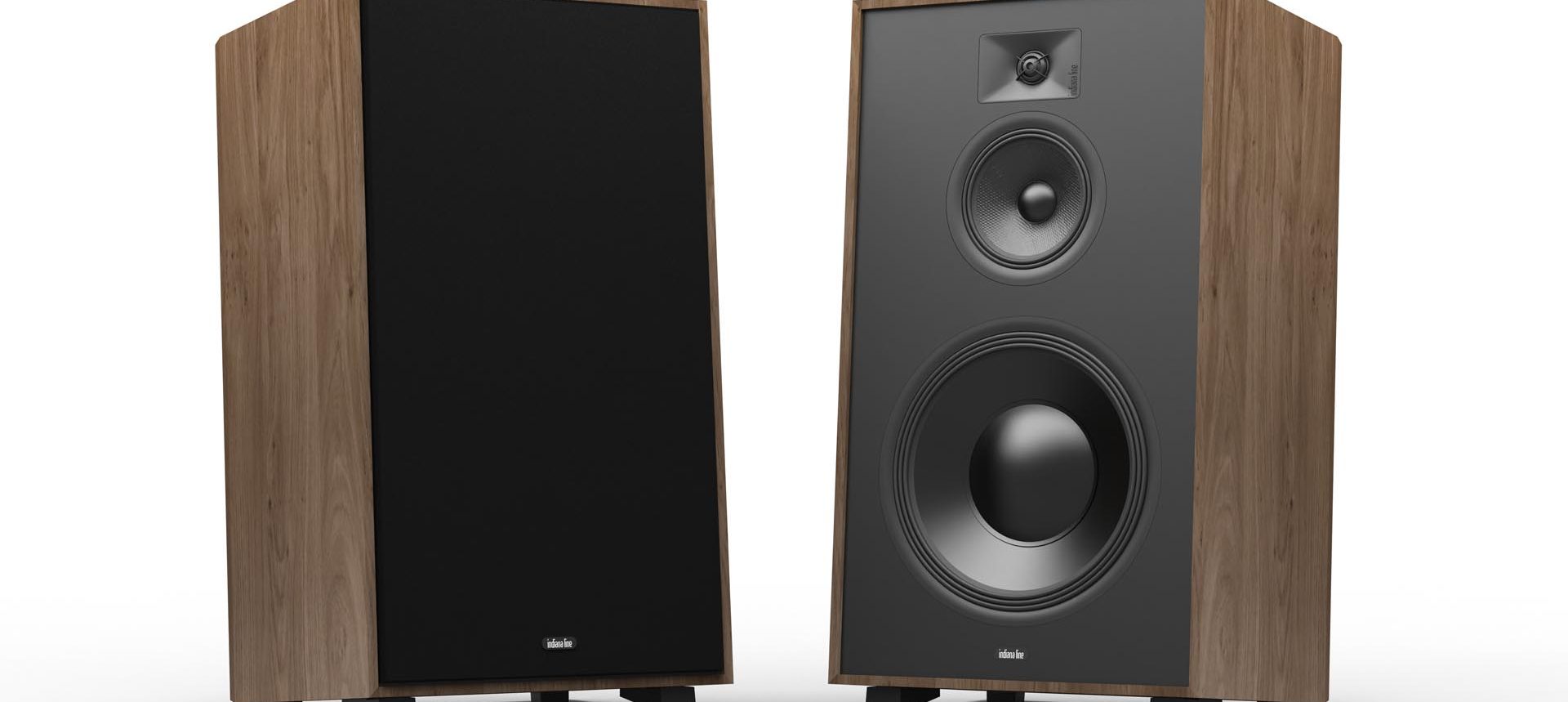
The middle register is where an amplifier’s construction choices leave the deepest impression on the listener’s perception: it is the area of voices, of wind instruments, of the piano in its central extension, of the electric guitar with its body of harmonics. The Utah 8s, with the 6.5-inch Curv driver covering the heart of the spectrum, mercilessly reveal any unwanted coloration of the electronics driving them. The R-N1000A performs in this region with a neutrality beyond what its price would suggest. A well-recorded female voice, heard in high resolution from Qobuz, arrives with a convincing physical presence: there is neither the dry thinness of certain overly analytical electronics nor the artificial warmth of those that compensate for a lack of transparency with an excess of coloration in the warm area of the spectrum. There is simply the signal, treated with respect. The top extension is open and airy, never exaggerated, able to carry the information of the finest harmonics without adding artificial emphasis. Drum cymbals have the real metal body of the instrument, not the bright reflection of a DAC that exaggerates the 10 kHz area to give the impression of detail. The bells, the metallic strings of the guitar, the breath of the flute-everything comes with the right measure, and the quality of the ESS SABRE ES9080Q converter contributes greatly to this. The R-N1000A then builds a convincing soundstage. With a good quality orchestral recording, violins do not flatten out on the line joining the two speakers but stand at a perceptible distance, woodwinds stand further back, percussion occupies the background with solidity. This three-dimensionality does not sound like a sonic feature added by electronics to impress showcase listening: it is the result of faithful reproduction of the spatial information already present in the recording. This is a subtle but fundamental distinction in understanding the character of this amplifier: it does not interpret, it does not embellish, it does not exaggerate. It conveys.
Conclusions
After hours of listening with high-resolution digital sources and through the internal USB-powered DAC, the impression that remains is of an amplifier built by those who know exactly what they want to achieve and with an economy of scale impossible for almost all manufacturers. The R-N1000A does not dazzle with sonic gimmicks, nor does it impress with spikes of brilliance or bass heaviness built to impress in the first half hour. It makes itself appreciated over time, with consistency and maturity, exhibiting a first-class, almost unbeatable price/quality ratio. Of course, it can always be improved: more authority, more rhythm, even more power-the areas to work on would be there, as a matter of course. For certain, however, the amount of money to invest to get something more is undoubtedly very high, and the R-N1000A proves to be extremely balanced even compared to Yamaha’s own range, and also for this reason to be held in high regard.
Specifications
- Power: 100 W + 100 W (8 ohms, 20 Hz-20 kHz, THD 0.07%)
- Dynamic power: 140 / 170 / 220 / 290 W (8 / 6 / 4 / 2 ohms)
- DAC: ESS SABRE ES9080Q
- Audio resolution supported: PCM up to 384 kHz / 32 bit, DSD up to 11.2 MHz
- Frequency response: 10 Hz – 100 kHz (±1 dB)
- Signal-to-noise ratio: 100 dB (CD, Pure Direct)
- Network connectivity: Wi-Fi/ethernet
- Bluetooth: Yes (SBC / AAC)
- Streaming: AirPlay 2, MusicCast, compatible streaming services
- Radio: FM + DAB / DAB+
- Digital inputs: 2 optical, 1 coaxial, USB-B, HDMI andARC
- Analog inputs: 3 RCA, 1 phono MM
- Analog outputs: RCA pre out, sub out
- Headphone output: 6.3mm
- Power consumption in stby: 0.1W
- Dimensions: 435 × 151 × 395 mm
- Weight: 12.3kg
Price: 1599€.
Manufacturer: Yamaha 10-1, Nakazawacho, Naka-ku, Hamamatsu-shi, Shizuoka, 430-8650, Japan
Distributor: Distributor: Yamaha Branch Italy Via A. Tinelli, 67/69 20855 Gerno di Lesmo (MB)




GIPHY App Key not set. Please check settings