



 Audio 2G
Not too long ago we reviewed the floorstanding model of ATOHM’s Sirocco series, named 2.24, where we mistakenly thought that the initial 2 referred to the number of ways, which in fact are two and a half. In the case of the model under test, the ATOHM Sirocco 1.24 bookshelf, we understood that the number is progressive. So this is the entry model of ATOHM‘s Entry Level series. Here, however, the denial is far more substantial: technology, construction, and performance are anything but entry-level. Follow us to discover this amazing mini speaker.

Profile of ATOHM
At the helm of this transalpine company is a top-notch technician: Thierry Comte who, after a stint as technical director of Triangle-a prestigious French loudspeaker manufacturer-has worked with Onix and Waterfall, the latter known for its distinctive transparent loudspeakers. He later founded Welcohm Technology, registering the brand name ATOHM under which he operates in the loudspeaker construction business, both as a contractor supplier and by selling kits directly to self-builders.
ATOHM differs from most competitors because, like its compatriots Davis, Focal and a few others, it designs and manufactures its drivers in-house, without relying on traditional Scandinavian companies that, while offering customizations, work essentially on predefined catalogs. This choice requires uncommon know-how and manufacturing capabilities.
On the technical side, Comte uses sophisticated simulation systems and laser interferometry measurements to optimize the geometry of all moving mechanical parts, aiming for maximum linearity over the entire band before intervening with corrections on the crossover filter. His research has also convinced him that the final quality of a loudspeaker does not depend only on the properties of the diaphragm, but is the result of many combined parameters: the stiffness and length of the voice coil, the characteristics of the windings, the type and amount of glue used-both in driver assembly and cabinet construction-and finally the geometry, weight, and viscoelastic properties of the suspension.

ATOHM Sirocco 1.24: construction
The speakers featured in our test are the smallest model of the recently revamped Sirocco series, which consists precisely of the ATOHM Sirocco 1.24 and a floorstanding model, the 2.24, which we tested on the Audio 2G channel some time ago. Recall that this series constitutes theentry level of the French manufacturer. The cabinet, made with considerable care from 18 mm MDF, has the typical proportions of the traditional bookshelf. Compact, with a regular parallelepiped shape (18 x 34.5 x 26 cm), it has no particular morphological complexities such as tapered walls. If you will, the most “atypical” element is the base: the speaker’s bottom panel, the one on which the bass reflex tuning port outlet is located, is positioned by means of metal supports at a predefined distance from a square metal base that constitutes the speaker’s ground contact element. Applause goes to the real wood veneer, light oak in our case but they are available in dark walnut and then in black and satin white, which enhances their aesthetics and increases their compatibility with home environments. Typologically, the system is a two-way bass reflex. The stated sensitivity is 88 dB/2.83V/1m with an impedance of 6 ohms (min. 4.4 ohms at 200 Hz). Frequency response ranges from 46Hz to 25kHz (-3dB).

The interior of the cabinet of the ATOHM Sirocco 1.24 has a reinforcing rib with the internal volume largely filled with two different types of acoustic absorber; in the upper part, at the tuning tube, there is a chamber filled with sound-absorbing material with the function of impedance adaptor, acoustic filter and standing wave absorber. The solution, also applied in other ATOHM speakers, is called SWDTM™(Standing Wave Damper) and is intended to limit resonant modes along the vertical axis. The crossover of the Sirocco 2.24, is mounted at the connector tray, articulates on two overlapping boards and performs the crossovers between drivers at the frequency of 3500 Hz. It is based on 6 dB/octave cells, supplemented by impedance compensation circuits. As for the components used, they are carefully calibrated and meet specific quality standards according to their application (air inductors, MPT capacitors, inductors with low-resistance laminated steel core, etc.). The internal wiring is made with a specific 1.5 mm² multi-wire OFC cable. On the connection tray we find gold-plated Binding Posts not arranged for bi-wiring and a tweeter emission attenuation switch with three steps of -2 dB each.

Drivers
The upper frequencies, from 3,500 Hz up to the high end of the reproducible bandwidth (25,000 Hz), are handled by the tweeter (WSD20 DND 04F) with silk dome equipped with a powerful double circular neodymium magnetic complex and 20 mm coil made with CCAW wire (copper and aluminum alloy that provides a good balance between lightness and conductivity). By virtue of the lightness of the moving crew this component has a sensitivity of 97 dB / 2.83 V / 1 m, achieved without horn or compression chamber loading. The front flange is made of die-cast aluminum to eliminate vibration and is an optimized waveguide to temporally align this tweeter with the C150 mid-woofer. Combined with an ogive with a phase equalizer function, it improves efficiency and provides nearly constant directivity over the entire frequency range. Each component of this tweeter is manufactured with extreme precision, and its assembly receives meticulous attention to detail. Quality control includes frequency sweep tests and five measurements conducted in a small anechoic chamber. These checks allow the manufactured tweeters to be classified according to sensitivity and matched with +/-0.25 dB accuracy before being inserted into the speakers.

Let us now turn to the unit used as the mid woofer on the Atohm Sirocco 1.24: this is a 15-centimeter component called the C150 DCR 04, equipped with a paper cone made from oriented short fibers. A specific treatment on the back face is applied to optimize and dampen cone breakup at higher frequencies, thus improving the linearity of the response and simplifying the crossover tuning process. The rubber suspension incorporates LDS™(Low Diffraction Surrounding) technology, which enables progressive behavior as the midrange breakup approaches, so as to achieve the most linear frequency response possible. Its optimized geometry ensures symmetrical stiffness during maximum excursions while reducing moving mass. The development of the motor assembly benefited from the experience gained over many years of design and advanced electromagnetic simulations (F.E.A.); it features an 84-mm ferrite magnet combined with optimized polar expansions and a 25-mm coil. The chosen geometry maximizes the concentration of magnetic flux in the air gap, offering a high, constant and symmetrical force factor (BL) over a wide range. There are many technological peculiarities of this component, among them we like to mention the M-GUARD Technology that combines a specific “progressive” spider geometry with a material with special mechanical properties. The result is a spider that maintains an almost constant stiffness coefficient over the entire nominal excursion range (+/-6 mm) and gradually increases it beyond this point, reaching more than three times its value at +/- 12.5 mm. In practice, a kind of “mechanical soft clipping” is achieved, allowing the driver to handle up to an additional 6 dB of voltage (4 times the power increase) without significant audio degradation, thus extending the absolute limit by an additional 2 dB and greatly improving reliability. Finally, we mention the technology called TICR™(Thermal & Inductive Control Rings), which involves the use of two copper rings placed symmetrically around the voice coil. This arrangement improves electromagnetic control and thermal dissipation.

Conclusions
If I go back in my mind to a few years ago, I can think of no loudspeaker costing less than 2,000 €, bookshelf or floorstanding makes no difference, with respect to which I used a similar evaluation grid to that employed in the critical listening of the ATOHM Sirocco 1.24. It may be that the French company builds its drivers in house with advanced technology, it may be that the designers know their job inside out and manage to make the most of this competitive advantage, the fact is that the value for money of these speakers is, in my view, truly astounding. So much so, in fact, that I wanted to make sure with the Audioplus distributor that the €1,750.00 figure referred to the pair and not to the individual speaker. A way of saying that if they had cost twice as much I would still have found it correct. A listen is recommended to all, but especially to those who claim that audio is now just a game for bored millionaires.
Giulio Salvioni
ATOHM Sirocco 1.24: listening
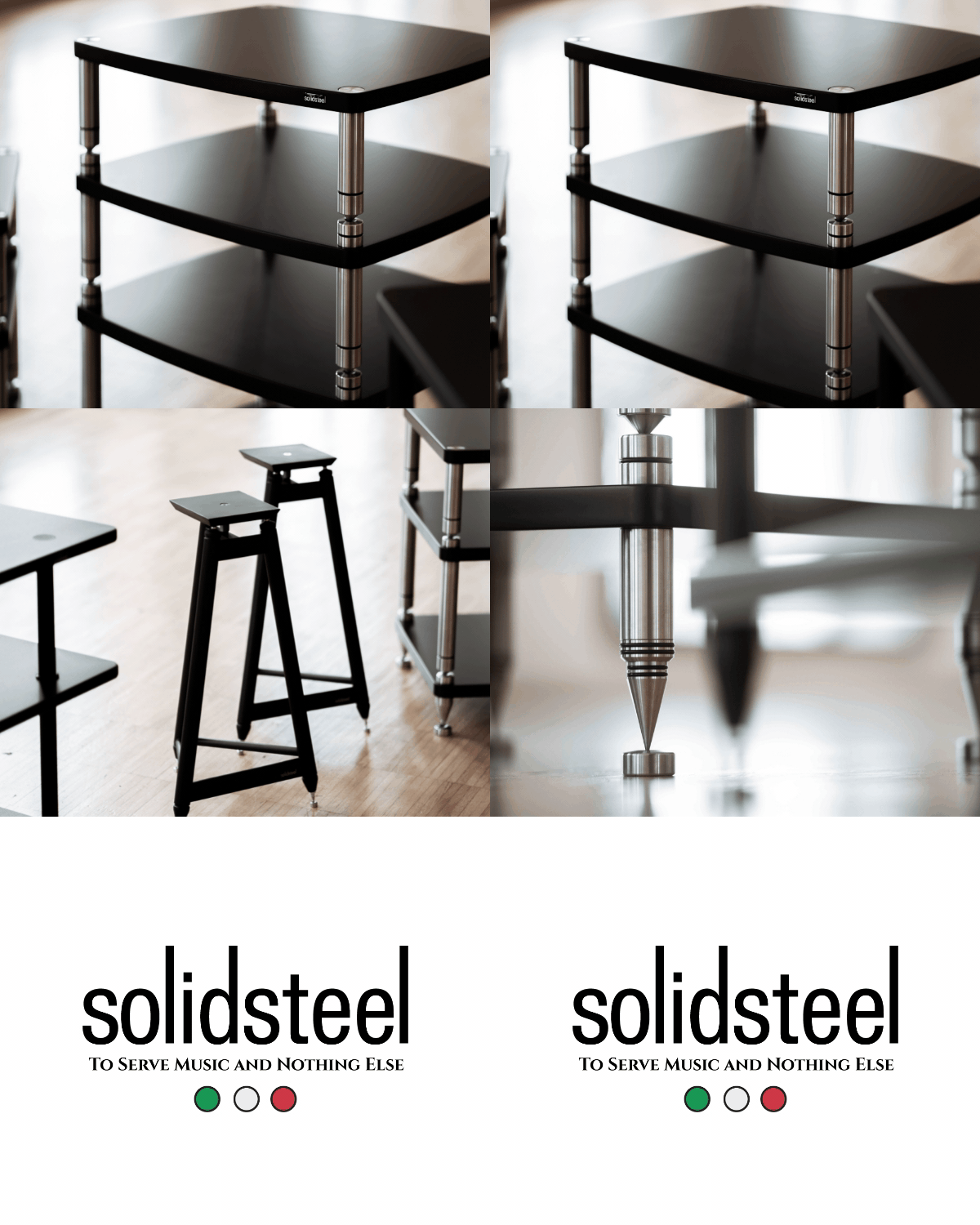
The system with which the ATOHM Sirocco 1.24 was tested consisted of the Audio Analogue Maestro 2.0 integrated amplifier, while the Aqua La Scala MKII DAC connected via USB to an Audiolinux-based Audio PC, with JCAT USB XE card and JCAT NET XE network card both equipped with dedicated power supply was used as the digital source. Signal, power and power wiring was Neutral Cable from the Reference series. Positioning in the room, also by virtue of the particular downfiring bass reflex configuration, did not present any particular difficulties other than finding a spot where the size of the virtual soundstage image reached its maximum expression. After a few attempts we found about 60 of cm from the back wall and 90 cm from the side walls to be a satisfactory compromise between downward extension and spatiality. During the test the Sirocco 1.24s were placed on stands of the SolidSteel SS-7.
As it was logical to imagine, the listening impressions traced what we had been able to appreciate during the test of the Sirocco 2.24s. Obviously, the greater lithium of that model allows an extension toward the low frequencies that the nameplate data alone – 46 Hz for the 1.24 and 40 Hz for the 2.24 – did not suggest. What remains unchanged is the extraordinary ability to produce great sound pressures thanks to the considerable power handling. We had had an inkling of this ever since the technical analysis phases(Gutting) that we performed to shoot the video for YouTube, when we had noticed the presence of some devices aimed precisely at achieving this characteristic. However, it is one thing to see and another to listen. If we consider that the Audio Analogue Maestro 2.0, with its 200 W @ 8ohm, is not exactly a “featherweight,” seeing it play at two-thirds volume without any hint of compression by the small ATOHMs made quite an impression on me. By the way, it’s not that I had decided to venture into that territory out of pure sadism towards the French bookshelves, I did so because the higher I turned up the volume knob on the Tuscan integrated the better those sounded. True, at one point I felt a certain sense of stiffening, of a sudden reduction of that naturalness that characterizes the Sirocco 1.24s. But, I assure you, the chorus of the German Requiem, Op. 45 by J. Brahms had been assuming credible proportions for a while, placing itself well behind an orchestra that sounded impeccable both in spatial arrangement and in the timbre of the various instruments. Just now I was writing about the naturalness of these speakers: with the same amplifier and source, our reference in the bookshelf sphere, namely the Vivid Audio Kaya S12s, made due proportions, sound with a more analytical approach and with a higher resolution that allows, if desired, to concentrate in following a particular instrument (or group). With the ATOHM Sirocco 1.24s, one is more inclined to let the music flow, perhaps in a less “cerebral” and more relaxed enjoyable way. I suppose that, at this point, there will be someone among my readers who will be sharpening his pen (or keyboard for that matter) to cover me with insults because I have matched 1,750€ speakers with an amplifier that costs ten times more. I beg him (or her) to calm down: the rationale for the operation is in trying to push the speaker to the limit in a context far beyond that in which it will probably be called upon to express itself. After that, the test continues under more “normal” and “predictable” conditions. In this particular case I first connected the ATOHM Sirocco 1.24 to a Moonriver 404 and then to our Copland CSA 100, coincidentally both amplifiers from the Scandinavian area. The first test in particular was quite interesting because it allowed me to realize that even a relatively modest power amplifier (50W @ 8ohm) can make the French bookshelves sound satisfying. This brings me to the second point of evaluation of the Sirocco 1.24s, which is their neutrality. This is a parameter that is often considered, with good reason for goodness sake, a plus. Nevertheless, I believe that it is not always clear what is meant by this term, and this causes that sometimes, when the listener is placed in front of a neutral listening system, whether because of the speaker used or something else, he or she considers it uninvolving. Put another way, I believe that some listeners tend to favor audio systems that are not neutral at all but characterized in this or that direction. Returning to the ATOHM Sirocco 1.24 protagonists of our test, I think I can count them among the speakers that tend to be neutral because, with the same source, they unequivocally highlighted the characteristics proper to the three integrated amplifiers with which I tested them. I was saying, for example, of the Moonriver Audio 404 (Fågelsång), an amplifier with a most relaxing, pleasant and engaging sound, which saw these characteristics shine through thanks to the French bookshelves. Certainly the chorus of the aforementioned Brahms pages did not have the same emotional impact, but the track Rose from Manu Katché’s Neighbourhood album, was a real treat.
Conclusions
If I go back in my mind to a few years ago, I can think of no loudspeaker costing less than 2,000 €, bookshelf or floorstanding makes no difference, with respect to which I used a similar evaluation grid to that employed in the critical listening of the ATOHM Sirocco 1.24. It may be that the French company builds its drivers in-house with advanced technology, it may be that the designers know their work inside out and manage to make the most of this competitive advantage, the fact is that the value for money of these speakers is, to my way of thinking, really attractive. So much so that I wanted to make sure with the Audioplus distributor that the €1,750.00 figure referred to the pair and not to the individual speaker. A way of saying that if they had cost twice as much I would still have found it correct. A listen is recommended to all, but especially to those who claim that audio is now just a game for bored millionaires.
Giulio Salvioni
Technical specifications.
- Bookshelf speaker: 2-way bass reflex
- Efficiency: 88 dB/2.83V/1M
- Impedance: 6 ohms ( 4.4 min. @ 200Hz)
- Frequency response: 46 Hz – 25 kHz
- Crossover frequency: 3.5 kHz
- Mid/bass unit: C150 DCR 04
- Tweeter : WSD20 DND 04F
- Filter slope: 1st order with impedance compensation;
- Cabinet: 18 mm MDF;
- Finish: Genuine Lego veneer or satin white or black paint;
- Dimensions: 180*345*260 (mm);
- Weight: 7 kg.
Price: €1,750.00 the pair including VAT.
Manufacturer: WELCOHM TECHNOLOGY
12 rue du breuil – 70150 PIN (France)
Tel : + 33 3 81 47 91 01
contact@atohm.com
Distributor for Italy: AUDIOPLUS HI END VIA CRISPI 77 63074 SAN BENEDETTO DEL TRONTO (AP) TEL: 0735.593969 FAX: 0735.575014




GIPHY App Key not set. Please check settings