



 Alessandro Catalano
The Construction
A look at the internal layout reveals a clear effort to keep the two channels independent, each with its own power supply and amplification stages. This design requires space, components, and adequate thermal management, especially when aiming to achieve power levels of this magnitude. In the ABsolute 3.0, the separation of the channels is one of the core principles around which the entire unit was designed.
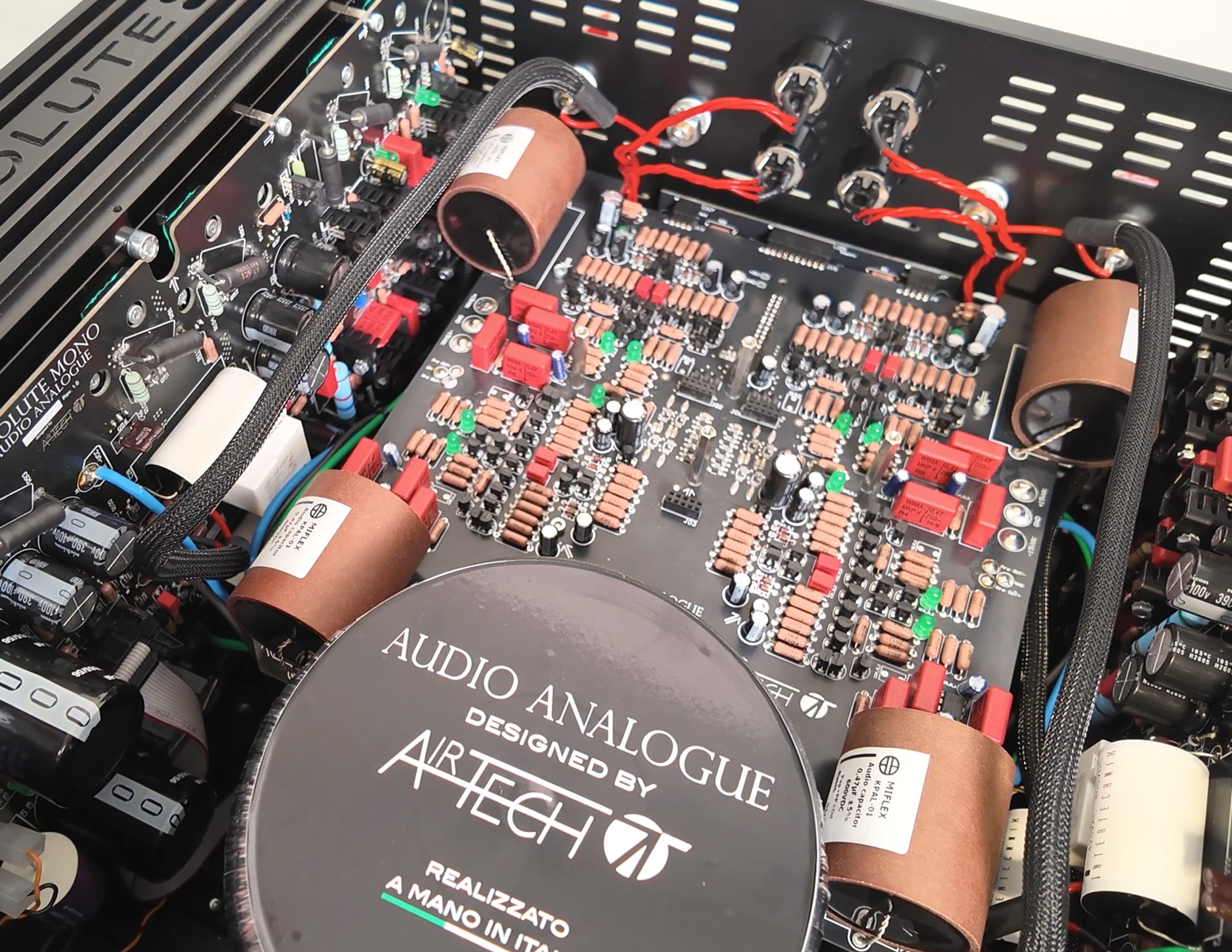
The circuitry uses discrete components, with the stages distributed across independent boards and without global negative feedback. Each channel features twelve bipolar power transistors and a filter capacitance of 89,600 µF. Special attention was also paid to the internal wiring, which uses 7N OCC solid copper conductors. The power supply employs two 1,200 VA toroidal transformers, one per channel. The design of this section plays a crucial role in an amplifier intended to drive speakers with widely varying electrical characteristics. Current demand changes constantly with the musical signal and the load impedance, and the power supply must keep pace with the output stages even during the most demanding passages. This is one of the reasons why, when evaluating an integrated amplifier in this category, it is worth taking a close look at what lies upstream of the output stage.
The same attention to detail is evident in the mechanical components. The machined aluminum chassis features side panels that also serve as heat sinks, integrating heat dissipation into the device’s design. The overall design conveys solidity and gives the impression of a product built to last—exactly what one would expect from a product of this caliber.
Volume Control and Connections
A particularly interesting section is the one dedicated to volume control, which is handled by a network of resistors switched by relays. The microcontroller manages the selection and control operations, while the audio signal is attenuated in the analog domain. The precision of the adjustment and the balance between the two channels therefore depend on the resistor network and its switching.
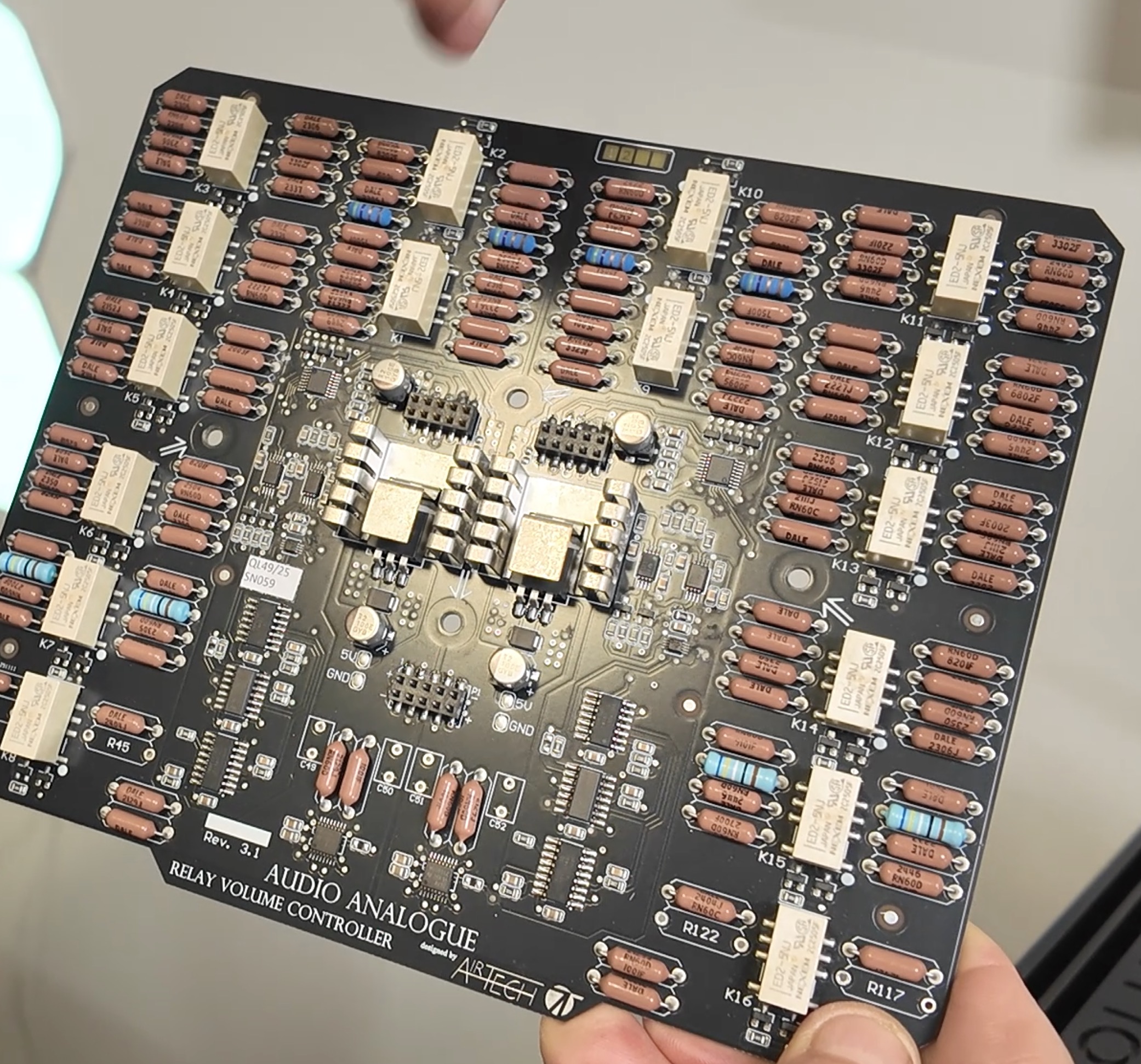
Through the menu accessible via the remote control, you can select four adjustment curves. This changes the volume progression, allowing you to adapt the control response to the sensitivity of the speakers, the output level of the sources, and your listening habits. This feature is particularly useful when you want a more gradual adjustment within the volume range used most frequently. The remote control, crafted from solid aluminum, is a perfect match for the amplifier’s build quality. The rear panel offers five line inputs: three unbalanced RCA and two balanced XLR. One of the RCA inputs can be set to Direct Mode to use the unit as a power amplifier—which is also useful when connecting to an AV system—while entrusting level control to a preamplifier or an external processor. Rounding out the package is a high-quality power cord, naturally bearing the AirTech brand.
The speaker terminals are generously sized, allow for a secure connection, and accept banana plugs, spade connectors, or stripped wire. The ABsolute 3.0 focuses all of its functions on analog line amplification. The DAC and phono stage must therefore be selected separately, depending on the needs of the system and the sources used.




GIPHY App Key not set. Please check settings