



 Audio 2G
Canor is a company recently distributed in the Italian territory, and therefore not very well known to the enthusiast public. Not helping the spread of the brand is the type of products offered, mostly tube and certainly not affordable in cost. The company started way back, as EDGAR in 1995 debuting with an integrated amplifier, the TP101, 4 EL34 as power amps and the classic aesthetic with exposed tubes.

It became Canor in 2007, and in 2008 the first tube integrated amplifier debuted with the new design that is then what it is today. The philosophy is to pay the utmost attention to the smallest details, and among them a very important aspect for the manufacturer is the quality of the tubes and their selection. Finding nothing on the market suitable for the Slovak company’s needs, they develop in 2012 the Aladdin system capable of very tightly coupling pipes. Another significant step forward is the CMT system, which starts from the assumption that they want to overcome the sound characteristics of air wiring through a printed circuit board that on its side has a standard of repeatability, reliability and shortness of connections unknown to the other. They then develop printed circuit boards that where possible and as much as possible have real slots of a certain thickness.

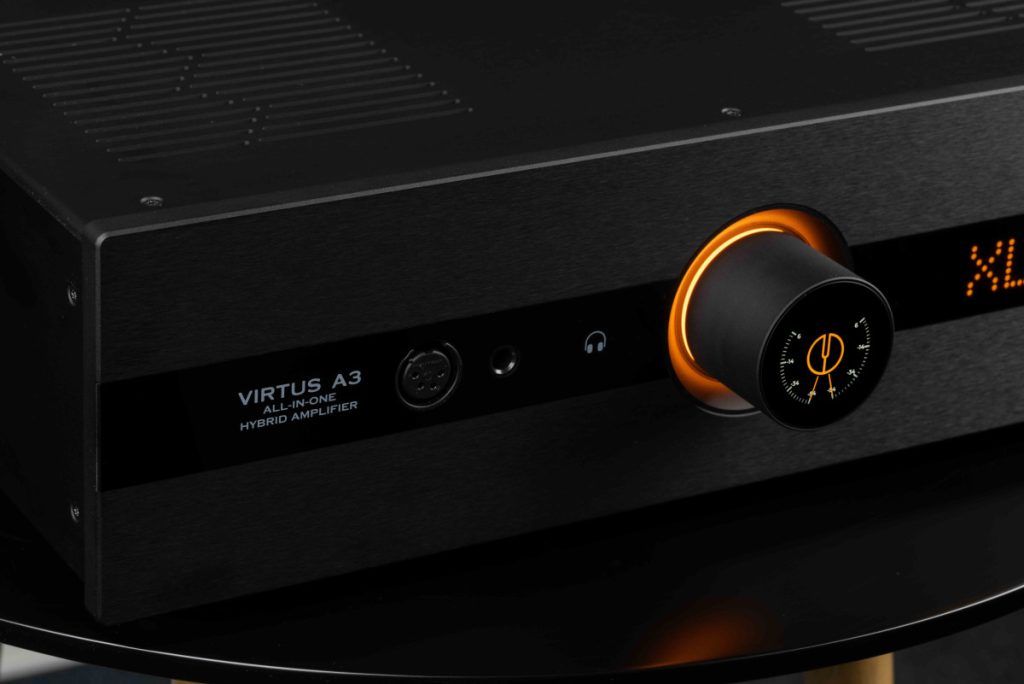
The company grows, and so in 2015 Canor changes headquarters, settling in the current 8000sqm in Prešov, in 2018 the leap into solid state with the first hybrid amplifier, AI 1.20. Then the first Reference series, and the introduction in 2023 of the Premium line and “our” Virtus I2 and Asterion V2 with significant improvements over previous products. The range offered sees numerous amplifiers divided into 3 lines. From the Reference with Virtus M1 tube amps, Virtus S1S solid state, then the Premium with Virtus I2 and AI 1.20, and finally Performance, with AI2.10 hybrids and the brand new A3 in pure class A. A preamplifier from the Reference series, Hyperion P1, two Phono, one in the Premium, Asterion V2 and one Performance, PH2.10. Finally a Performance CD Player, the CD 2.10 and a DAC, also Performance, the DAC 2.10.
Virtus I2
It is a purely analog integrated amplifier, with the possibility of triode/ultra-linear configuration with a button on the front panel, with no inputs except line, 4 in all RCA, with the interesting possibility of using another equal amplifier doubling the power, in which case it will be necessary to use the dedicated speaker outputs and the Ethernet link between the two machines (which is actually an RS232 carried over RJ45) and move the switch to Master or Slave depending on whether that unit will command inputs and volume over the other. In this configuration only the two XLR inputs, named as XM1 and XM2 on the front panel, will be available, so from the 4 RCA inputs you go down to two but gain watts. This is a very interesting possible upgrade, especially because you can do it later, and if you only have RCA signals you can use passive unbalancers without losing performance.

An interesting construction
The Virtus I2 case is made of metal at the bottom and of finely milled aluminum for all upper parts, thus front, back, and lid, which has large windows and smaller louvers to allow for ventilation; it is obvious that the heat generated is a lot and therefore needs some air for ventilation. Interesting is the power supply system that dynamically chooses the primary transformer winding from three different ones, 250V, 240V or 230V, so that performance is as linear as possible. This function is performed by a circuit dedicated to and connected with the ignition circuit; at start-up the machine measures the mains voltage and chooses the most suitable winding, which will then eventually be switched dynamically in a very short time, and without affecting operation, given also the filtering capacities of the various sections, including the huge high voltage electrolytic, 2200µF 500V, the size of a can. On the rear panel a first board leaning against the connectors housing the input switching relays, and immediately behind that the volume one with 6+6 relays, for the two channels, and working in combination resistors. Up to here it is all passive, via then a double shielded cable the signal is carried into the amplification board, where it finds a triptych of shielded 12AX7s and then the 4 KT88s. Many fine components, which we find everywhere, black Mundorfs stand out, but there is no lack of many other fine “pieces” among the components. The remote control is a compact, milled aluminum object, quite ergonomic and can also drive a Canor CD player.

The selection of valves
In Canor, perhaps much more than in other companies, the selection of valves that end up in the products, such as replacement valves, is of great importance, so much so that the manufacturer was prompted to build a proprietary system called Aladdin (with clear reference to the famous fairy-tale lamp), which was launched in 2012 and to this day presides over the selection processes. The problem, in fact, is that all tube measurement systems are, technologically, stuck in the 1960s, perhaps 1970s, the time when valves were discontinued, and therefore relatively inaccurate and slow compared to the microprocessor-based management of modern times. What was needed was a computerized system that in the fastest way possible would be able to select the valves, and here it gets complicated, because it is not at all easy to evaluate a cold pipe, just connected, it has to be warmed up to be sure to make an effective measurement. But a good day dawns, and so the Aladdin system allows for relatively quick but extremely accurate selection. Certainly it is true that the new electronics, thanks to very precise bias adjustment systems, are able to get even very different valves to get along well, but it is equally true that the more similar valves you start with the better, especially in terms of aging. The manufacturer’s goal is to select the most similar tubes, with very stringent windows, which are then hand-marked by the operator with a sequential number, which is what we then find on the metal ring of the socket.
In the modern world, where there are fewer and fewer manufacturers of tubes and often more and more differences between the same acronyms, the enthusiast, also for the sake of tweaking, sometimes tends to replace what is standard with products found on the net and which are declared as “matched pair” or “matched quad,” but without stating how they were selected and with what instrument (which should in turn be calibrated), one then goes on trust, and very often one finds real duds. The enthusiast, in fact, often looks for NOS, or New Old Stock, products that have been sitting in storage for dozens of years, new, and thus have a long life expectancy. This, allow us the digression, applies to valves, but not, for example, to all those products with rubber or plastic parts for example, such as cylinder heads, and for which dozens of years of standing idle inside a warehouse for certain have severely compromised their performance (imagine what might be left of the sagging of a suspension rubber).
So, back to us, we have no certainty about how the selections were made, and therefore it is always an extremely slippery slope to buy products from the net. A manufacturer like Canor, but there are many others, rigorously select the valves they use, and so you have absolute assurance that those valves are indeed very similar to each other, reliable and guaranteed.

Ultralinear and Trido, the differences
Ultralinear is basically a type of amplifier output transformer connection invented by engineer Alan Blumlein of EMI and popularized in the 1950s by David Hafler and Herbert Keroes of Acrosound. It consists of a different connection of the G2 screen grid of power tubes that is not connected directly to the high-voltage supply, as in the pentode, nor even to the anode, as in a triode, but to an intermediate point in the secondary of the output transformer that represents a fixed fraction of the anode voltage, around 43% (in EL34 or KT88, but it varies with other tubes). The effect is to combine the advantages of the triode and pentode connection, achieving better linearity and harmonic distortion than the pentode, a lower output impedance and thus a higher damping factor (better speaker driving capability), and higher output power, in fact in our case it is a doubling compared to the triode configuration, achieving probably the best compromise between efficiency, distortion and bandwidth. In the case of the Virtus I2, it is possible to switch between one (ultralinear) and the other (triode) configuration by means of a button on the front panel, a choice we consider apt, since putting it on the remote control, although more convenient, would probably have meant repeated and close switching, and thus stress on the circuit. The listening differences are there, substantial ones; you will read about them in a moment.

A very interesting listen
The Canor Virtus I2 contains, in essence, two amplifiers, and with two rather different souls, almost like two distinct personalities coexisting harmoniously in the same body. But let’s go step by step, because each aspect deserves attention.
From the first listen, we were particularly impressed by the bass: fascinating, deep, enveloping. Not the classic tube bass, sometimes bloated and clunky, but something different, more like what one would expect from a very good solid state. It is voluminous, round, with an extension that surprises and a harmonic richness that leaves its mark. It stands out without ever being obtrusive, and it sounds wonderful with any setting. The music captures the listener from the first moments, with a fluidity that engages and seduces. Changing tracks, we turn to one of our most recurring references – Mannoia accompanied by Rea – and immediately we are greeted by a deep, intense, nuanced voice that seems to fill the space naturally. The piano follows with splendid tonal colors, rich, refined, almost pictorial. The Virtus I2 is, to all intents and purposes, “dreamlike,” in the noblest sense of the word: it evokes emotions, creates soundscapes, transports one elsewhere. The differences between the two modes of operation, triode and ultralinear, are numerous and clearly distinguishable, each with its own character. Let’s put on Pat Metheny’s “Offramp,” and choose “Are You Going With Me?” In the Triode mode version, the notes emerge soft, velvety, with a reverb that floats through the air and fades naturally. The musical message is intimate, almost whispered, enveloping. Switching to Ultralinear mode, the sound immediately changes register: it becomes more focused, more direct, with a more sculpted image and more incisive detail. However, at the same time, the musical message seems to recede slightly, as if it loses some of the emotional component that had impressed us so much. Certainly, individual sounds are clearer, more precise, can be followed and analyzed more rigorously, but in this specific case we clearly prefer the triode, which gives us a more engaging, more authentic listening experience. However, when the music becomes more complex, with a greater number of instruments and a more articulated texture, that is when the ultralinear mode shows its full potential. In these contexts, a powerful, present, authoritative bass line is particularly appreciated, but always controlled and never excessive. The overall sound is dynamically impressive, with a responsiveness reminiscent of the best transistor amplifiers, while retaining all the tonal and harmonic advantages of tubes. It really is like having, as we mentioned above, two amplifiers in one. Two distinct sound worlds, each with its own virtues, ready to indulge personal tastes or different musical genres. The Virtus I2 thus proves to be an extremely valuable product, the result of a well-conceived and equally well-executed design. Inside we find high-level technical and mechanical solutions, denoting great attention to build quality and reliability over time. All offered at a more than reasonable price. Absolutely worth listening to.
Technical characteristics:
- Power: 2 x 40 W / 4, 8 Ohm ultralinear, 2 x 20 W / 4, 8 Ohm triode
- Monoblock power output: 1 x 80 W / 8 Ohm ultralinear, 1 x 40 W / 8 Ohm – triode
- 30 dB gain
- Input sensitivity: 500 mV
- Frequency response: 10 – 50 000 Hz
- Input impedance: 30 kOhm
- Inputs: 4 x RCA, 1 x RCA Line-Out
- Monoblock inputs 2 x XLR
- Total harmonic distortion: < 0.05 %
- Signal-to-noise ratio: > 95 dB
- Valves: 1 x 12AX7, 2 x 12AT7, 4 x KT88
- Power supply: 230 V / 50 Hz / 375 VA
- Dimensions (W x H x D) 435 x 170 x 485 mm
- Weight 28 kg
Price: €9000
Distributor: Audiogamma spa
Manufacturer: Canor Audio




GIPHY App Key not set. Please check settings