

 Audio 2G
Mindful of my previous experiences with the Norwegian brand, which had moreover left me extremely satisfied, great was my curiosity about this Hegel H600 Integrated Amplifier, which stands out in the catalog as a top product. In particular, I had always tried integrated amplifiers: first the H95 and more recently theH120 for our YouTube channel. The interesting thing is that Hegel has developed multiple technologies that it uses, declined as appropriate to a greater or lesser extent, on almost all its products. So what I expected from the H600 was what I had experienced on the smaller models, but elevated to the nth degree. Let us see, then, if expectations were met.
I begin with the typological description, which, never more so than in this case, assumes considerable relevance. this is a high-power integrated amplifier, we are talking about more than three hundred watts into eight ohms, equipped with everything necessary for listening to streaming digital media, without, however, neglecting analog sources. I point out in this regard that last year the Hegel H600 Integrated Amplifier won the EISA Award for Best High End Streaming Amplifier. The whole thing is presented in a package of absolute restraint and unquestionable elegance, albeit extremely connoted toward an aesthetic/functional ideal with which one may or may not agree. I fully do, but I can understand that an approach such as Hegel’s, especially when applied to a flagship model, might perplex some. Regarding sonic performance I refer you to the second part of this review since, as usual, in the first I will address the technical description.
Technical description of the Hegel H600
the Hegel H600 integrated amplifier under test constitutes the pinnacle of Hegel’s offerings in the area of integrated amplifiers, constituting its de facto reference model. With its 303 watts into 8 ohms, a damping factor of 4,000 and the ability to handle even 2-ohm loads with absolute confidence, the H600 ranks among the small group of “super Integrateds,” a relatively recent type that is gaining increasing acceptance among enthusiasts seeking reference performance but combined with small size and great ease of use. The amplifier features a dual mono design, bringing it as close as possible to the performance of two mono amplifiers in a single enclosure. It should not be regarded as a power amplifier equipped with a volume control, for inside we find a sophisticated preamplifier section equipped with an extremely precise volume attenuator, the same as that found in the reference Hegel preamplifier, namely the P30A.
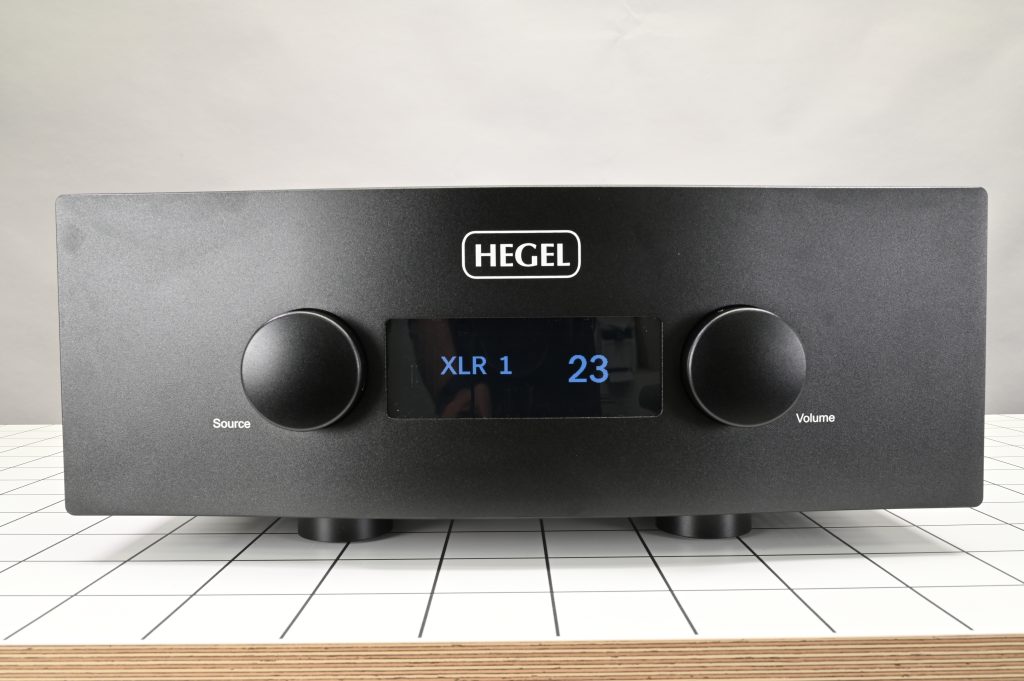
Let’s start with a description of the exterior and then delve into some of the technologies that characterize this product. As can be gleaned from the images, the aesthetics are as spartan and minimalist as one can imagine: the metal cabinet painted in scratch-resistant black is excellently crafted and gives a nice solid feel to the whole. The large heat sinks are not visible but concealed by the side panels, with heat escaping from ventilation grilles located at the top. The front panel, whose thickness tapers at the ends, is nicely finished and bears in the center a bright OLED display at whose sides we find the volume knob and input selector knob. The power switch is located below the display, thus on the bottom panel; a position whose uncomfortableness is mitigated by the considerable height of the four large aluminum support stands with scratch-resistant finish, which nonetheless make it easy to operate and also ensure excellent stability and low vibration.
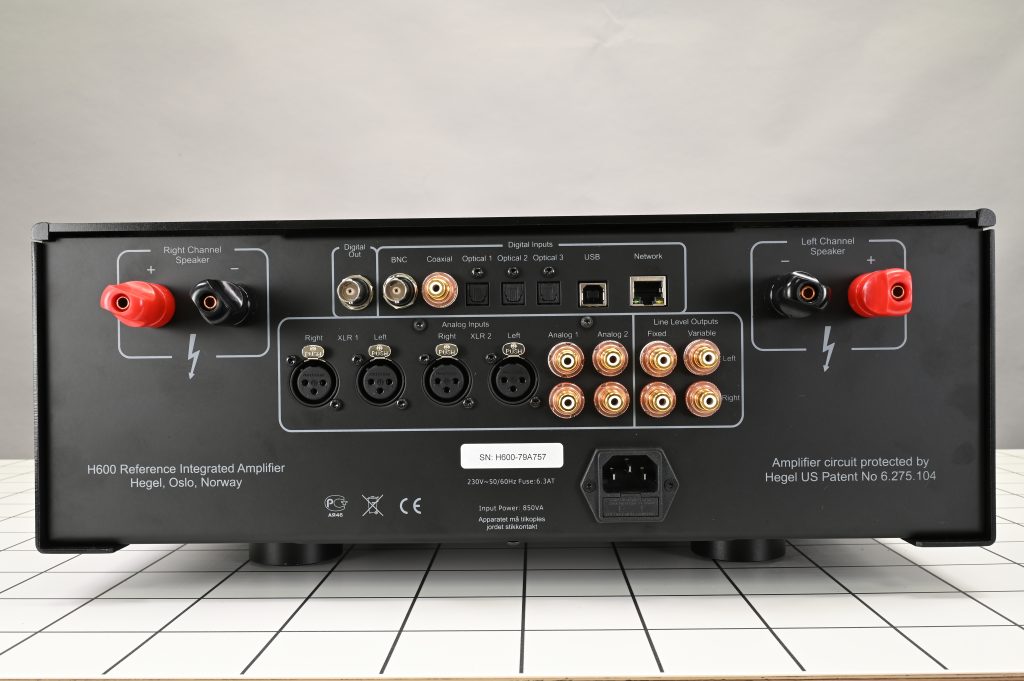
The rear panel, by virtue of a well-organized layout, is “self-explanatory,” so to speak, and features a multitude of connections such as to satisfy any need: two sets of balanced inputs in XLR format, which match the balanced/dual-mono circuit design, as well as two unbalanced inputs in RCA format. The digital section includes as many as three optical and coaxial (RCA/BNC) inputs. On the analog output front we have a pair of fixed-level RCA outputs and a pair of variable-level RCA outputs. While on the digital side we have a 75 ohm fixed-level BNC output, which is useful in case you wanted to make a “DAC-Loop” to connect an external DAC. In this way it would be possible to use the streaming input of the H600, send the digital signal to the external DAC and play the analog output through the amplifier, thus bypassing the internal DAC stage. This is in case one felt the need for a more sophisticated conversion section. Bluetooth connection is missing, judged to be of insufficient quality by the manufacturer, just as there is no trace of Wi-Fi. Still on the missing features front, I point out the absence of a headphone output. Completing the picture is the canonical IEC power cord receptacle and a pair of sizable speaker binding posts. All functions are replicated on the very heavy metal remote control (RC8) through which one can access additional features such as checking the installed firmware version, configuring individual inputs in home theater mode with a default volume level, setting the maximum volume level, even pre-setting the start-up volume. It is also possible to access the menu to view the IP address assigned to the H600 by the DHCP server and possibly change the name under which it presents itself on the network, a procedure, however, that requires access via web browser to a specific configuration page.
SoundEngine 2
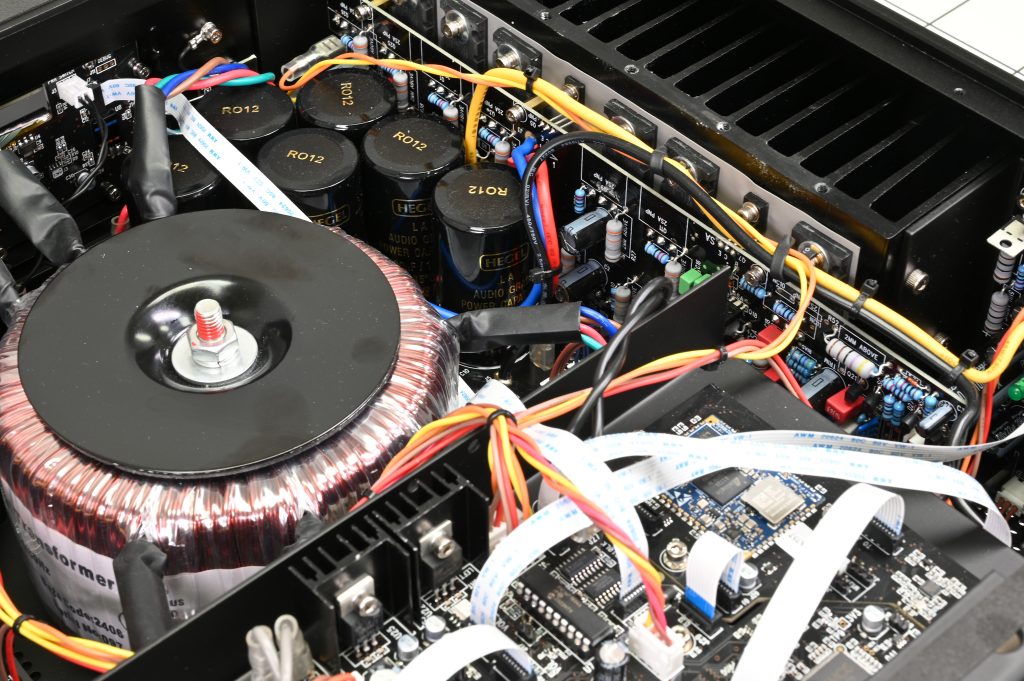
The Hegel H600 Integrated Amplifier operates in Class AB, however, it employs Hegel’s “SoundEngine” technology, now in version 2. This is a feature we find on the Norwegian manufacturer’s entire production, which is based on the use of two units that designer Bent Holter calls analogue computers . The first, comparing the input and output signals, establishes the level of distortion; the second, based on what the first unit detects, determines whether it is necessary to intervene by adding to the output signal a signal equal to the inverse of the distortion. In this way, in the designer’s intentions, two problems that plague the loop feedback technique are solved: time delay and nonlinearity of behavior in different frequency ranges. Thus, the goal of SoundEngine 2 technology is to minimize both harmonic and crossover distortions of the push-pull power output stage through a feed-forward mechanism. Among the benefits of this technology is also, according to the designer, the exceptional ability to control the loudspeaker, resulting in a claimed damping factor of more than 4000. Six pairs of ultra-fast high-current transistors in push-pull configuration, mounted on a large finned heatsink, are used as active devices. Another point on which the Norwegian manufacturer pays close attention is minimizing interference between the high and low-power stages. In particular, the circuits dealing with voltage gain and current gain are separate and have dedicated power supplies. In the photo of the interior we can see the presence of a huge toroidal transformer with separate secondary windings for the two amplification sections behind which we find six large filter capacitors per channel marked Hegel. We were also able to discern the presence of two other toroidal transformers, one dedicated to the digital section and another to the preamplifier section.
H600: digital section
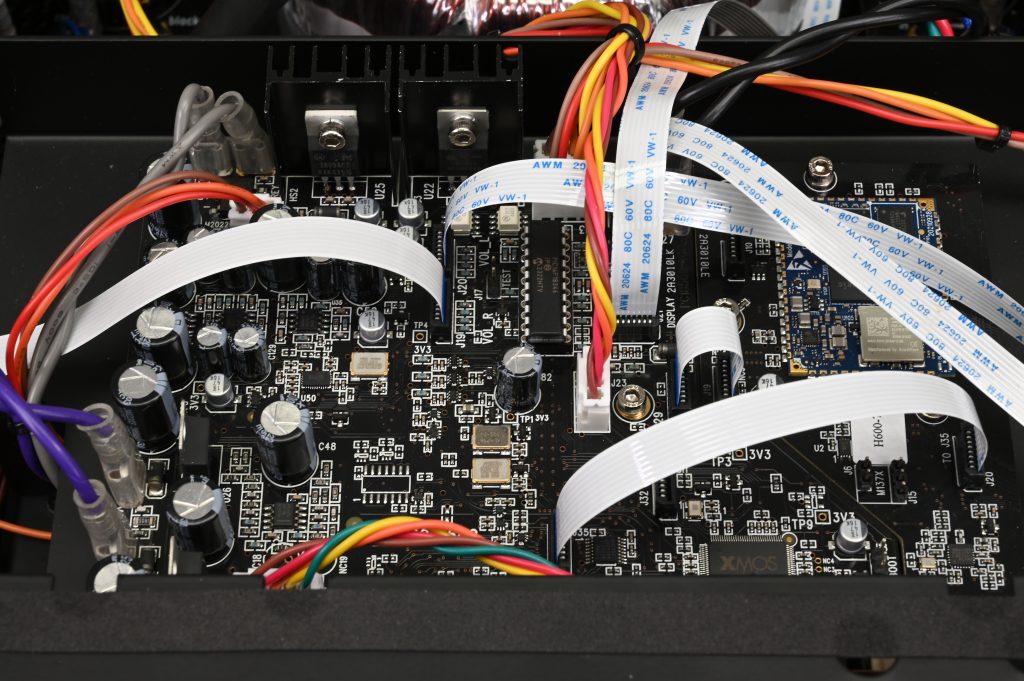
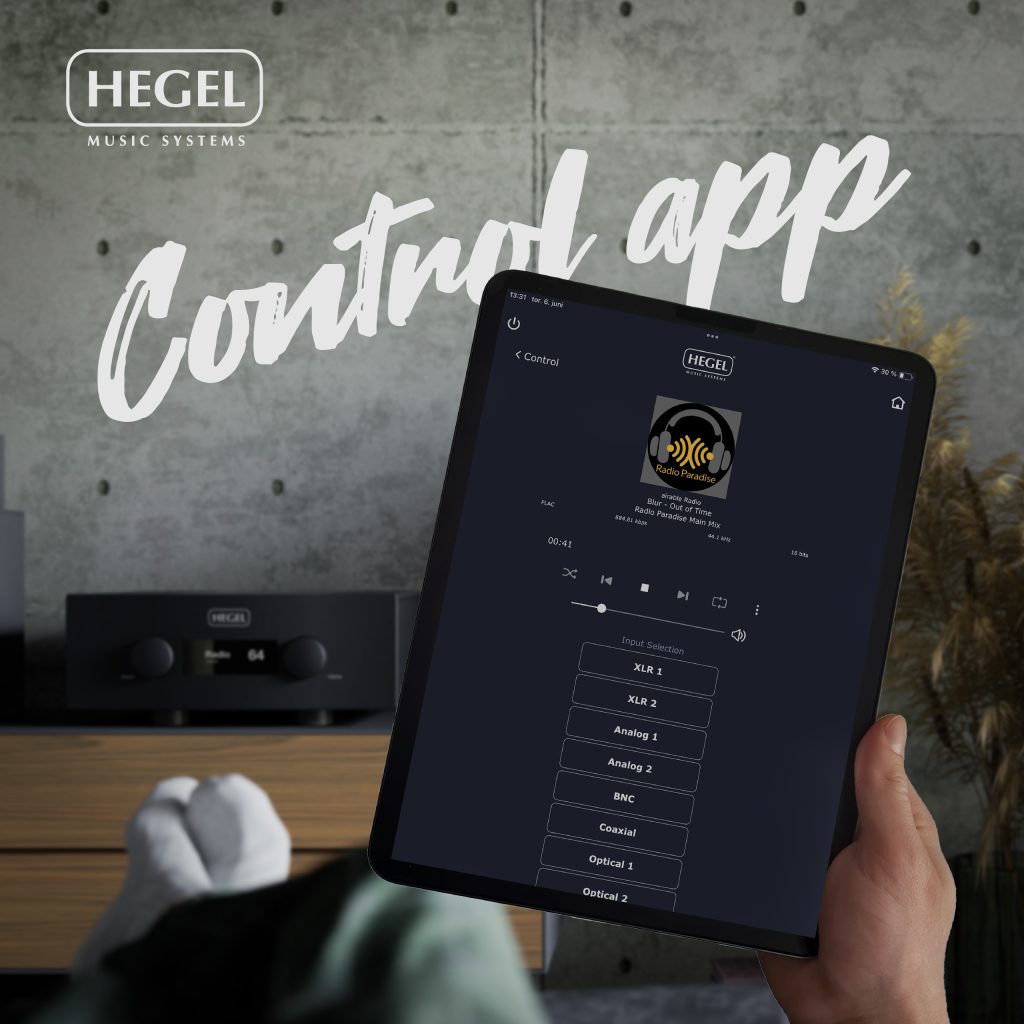
Let us now turn to the digital part of the Hegel H600 integrated amplifier, which is housed in a kind of steel “shielded enclosure” located near the rear panel, and is based on the ESS ES9038Q2M DAC chipset, capable of handling input files up to 384kHz/32-bit (PCM) and DSD256 (DoP) via the USB-B port or 192kHz/24-bit and DSD64 via the network streaming card for which an Ethernet connector is provided. The H600’s D/A converter is bit-perfect without oversampling and has its own dedicated power supply. The internal server supports UPnP, Spotify Connect, Qoubz Connect (coming soon), Airplay 2, Tidal Connect, Google Cast™ and Roon Ready. All digital inputs except USB are Auto Sensing type, which means that any device connected to these inputs can wake up the amplifier from Standby state and set it to the right input. Interestingly, until recently, Hegel did not have its own App to drive via smart devices its products, recommending the use of Conversdigital’s mConnect Player. The H600 is the first unit that can be controlled via the new Hegel Control app, available for iOS and Android mobile devices. The app is simple, well-organized and responsive. At the user interface level, it is entirely consistent with the minimalist approach of the Hegel brand. Also interesting is the fact that it allows access to Airable Radio and Airable Podcasting. Certainly this is nothing particularly innovative, however, I think it is good that the issue has been addressed. So we have three options for controlling the amplifier: from a phone or tablet with the Hegel Control app, using the remote control, or via the large and convenient knobs on the front panel.
H600: listening
I really like integrated amplifiers with an on-board DAC/streamer because of their practicality: just connect the speakers-in this case, alternatively, Vivid Audio Kaya S12s or Kaya 90s-the network cable and the power cable and you’re done. To make some comparisons, I connected the Hegel H600 integrated amplifier to an Antipodes Audio K30 music server on which ran the Roon server-side and HQPlayer player-side combo. In the latter case, of course, the USB input was used. For completeness I also wanted to try the Network input using AirPlay2 mode from my aging iPhone 12 on which the Qobuz App was running. Everything worked perfectly and listening started in an instant. Nevertheless, I believe that the sonic performance of this solution did not do justice to the excellent qualities of the amplifier, which expressed itself much better using the Network connection, yes, but with more sophisticated protocols or via USB input, revealing all the remarkable qualitative gifts of which it is capable.
The first aspect of the Hegel H600 that anyone can realize from the first notes is the exuberant power. True, the nameplate figure – 303 W into 8 ohms – leaves no room for doubt, however, “touching them with your own hands” always makes a certain impression. I say this not thinking about the achievement of who knows what sound pressures (I am not a fan of very loud listening, which I always find annoyingly unnatural), but rather thinking about the absolute naturalness with which this amplifier was able to handle impressive dynamic surges, providing the right energy to the Vivid Audio speakers. Especially the small Kaya S12s, about which we have written so many times and which are not exactly a “foul-mouthed” speaker, showed that they liked the pairing by unleashing their enormous potential. Among the Hegel technologies with which this amplifier is equipped is one called Organic Sound. Quoting the manufacturer:
“…all parts of a dynamic recording are reproduced exactly as the original. The quality of the sound coming out of your speakers is limited only by what happened in the recording studio. Nothing added, nothing taken away-no artificial ingredients.” .
This description does not coincide with the meaning I attach to the adjective “organic” when referring to sound. Personally, I associate the idea of organic sound with a tube amplifier, with its merits and flaws, and I have a hard time superimposing on the term the sonic perception I had of the H600 which, on the contrary evoked a sense of clarity and terse atmospheres of Nordic memory. The matter could be dismissed by some as an insignificant “linguistic diatribe” and perhaps they would not be wrong. However, it served me well to delineate the sonic character of the product under review. Timbrally, the Hegel H600 is very rich and textured: with the right recordings the reconstruction of ancient instruments, violins, violas, cellos is believable exactly as one would expect it to be in a High End amplifier. The brass instruments of the great symphony orchestra are bright, crisp, and stand out without ever sounding scratchy. The timpani, when they come in, do so with astounding speed, and the decay time of the sound is exactly what you would expect it to be. In pairing them with the Kaya 90s, which are equipped with four woofers paired two-by-two, I found a tendency to place emphasis on the lower registers, which in some situations – I am referring to chamber ensembles-it proved a bit forced but, conversely, particularly enjoyable in Jazz/rock/pop repertoire. In contrast, the Kaya S12s showed that they liked this surplus of energy in the low range.
As I had mentioned in the description, I wanted to try connecting the Aqua La Scala MKII DAC (holder of the reference role in my Room 2) and the Antipodes K30 music server, to test the limits of the streaming/DAC platform on board. The result was excellent, which was not hard to imagine; in particular, the level of harmonic detail and overall timbral balance increased, mitigating that tendency to accentuate the low range I referred to earlier and making the overall sound more oriented toward a “color” that slightly diluted the tendentially cool character of the Hegel H600.
Declared technical specifications
- Type: Integrated amplifier with integrated streaming platform;
- Output power : 300 W per channel (8 ohms), 600 W per channel (4 ohms); dual-mono configuration;
- Frequency response: 5 Hz-100 kHz;
- THD: Less than 0.005% at 50 W into 8 ohms, 1 kHz;
- Damping factor: 4000 (8 ohms);
- Analog inputs: XLR (x2), RCA (x2);
- Analog line-level outputs: XLR (x1), RCA (x1);
- Digital inputs: coaxial (BNC), coaxial (RCA), USB, optical TosLink (x3), network;
- Streaming: Spotify Connect, AirPlay, Google Cast, Roon Ready, Tidal Connect, airable Internet radio and podcasts, UPnP, JPLAY certified;
- Streaming formats: MP3, WAV, FLAC, ALAC, AIFF, DSF, DFF, AAC, PCM, MQA, Ogg;
- Dimensions: 17.1cm x 43cm x 44.5cm (AxLxD);
- Weight: 22 kg.
Price: €12,500
Distributor for Italy: HIFIGHTSRL – Via Enrico Fermi 20/2
35030 – Rubano (PD)




GIPHY App Key not set. Please check settings