



 Audio 2G
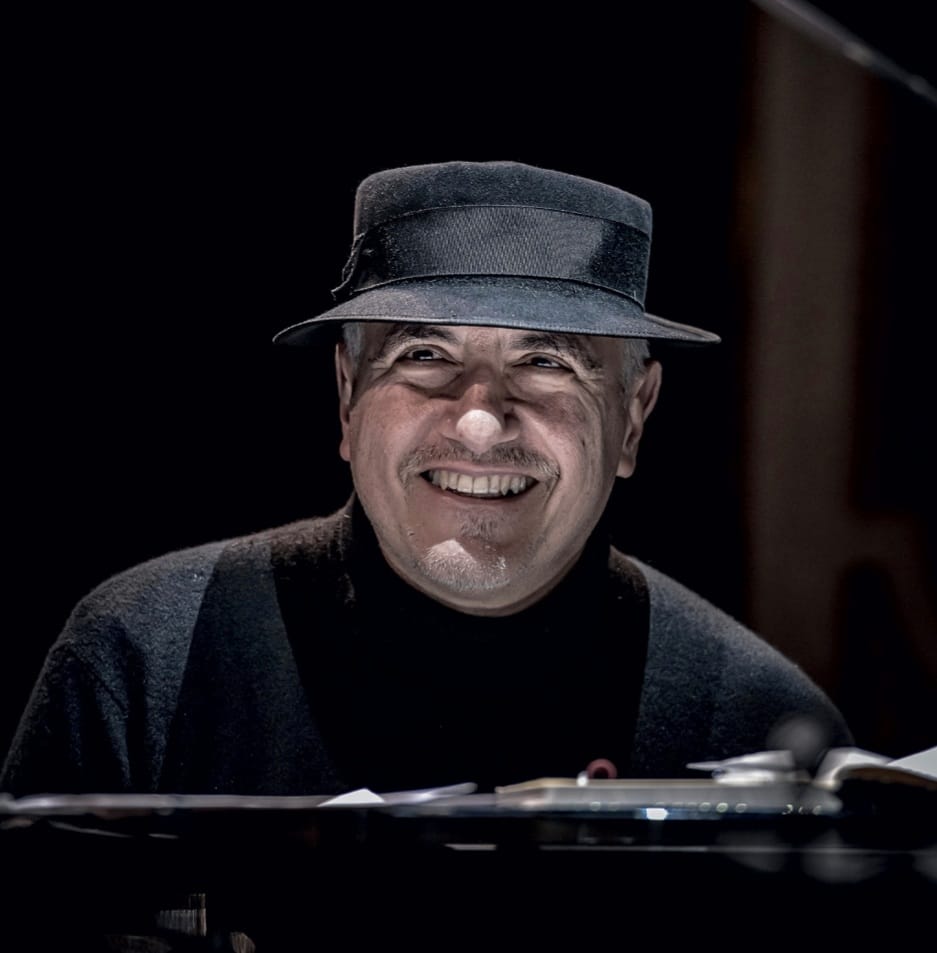
Interviews are usually question-and-answer sessions, but then there are conversations like this one, in which a great musician ends up sharing his own way of experiencing music. My meeting with Danilo Rea was exactly that: a spontaneous chat, full of anecdotes, memories, and reflections that every music lover—and “also” every hi-fi enthusiast—should listen to, because the Maestro is one of the few who truly loves the world of hi-fi.
It all starts with an episode that’s as curious as it is significant. Danilo recounts the time when, upon entering Mina’s recording studio, he found himself holding the headphones the singer used to record her albums. Not some ultra-expensive modern pair, but an old pair of Koss headphones, worn down by time, with the padding practically gone. An extremely uncomfortable pair, yet irreplaceable. For Mina, those were “her” headphones—the ones she’d used to learn to hear her own voice. This story serves as the starting point for a very interesting reflection: in music, familiarity with a sound can count for much more than the obsessive pursuit of the latest technological innovation. In the end, Rea recalls, true talent transcends any limitations of equipment.
From here, the conversation turns to the great performers. Danilo explains how top-tier artists would often record just one or two takes, relying entirely on the inspiration of the moment. It’s the “feeling” that counts—that spark that can’t be reproduced on command and that often makes a recording one-of-a-kind.
The interview continues with a journey through Italian music of the 1970s and 1980s. Rea recalls the early days of his career with New Perigeo, his work alongside Riccardo Cocciante and Rino Gaetano, and a time when, he says, established artists and young musicians worked side by side without any barriers or hierarchies. It was a creative atmosphere very different from today’s, when record labels invested in seeking out new ideas and developing artistic projects.
One of the most interesting points concerns the sound of the recordings themselves. According to Danilo, the period up until the 1990s was an extraordinary era in terms of sound quality. Subsequently, due to the increasingly widespread use of compression, sampling, and productions made in small studios, something was lost. But the pianist emphasizes a fundamental concept that’s also key for hi-fi enthusiasts: even the best system in the world can’t compensate for a mediocre source. If the musician produces a great sound right from the source, that quality will reach the listener regardless of the system’s price. If, on the other hand, the sound is poor to begin with, no technology can transform it into something it never was.
There’s also a fascinating recollection of Peter Gabriel’s Real World studio, where Danilo took part in the recording of Claudio Baglioni’s “Oltre.” He describes an environment that was technologically cutting-edge for its time, filled with extraordinary musicians like Manu Katché and engineers who had worked with Yes and John Lennon. But what strikes him most, even today, is the extreme simplicity and approachability of Peter Gabriel, one of the biggest stars in international music.
The conversation then turns to the piano and the importance of interpretation. Using his recordings with Gino Paoli and Fiorella Mannoia as examples, Danilo explains how the same instrument can take on completely different characteristics depending on the sound engineer, the producer, and the sonic vision guiding the recording. It’s an invitation not to judge a sound system or a recording too hastily by listening to just one song or one piano track: behind every album lies a specific artistic vision.
One of the most moving moments is her account of her relationship with Gino Paoli. Rea explains how accompanying a great performer means, first and foremost, listening, breathing in unison, and leaving room for silences just as much as for the notes. She recalls a quote from Paoli himself that perfectly sums up his philosophy: it doesn’t matter whether you sing perfectly in tune; what matters is being able to move the listener. This leads to a reflection on the role of improvisation, mutual listening, and the ability to build, moment by moment, a shared musical narrative.
It’s a conversation that goes far beyond technique. It’s about music lived, about experience, about emotions, and about that wealth of knowledge that only those who have spent a lifetime alongside the greatest artists can convey so naturally.
This is just a fraction of the topics covered during the interview. To hear Danilo Rea himself share all the anecdotes, the nuances of his stories, and his full reflections on sound, recording, and the art of performance, we invite you to watch the full video posted on our YouTube channel.




GIPHY App Key not set. Please check settings