



 Audio 2G
Designed to integrate with other components in the same series, the latest addition to Rotel’s Michi family is a top-loading CD player with USB input and DAC.
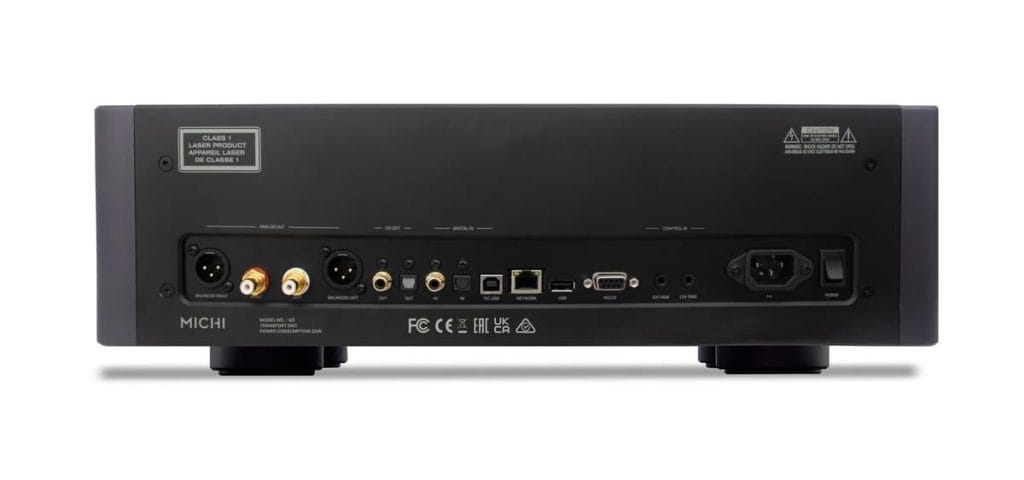
The name assigned by Rotel to the Michi Q5 is “Transport DAC” even though, judging from the aesthetics, it is first and foremost a CD player. The majestic top-loading mechanism and being placed in the “CD players” section of Rotel’s website also suggest that it is primarily a unit designed for lovers of silver discs. Nevertheless, on the rear panel, we find a conspicuous array of digital inputs to take advantage of the internal DAC unit, as well as some digital outputs as well.
Rotel can boast a long tradition in the field of CD player production. A tradition that has its roots as far back as 1985 with the RCD-850 model. Next to this Q5, which is then the only CD player in the Michi line, there are currently no less than four other players in the Japanese manufacturer’s catalog, testifying to the brand’s dedication to this seemingly declining format, but with respect to which Rotel highlights a “strong global demand” and its intention to continue supporting it.
Technical Analysis: cabinets, inputs and DAC
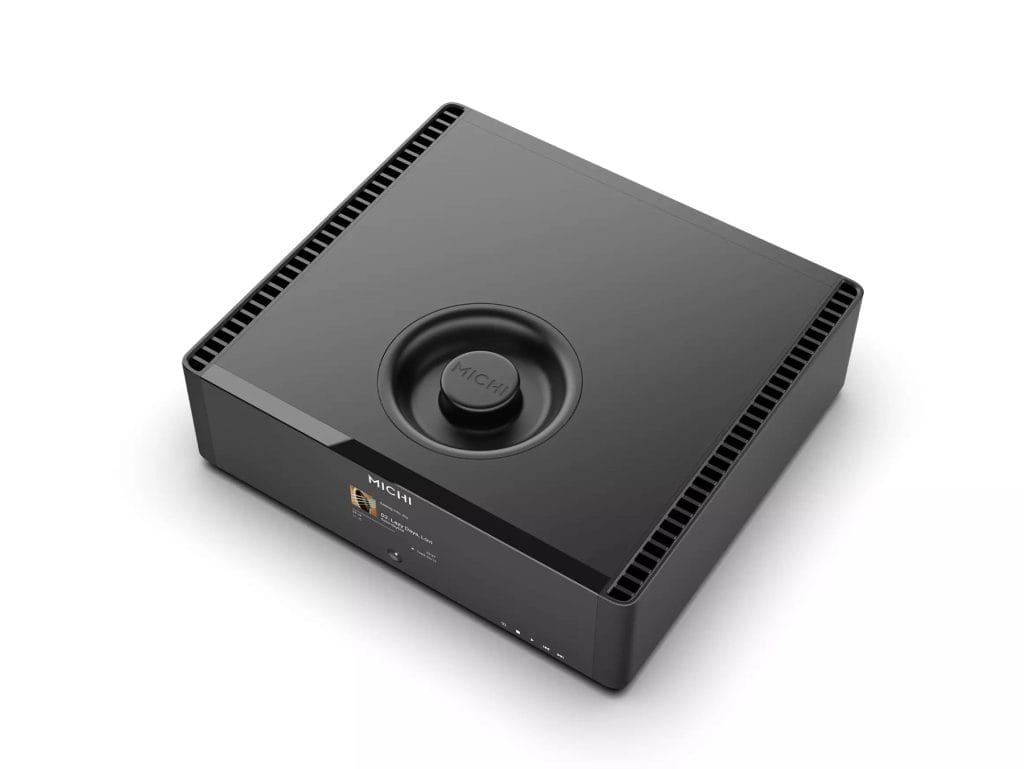
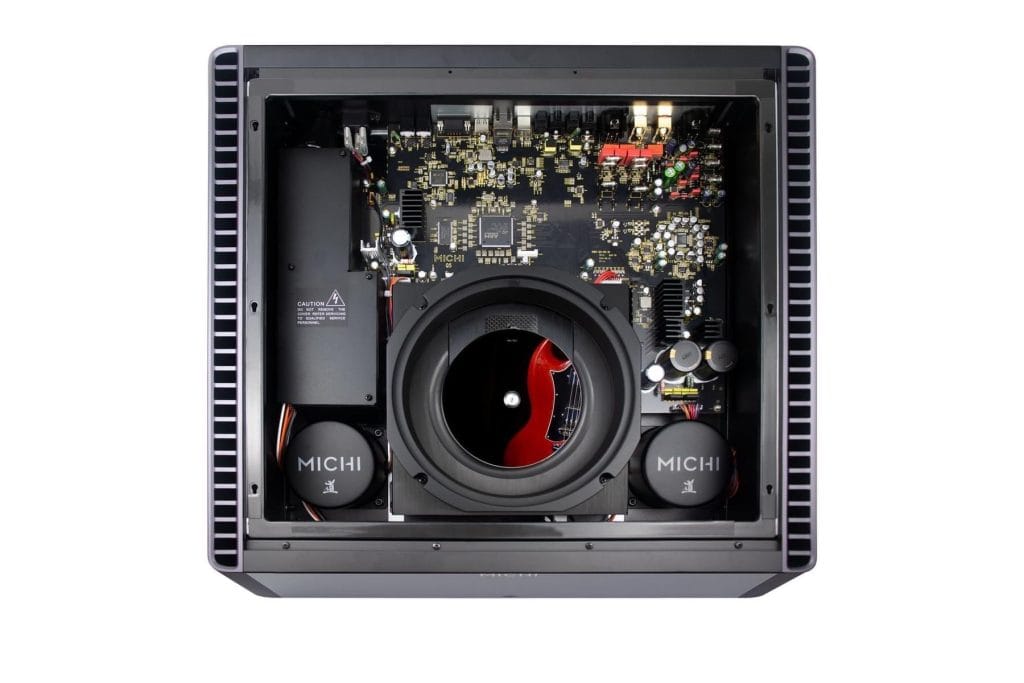
The Rotel Michi Q5 CD Player fully belongs to the Michi series, so it shares its imposing full-width cabinet (43 cm) and the high level of finish of the internal components, similarly to what we saw on the integrated Michi X3 S2 we had the opportunity to test a few months ago. The “combined arrangement” of metal cabinet, side heatsinks (superfluous, in this case) and a pair of home-made toroidal transformers contribute to the overall weight of an impressive 23.5 kg.
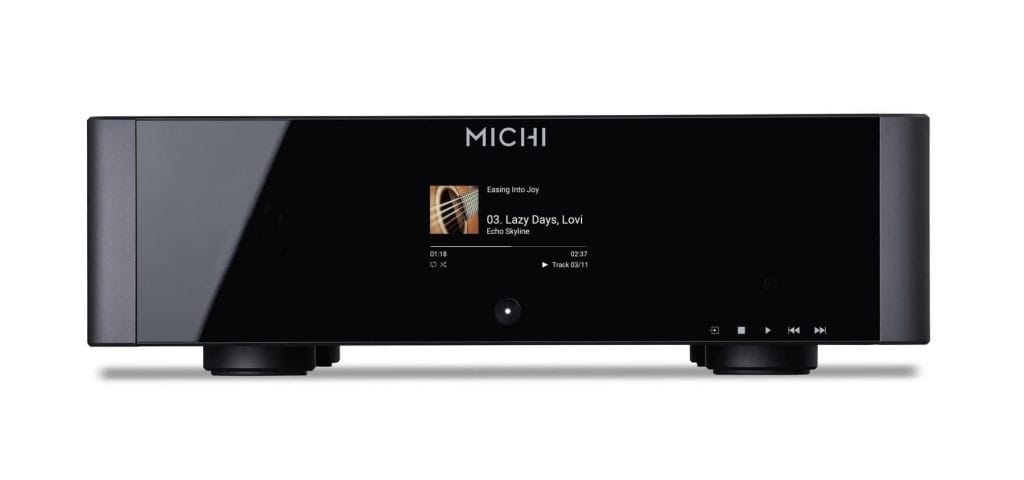
The front panel is made of “flush” glass and houses a large color TFT display that shows album covers and information about the tracks they contain. Since this information, or rather metadata, is not written on the surface of the CDs, an Internet connection is required to retrieve it from an online database. For this purpose the Michi Q5 is equipped with a wired Ethernet connection, but not Wi-Fi. The reason for this seemingly bizarre choice is due, according to Rotel, to the fact that streaming technology evolves very rapidly while the Q5 has the ambition to last far longer than any streaming module that could possibly have been placed inside it. Better, then, to rely on an external streamer-perhaps one from the Michi series that the manufacturer announced some time ago-connected to one of the digital inputs, namely USB-B, coaxial and optical. The USB-B input supports audio files up to 384 kHz/32-bit PCM and 4x DSD. Digital signals are processed by a DAC stage based on that developed for the P5 S2 preamplifier, which drives analog outputs that are both balanced (XLR) and unbalanced (RCA). For this model, Rotel uses a single ES9028PRO DAC chip, that is, the same chipset employed in the P5 S2 preamplifier, which, however, employs two in a dual-mono configuration. This poses a small problem for those who own both the preamplifier and the player; the manufacturer advises those who own both the preamplifier and the player to try both configurations to decide for themselves which they prefer.
Technical Analysis: CD Mechanics
The production of dedicated CD players, especially the particularly fine ones from Philips and Sony, came to an end more or less in the late 1990s, when the market was flooded with CD-ROM/DVD-compatible players. The companies that continued to come up with new models of CD players, including Rotel, were either forced to turn to individual suppliers in the Far East for lasers, servos, mechanisms, etc., or–a widely used solution–to use computer-sourced ATAPI CD/DVD-ROM drives. Rotel took a piecemeal approach, seeking the best suppliers for each component of the unit. The CD player, RF amplifier, and decoder/error correction chips used in the 14- and 15-series players are sourced from Toshiba, and although they have been obsolete for years now, Rotel had the foresight to purchase ample supplies that will last for at least the next decade. The top-loading mechanism of the Rotel Michi Q5 CD Player uses the same Toshiba integrated circuits, but the laser, motors, and code written for the servo/decoder board are specific to this model. In addition, the line-tracking laser is mounted on a CNC-machined metal alloy plate suspended from a steel chassis, for a total weight of 1.7 kg (to which the 1.1 kg of the top cover should be added). The tray is also made of metal alloy: there are no plastic moving parts in the Michi Q5, apart from the small magnetic disk that locks the CD to the motor spindle.
Technical Analysis: user interface
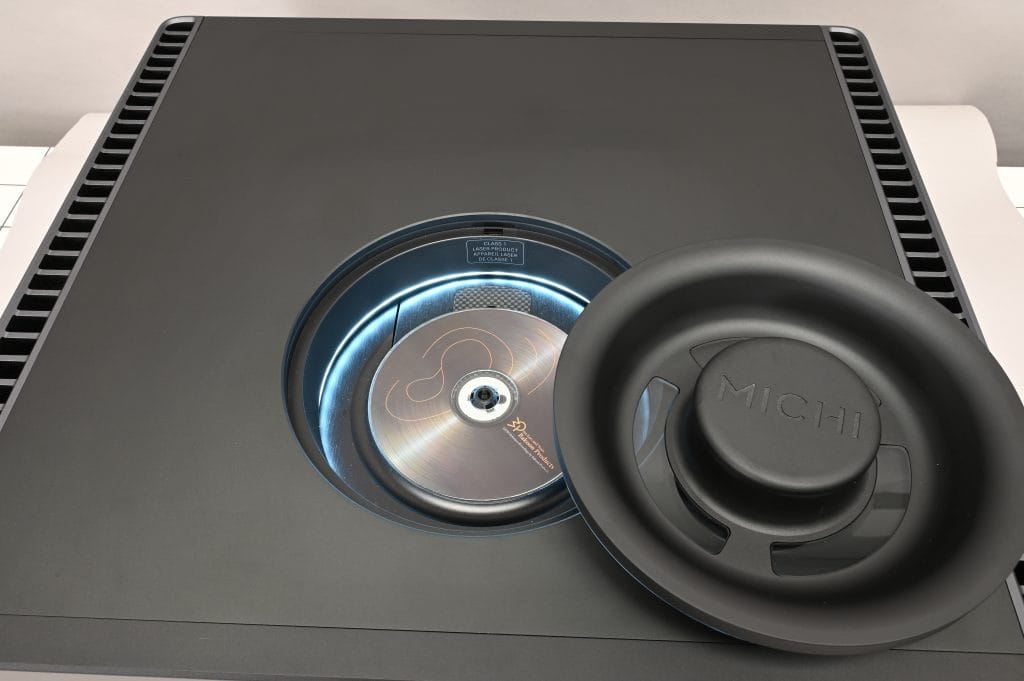
It only takes a few hours of use to realize that the choice of the top-loading type(top loader), in addition to undeniable technical motivations, is probably motivated by the desire to offer the user a “tactile” experience as similar as possible to that of using a vinyl record. I also say this with reference to the beautiful metallic remote control that – strangely enough – lacks a STOP button. When we asked a representative of Rotel why this choice was made, we were told that the STOP button on the remote control would be useless, since you use it only in case you want to change the CD, which still implies the need to go to the vicinity of the player to intervene on it. And in what way can one intervene? With a series of physical controls located on the left, on the underside of the chassis, which in turn are signaled by what appears to be a row of “touch” controls located on the front panel of the player, but which is actually just a series of indicators. In short, from the point of view of the consistency of the user interface, some perplexity the Rotel Michi Q5 CD Player has caused me. In support of this statement, I point out the fact that the Q5’s CD compartment cover does not turns out to be “locked” when a disc is inside and spinning; therefore, if you open it during playback (or with playback “paused”), there is a chance (and it happened to me) that the disc will lift off the mechanism that sets it spinning by going to impact the edges. Apart from this not insignificant detail, what fascinated me was the workmanship of the very heavy disc loading compartment cover. A masterpiece of elegance and functionality, it integrates a disc pusher and a series of transparent windows that allow one to observe the rotation of the CD. Equally gratifying and “scenic” is the white LED ring surrounding the inner perimeter of the CD compartment, which lights up when the lid is lifted. Quirky, to say the least, is the fact that it can be turned off by disabling the “Upper LED Mode” from the menu. I frankly doubt that anyone would ever want to deprive themselves of such a sight. Other menu options accessible with the remote control buttons include naming the source/input, managing network parameters, firmware status and its update, switching between two “PC-USB decoding” modes (one of which extends PCM handling from 24 bits to 32 bits at the expense of DSD and MQA compatibility), and adjusting the brightness and timeout of the main front display.
Rotel Michi Q5 CD Player: Listening
Listening
We installed the Rotel Michi Q5 CD player in our best system by playing it with Soulution 511/525 amplification and Vivid Audio Kaya 90 speakers. Obviously, the following considerations are related to listening to the machine in “full” operation, that is, as a CD player taking advantage of the internal conversion unit. Before moving on to the listening notes, I would like to take the time to mention the only two negative notes I found. The first is the relative discretion with which the Michi Q5 decides to show or not show metadata on the display. This is indeed curious, but I should note that with some CDs in a few moments the tracks with their titles and disc cover were presented on the TFT display, while with others they were not. I do not think that this is attributable to a lack of completeness of the database that is consulted by the machine because, in fact, even rather rare CDs were recognized, while other very well-known ones did not have the same fate. Let us say, however, that this is not a big problem, at least for me. Much more penalizing is the failure to support the SACD(Super Audio CD) format, which has prevented me from listening to some discs that I love very much. This, I must say, is a bit of a shame because it prevents some enthusiasts–including yours truly–with several titles in SACD format from considering buying this Michi Q5 as the “ultimate player,” a title to which they might otherwise certainly aspire.
Now to the actual listening. Years and years of music on file had made me forget how good the classic CD in Red Book format was, when fed to a player worthy of the name. The first thing that strikes you about this Rotel Michi Q5 CD player is the breadth of the sound front. It almost seems to want to go hand in hand with the player’s imposing physical dimensions. The stage unfolds coherently on all three axes, projecting far beyond the speakers and even the physical limits of the listening room. Another aspect that does not go unnoticed is the granitic solidity of the bass range. Deep, stentorian when needed, fast and very well articulated. It makes quite an impression to hear after so many years some CDs, which I did not think were particularly good, sound so spectacular. Poor things! Probably the blame for the poor performance was not on them but on the player I employed at the time. Within the picture just described there is also room for delicacy: the midrange of the Rotel Michi Q5 is particularly rich, natural, harmonically detailed. In short, I would call it “rich in content and expressiveness,” something one immediately realizes when listening to the large symphony orchestra where it is easy to follow the alternation of the groups of instruments precisely by following their harmonic traces. I therefore applaud the conversion section and the output stages of this player which have been able to authoritatively drive a demanding preamp like the Soulution 525, thus managing to make the most of its extraordinary sonic gifts.
Conclusions
We have long wondered who might be the typical buyer of such a machine today, in 2025, when streaming music reigns almost unchallenged. The answer all things considered is simple and reveals the intelligence of Rotel’s offering. In our opinion, the potential buyer is the longtime audiophile with an extensive CD library who wants to equip himself with an ultimate machine, yet without spending a fortune. The Rotel Michi Q5 CD player can be purchased for just under 5,000.00 euros in spite of a list price about a thousand euros higher. Considering the quality of the product, its satisfying appearance, and the fact that it can also be used as a DAC this is a decidedly attractive price in terms of value for money. Of the two shortcomings listed, the first – I am sure – will be solved by a future firmware upgrade, the other and that is the inability to handle SACD, unfortunately remains.
Giulio Salvioni
Price: €6,000.00 including VAT.
Distributor for Italy: Audiogamma spa – Via Nino Bixio 13 – 20900 Monza (MB) Italy
Tel. +39 02 55181610
web: www.audiogamma.it
Technical Characteristics
- Total Harmonic Distortion: CD/Electrical/Optical/PC-USB inputs: < 0.0006%
- Intermodulation distortion: < 0.002%
- Frequency Response: 20 Hz – 20k Hz, +0 dB, -0.1 dB
10 Hz – 70k Hz, +0 dB, -3 dB - Balance between channels: ± 0.5 dB
- Channel separation: >104 dB @ 10k Hz
- Signal-to-noise ratio (IHF “A” weighted): >115 dB
- Dynamic Range: >99 dB
- Input Sensitivity: 0 dBfs / 75 Ω
- Analog Output Level: Unbalanced (RCA): 2.3 V
Balanced (XLR): 4.9 V - Impedance Analog Outputs: Unbalanced (RCA): 100 ohms
Balanced (XLR): 4k Ω - Electrical/Optical Input Formats: SPDIF LPCM (up to 24-bit / 192k Hz)
- PC-USB: USB Audio Class 2.0 (up to 32-bit / 384k Hz)*
*Driver installation required
Native DSD (up to 4X, 11.2M Hz) and DoP (up to 2X, 5.6M Hz)
MQA and MQA Studio (up to 24-bit / 384k Hz)
Roon Tested - D/A Converters: ESS ES9028PRO DAC
- Power supply: 230 V, 50 Hz
- Power consumption: 25 W
- Standby power consumption: <0.5 W
- Dimensions (W×H×D): 485x150x452 mm
- Net Weight: 23.5 kg
- Finish: Black




GIPHY App Key not set. Please check settings