

 Giulio Salvioni
The case of Beethoven's Ninth Symphony
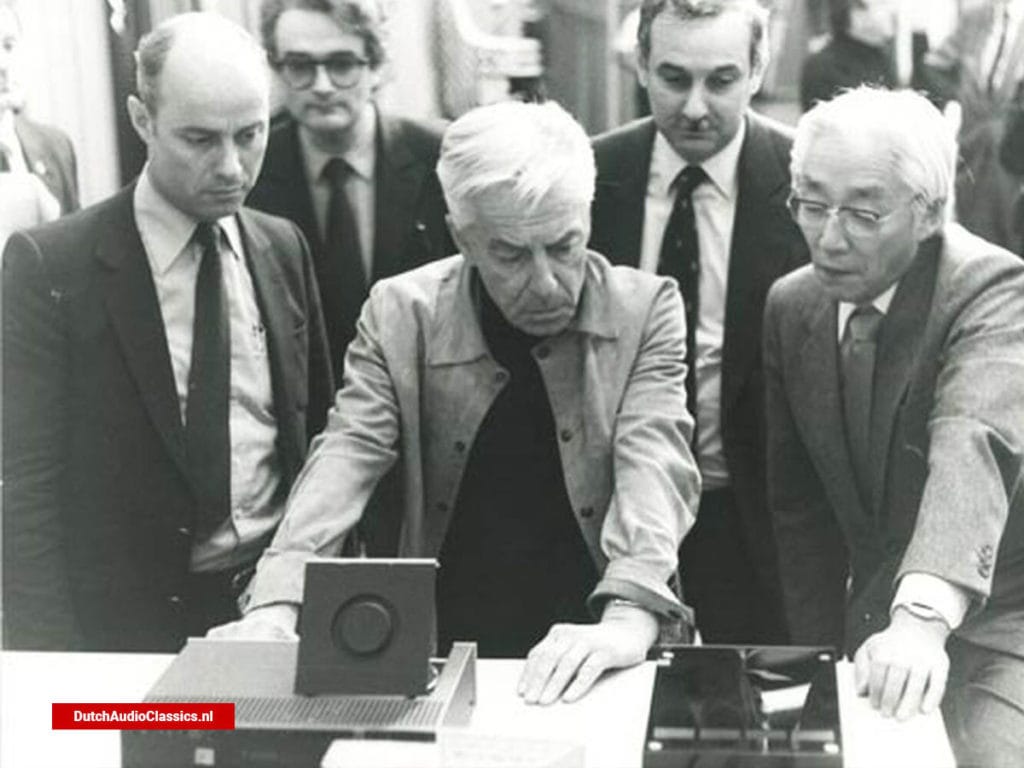
Where does the value of seventy-four minutes maximum CD length come from? The answer to the question has to do with Ludwig van Beethoven, and the story associated with the number 74 has become something of a curious legend in audio so it is worth reporting. Both Sony and Philips were aware that Herbert Von Karajan would be a crucial testimonial for the success of the new format they were working on. Even before the official debut, the legendary conductor had already magnified the gifts of the new technology in several interviews, agreeing to attend the press conference presenting the CD prototype that was to be held in Vienna (Fig. 10). Von Karajan had set a condition, however: that the new technology could allow listeners to hear Beethoven’s entire Ninth Symphony without interruption. The longest recording Sony could find was one from 1951 by Wilhelm Furtwängler, which was precisely 74 minutes long. There is another version of this story, however, which says that it was the president of Sony who insisted that the Ninth Symphony should go in its entirety on one CD. Whichever one is true, Beethoven’s last symphony underlies at least a couple of the technical features of the Compact Disc format (the other concerns the choice of sampling rate set at 44.1 kHz). Then there is a much less artistic and more commercial version of the same story that was revealed by an engineer on the Philips work team, Kees A. Schouhamer Immink, explained that his company was lobbying for the CD to be similar in size to the cassette tape, while Sony was pushing for a 12-cm disc, i.e., slightly larger, because they knew that Philips already had a factory that could produce 11.5-cm discs, and if they chose the 12-cm version as the industry standard, they would eliminate Philips’ competitive advantage in production. Eventually the maximum duration was set at 74 minutes and 33 seconds, allowing consumers to hear the entire Ninth Symphony without interruption. In fact, at least in the early years of production, the real limit for CDs was 72 minutes, not 74 minutes, as this was the maximum length of the U-Matic videotapes used to make the audio masters. Getting to put Furtwängler’s recording on a single CD would have to wait until 1997, when technological developments made it possible to overcome this final hurdle.
Epilogue: the evolution of digital audio
Compact disc almost totally dominated the consumer audio market until the early 2000s. Paradoxically, almost as it reached its maturity and thus in conjunction with the resolution of the technical issues that plagued its early years, developments in computer technology made it obsolete as virtually redundant. Responsible for this further transition was the digital audio file. Regardless of its format (.WAV, .FLAC, ALAC, .mp3 and many others), the audio file has enabled an epochal shift: untying the content (the music) from the container (the physical medium). In this new paradigm, the container is no longer there and the audio file becomes dematerialized. It is worth reflecting on the sonic/qualitative consequences of such a shift, beyond the commercial considerations to which we will return later. Over the past two decades, the cost of computer memories has fallen dramatically while the technical performance of digital devices has risen to heights never before experienced. These two factors made it possible to produce audio files of very high quality, albeit of enormous size. Put another way, it was finally possible to deploy the full power of digital audio once the barrier of the Compact Disc format whose technical specifications (44.1 kHz/16 Bit) had been determined by the technology available in 1979 was removed.
From a commercial or, if we prefer, distribution perspective, audio files have had devastating spin-offs: when combined with digital signal compression algorithms that greatly reduce their size, they can be easily transferred over computer networks generic (as attachments to e-mails) or based on specific protocols. This is what happened in the early 1980s: with the complicity of the simultaneous spread of the Internet, coupled with the rapid developments inhome computing, the phenomenon of illegal distribution of digital files (audio and multimedia) was witnessed. This phenomenon has been facilitated by peer-to-peer sharing technologies such as Napster and BitTorrent. Only Apple Computer’s introduction of the iTunes Music Store on April 28, 2003, along with the popular iPod portable media player, put a stop to the practice of illegal file-swapping and the resulting economic losses that had cast doubt on the very existence of the recording industry for some years. That shift, however, had at least a couple of important artistic consequences: membership in Apple’s Music Store required record companies to accept the idea of single-track sales. This started the phenomenon of artists releasing a single and then disappearing from the music scene. There was also less need for the large-scale recording project, given the fact that it was now common practice to release only one track at a time. On the end-user side, the practice of constructing music selections based solely on the criterion of relationship to the consumption occasion began to spread: thus was born the phenomenon of Playlists for running/studying/driving/meditating/working/etc. Finally, the habit of listening to these playlists on personal devices (first the iPod, later the smartphone, which will engulf it over the years) transformed the listening experience from a collective to a personal phenomenon.
Beyond the issues of copyright infringement, the development of digital audio has brought significant benefits to consumers and record labels. In addition to facilitating transfer and archiving, this technology has fueled the availability of so-called back catalogue titles stored in record label archives by making it possible to convert old recordings and distribute them digitally at a fraction of the cost of physically reissuing albums on LP or CD. Digital audio has also enabled significant improvements in the restoration and remastering of acoustic and otherwise pre-digital electric recordings.






GIPHY App Key not set. Please check settings