



 Audio 2G

Marantz is a fundamental part of the history of Hi-Fi audio. Its origins date back to the early 1950s in the United States, when Saul Marantz—a music lover, record collector, and self-taught designer—began creating equipment designed to meet the needs of the most discerning audiophiles. And here it’s worth telling a story within the story—that of Saul Marantz, who was essentially self-taught. In fact, he did not earn a college degree or a bachelor’s degree in electrical engineering. Due to his family’s financial difficulties, he had to drop out of school after the eighth grade (the equivalent of middle school) to go to work. He later took some art and graphic design courses at the Pratt Institute in Brooklyn, where he trained as an illustrator and commercial artist, but did not earn a degree. During World War II, while working for the Army Transportation Service, he earned his GED (General Educational Development), a U.S. diploma equivalent to a high school diploma. His knowledge of electronics was essentially self-taught. Even as a boy, he built crystal-set radios and other experimental devices, nurturing a passion that eventually led him to found Marantz.

Although he did not hold a degree in engineering, he possessed an extraordinary talent for electronic design, which led him, in the basement of his home in Kew Gardens, Queens, New York, to design a device capable of delivering superior sound quality and greater flexibility of use. That project, called the “Audio Consolette,” was so successful that it convinced him to turn his passion into a business. Thus, in 1953, the Marantz Company was founded. From the very beginning, the brand distinguished itself through a rigorously quality-oriented approach, with products designed without compromise and characterized by high precision in construction. Throughout the 1950s, the company introduced devices destined to become true icons of high-fidelity audio, such as the Model 7 preamplifier, the Model 8B power amplifier, and the Model 10B tuner
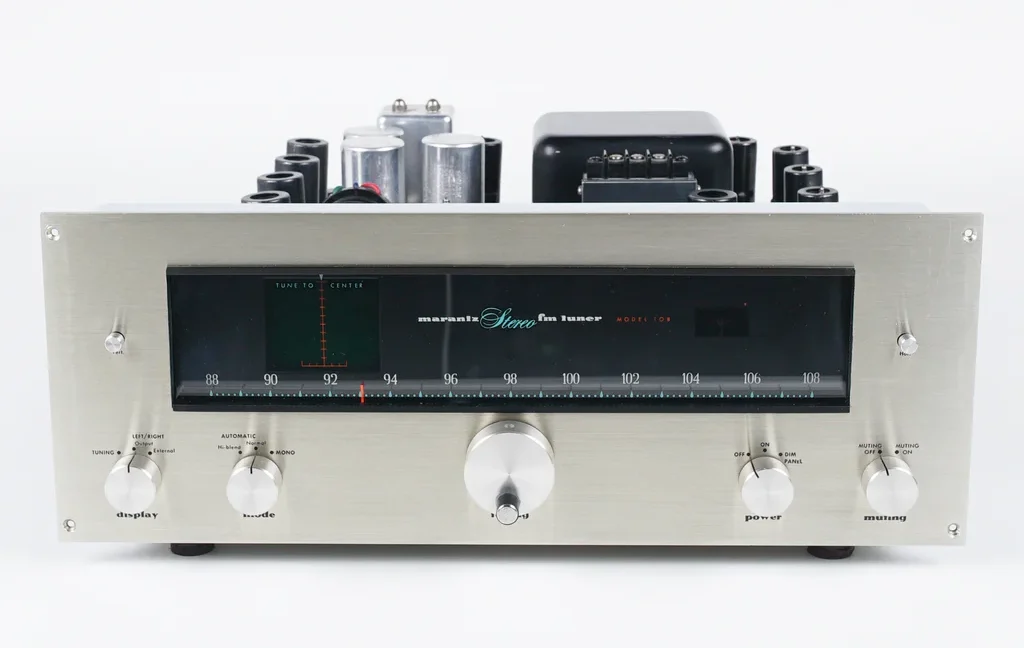
These components not only delivered exceptional performance for their time but also helped set the standards for modern hi-fi audio thanks to their innovative design and sound quality that is still considered a benchmark today. During the 1960s, Marantz solidified its international reputation, but the company’s growing expansion required increasingly substantial investments. In 1964, Saul Marantz decided to sell the company, while continuing to collaborate with it. Ownership passed to Superscope Inc., an American company that initiated a phase of strong commercial growth while maintaining a focus on the brand’s quality. It was precisely under Superscope’s leadership that, in the late 1960s and especially in the 1970s, Marantz experienced one of the most celebrated periods in its history. Production also expanded to Japan thanks to a partnership with Standard Radio Corporation, which would later become part of Marantz Japan. Those years saw the creation of some of the most famous stereo receivers of all time, characterized by elegant blue-illuminated tuning dials, brushed aluminum front panels, and extremely robust construction. Models such as the 2230, the 2270, and the legendary 2600 are still highly sought after by collectors today and represent the brand’s classic image

In the 1980s, the audio market underwent a profound transformation with the arrival of digital technology. Marantz actively participated in this evolution by investing in the development of Compact Disc players, often in close collaboration with Philips, which had since become one of the company’s major shareholders. This collaboration enabled Marantz to produce CD players that were acclaimed for both their reliability and musical quality, contributing to the widespread adoption of the new digital format without compromising the sound philosophy that had always distinguished the brand. During the 1990s, Philips acquired full control of Marantz, integrating it into its own audio division. During this period, the brand continued to develop amplifiers, CD players, and home theater systems, strengthening its presence in both the traditional hi-fi sector and the multichannel home entertainment sector. Ken Ishiwata, an engineer and brand ambassador for over forty years, played a pivotal role in the company’s recent history. Having joined Marantz in the late 1970s, Ishiwata helped refine numerous products through meticulous work to optimize components and circuitry.




GIPHY App Key not set. Please check settings