



 Audio 2G
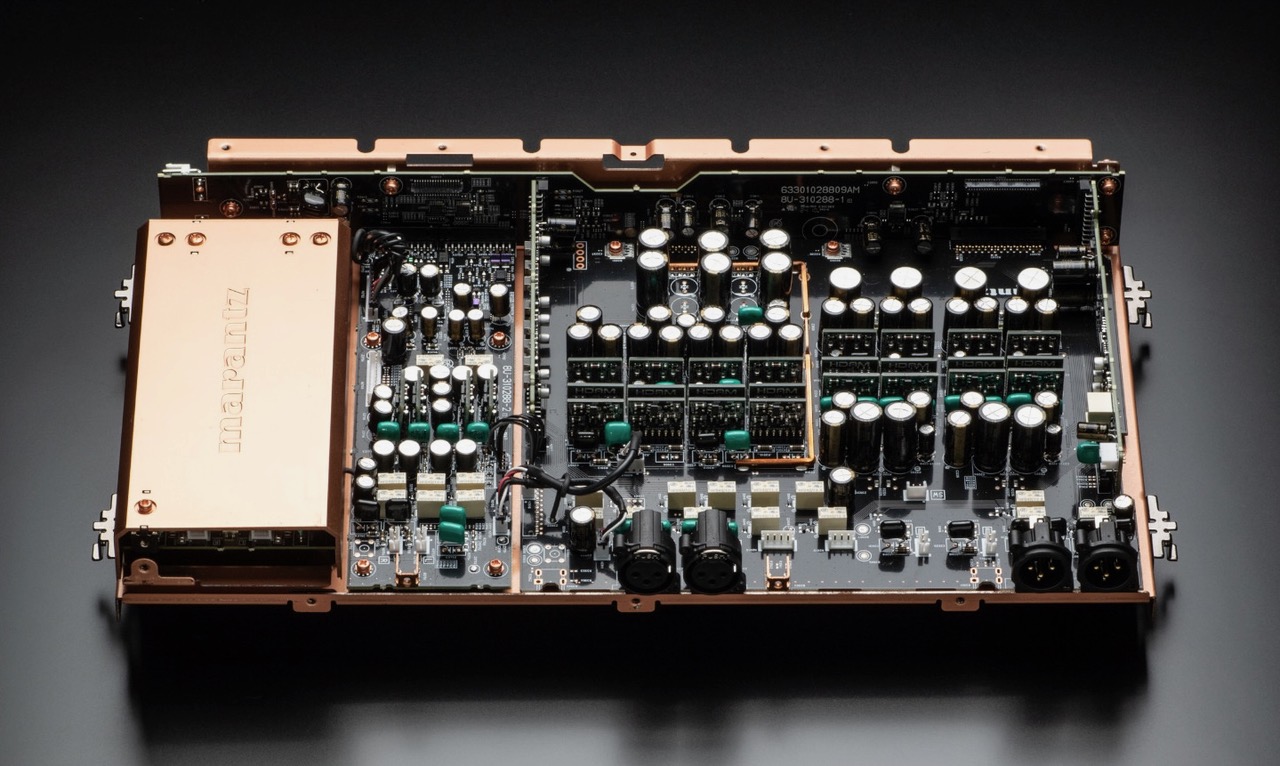
The acronym HDAM stands for Hyper Dynamic Amplifier Module and refers to a family of discrete circuits developed in-house by Marantz in the early 1990s. At a time when much of the audio industry had already adopted increasingly sophisticated integrated operational amplifiers, the engineers at the Japanese company decided to take a radically different approach. The underlying idea was as simple as it was ambitious: to replace a monolithic integrated circuit with a small amplifier built entirely from selected discrete components, mounted on a dedicated board, and optimized exclusively for audio applications. From an industrial standpoint, this was an uneconomical choice. A modern operational amplifier integrates hundreds of perfectly matched transistors into just a few square millimeters, offering excellent performance, lower costs, and high production repeatability. A discrete module, on the other hand, requires dozens of components, a significantly larger area on the printed circuit board, longer assembly times, and a much more complex design. For Marantz, however, the ability to fully control the circuit’s behavior was such a significant advantage that it justified this increase in complexity.

Unlike an integrated operational amplifier, in which the designer can only adjust the external feedback circuit, an HDAM module allows the designer to define every single parameter of the signal path: bias, quiescent current, input impedance, drive capability, response speed, bandwidth, frequency compensation, and stability with complex loads. The result is a circuit developed specifically for that particular application, rather than a general-purpose device adapted for audio use. Over the years, HDAMs have undergone numerous evolutions. The first modules, used in CD players and preamplifiers of the 1990s, were already characterized by a fully discrete design, but subsequent generations have progressively improved speed, noise floor, and linearity.

With the Premium series and subsequently with the Series 10 project, the latest HDAM-SA3 family was introduced, in which the entire layout was redesigned to operate within a fully balanced architecture. Perhaps the most interesting aspect is the slew rate: the maximum speed at which the output voltage can follow a change in the input signal. When this parameter is not sufficiently high, the fastest signal edges are inevitably smoothed out, introducing a form of dynamic distortion that—though difficult to measure with traditional sinusoidal tests—can affect the naturalness of musical reproduction and thus be extremely noticeable to the listener. HDAM modules were designed specifically to maximize this parameter, thanks to the use of high-frequency discrete transistors, extremely short signal paths, and a higher current-delivery capacity than is typically available in commercial integrated circuits.

Of course, this does not mean that an HDAM is automatically better than a modern audio operational amplifier. Over the past twenty years, devices such as the OPA1612 from Texas Instruments, National Semiconductor’s LME49720, or the MUSES developed by New Japan Radio have achieved exceptional performance levels, with noise, distortion, and linearity often approaching the limits of measuring equipment; however, the difference lies in the design approach. An integrated circuit inevitably represents a compromise designed to satisfy thousands of different applications. An HDAM, on the other hand, is created exclusively for use within Marantz equipment, allowing engineers to optimize every parameter in accordance with the product’s overall architecture. More than thirty years after their introduction, they continue to represent not so much an alternative technology to modern operational amplifiers as a testament to a specific design philosophy. Marantz continues to believe that the analog stage should not simply be purchased from a semiconductor catalog, but rather designed, optimized, and tuned as an integral part of the sonic identity of its equipment.




GIPHY App Key not set. Please check settings