


 Audio 2G

The Audia Flight FLS10 Integrated Amplifier was sent to us by the kind owners of the brand from Civitavecchia, just outside Rome, shortly after our meeting during the 2025 Monaco High End. On that occasion we had posted on the Audio 2-G YouTube channel a short in which we showed the Flagship Instrument No. 8 Signature amplification. In this test we deal with an interesting integrated amplifier, with a decidedly more affordable price, but still characterized by a design and construction approach with a clear High End approach.
Audia Flight
Audia Flight was founded in 1996 by Massimiliano Marzi and Andrea Nardini. All products are entirely handmade at the company’s headquarters in Civitavecchia, just over 70 kilometers north of Rome.
Starting from the belief that a component should not alter the electronic signal, the two owners devoted two years (1994-1996) to the research and development that would form the basis of all components made over the following years. The research began with the realization that the traditional voltage feedback approach to circuit design, with its limited ability to handle high-speed transients and complex loads, tended to alter the electronic signal and thus introduce inaccuracies. This led to the design of a circuit based on the current feedback approach, which allows faster response speed and better load control, thus producing a more accurate signal.
In 1997, Audia Flight launched the first version of the Flight 100 power amplifier, which was well received by critics and customers. Soon after, Audia Flight introduced the Flight Pre and the Flight 50 power amplifier, achieving similar success. The Flight Pre in particular featured a sophisticated multiple-section cabinet design and a constant-impedance volume attenuator to achieve accurate frequency response at all volumes. In 2001 Audia Flight introduced its first integrated amplifier, called Flight One, which integrated many of the design solutions found in the Flight Pre, Flight 50, and Flight 100 amplifiers. Today the product line includes the Classic Series, the Three S Series, the FLS Series, and the Instrument Series, i.e., the flagship series.

Exterior
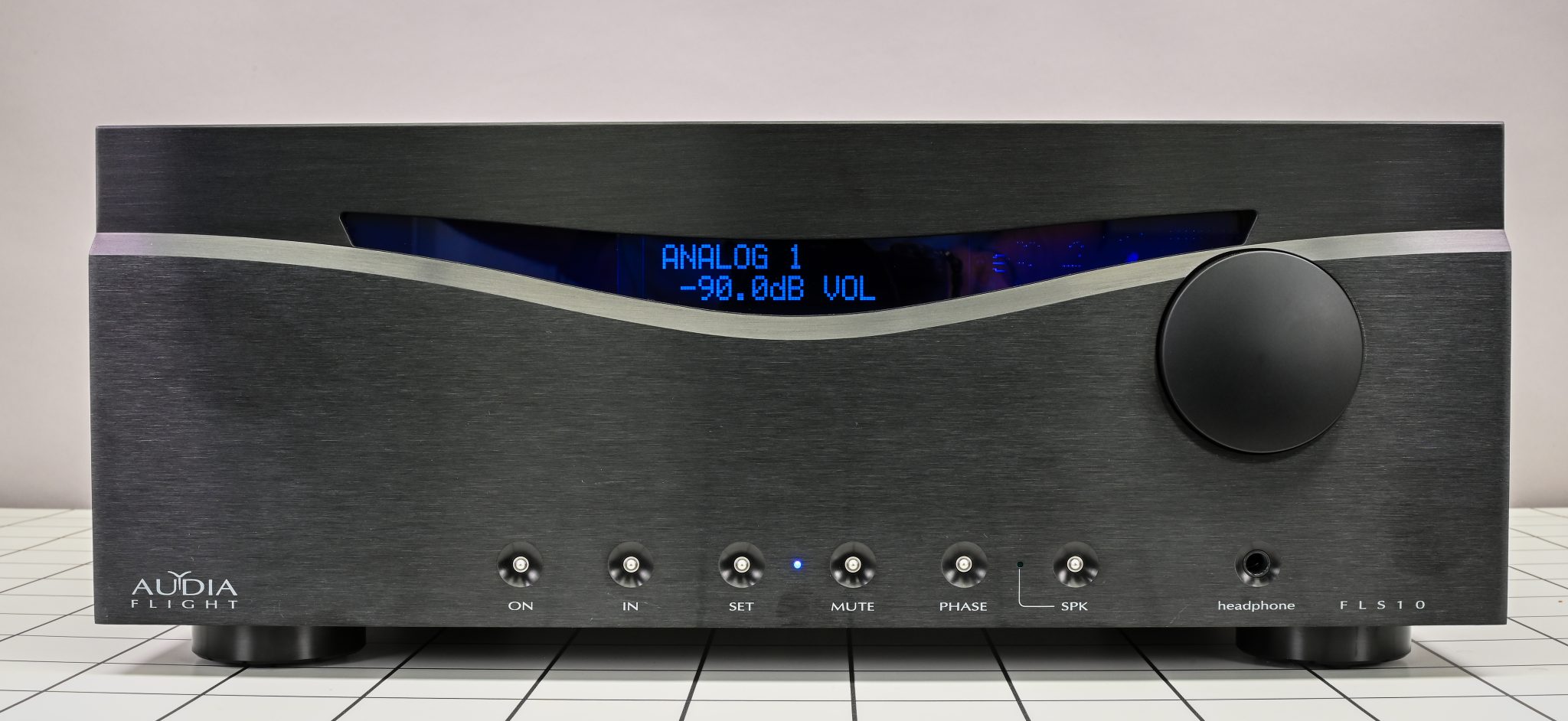
the Audia Flight FLS10 integrated amplifier, for several reasons cannot and will not “hide” and/or disguise its presence in the listening room. Its 36 kilograms of weight implies the need for a sturdy electronics stand table, as well as the need for at least two people to remove the amplifier from its packaging and place it in position. The two large heat sinks that occupy the entire sides of the unit also require leaving it a good amount of space to ensure adequate air circulation. I appreciated the solution devised by the manufacturer for implementing the radiators, which, although external, are covered on the top and bottom. This way, they are not annoying when moving around and are also less visible, which benefits aesthetics. I suppose the chimney effect is slightly affected, however, the lower and upper panels bordering the fins are a good 7 millimeters thick aluminum and complement the radiant surface. Note that the heatsinks have a corrugated section, which increases their efficiency, with the end result that the FLS10 integrated amplifier is unlikely to offer surfaces with temperatures above 50 degrees to the touch. The cabinet has no visible screws: to fasten the top panel, on which the manufacturer’s logo is engraved in large size, long welded metal elements bearing at the end a thread on which a bolt is engaged and pulled from the bottom. This is just one of many possible examples to tell of the excellence of construction that emanates from this amplifier, which is truly superbly constructed. Even the front panel, in its simplicity, stands out for its elegance: a sort of “Wave” motif, positioned about two-thirds of the way up from the bottom, runs through it from side to side. Immediately above it we find a shaped slit that houses the blue-character OLED display. The multifunction rotary encoder, which also plays the role of volume control, is recessed on the right, while a theory of small buttons is located near the bottom edge. The overall aesthetic result is that of a device that unmistakably conveys solidity and strength combined with austere elegance. Moreover, something that I personally greatly appreciated, the image of the Audia Flight FLS10 is entirely consistent with that of the rest of the production of this manufacturer, including the models of the Strumento series. As far as the finish is concerned, you can choose between silver or black; in either case, the ability to blend in with the decor of the room that houses it will probably be modest given the personality of this amplifier which, for the reasons just stated, certainly does not tend to blend in.
Operations
the Audia Flight FLS10 integrated amplifier is simple to use in everyday operation, however, I found the need for some extra attention in the setup phase. This is largely due to the use of softkey controls, which means that their effect depends on the function set beforehand. For example, the rotary encoder located on the right basically controls volume, but pressing the “In” button can sequentially select inputs (provided this happens within 5 seconds). The “Set” button, on the other hand, acts on programmable settings, such as the differential gain of an input (up to ±6 dB), its name, whether it is in use or not, whether to use it in “direct” mode (to integrate the amplifier into a multichannel system), whether to disable the infrared receiver, and what attenuation to use for muting (full or -30 dB). Also available from the front panel are direct controls for absolute phase inversion and speaker connection. Perhaps because of the small size of the input/function buttons, which require delicate fingertip action, I found control of the unit not exactly straightforward. It’s probably just a matter of getting used to it, as is always the case with interfaces that diverge from established standards. In any case, the handsome metal remote proves to be quite functional, with a more responsive volume control and additional options, such as the left/right balance setting, that are not accessible from the front panel of the FLS10 itself.
As for the display, I found the choice of lettering nice, with the large blue lettering on a black background evoking 80s memories, reinterpreted with OLED technology. In any case, it is large and clear enough to be seen from a distance when using the remote control, thanks in part to the brightness adjustment feature that proved particularly useful. The only caution is to stand roughly on axis to read it, otherwise the large “eyelash” above it prevents it from being read when viewed from above.

Audia Flight Integrated Amplifier:Construction
Based on the Audia Flight FLS4 power amplifier operating in Class A, the Audia Flight FLS10 integrated amplifier is a Class AB capable of delivering 200 W into 8 ohms, equipped with extensive connection options. On the rear panel we find two unbalanced RCA outputs and a balanced XLR preamp output, along with a headphone jack located on the front panel. Five inputs are then available, including three unbalanced RCA and two balanced XLR. In the basic configuration the FLS10 is an analog line amplifier. However, it should be noted that there are two slots on the rear panel for the installation of optional expansion boards, which provide additional functionality: a MM/MC phono board (€1,350), a DAC board equipped with its own power supply and compatible via USB with PCM signals up to 768 kHz and DSD up to 5.6 MHz, and with additional digital inputs, including S/PDIF in coaxial and optical formats (€ 2,250). And again a DAC/streamer card (€ 4,000) and finally a card that offers two additional RCA or XLR inputs (€ 600).
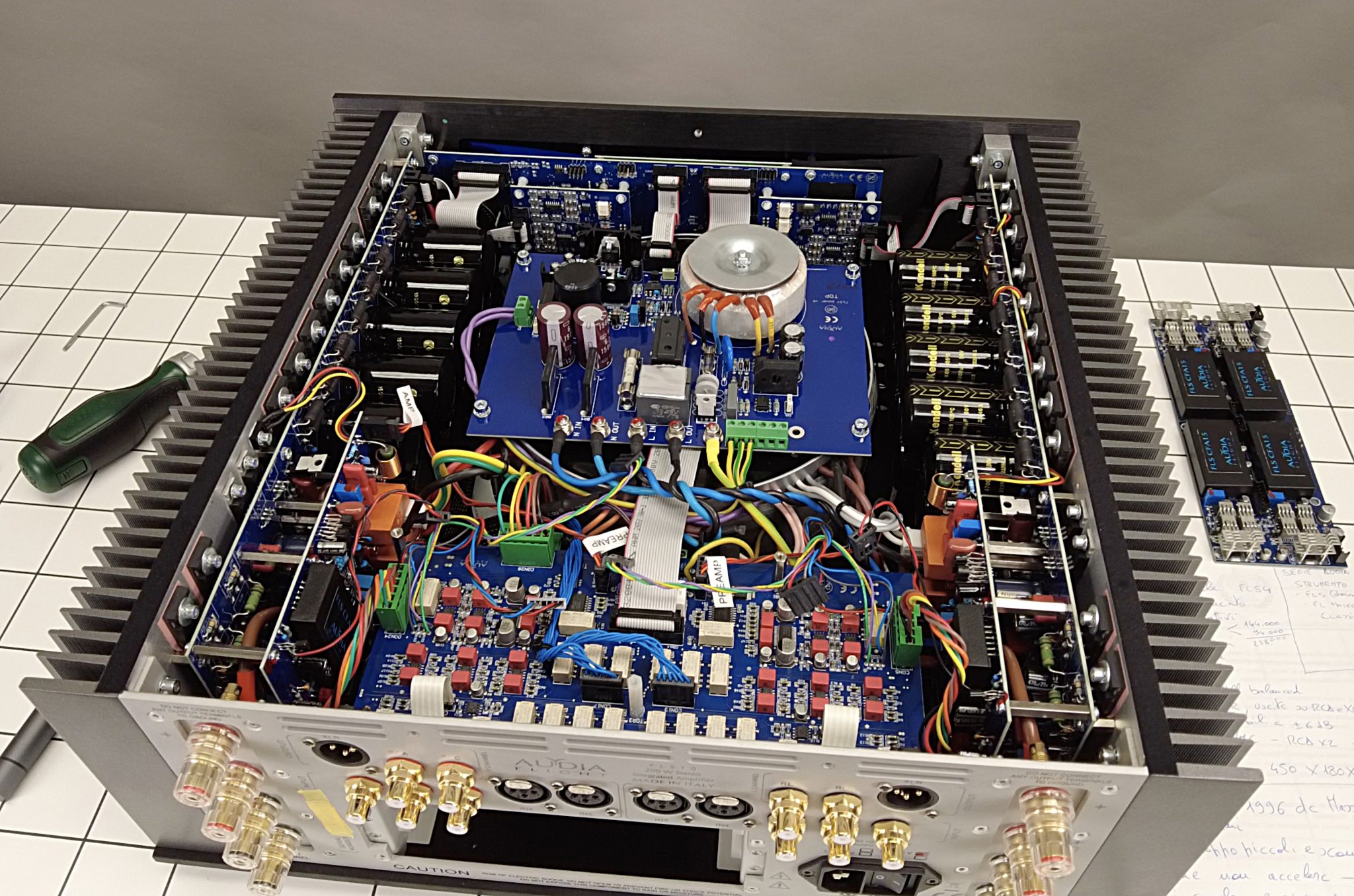
Once the top cover is removed, one is impressed by the sheer size of the gigantic 2-kilowatt toroidal power transformer and 12 secondaries, including power transformers for individual channels, embedded in resin to cut down vibrations and magnetically shielded. It is obvious to assume that a substantial part of the 36 kilograms of the total weight of this integrated amplifier can be attributed to the transformer. The capacitors used (288,000 µF for the power amps alone) are of high quality. The preamplifier section is located close to the rear panel and four “Current Feedback Gain Modules” embedded in resin stand out on it, initialed FLS CFA 15. Of these modules there are four more in the two power sections. The amplifier is a dual mono balanced from input to output and therefore the volume control is also balanced. The chip on which it is based is the Muses 72320, which we have already encountered in several realizations tested on our Audio-2G.com Channel. The power sections of the two channels, placed vertically and in contact with the side heatsinks, are in a “bridge” configuration, thus consisting of two amplifiers operating in counter phase. The active power devices are bipolar, that is, 8 pairs per channel of MJL3281/1302.
Audia Flight integrated amplifier: listening
Sometimes – not always, for goodness sake – it happens that one can infer the sonic characteristics of an audio product from its appearance. This is not the case with the Audia Flight FLS10 integrated amplifier. In spite of an image that conveys strength and power, on listening test the Civitavecchia integrated revealed a fine musician’s sensitivity. Of course, when it’s time to show its muscles, it doesn’t back down: the kick drum of Mike Portnoy of Dream Theatre on the opening track of A Change of Season is mighty, as are the timpani of the Chicago Symphony Orchestra conducted by Muti grappling with G. Verdi’s Messa da Requiem. But when I turn to Max Richter’s On the Nature of Daylight , I realize that the strings, and particularly the solo violin, are offered with a delicacy, a finesse, a resolution that touches the soul. The quietness and resolution are at the highest level, which allows one to enjoy this beautiful track from Heard On Tour 82024) . Of course, such an amplifier must be accompanied by equal partners; in this specific case it was Vivid Audio’s Kaya series speakers model 90 – floorstanding with 4+4 woofers – and S12, a very refined standmounter with a record-breaking spatial reconstruction capability. As a digital source we used the Playback Design MPD-8 DAC connected to the Antipodes Audio K30 server/player (G4 upgrade), all wired AudioQuest Mythical Creatures and, limited to USB, Mad Scientist Black Magic Ultra. The unit we were sent was not equipped with option cards, so we are unable to report anything with respect to the internal DAC or phono preamplifier. Returning to the Audia Flight FLS10, therefore, we can reiterate that the aspect that convinced us most is precisely its articulate and multifaceted sonic personality that allows it to deal with whatever musical material you feed it with absolute authority and ability to extract the best from the recorded material. This is to say that even the less “successful” recordings, those that in short have some flaws, still come out nicely. Such products, regardless of the market segment they go into, are not many. I can think of another high-end integrated amplifier that we tested some time ago that could be considered a possible competitor to this Audia Flight: the Vitus Audio Ri 101 MK II. In both cases, these are Class AB solid-state amplifiers, equipped with all the power needed to drive any speaker to the fullest and, what is most important to me, endowed with fine musical sensitivity. This implies that the person who designed them, in addition to being an outstanding technician, is also a fine music lover. Of the delicacy of the Audia Flight FLS10 I was confirmed by the effectiveness with which K. Jarrett’s delicate touch was portrayed in the closing track of the recent New Vienna (Live), Somewhere Over the Rainbow . I then move on to the vocals with the chiaroscuro of And I Think of You, taken from Luce with D. Rea at the piano, where the interaction between the two artists is reproduced in an absolutely fascinating way.
Conclusions
Audia Flight FLS10 integrated amplifier Audia Flight FLS10 reintroduces the old-but still relevant-question, “What else might I need in audio?”
As I listened to it I was thinking about how much joy a music machine like this can give without forcing its owner to deal with all the complexities that high-end audio inevitably brings. A source, a pair of speakers up to the task, and this amplifier. There you have it, a Super System that can last for years and provide endless excitement.
At my age, with the onset of nausea from Hyper Audio Complexity, I am beginning to think about it….
Giulio Salvioni
Declared technical specifications
- Output power per channel Wrms: 200/380/700 (8/4/2 ohms)
- Inputs: 3 unbalanced (RCA), 2 balanced (XLR)
- Outputs: 1 unbalanced (RCA), 1 balanced (XLR), 1 unbalanced REC (RCA)
- Gain range: -90dB / +10dB
- Gain resolution: 0.5dB
- Frequency response (-3dB): 0.3 Hz ÷ 500 KHz
- THD: < 0.05 %
- S/N ratio: 110 dB
- Input impedance: 47 Kohm
- Damping factor (at 8 ohms): > 650
- Main voltage AC (50-60Hz): 100, 110-115, 220-230, 240 V
- Standby power consumption: less than 1 W
- Power consumption (200W RMS @ 8 Ohm both channels): 840W
- Dimensions and weight 450x180x440mm (W x H x D): 36kg
Price: €12. 200.00
Manufacturer: Audia Flight Via Alfio Flores, 7 – 00053 Civitavecchia (RM)
Tel. +39 0766 561403
email: info@audia.it




GIPHY App Key not set. Please check settings