



 Audio 2G
Douk Audio is part of the world-universe of Nobsound, a very large Chinese company that basically produces first-price products, mainly tube amplifiers. The catalog is extensive and distinguished by originality both in design (the

The idea behind the Q11 is fascinating. The device allows you to choose between two digital-to-analog converters: the ESS9038Q2M and the AK4493. In theory, one can thus modulate the sound character according to the music genre or one’s preferences. It is a concept that promises flexibility and customization, but in practice the differences between the two DACs turn out to be less pronounced than they should be, and this will allow us to make many other considerations. On the technical side, the Q11 is flawless, with impressive claimed data: a signal-to-noise ratio of more than 117 dB and a total harmonic distortion of 0.0003%. It supports PCM streams up to 32 bits and 384 kHz, as well as DSD256 playback. Connectivity-wise, Q11 has optical, coaxial and USB inputs, and offers four separate outputs, two RCA and two on 3.5mm mini-jack. It adapts easily to a variety of contexts, from desktop DACs to the most sophisticated systems, with intuitive operation even though there are few setting options, suffice it to say that there are no selectable filters for the two DAC chips. The OLED display is dual and in common with other Douk products, the left one gives indications of sample rate, volume (not excludable, must be set to maximum to achieve bypass) and status, the right one which DAC is selected. The large knob on the front lets you select the input, turn on/off, and of course adjust the level. The supplied remote control is the usual one we have seen in many other implementations, small but nonetheless and effective.
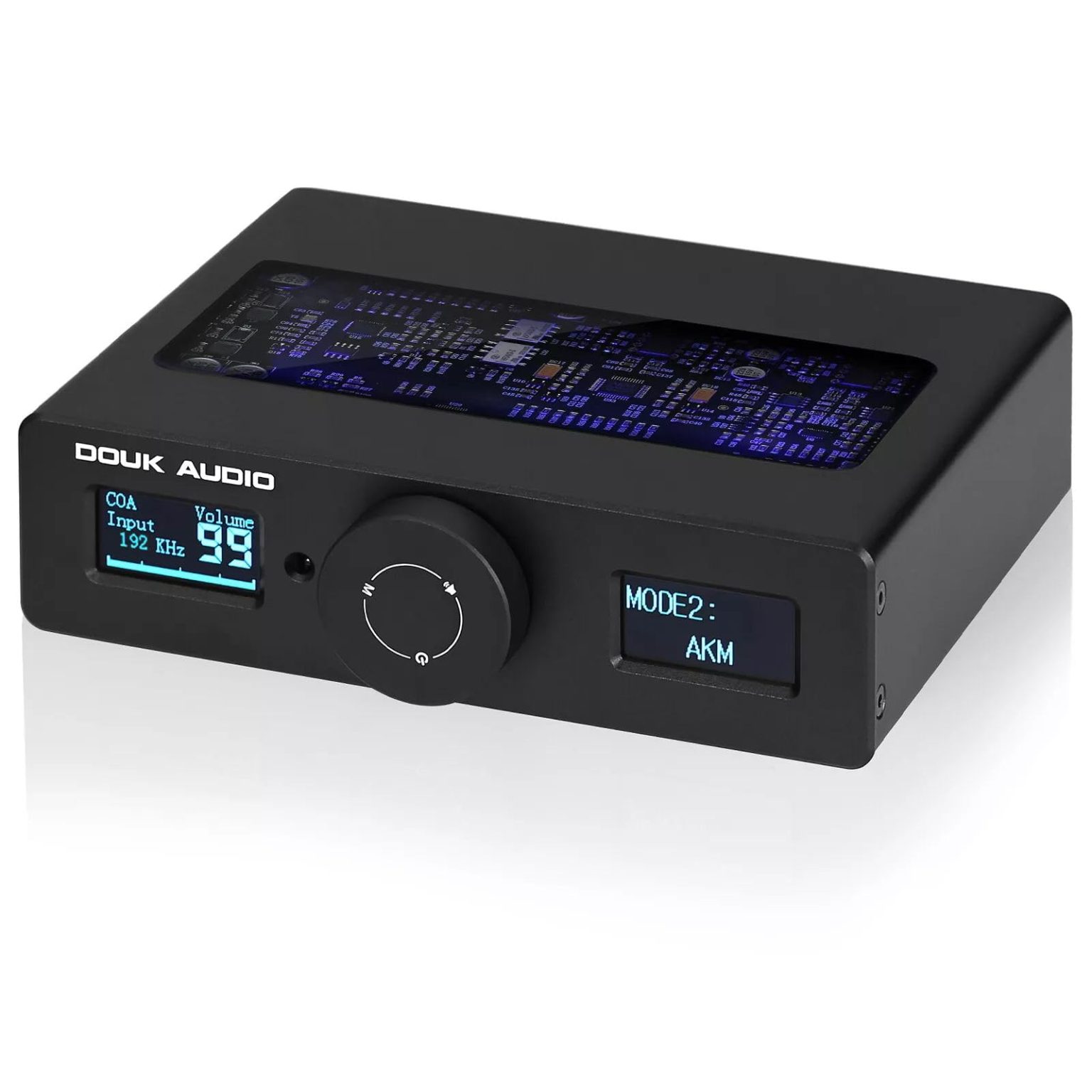
Aesthetics is undoubtedly one of the strong points. The body is CNC machined aluminum with an anodized finish and clear plastic top panel hints at the circuits illuminated by three light blue LEDs that diffuse light in a very unobtrusive way. The dual RCA/Minijack audio outputs are connected to the two DACs, and it is possible from set-up to choose whether to use both for ESS, AKM, or the first ESS and the second AKM, so, in this case, you can listen in real time (if you have a preamp with two free inputs) to the difference between the two DACs. The mini-jack outputs more suitable for plugging in an amplifier than headphones, given the output voltage of 1.8V with the AKM and 2V with the ESS, which also does not recommend direct coupling to a power amp. It is possible to change the output op-amps, supplied the LM49720, excellent products, which can be replaced with some others, one option could be OPA2134, but without an absolute guarantee of improvement.
Listening
The dual switchable DAC concept is undoubtedly a bold and original step, but its practical application seems to represent more of an exercise in style than a real benefit. Douk Audio Q11 is a converter with an overall neutral character, but lacking the liveliness and depth one might expect. The first impression is of a correct but rather flat sound, with restrained dynamics and a soundstage that tends to remain compressed between the speakers. The
Technical characteristics:
- Inputs: PC-USB/Coaxial/Optical
- Outputs: 2X RCA / 2X 3.5mm minijack
- DAC chips: ESS9038Q2M+AK4493
- Maximum frequency supported: PCM 32bit / 384KHz DSD256
- PC-USB: W7/W8/W10/MAC/Linux
- Frequency response: 20Hz-20KHz (±0.3dB)
- Distortion THD+N: 0.0003%@1kHz
- Signal-to-noise ratio: ≥117dB
- Output voltage: AK4493:1.8V, ESS9038Q2M:2V
- Supply voltage: DC 12V≥1.5°
- Dimensions: 155X125X42mm
- Weight: 590 grams
Price: €149
Builder: Room 1329, Wangcheng Building, Qinghu District, Longhua Street, Longhua New District, Shenzhen.




GIPHY App Key not set. Please check settings