



 Andrea Allegri
One of the great unsolved mysteries of other fidelity, at least for yours truly, is the numbering assigned to JBL models. For more than eighty years, in fact, the U.S. manufacturer has been using seemingly indecipherable number sequences, seemingly unrelated even to possible technical reasons. One guesses that current monitors have a 43 while the high-end Summit series has a 9. The rest, however, seems like a trifecta of eight or at best a trump if we wanted to play 43 and 9 (on the wheel of Northridge – California, mind you), as we are about to learn about the JBL 4309, the smallest passive Studio Monitors.
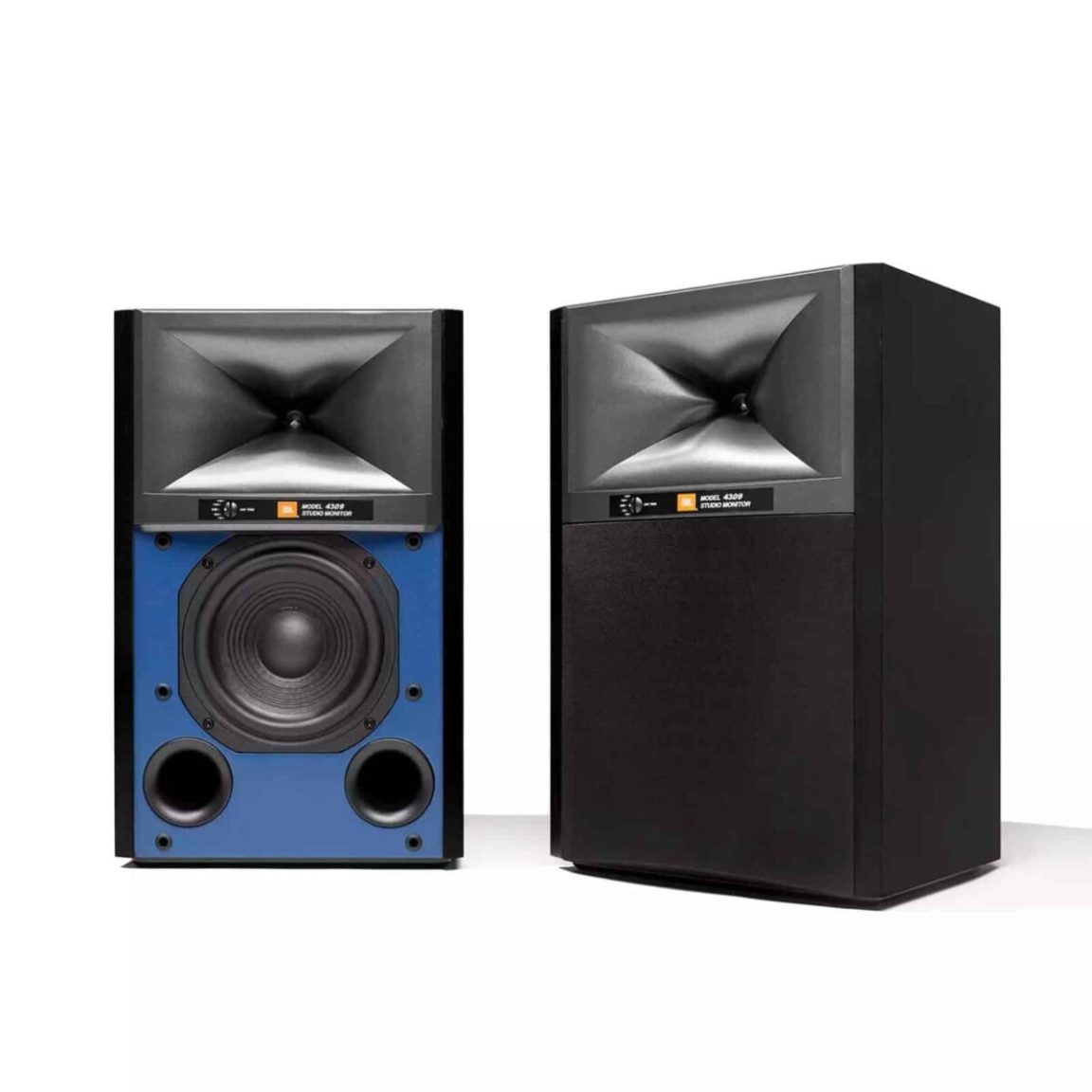
Blue and Horns - The Tradition of American Monitors.
Few products manage to combine historical identity and design consistency like California speakers. Whether white woofers or blue fronts, JBL monitors are always easily identifiable, something that even those who are not “devotees” of high fidelity can recognize at a glance. In the case of the 4309s we do not have the aforementioned white woofers but a more conventional black paper cone. There is a blue front panel, though. The system is a two-way bass reflex (read if you want our in-depth bass-reflex vs. enclosed box here) with dual front ports. The upper driver is horn-loaded whose opening occupies almost the upper half of the front panel. The remaining part, where the 6.5-inch midwoofer and the two reflex ports are housed, is instead a panel of the classic JBL blue that it is almost a shame to cover with the grille, at least in the version with the elegant black finish that has the grille to match while in the walnut version the canvas is blue. The proportions are those of a parallelepiped that is wider than it is long, contrary to the theory of narrow front baffles, but seeming to respect the famous 1.62 golden ratio. The horn is evidently a defining element for both the eye and the ear. It is made of rigid plastic material and has a special shape called HDI (High Definition Imaging) derived from studies done in Northridge labs. The Harman Group team of researchers has been promoting the concept of dispersion as evenly as possible for years. In fact, according to them, it is not enough for the speaker to have linear frequency response on axis, it must have it as much as possible off axis as well. This is because from our seat we hear not only the direct emission but also a part of sound reflected from the environment, for example from the side walls that are affected precisely by the off-axis emission of the loudspeaker. In Harman, they have developed a compound measurement, called “Spinorama” (now increasingly regarded as a standard survey even by competing manufacturers) in which the loudspeaker is analyzed from different angles as a function of room reflections. The application of this concept on horn loading thus led to the shape we see in the HDI drivers, now employed on several JBL lines but derived from the professional M2 Master Reference Monitor system. A few years ago I had the opportunity to visit the Harman research center in Northridge and realize how this very speaker was considered a reference in many of their rooms or laboratories.

The HDI horn profile is applied to a 2410H-2 compression driver equipped with a one-inch diaphragm made of Teonex®, a polyethylene-derived material with excellent mechanical and chemical properties. The compression driver is evidently a choice derived from JBL’s professional DNA, which is applied here not so much to have high efficiency (the speaker does not exceed 87 dB sensitivity) as to achieve a certain dynamic performance of the speaker. Such a transducer also allows a relatively low crossover with the midwoofer at 1.6 kHz. Speaking of crossovers, the crossover board is located inside the rear panel, right at the treble unit, which is difficult to inspect without risking damage to the speaker. On the bottom edge of the horn is a high-frequency level control, useful for compensating for room output or balancing with other components in the audio chain. The rotary switch, a sort of thumbscrew that can be operated with a coin, for example, has five positions, the one for flat output plus two in attenuation and two in boost in fairly fine 0.5-dB steps. The mid-bass part is handled by a 6.5-inch midwoofer with a pulp cone and rubber suspension. The magnet assembly is of considerable size and has a large decompression hole at the bottom. The basket is made of die-cast aluminum and has a streamlined design with arms placed in pairs arranged at 120 degrees to each other. It has no special ventilation openings at the collar level where the magnetic assembly attaches reason why it is impossible to “peek” inside to see the coil. The speaker is branded JBL and manufactured by Eastech, a Chinese OEM giant that also owns Scan Speak A/S.

The reflex ducts have a length that also takes advantage of the vertical development of the cabinet by making a ninety-degree bend internally and thus reaching about twenty-five centimeters, an extension that is impossible to achieve linearly since the depth of the cabinet is twenty-three centimeters. Both the outer and inner ports are flared to reduce turbulence, and the duct splitting rather than the single opening also plays an effective role in this direction. Thanks to the positioning of the openings at the front, it is possible to place the speakers close to the back wall, which indeed, as we shall see in the listening test like to be placed with their “backs to the wall.” The cabinet is made of MDF nearly two centimeters thick, with open internal stiffeners (H-bracing) located at the lower edge of the horn. It appears solid and well damped and is filled with medium-density absorbent material. On the rear panel we find a conventional terminal block, a plastic tray, and gold-plated, non-isolated contacts set up for bi-wiring or bi-amping. The cabinet has a thin stand base, about an inch thick and chamfered along the edge, which weighs down the bottom of the speaker and raises it slightly off the stand surface.

Listening - Small monitors, great satisfaction
The test period took place in the home environment, thirty-square-meter average treated room and 60-centimeter stand as recommended. Different available amplifiers (Anthem MRX720, WiiM Amp Ultra and Arcam A15+) were used to understand what the behavior was under different driving. The JBL4309s showed that they liked quite energetic conducting; they are in fact horn speakers but not exactly high efficiency. Those who would choose them believing they could be matched with low-power amplifiers would be way off the mark. They are dynamic and generous but need good power to perform at their best. The 4309s easily show muscle and their undoubted character if the amplifier is up to the task; some eighty robust watts is, in my personal opinion, the advisable minimum. It seemed congruous to match the Arcam A15+ both energetically and timbrally. The timbre of the 4309s is forthright and appreciably open, not without some characterization in the mid-high range that, however, often goes unnoticed thanks to the other qualities on the side. Prominent among them is the rendition of the lower register, which is catchy and substantial and will appeal to those who like a solid sound. The bass actually has good depth and stands out more for its presence, as well as its feeling of control, than for its descent into “infrasound.” Drivers of this size physically cannot compete with larger gauges, but the designers here have really made the most of the midwoofer’s gifts and its strength while also dosing the contribution of the reflex emission, which appears well integrated. In top JBL systems I have always liked the speed in transients and the ability to transmit a lot of energy to the room, always provided the amplification was adequate. The 4309s perform in proportion and can give considerable involvement despite their compact size. I wanted to listen as the first track to Tracy Chapman’s “Fast Car,” from an album that they consider at Harman to be perhaps the most discriminating after the tests they have done employing different samples of listeners. Effectively with this track the speakers performed flawlessly showing credible vocals, with completely marginal midrange inflections. The overall listening was made enjoyable by the guitar, detailed and rich in harmonics, and the assertive drums. The bass then appeared initially legato but loosened up fairly quickly, briefly demonstrating its authority and good articulation.

Although I have never found it appropriate to classify a component as suitable for a specific genre I must say that these American speakers have a certain feel for rock. Van Hallen’s “Ain’t Talking ‘Bout Love” exceeded the expectations I had about a stand-mounted speaker with bright, direct electric guitar, whose effects and distortion do not distort even when turning up the volume beyond what is permissible. I then found really compelling listening to Massive Attack’s “Mezzanine,” an album made spectacular at times almost as if it were a floorstanding system. The record is particularly dense in the low end, a sound that fits well with the characteristics of the 4309s, who managed to convey a tight rhythm and deep hits, appropriately recreating the dark and ominous atmosphere that, for example, pervades “Angel.” The album’s sometimes dirty, sometimes bright sounds were brought out perfectly. The monitor setting allows them to be revealing and sincere while simultaneously tending to place sounds and instruments on one plane. The scene, therefore, is more inclined to advance toward listening rather than to develop in depth, especially if one wants to take advantage of the reinforcement at the bottom of the back wall. It is necessary for this to choose well the geometric dimensions of the speaker-listening point triangle and to dose the distance from the wall so as to exploit the undoubted potential of these speakers. Otherwise, it is easy when seeking a certain ambient “breath,” both in width and depth, as in classical music, to find oneself watching the performance almost on the podium rather than in the tenth row. It is a matter of taste as well as habit to perceive the performers at close range. It happened to me, for example, listening to Anne-Sophie Mutter in Beethoven’s Violin Concerto conducted by Karajan, finding the soloist closer than I was used to with other systems and aligned with the rest of the orchestra, also aided by the dry setting of the recording. Even with the classical, the California speakers were consistent with their monitor disposition also in terms of timbre, showing vivid and precise instruments.
Conclusions - JBL: Always Winning Numbers.
If the numbering is a mystery, it is instead easy to understand why JBL is a staple for many fans. Without bothering the great systems of the house even in a compact realization like this one we find the characteristics that have made the American manufacturer famous. In an increasingly standardized world there are still those who make things by continuing development and research in the sign of their tradition. A JBL monitor is always distinguished by its shapes, colors or drivers, but above all by its sound. A sound with character, at times perhaps even minimally characterized but ultimately winning. The 4309s are the scaled representation of the great California monitors and will be able to give proportionally the sensations and intensity that JBL has demonstrated in its 80-year history.
Technical characteristics:
- Type: 2-way bookshelf speaker.
- Low frequency driver: 6.5″ (165 mm) woofer with pure cellulose cone.
- High-frequency driver: 2410H-2 1″ (25 mm) annular ring, compression driver with Teonex® diaphragm and horn with advanced HDI™ geometry.
- Recommended amplifier power: 25 – 150 W RMS.
- Impedance: 4 ohms.
- Sensitivity: 87 dB / 2.83 volts / 1 m.
- Frequency response: 42 Hz – 30 kHz (-6 dB).
- Coverage angle (-6 dB): 100° horizontal × 80° vertical, 2 kHz to 17 kHz.
- Crossover frequency: 1.6 kHz.
- Recommended stand height: 60 cm.
- Cabinet type: H-shaped reinforced structure, bass-reflex with front ducts.
- Grille: Monitor style coordinated with the horn, available in dark blue (with walnut cabinet) and black (with black cabinet).
- Dimensions with grid: 420 mm 260 mm 228.6 mm (H × W × D).
- Controls: UHF tone control.
- Input type: Double pair of gold-plated terminals with jumpers.
- Weight (each): 10.98 kg.
- Shipping weight: 24.0 kg.
Manufacturer: JBL
Distributor: Audiogamma
Price: 2750 € the pair




GIPHY App Key not set. Please check settings