

 Audio 2G
A DAC-preamplifier that also serves as the company’s first headphone amplifier, and a pair of 100-watt mono power amplifiers making their debut in the 800 Series with the new Smart Current output stage. Two identical 30-cm-square chassis make up a complete Boulder system, without the weight and bulk of the larger series.
Why this pairing?
The 812 and the two 851s were designed to work together from the very beginning. The primary design constraint for the mono power amplifier, as stated by Boulder itself, was to fit into a chassis with the same footprint as the 812: 12 x 12 inches (approximately 30.5 x 30.5 cm) by 3.5 inches in height. The second was to adopt the new Smart Current polarization, originally developed for the 1100 series and introduced here for the first time in the 800 series.
The result is a system consisting of three identical enclosures—which can be stacked or placed side by side—that the company in Louisville, Colorado, presents as the most compact way to achieve “the Boulder sound.” The American company, founded by Jeff Nelson in 1983 and with its roots in the world of professional mixing consoles, manufactures its own printed circuit boards, mechanical components, and assemblies in-house; the only process outsourced is anodizing.
The 800 Series isn’t entirely new: the 866 integrated amplifier and the 861 stereo power amplifier paved the way. But with the new 851, unveiled at the High End show in Vienna in June 2026, the series incorporates the company’s latest amplification technology for the first time.
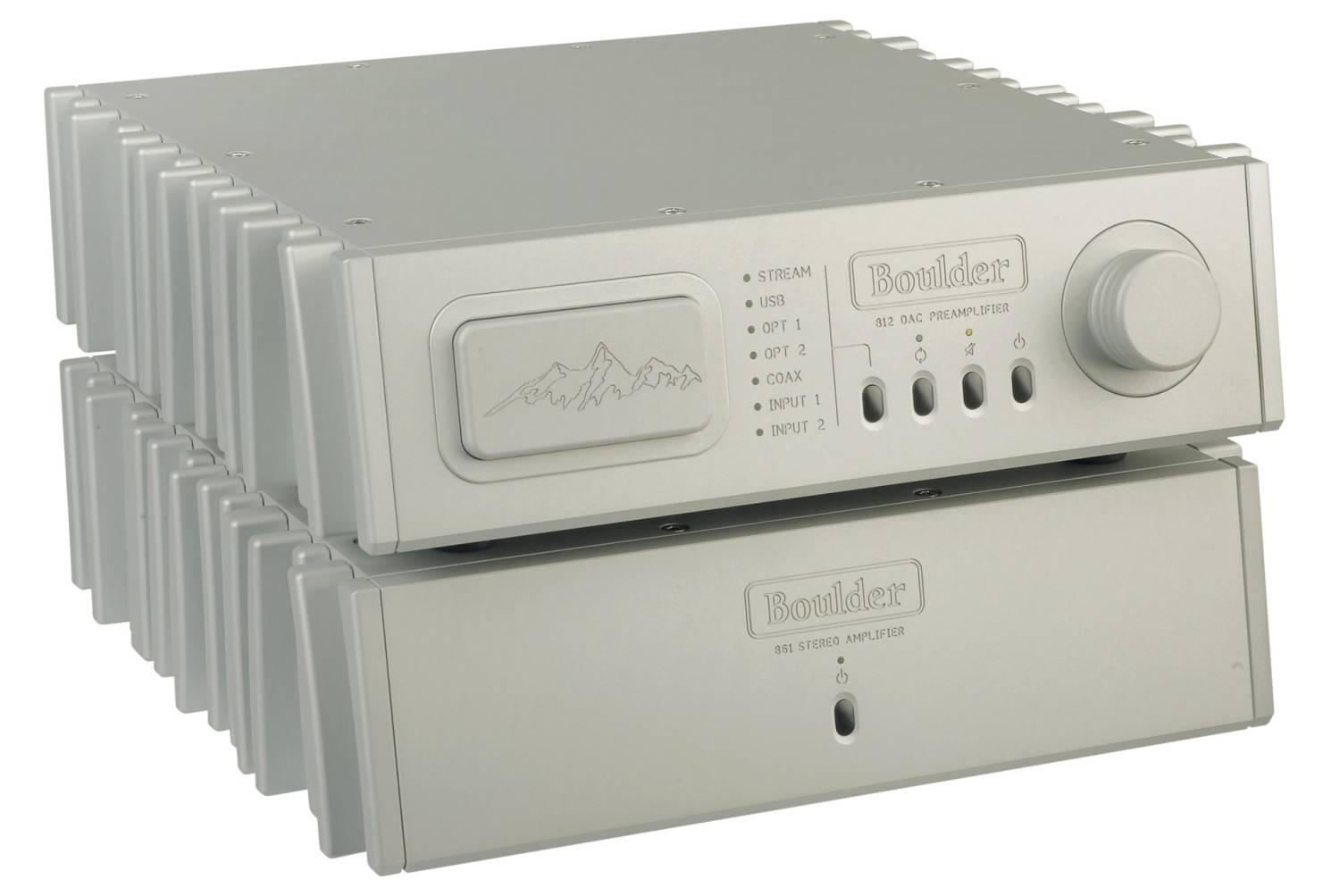
Boulder 812: Three Devices in One
The812 It is a DAC with a built-in streamer, a balanced preamplifier, and a headphone amplifier. Boulder describes it as perhaps the best value-for-money product in its history, and it can be used in any one of its three functions or in any combination thereof. The design is explicitly based on the DSP and conversion topology of the 866 integrated circuit. Input data is, if necessary, converted asynchronously (reclocking and frequency conversion); a DSP running proprietary Boulder software processes the stream, oversampling it to maximize the operating frequency and reduce distortion; the DAC chips generate the analog signal; and a multipole Bessel analog filter, tuned for optimal transient response.
The digital input selection is complete: USB-B for the computer, two Toslink optical inputs, one S/PDIF coaxial input, four USB host ports for external storage devices, and Ethernet. On a network, the 812 acts as an endpoint. Roon and streams via UPnP and AirPlay. Boulder does not disclose the model of the conversion chips or the maximum sampling rates in its official specifications, but under the cover we discovered a pair of AD1955 chips. The analog inputs consist of two pairs of XLR connectors, and the preamp output is a single pair of XLR connectors; these feed into a truly balanced and differential input stage, which also accepts unbalanced sources via an adapter. From there, or from the DAC output, the signal proceeds to the attenuator and the output stage.
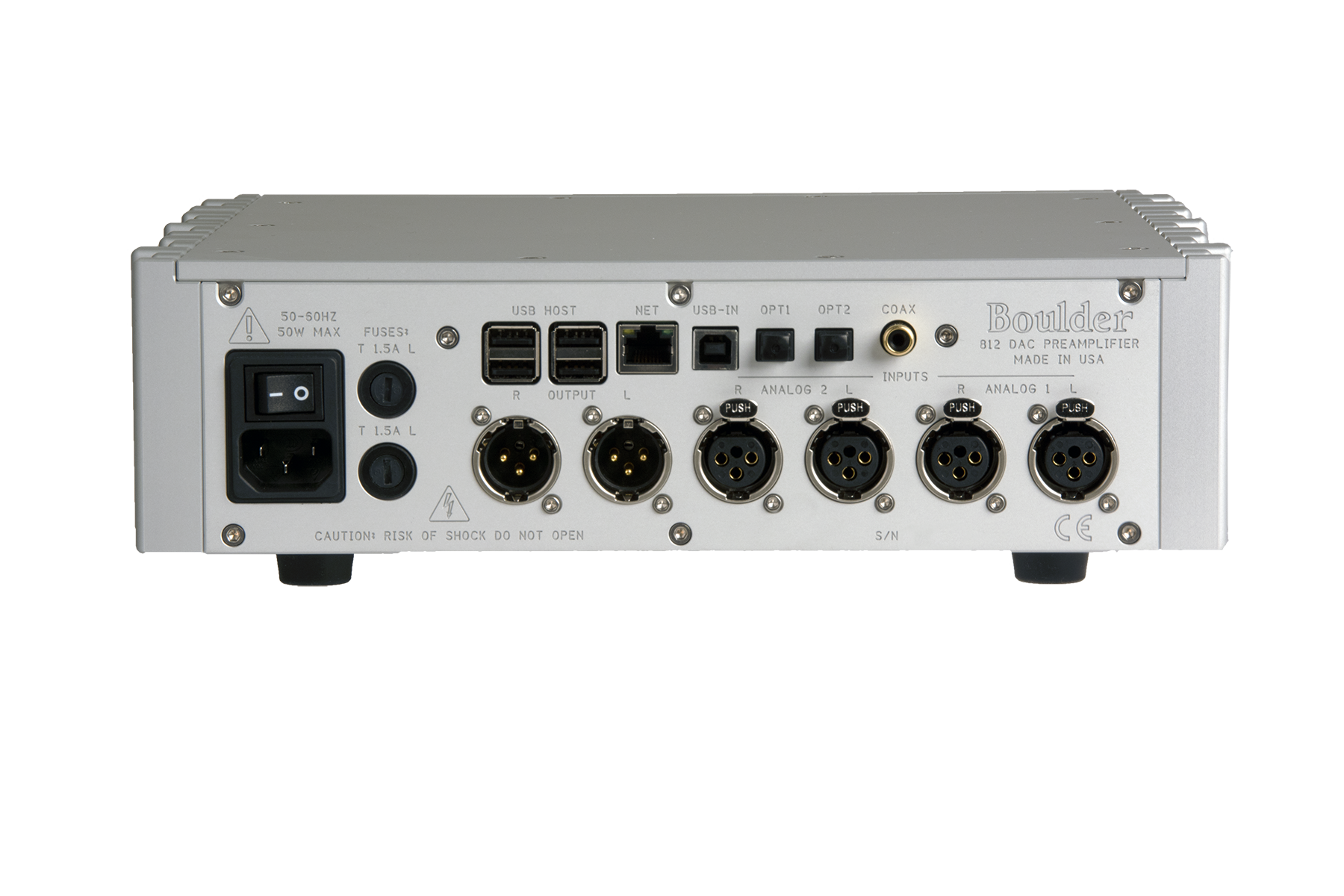
The volume control is a solid-state step control with an optical encoder: 100 dB of range in 1 dB steps using a resistor network. The frequency response starting at 0.02 Hz indicates a circuit that is practically DC-coupled, consistent with the Boulder school of thought. The 14 Vrms output is far more than enough to drive any power amplifier, including the 851.
The front panel controls the inputs and volume; the Boulder Controller app (iOS and Android) gives you access to everything else: headphone sensitivity, input and output settings, library management from a USB drive or server, even custom icons for the inputs, and there’s also an optional RF remote control. An output switch button toggles between headphone mode and preamp mode: when the preamp outputs are feeding the power amp, the headphone jacks are disabled, and vice versa.
The 812 is also the first headphone amplifier Boulder has ever produced, and it’s built in true Boulder style. It features a cascade of transistors that, according to the manufacturer, adapts to any load connected to it.
The starting point was research into the most popular headphones and their electrical requirements. The key finding that guided the project was the wide range of impedances: the difference between a 16–32 Ω dynamic earbud and a 600 Ω headphone is much greater than the difference between the easiest and most challenging speakers. Therefore, the same circuit requires current for low-impedance loads and voltage for high-impedance ones.
The power output at 32Ω is 200 mW, dropping to 80 mW at 600Ω—in short, more than enough for any headphone. In practice, 200 mW is more than enough for any modern dynamic headphone and for most planar magnetic models. For a headphone with a sensitivity of 100 dB/mW, this translates to a theoretical peak of over 120 dB. The limit is only approached with the most demanding planar magnetic headphones: a headphone with a sensitivity of 83 dB/mW would reach a peak of about 106 dB, which is sufficient for listening but leaves little headroom. On the front panel, hidden behind an elegant magnetic flap engraved with the Boulder logo, there are four outputs: a 3.5 mm jack, a 6.35 mm jack, a balanced 4-pin XLR, and a 4.4 mm Pentaconn, which is also balanced. This provides comprehensive coverage, from travel earbuds to reference-grade headphones.
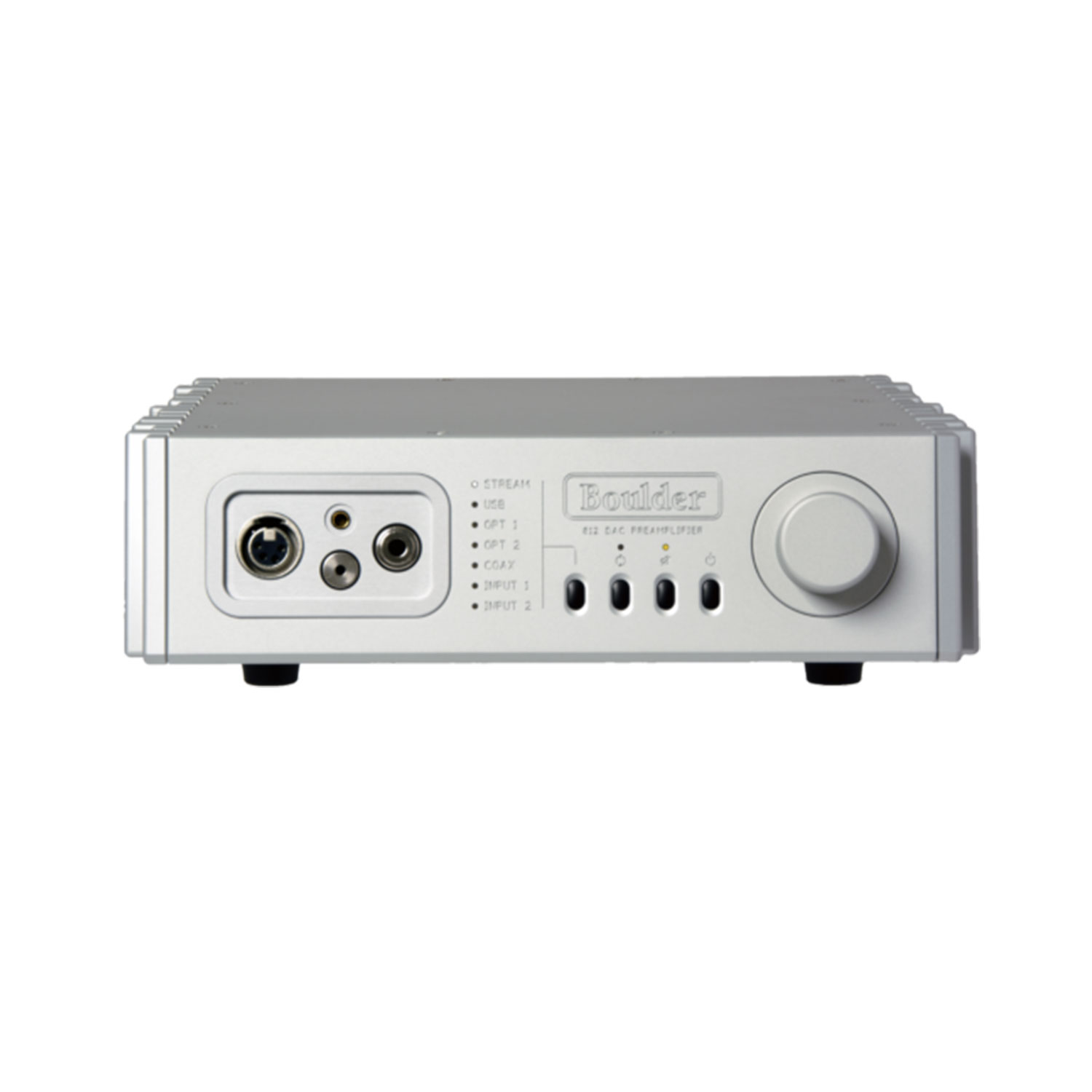
The jacks are mounted on a dedicated panel, which separates them from the main front panel to prevent scratches when plugging in the cables. It’s a detail designed with real-world use in mind: as they wear out, individual jacks or the entire panel can be replaced at a retailer. You can adjust the headphone output sensitivity—essentially the gain—from the app. This feature is more useful than it seems: with very sensitive headphones, it prevents you from hearing everything at the lowest volume levels, where every 1 dB step makes a noticeable difference; with hard-driving planar headphones, it gives you more headroom.
Boulder 851: a 30-centimeter monaural speaker
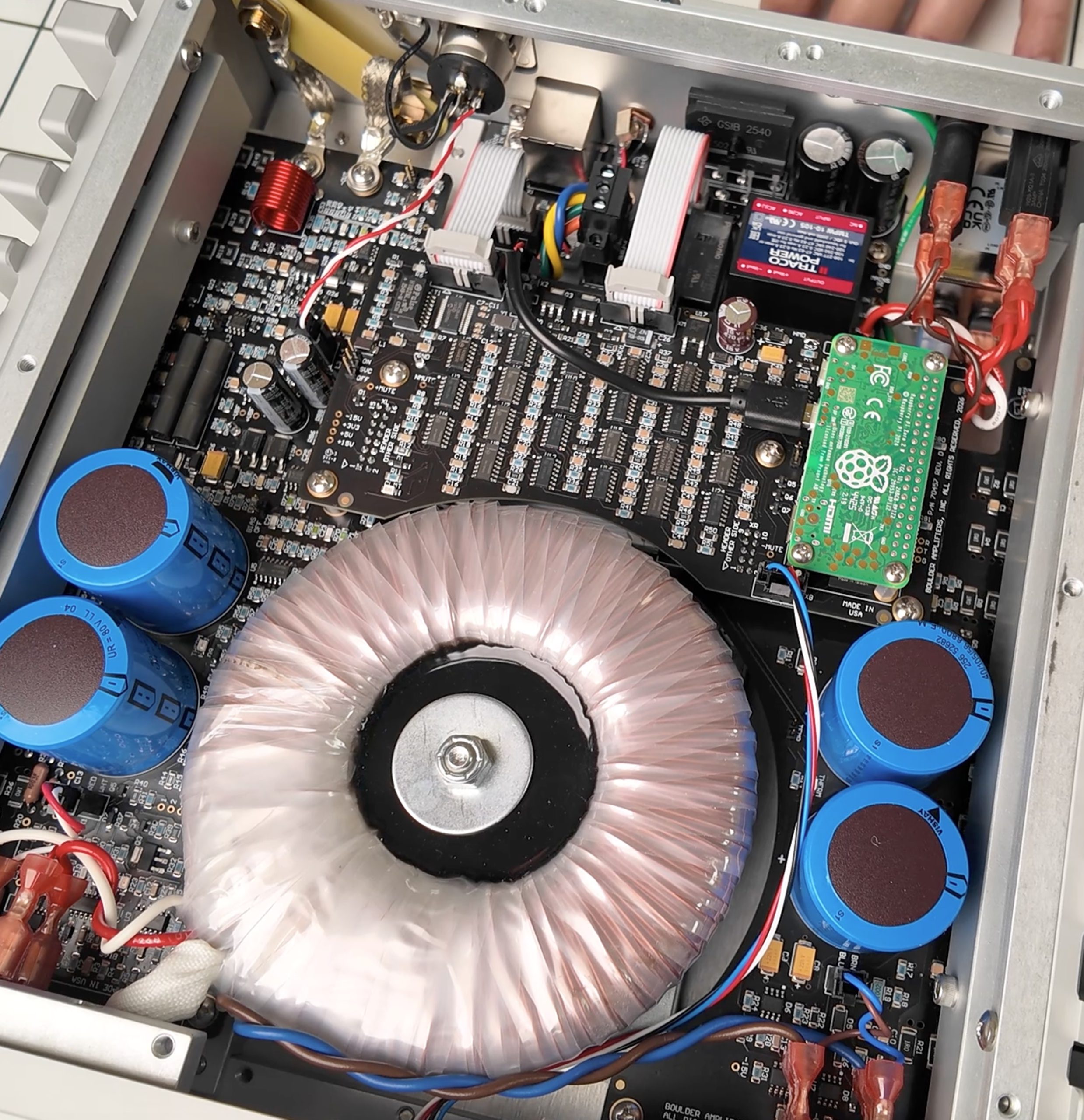
The 851 is derived from the 861 stereo power amplifier, from which it borrows the circuit design, but each chassis drives only a single channel. In the process, Boulder has simplified the signal path, improved separation and dynamic headroom, and—most importantly—replaced the output stage with the new Smart Current technology, which we’ll discuss later; it is the smallest Boulder power amplifier to incorporate this technology.
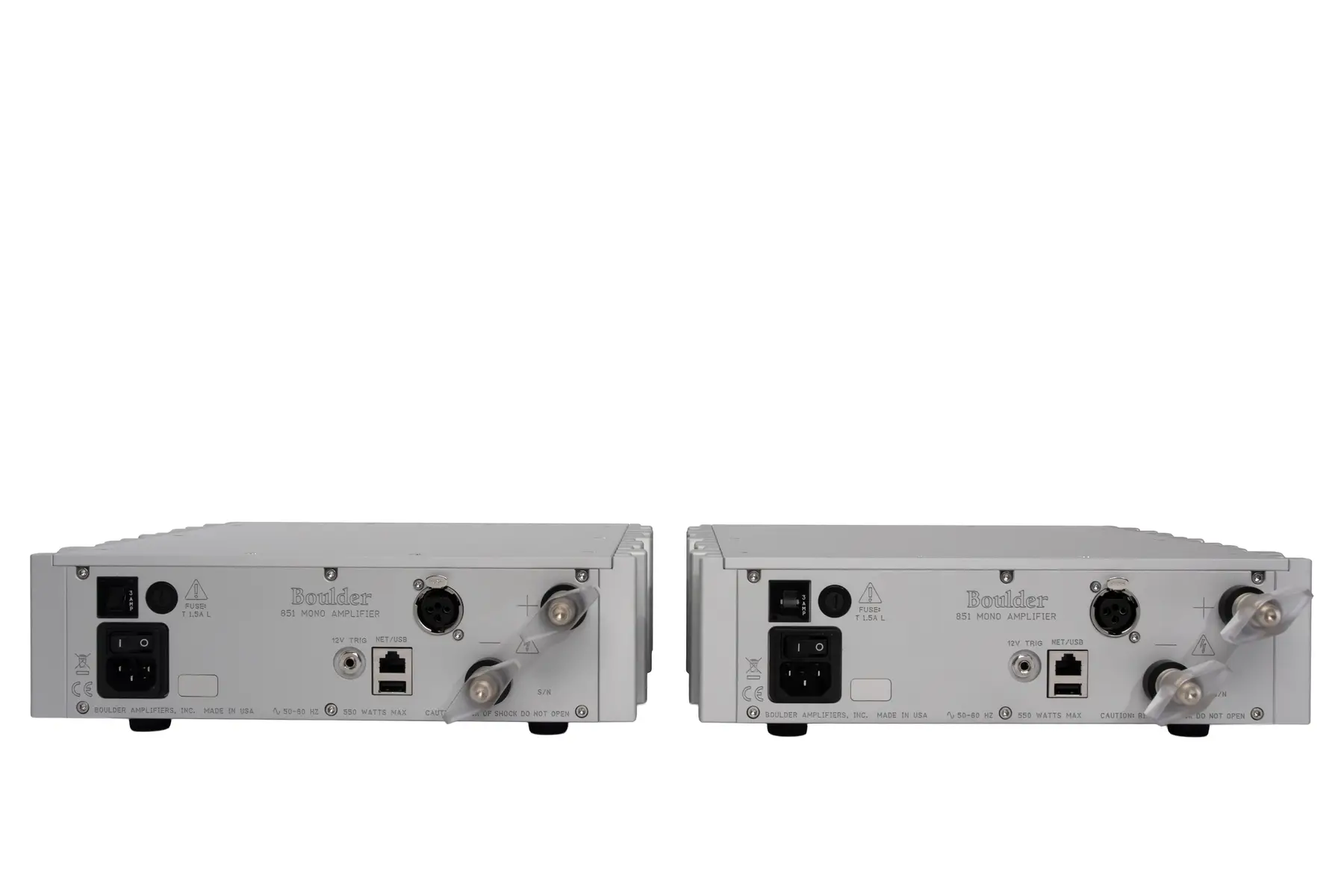
One hundred watts into 8 Ω may seem like a modest figure for a power amplifier in this class. But the fact that the power doubles exactly at 4 Ω and reaches a peak of 350 W into 2 Ω indicates that the power supply and output stage are designed for current rather than voltage. The 851 uses an array of active components and can deliver much more current than a typical 100-watt amplifier. It is DC-coupled, with no capacitors in the signal path: hence the response that starts at 0.015 Hz with a servo that cancels out any DC offset coming from the preamplifier or the source. There are numerous protective features, since a DC-coupled amplifier cannot afford any glitches: a current limiter mutes the output in the event of a short circuit; a DC detector mutes the output if it detects DC voltage toward the speakers; a thermal protection circuit mutes the amplifier when the heat sinks reach 70 °C and reactivates it once the temperature drops below 60 °C.
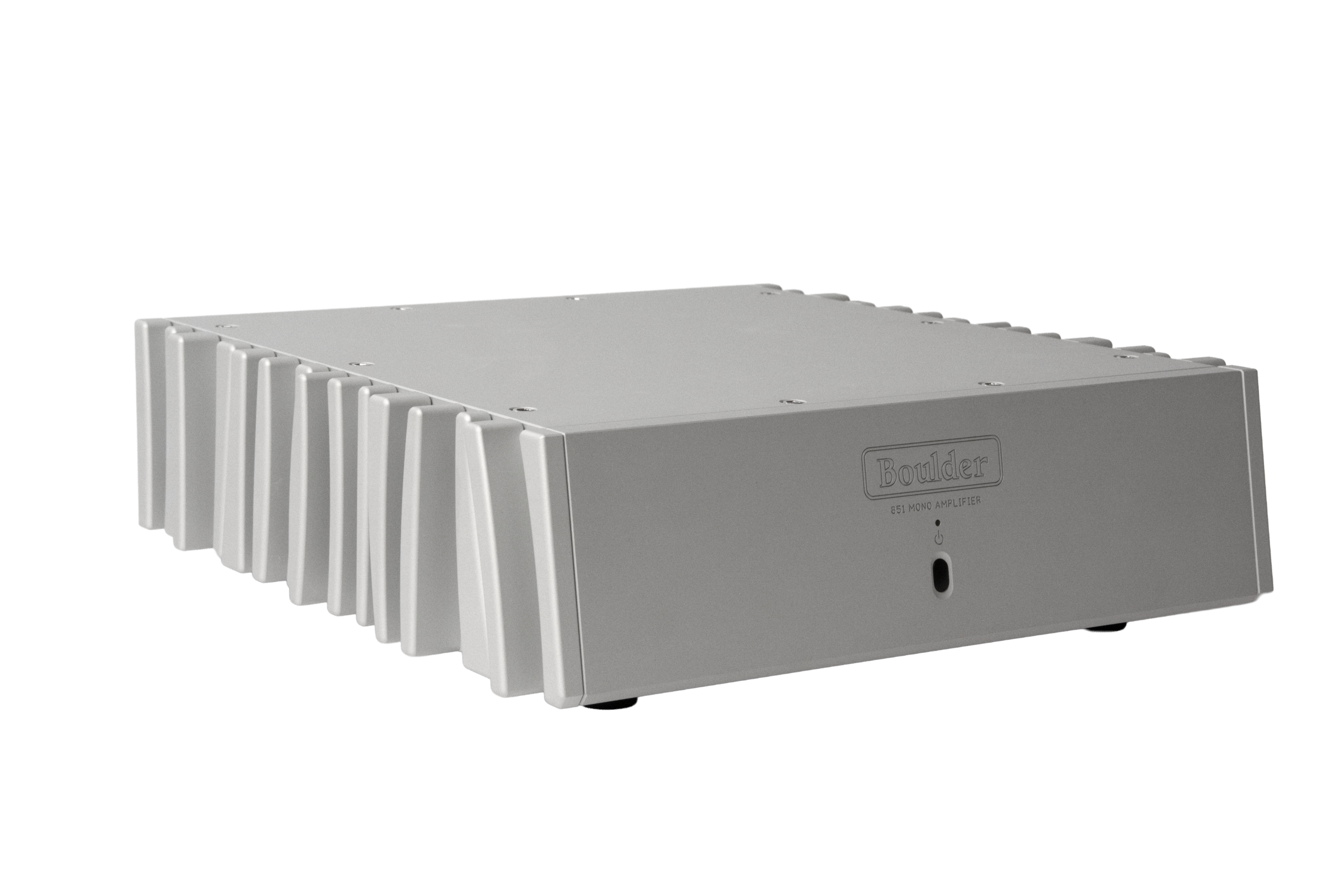
The printed circuit boards, chassis, and assembly are manufactured at the Boulder plant in Louisville, just a few minutes from the city that gives the brand its name. The output terminals are the classic Boulder design with 6-mm knurled-knob screws—beautiful and extremely practical. On the back, in addition to the XLR input, there is the main power switch; on the front, there is a single standby button with a white LED, which flashes during startup and remains steady during operation.
Smart Current: What Boulder's White Paper Says
Smart Current is an output stage that continuously measures the current required by the speaker and automatically adjusts the bias so that the transistors in one half-wave never turn off before those in the other half-wave have already turned on. Boulder describes it in a document authored by founder Jeff Nelson, “An Improved Power Amplifier Design,” published in December 2024 for the 1100 series and updated in June 2026 with the release of the 851. On the website, the document appears as “Class-A Smart Current White Paper.” We summarize the reasoning step by step. Nelson begins by defining the perfect amplifier: it raises the input voltage to the level required by the speakers, provides all the current the load demands, has zero output impedance (i.e., infinite damping factor), and adds no distortion. According to the white paper, we have achieved the first three objectives today, while the fourth is compromised by the transistors themselves.
Every power transistor has, within its silicon chip, a parasitic capacitance that cannot be eliminated because it is intrinsic. This capacitance must be charged and discharged with every voltage change, and the time required for this slows down the device’s response. In a classic push-pull stage, including the Boulder design, one set of transistors provides the positive current during the positive half-cycle and a second set provides the negative current. The critical moment is the zero-crossing: one set turns off while the other turns on, and the delay caused by the parasitic capacitance generates crossover distortion. Nelson describes this as a “graininess” added to the sound, which worsens as frequency increases, where the capacitances must be charged more quickly. The classic solution is to run a quiescent current—the bias—through the transistors to charge and discharge those capacitances. The white paper compares the different approaches, including those used by Boulder itself:
| Type | How It Works | Advantages | Limitations | Used by Boulder |
|---|---|---|---|---|
| Class A | Repetition current higher than that of the speaker | No transistors turn off | Always heats up | Not selected |
| Class A shift | Raise the pulley according to the signal | Class A without constant calibration | Level adjustment | 2000 and 3000 Series |
| Class AB | Low-level only | Less heat and lower power consumption | Uncertain transition | 861 and 866 |
| Smart Current | Real-time Polarization | No A/AB transition | Circuit complexity | 1100 and 851 Series |
The New Idea
Smart Current is the result, Nelson writes, of a year of research. The first constraint was the safe operating area (SOA) of the power transistors; then came the temperatures of the devices and heat sinks, as well as the thermal limiting circuits. Heat shortens the lifespan of electrolytic capacitors in particular, which is why Boulder has always used versions rated for higher temperatures. Resistors and integrated circuits were also tested for their SOA. According to the company, this has brought the failure rate close to zero.
The stated goal is to eliminate the distinction between classes: no longer choosing between A and AB on paper, but a stage that manages itself. A second goal was a robust circuit, without trimmers or manual adjustments, to reduce production errors and simplify repairs. To achieve this, Boulder applied its own test bench and software—developed in-house over many years to create sets of resistors selected with extremely high precision—to the output stage. Until now, these had been used to ensure repeatable gain calibration and common-mode rejection; now they are also used for the output stage.
The core of the problem remains the same: preventing the two groups of transistors from turning off at the exact same moment. In fact, the goal is to ensure that the opposite group begins conducting well before the one currently supplying current turns off, at all audio frequencies. Smart Current achieves this by continuously adjusting the current margin: it monitors the current drawn by the speaker and adjusts the bias accordingly. According to Boulder, crossover distortion drops so close to zero that it is inaudible, and in internal listening tests, everyone noticed a marked increase in clarity.
Why, then, does Boulder call the 851 a “true Class A” amplifier—the only one in the 800 series? The classic definition of Class A is precisely this: no output device ever turns off, throughout the entire signal cycle. Since Smart Current always keeps the opposite stage in the on state, the definition is met—but without the enormous, fixed quiescent current of a traditional Class A amplifier. It’s an approach from the same family as other dynamic or “non-switching” polarizations seen throughout the history of high-fidelity audio; the difference Boulder claims is that the regulation follows the actual load current, moment by moment, rather than level thresholds.
It should be noted that the white paper is an informational document: it does not contain diagrams, polarization curves, or comparative crossover distortion measurements, and it is rather cryptic. We only know for certain that the 851s generate heat, but certainly not like a conventional Class A amplifier.
Audio Sample
We really liked both amplifiers. The sound of the 812 + 851 combination has the subtle, smooth texture typical of a good Class A amplifier, but with the power, control, and responsiveness of a well-sized Class AB amplifier. It is, after all, exactly what Jeff Nelson’s white paper promised—and upon listening, that promise is delivered.
We listened to the pair in two configurations. In the first, the 812 functioned as a complete system—streamer, DAC, and preamplifier—connected to the two 851s via XLR. In the second, we used it solely as a preamplifier, fed via a balanced analog input from the Aqua La Scala MK3 converter, which in turn was powered by a DIY PC streamer. The speakers were the Franco Serblin Accordo Essence—a pairing we’ll return to, as it deserves a chapter of its own. For the headphone section, we chose the Dan Clark AEON.
The 851s were left on for a long time before the actual listening sessions, as is appropriate for electronics that are always in conduction mode. The improvement from when they were off to when they were fully warmed up is evident, especially in the smoothness of the midrange and the airiness of the treble.
The character: Class A in texture, Class AB in punch
The first thing that strikes you is the texture of the sound. Acoustic instruments have a fine, silky texture, without that slight graininess that often accompanies transistors when the signal crosses zero. Vocals have body and warmth without becoming muddy, and the strings have just the right sweetness without losing the bite of the bow on the string. It’s the kind of soundstage typically associated with pure Class A power amplifiers: relaxed, continuous, and free of artificial harshness.
The surprise is that this smoothness isn’t accompanied by any sluggishness. When the music calls for energy, the 851s deliver it with a responsiveness you wouldn’t expect from two such small enclosures with “only” 100 W per channel. Transients are crisp, percussion has impact and decay, and the bass is tight and articulate. The drive—the sensation that the amplifier is always in full control of the speaker—is that of a well-powered Class AB amplifier. The two characteristics coexist without one overpowering the other, and this is perhaps the most interesting finding of this review.
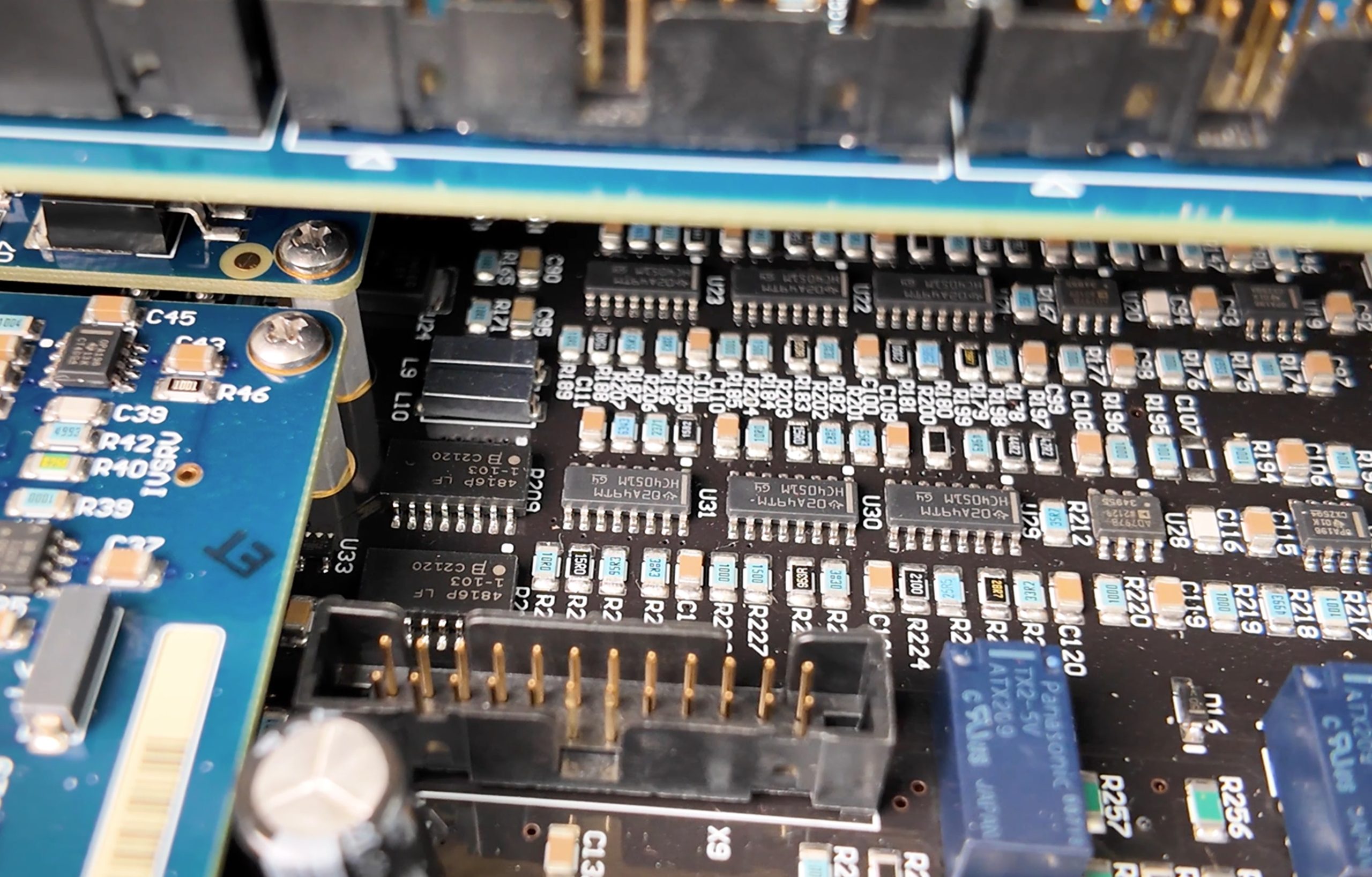
The details are always evident, but never shoved in your face. All the subtle nuances are there: the musicians’ breathing, the reverb tails, the variations in pressure on the piano keys. This is also thanks to the background silence, which allows the more distant layers of sound to emerge without needing to turn up the volume. However, this attention to detail never comes at the expense of musicality: the whole remains cohesive, and listening to it doesn’t become tiring even during long sessions.
In terms of performance, the rated 100 W should be interpreted as Boulder suggests: what matters is the current and stability under load, not the wattage. The 851s demonstrated excellent control even during the densest orchestral passages and at high volumes, without any harshness or compression of the soundstage. The dynamics unfold naturally, and the crescendos reach their full potential without any sign of strain. Anyone worried about running out of power with normal-sensitivity speakers can rest assured.
The Collaboration with Franco Serblin
With the Franco Serblin Accordo Essence, the connection was immediate—and, in some ways, surprising. The speakers designed by this great engineer from Vicenza are known for their musicality, natural tonal quality, and ability to make the cabinets disappear; however, they require an amplifier that combines refinement and control, because they tend to mercilessly expose any harshness or dullness in the signal source.
The 851s are the ideal partner precisely because of their dual nature. Their fine, Class A texture blends perfectly with the warm, natural timbre of the Serblin speakers, bringing out the warmth of the instruments, the richness of the vocals, and the texture of the strings. The Class AB drive, on the other hand, gives the low end the control and articulation that make it responsive—not just full-bodied. The soundstage opens up wide and deep, well separated from the speakers, with a credible and stable sense of space.
It’s one of those pairings where the two components seem to complement each other perfectly: the American electronics bring precision, control, and clarity, while the Italian speakers add warmth, openness, and a sense of music. The result is a beautifully balanced sound that makes you want to listen to one album after another.
The 812: Source, Preamplifier, and Headphone Amplifier
The 812 performs at its best as a pure preamplifier, with an analog XLR input. This was to be expected: the balanced, differential input stage and the step attenuator are at the heart of the Boulder preamp experience, and the fully balanced signal path all the way to the 851 preserves the transparency.
When used with the built-in streamer and DAC, however, the 812 performs very well. The sound is clean, precise, and tonally accurate, with the same tonal balance that characterizes the entire system. For those looking for a compact, all-in-one solution, the 812 on its own, paired with the two 851s, is already a high-end system—no need to add anything else.
However, when you connect the Aqua La Scala MK3—the Italian discrete R2R DAC powered by the PC streamer—upstream, the leap in quality is striking. The soundstage gains depth and breadth, the midrange becomes more textured and three-dimensional, subtle details emerge more naturally, and the flow of the music becomes more organic. The differences lie not so much in the amount of detail—which is already excellent with the internal digital section—as in the sense of realism and the three-dimensionality of the soundstage.
It must be clearly stated that even in an all-internal configuration, the performance is excellent. The 812’s digital section is not just an afterthought: quite simply, a dedicated converter of that caliber, paired with a high-quality source, raises the bar even higher, and the Boulder preamplifier is transparent enough to reveal this clearly. This is also a good sign for the future: the 812 is a component that can grow alongside the system.
To put the 812’s headphone amplifier to the test, we chose the Dan Clark AEON, which is quite demanding in terms of current and voltage. The 812’s driving capability seemed limitless to us, with plenty of headroom even at the highest volumes and during the most demanding passages.
The dynamics are impressive, whether in the sweeping contrasts of Mahler’s Fifth Symphony or in the subtlest nuances of Danilo Rea’s piano playing. The sound has breathing room; the soundstage extends beyond the ear cups with a sense of space rarely found in headphones, and the power is accompanied by detail that is always present yet never tiring. The low notes of the bass on Metheny’s album are deep and controlled, a sign that the headphone amplifier keeps the planar drivers in check just as power amplifiers do with speakers.
This confirms what was mentioned in the technical section: the 812 doesn’t have a standard headphone output, but rather a true reference-grade headphone amplifier. Owners of high-end headphones may want to consider it for this feature alone.
Listening to Giulio Salvioni
I’ll admit it: when I first saw the 851 power amplifiers, with their delightful design—marked by dimensions that are unusual compared to those of the American manufacturer’s power amplifiers—I thought: “…even Boulder is started started making Class D amps…”. This assumption is obviously incorrect becauseit’s, as you may have read in the’article by G. Valletta, these power amplifiers are based on an innovative implementation of Class A. The reason for this latest design effort—aimed at making Class A, which is notoriously characterized by its substantial size, weight, and heat dissipation, is To put it simply: the A-Class sounds good. Very good. I don’t know if this is solely attributable to the’absence of crossover distortion—given that the problem is eradicated at its root by the circuit topology—or ifthere’s some other factor influencing the sound. What I do know is that when I happen to listen to a Class A amplifier it’s almost immediately apparent how refined it is and how it conveys the musical message in such a natural way. On the other hand, in most cases, you find yourself dealing with power levels that aren’t exactly abundant, which limitsabit choosing the right speakers to pair with them.
When I started listening to this beautiful Boulder trio—consisting of the 812 preamp and the pair of 851 monoblock power amps—the first thing I noticed was that they certainly didn’t sound like the Class D amplifiers I’ve had the chance to listen to, no matter how good they might have been. The key word—and I think I can say this with confidence,, is refinement. That very refinement that has, in fact, always been associated with Class A. Vocals, for example—both male and female—are very realistic and possess just the right body, ensuring they never sound thin or baritone-like, even when they’re not is The case. With these Boulders, the rumors are just, simply, true. I could say the same about the string instruments in a large orchestra, which are reproduced with just the right respect for harmonic relationships, making them distinguishable from one another in a skillful and satisfying mix.
It is worth noting that if it’s easy to notice the difference between these Boulders and a Class D amplifier, it’s not is equally obvious when comparing them to a conventional Class AB amplifier, at least in terms of power output. In’listening session paired with the Serblin Accordo Essence speakers, we achieved high sound pressure levels without any sign of harshness or distortion of any kind. Perhaps, in a few passages, I noticed a sort of stretching of the higher-frequency signalshigh a minor issue which—and I must point this out for the sake of professional integrity—I only noticed when comparing it to the monumental Audio Analogue Absolute 3.0, a 300-watt-per-channel Class AB amplifier.
As for the preamp, I can only praise its transparency and speed,, as well asthe the qualityquality of’implementation of the various featuresis that can be managed using the great app for smart devices. TheTheonly drawback, in absolute terms, is the qualityà of the streaming section that I seemed seemed a bitwas below the quality standards of this product. In other words, the listening tests conducted with some of the external streamers present in the studio—even when using the Boulder 812’s internal DAC—yielded better sonic results. I wrote a little’in fact “in absolute terms” becauseit is in the judgment it is It is necessary to give due consideration to practicality d’use resulting from an implementation that isis perfect implementation. Something precious that would inevitably be altered by’addition of an external device that, for example, would have to be controlled with an additional remote control or app.
I’ll conclude with an aesthetic observation: the highly distinctive design of the side heat sinks, which for some time now has been the “signature” in the American manufacturer’s design, works very well even in this smaller version.
Conclusions
The Boulder 812 + 851 combination is a system that’s compact only in size. When listened to, it demonstrates the tonal refinement and smoothness of a Class A amplifier combined with the power and control of a Class AB amplifier, with consistently prominent detail and excellent drive. Smart Current technology—at least judging by what you hear—is not just a marketing gimmick.
The 812 is a versatile system hub: a headphone amplifier capable of effortlessly driving any headphones, excellent as a standalone preamplifier, more than impressive with its built-in streamer and DAC, and capable of bringing out the best in a high-end external DAC like the Aqua La Scala MK3. Paired with the Franco Serblin Accordo Essence speakers, this combination is among the most successful we’ve heard recently. We highly recommend giving this system a listen to anyone seeking the Boulder sound in three 30-centimeter cabinets.
Technical Specifications:
Boulder 851
- Continuous power: 100 W into 8 Ω, 200 W into 4 Ω.
- Peak power: 150 W into 8 Ω, 250 W into 4 Ω, 350 W into 2 Ω.
- Input: 1 balanced XLR.
- Input impedance: 100 kΩ balanced.
- Outputs: 6 mm terminals.
- THD: 0.002%.
- Equivalent input noise: 2.6 µV (20 kHz).
- Frequency response: 20 Hz – 20 kHz +0, –0.04 dB; 0.015 Hz – 150 kHz at –3 dB.
- Gain: 26 dB.
- Power supply: 100/120/240 V, 50–60 Hz.
- Maximum power consumption: 550 W.
- Dimensions (WxDxH): 30.5 x 30.5 x 8.9 cm.
- Weight: 10 kg each.
Boulder 812
- Analog inputs: 2 balanced XLR pairs.
- Digital inputs: USB-B, 2 Toslink optical, 1 S/PDIF coaxial RCA, 4 USB host ports, Ethernet.
- Outputs: 1 balanced XLR pair; headphone output via 3.5 mm jack, 6.35 mm jack, 4-pin XLR, 4.4 mm Pentaconn.
- Volume: 100 dB range in 1 dB steps.
- Maximum input level: 6 Vrms.
- Maximum output level: 14 Vrms.
- Maximum gain: 19.4 dB.
- THD+N: 0.0017% (-95.5 dB) at 2 V, 2 kHz.
- Frequency response: 20 Hz – 20 kHz +0, –0.03 dB; 0.02 Hz – 250 kHz at –3 dB.
- Signal-to-noise ratio: 116 dB.
- Input impedance: 100 kΩ balanced.
- Output impedance: 100 Ω balanced.
- Headphone output: 200 mW into 32 Ω (THD 0.0010% at 2 kHz, 0.0053% at 20 kHz); 200 mW into 150 Ω (0.0010% and 0.0034%); 80 mW into 600 Ω (0.0011% and 0.0043%).
- Power supply: 90–240 V.
- Maximum power consumption: 50 W.
- Dimensions (WxDxH): 30.5 x 30.5 x 8.9 cm.
- Weight: 6.4 kg.
Prices:
812: €13,950
851, Luno: €13,950
Manufacturer: Boulder Audio
Distributor: Audio Graffiti




GIPHY App Key not set. Please check settings