

 Audio 2G
Chord ULTIMA Integrated is CHORD Audio’s top-of-the-line integrated amplifier and part of the British manufacturer’s most ambitious ULTIMA line.

Chord Ultima Integrated: dutiful premises and a bit of history
Chord Electronics was born in 1989 from the passion of John Franks, an engineer with a background in the avionics industry and collaborations with the likes of Raytheon, AT&T and Marconi Avionics. And this has undoubtedly shaped his approach to design, which has always been to try to go as far as is necessary (and beyond), sparing no expense in short, so as to make the best product according to what the technology offers at the time. After all, in avionics, compromises are banned, and Franks tries to do the same with his electronics, at all levels.

The Chord Ultima Integrated is one of its latest externals; we had seen it, it had attracted our attention in no small part, at the last Monaco Hi-End, where it towered right in the center of the Chord booth. The name is not chosen at random, and it is that of the two new technologies developed by the British manufacturer, which were introduced together five years ago in the brand’s flagship amplifiers, and which for the first time are being used in an integrated amplifier. So dual feed-forward, or evolved signal control with real-time error correction, and ultra-high frequency switching power supplies. Dual feed-forward is based on an idea of Malcolm Hawksford (Essex University) later taken up and refined by Bob Cordell of Bell Labs and further developed and refined for the audio world by Franks
It consists of two extremely fast additional amplifier circuits that monitor and correct the difference between the output and input and add, if necessary, a “difference signal,” a concept that while not new, in this integrated, as indeed in the Mono power amp, is implemented with ad hoc circuitry that in no way interferes with the original signal. The switched-mode power supply, always a Chord workhorse, operates in this case at 80 kHz, which means it does not interfere with audio signals. The first power supplies designed with this technique by Franks were unreliable, cost a lot of money and generated interference, and in fact, when ULTIMA technology debuted, he admitted that it took him more than 10 years of perseverance to overcome all the difficulties.
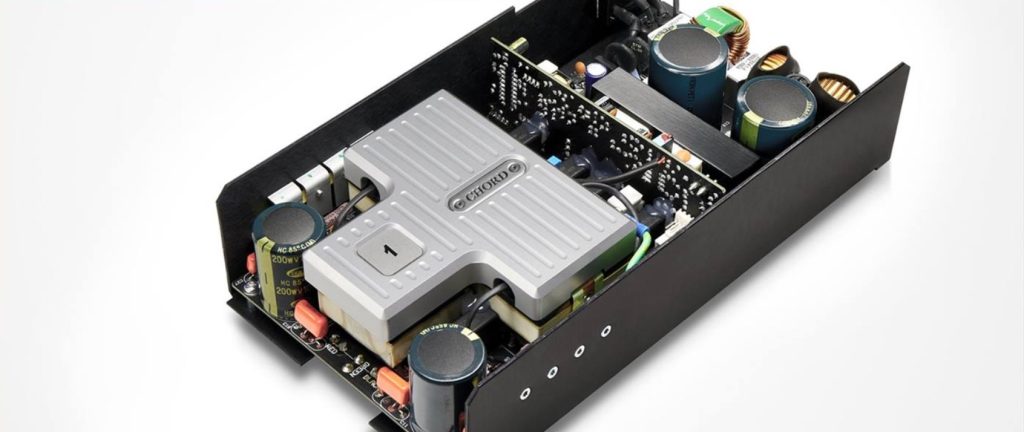
His approach is based on the consideration that a lot of energy is needed to stop and start within microseconds especially the woofers, and that energy, drawn directly from the power supply and very quickly, according to him can be delivered are by high-frequency switching, and not by conventional transformer-based. By the way, again according to him, small capacitors respond faster, which is why Franks does not use huge capacitances but rather relatively small batteries in parallel, so that the charging time is much faster. Chord ULTIMA Integrated uses four 80kHz high-power phase-corrected switching power supplies. Their operation is relatively simple; the incoming 230-volt supply is filtered and rectified, cut with high-voltage MOSFETs, and sent toward a high-frequency, ceramic-coated transformer. The resulting voltage is again rectified and sent to a proprietary dynamic coupling system that combines the positive and negative branches with strong magnetic flux to meet any power demand.
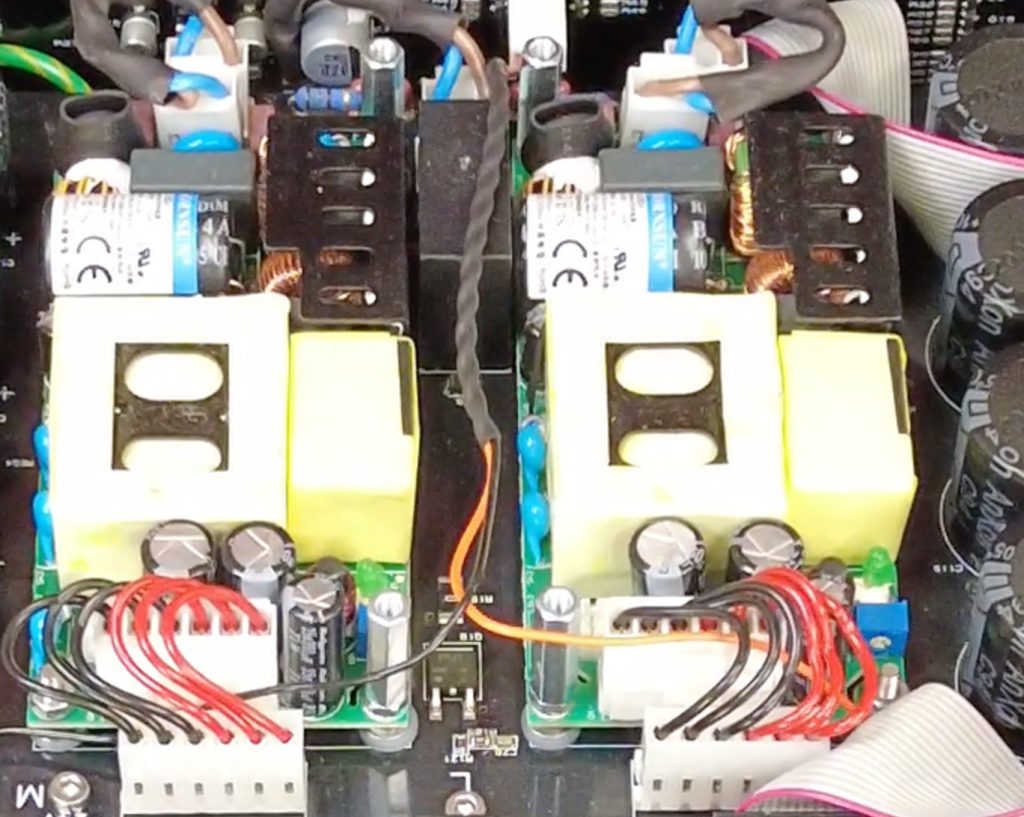
Another important peculiarity of ULTIMA is the bias, not fixed as in most amplifiers, which means that it almost always runs in class A, except of the times of greatest demand. We noticed that the fins heat up just a little, even though the whole case participates in dissipation, which makes us think precisely of a particularly fast and efficient variable rest management system. The output stages then adopt MOSFETs made for Chord by an aerospace company, and they are thermally coupled in production to match each other perfectly, so as to limit thermal drift as much as possible.
A "simple" amplifier
ULTIMA Integrated, in spite of an appearance that it is reductive to call original and futuristic, is an entirely traditional, totally analog integrated amplifier, with no DAC or Phono input. The symmetry is balanced, and so as is to be expected there is an XLR input, unfortunately single due to the scarce space on the rear panel, it is flanked by 3 RCA inputs and a rather incomprehensible XRL bypass for audio/video, we would have preferred two XLR inputs and the bypass to RCA, but so be it ! A balanced pre out that the manufacturer recommends using for passive multi-amplification since all Chord electronics have the same sensitivity and thus one would not run into level problems between ways. Finally, a trigger in/out for synchronized switching with other equipment.
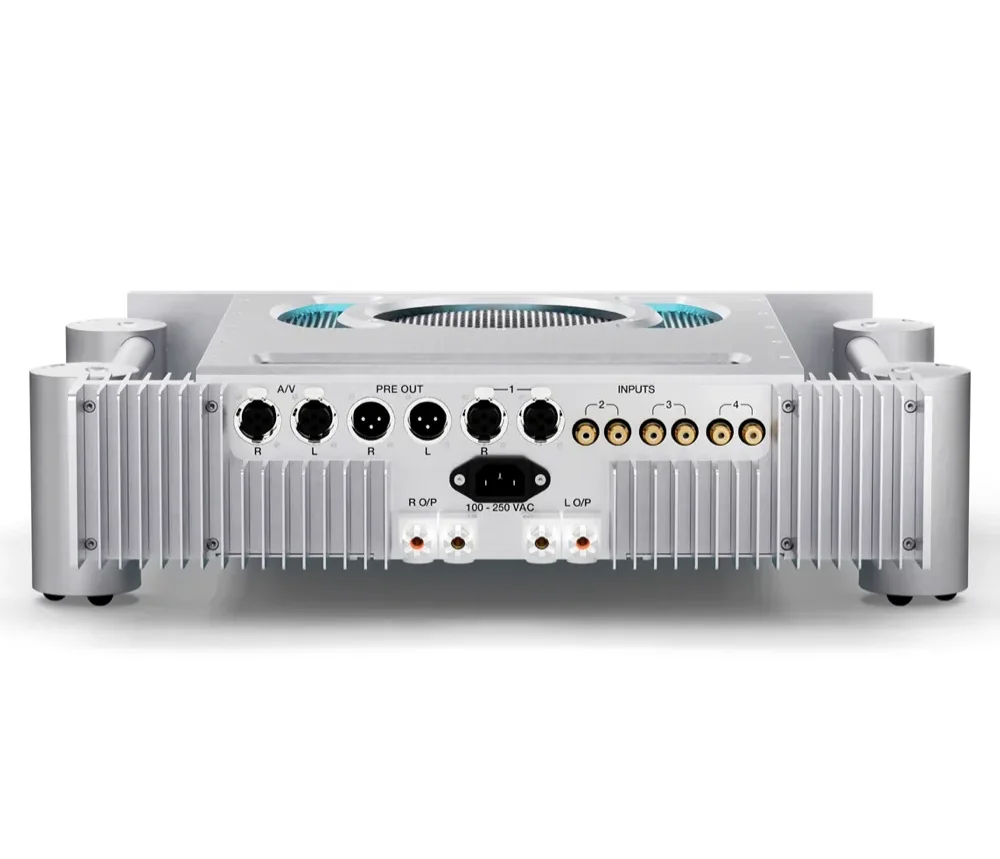
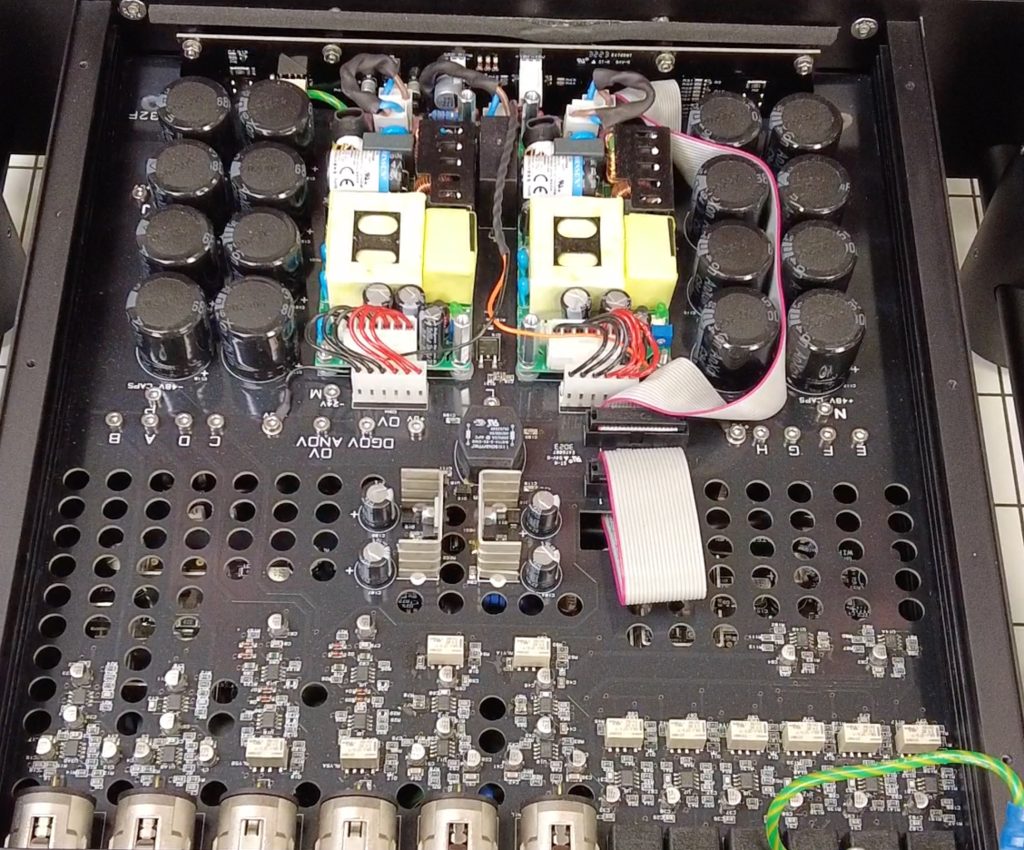
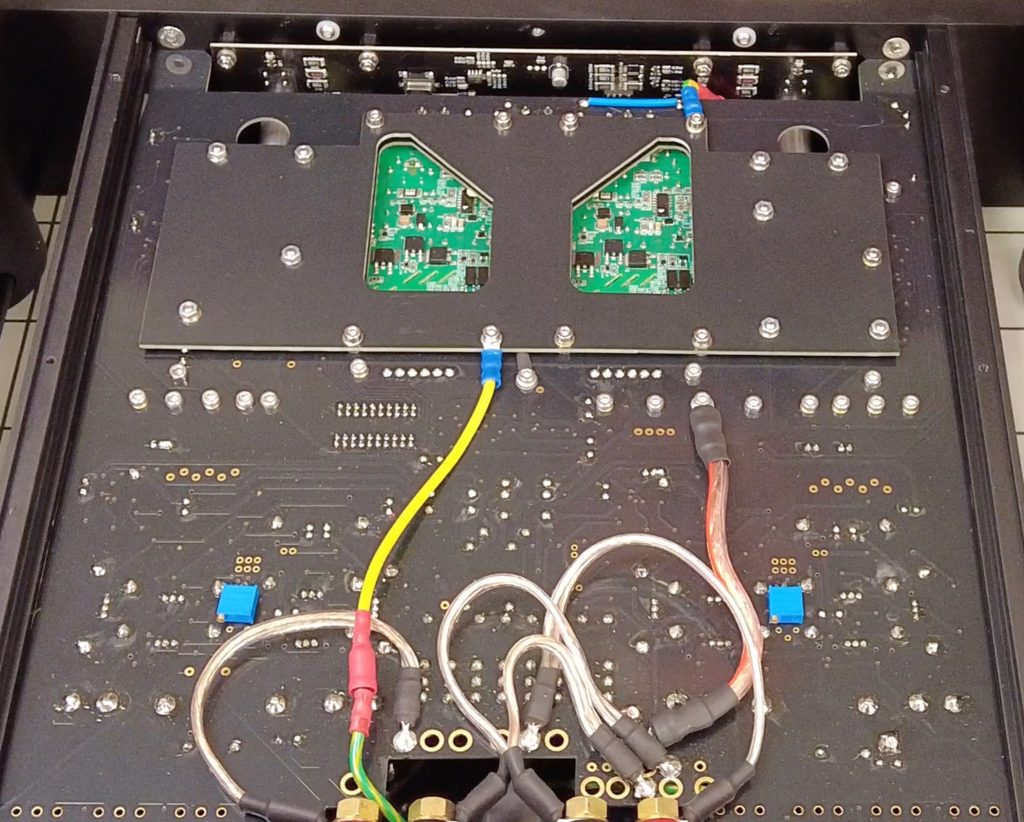
The speaker output binding-posts are entirely unprecedented and can accommodate any type of termination safely, we particularly liked. The electronics themselves are particularly compact if you take into account the fact that it is the central structure that houses the circuits, which are arranged on two large boards, one that can be inspected from the bottom and the other, component side, visible by removing the cover. Of course, it will not be an easy task for the technician who will eventually have to work on the machine, but we believe it is an eventuality that is very unlikely to happen, unless mistakes are made by the owner (e.g., short circuit of the outputs). Of the 4 switching power supplies present, those for preamplification and services are arranged at the top and the other two, the high-current ones, close to the end sections.
The futuristic aesthetics of the Chord Ultima Integrated
This Chord ULTIMA Integrated is no different from any of the British company’s products from an aesthetic point of view. It features a truly original shape that perfectly matches that of the other electronics in the top series. In fact, a dedicated stand is available that accommodates both the amplifier and possibly the pre/power pair and the DAVE DAC, soon to be tested on these same pages. The 4 columns on either side of the cabinet have a central hole that accommodates this structure and allows for very elegant stacking. The impact is undoubtedly particular, original, completely unprecedented in the world of Hi-Fi and beyond.
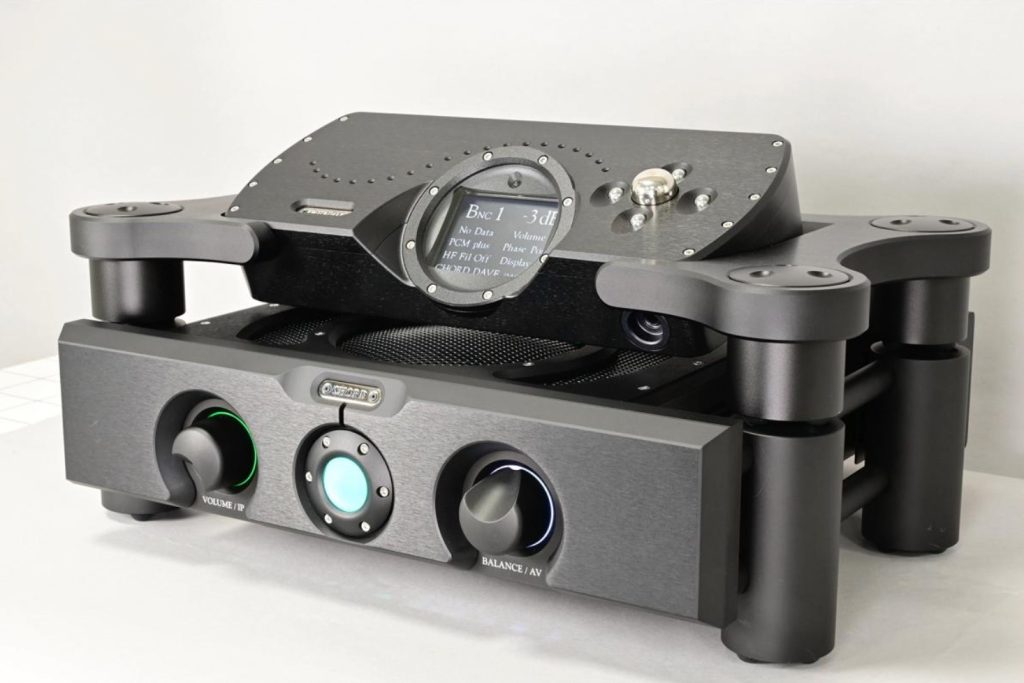
As usual for the British manufacturer, the layout of the controls is somewhat cryptic at first glance. One is faced with two knobs and an “eye” that closely resembles that of Hal 9000 from 2001 A Space Odyssey, which by the way is illuminated precisely in red when the amplifier is on standby. But one quickly becomes familiar with the product. Two light rings coaxial to the same number of knobs that control volume and balance change color when the controls are operated, either by remote control or physically. Repeated presses on the volume knob change the input, the center eye if pressed turns the unit on causing the sphere to change color, and finally the balance while not having the click can be placed more or less in the center since the manufacturer has made sure that there is some tolerance in the position that still ensures 0 between channels. The remote control is milled from solid aluminum and is quite compact and well made. It looks a bit too “normal” for a manufacturer like CHORD; we would have expected a much more “exotic” shaped object, but it perfectly performs the functions to which it is called.
A sound between the old and the new
We conducted numerous listening sessions with the Chord ULTIMA Integrated, using the Kaya S12s as speakers and the usual Aqua La Scala MK II for DA conversion. First of all, an innate driving ability stands out, allowing control without any uncertainty of the little ones from Vivid’s house, which, though relatively small in size, are a perfect litmus test for assessing current delivery. It seems more powerful, much more than the nameplate figure, but of that power that does not appear exuberant and overbearing as some modern products can do, but rather docile, gentle, not arrogant or overbearing. It is a reserve that is there but is expressed on the spur of the moment and does not emerge at all costs. But what is most striking is the sound that seems to come from a class-A amplifier. We do not know, we did not understand exactly, how the power sections work; there is talk of variable quiescent current, endorsed by the low temperature the fins reach, but what exactly this means in terms of bias only John Franks knows. The fact of the matter is that the sound is typical of a class A and closely resembles that of Musical Fidelity’s A1, albeit with due proportion. Delicate, compassed, extremely airy and well-proportioned, it makes you want to listen and listen, without ever being boring or tiring, as if our Chord ULTIMA tends to disappear, not to “pronounce itself,” in short, to let the music do the talking, with a very fine grain especially in the midrange and mid-highs, where it manages at times to be even moving. Not that the low end does not speak its mind in an energetic and effective way, far from it, in an extremely homogeneous and fluid sound message. In short, a machine that seems to belong to a higher class, much higher, and that does not seem to have any flaws except that of not being able to be interfaced to too large speakers with which it might go into some distress. It is very powerful and capable of delivering, but of course everything has a limit.
Technical specifications:
- Frequency response: 10 Hz-200 kHz +/- 3 dB
- Distortion THD: 0.01 % 20 Hz-20 kHz
- Signal-to-noise ratio: 90 dB all input
- Input impedance: 100 kΩ
- Maximum input voltage: 3 V RMS
- Maximum output voltage: 35 V RMS
- Gain: 21dB
- Separation: 100 dB
- Supply voltage: 80-250 V AC auto-switching
- Output power: 125 W on 8Ω
- Power Consumption: 200W
- Dimensions: 13 cm(H) x 48 cm(W) x 38 cm(D)
- Weight: 14.5 kg
Manufacturer: CHORD Electronics
https://chordelectronics.co.uk/
Distributor: HIFIGHT Italia VIa E. Fermi 20/2 35030 Rubano PD
Price: €11,350




GIPHY App Key not set. Please check settings