

 Audio 2G
The Crescendo series constitutes LAiV’s new entry-level range, and is designed to make the performance of the higher-end models accessible to as wide an audience as possible, while remaining true to the engineering philosophy and elegant design that has characterized the Singapore-based company since its debut in 2023. The Verse DAC is the first product in the Crescendo range.
Description
The manufacturer is keen to specify that the Verse is not a “simplified” version compared to the higher-end models, but rather a machine that preserves most of the typical and I would add “identity” features, of the models of this brand that we have had the opportunity to test over the past year, such as theHarmony DAC, the Micro DAC and the Micro DDC. All this in order to preserve what matters most, namely musicality and signal integrity. So let’s start with the compactly sized, square-plan cabinet, made of finely brushed aluminum and finished in black or gray. the unit is 16.8 cm wide, 18.8 cm deep (including connectors) and 4 cm high plus an additional centimeter for anti-vibration feet. The weight is just under a pound.
Interestingly, there is not a single screw visible (they are all on the bottom panel) and the characteristic upper left beveled corner has been retained, on which is the power button and the engraved model abbreviation, which complements the large embossed logo on the top surface.

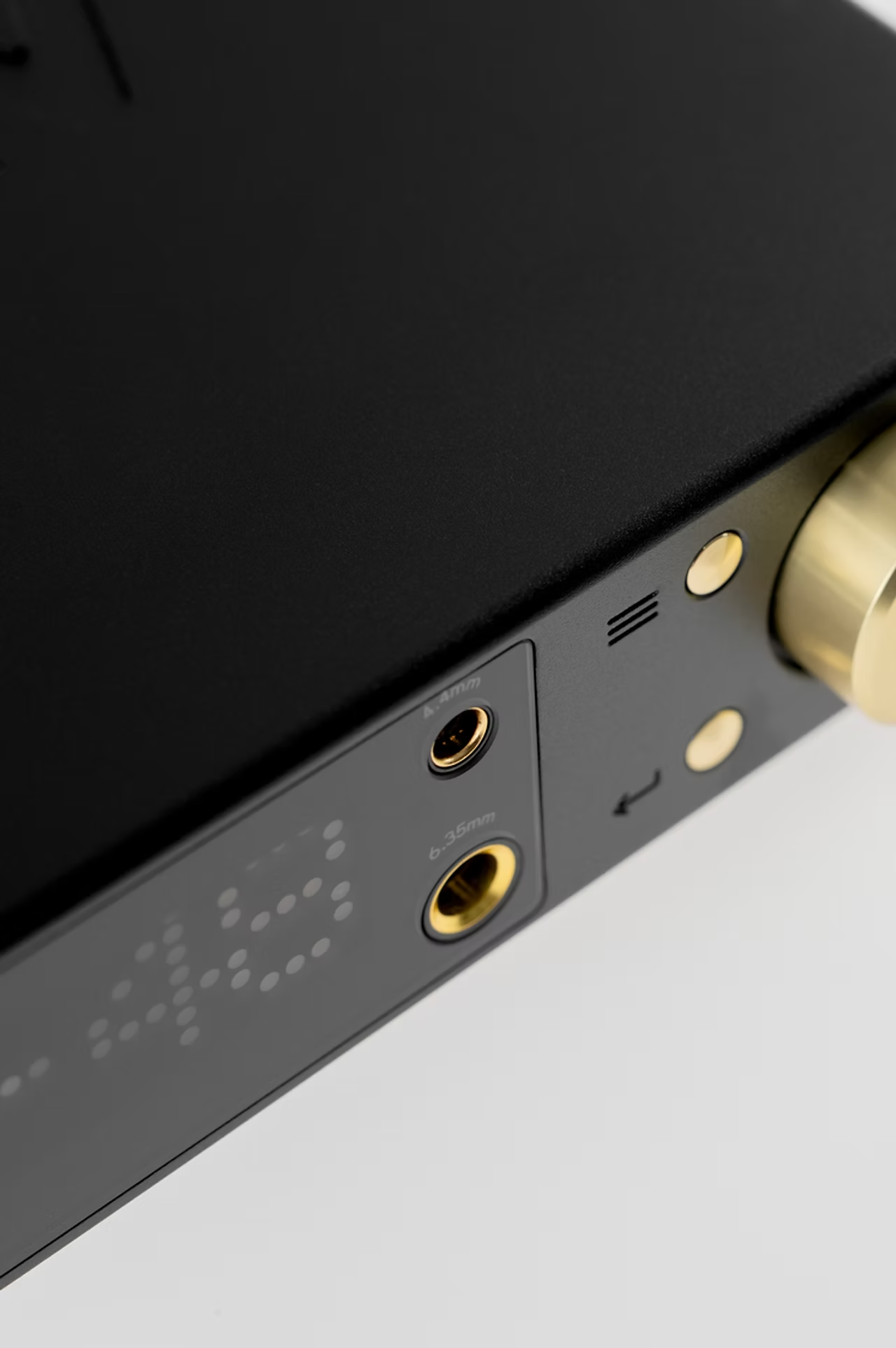
Another element that adds to the Family Feeling is the large character display with dot graphics. Since it is not particularly large, the information displayed does not always all fit in the available space, and since it scrolls across the display(Running Text), it can take a while to get used to reading it. The display can be set to auto-dimmer and/or auto-off, however, since it is LED, there is no risk of burn-in, so it can also be left on indefinitely. Next to the display are the two headphone outputs: one 6.3 mm and one 4.4 mm (balanced). In addition, there are two buttons for navigating the menus and, on the right, the encoder for adjusting the volume. The output of the Crescendo Verse can be set to fixed to function as a pure DAC or to variable to enable the built-in analog preamplifier.

Moving to the rear panel we find on the right side the set of digital inputs that includes: optical, coaxial and USB; there is also I2S on HDMI connector with a choice of 8 different pin configurations for wide compatibility. Should it be used in combination with other LAiV products the selection is made automatically. Slightly to the right is the input for the supplied 15V / 2A switching power supply. Analog output is on both XLR and RCA connectors, working in parallel. We found the solution adopted for updating the firmware very interesting, which includes an SD Card reader located on the bottom of the unit. This is decoupled from the table top by means of four attractive metal feet.

LAiV Crescendo Verse: technique
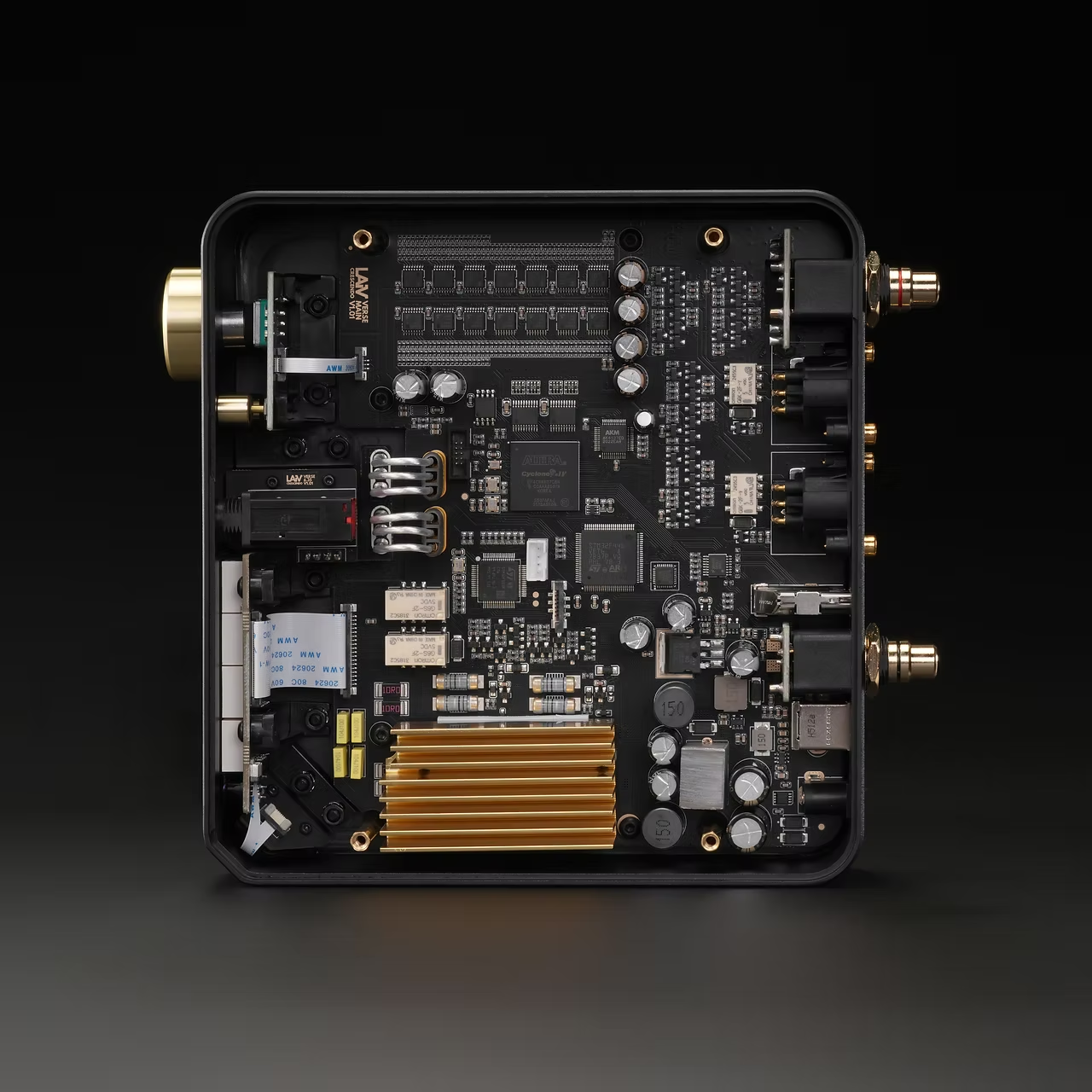
The D/A conversion section is based on a proprietary R2R symmetrical architecture with 0.05 percent tolerance resistors. This is an obvious “descendant” from the fine modules that equip the superior Harmony series, lacking, however, the beautiful gold-colored cabinet/heat sink that we had so much appreciated during our testing. This conversion section is capable of processing PCM and DSD signals (in native 1-bit format, but also via conversion to PCM), either without any modification (NOS = Non Oversampling) or with optional upsampling. In that mode (SRC), one can select 1x, 2x, 4x, 8x or 16x PCM upsampling rate and even resample to DSD 64, 128, 256 and 512. Finally, the digital PCM filter can be switched in SRC mode between Sharp and Slow. The power to perform such complex calculations is provided by the Intel Altera Cyclone FPGA platform. The headphone outputs are also extensively configurable: one can choose their gain to match the parameters of the headphones in use. The unbalanced output offers as much as 5.5 Vrms / 290 mW with an output impedance of 2.6 ohms, while the balanced output goes as high as 11 Vrms / 1100 mW with an impedance of 5.1 ohms. The output power is adjustable in three levels. Volume control is based on a buffered output module with 60 levels of attenuation available. Classic 2 volts are available at the output for on RCA connections and double for on XLR connections. Impedance is 82 ohms (XLR) and 41 ohms (RCA).

Listening
We listened to the LAiV Crescendo Verse by connecting it to the balanced inputs of a Vitus Audio Ri 101 MKII amplifier and, alternatively, a Canor Virtus A3 driving Vivid Audio Kaya S12 speakers. As a digital source we used a DIY audio PC with JCat components, on which runs the Audiolinux operating system. The wiring, as usual, is Neutral Cable from the Reference series. I would begin by addressing the question of the differences between NOS and SRC (or, if you prefer, OS) modes. Of course, I conducted extensive listening in both modes, but in general the NOS mode convinced me more. The strange thing is that with The Harmony DAC and with the uDAC this impression was more nuanced, while with the Verse I had no hesitation. In general, in NOS mode, the sound seemed to me to be more articulate, tangible, and direct, albeit sometimes tending to be too dry. As mentioned earlier, when operating in oversampling mode, the Verse offers a wide range of options including re-sampling to DSD 64, 128, 256 and 512. Using 16x DSD, for example, the sound becomes smoother and more relaxed with a slightly wider soundstage.
As far as the overall performance is concerned, I would have no difficulty in praising the Crescendo Verse for its excellent articulation, excellent resolution, and the overall smooth feeling that, especially in the high range, makes listening really enjoyable. Of course, having reached this point in the test, the mechanism of comparison with the LAiV uDAC was involuntarily triggered. Comparison that, moreover, is worth what it is worth having been carried out “asynchronously,” thus relying on memory and notes written at the time. I will return to the subject shortly in a dedicated paragraph, nevertheless I can serenely state that the uDAC expresses itself better in terms of timbre, dynamic capacity and, in general, “dimensional scale” of the reproduced sound. After all, however, it could not be otherwise: the Crescendo Verse is not only cheaper than the uDAC, but also offers several more features. So it cannot be compared to “pure” DACs since, in fact, it is not.

LAiV Crescendo Verse as headphone amplifier
We took advantage of the presence in the studio of an AUNE SR7000 headphone to essay the capabilities of the Crescendo Verse as a headphone amp, since this is one of the roles for which it was designed. I am not a headphone expert (you know that), nevertheless I was impressed by the combo which showed an unexpected pleasantness by virtue of a sound that is transparent, detailed but, at the same time, fluid and absolutely non-fatiguing even for those who, like yours truly, have decidedly short headphone listening endurance times. For the sake of completeness, I want to report that the connection used was the balanced one (4.4 mm) and that the various gain settings had a particular effect on the perceived quality. In particular with the maximum gain there was a certain harshness and aggressiveness perceived, while at the minimum, given also the type of SR7000 (closed headphone) there was not enough drive. The choice therefore went to the medium gain where there is less precision than at the highest gain, largely balanced by a feeling of greater softness and harmoniousness.

Compared with uDAC
When the LAiV Crescendo Verse was delivered to us, we wondered what the point of this device was given the presence of the uDAC in the Singaporean company’s catalog to meet the needs of the audience using desktop systems. Incidentally, there is also a risk of undervaluing the LAiV uDAC, since its size is about half that of the Verse and it offers fewer options at a comparable price. For example in the uDAC, it lacks volume control, DSD resampling, and headphone outputs. However, the better sound quality largely explains the point. Certainly the Verse sounds very good, but the uDAC’s bass performance is basically similar to that of the top-of-the-line Harmony DAC. So a considerably more articulate, robust and prominent bass than that of the Verse. Timbrally, the uDAC seemed to me to be more realistic, making the instruments in the large orchestra more believable, partly by virtue of better dynamic behavior that makes it more expressive. Finally, the uDAC is able to represent the virtual soundstage by providing a more articulate, wide and coherent image.
LAiV Crescendo Verse: conclusions
The LAiV Crescendo Verse DAC goes far beyond the functionality of a basic DAC: the R2R ladder type made of discrete components, the analog volume control, the output preamplifier also made of discrete components as well as the headphone amplifier stage, place it in a higher market segment. Whether in use as a fixed-volume DAC or as a preamplifier/DAC driving a power amplifier (or powered speakers), even as a headphone amplifier, the Verse always delivers a sound that is precise and articulate but, at the same time, smooth and refined. It certainly does not reach the heights of realism and authority that we heard with the Harmony DAC or the uDAC/uDDC combo, yet it offers more flexibility and functionality at a considerably lower price.

The Verse thus comes into its own as a flexible and musically rewarding DAC and amplifier that brings several key LAiV technologies to a more affordable level, with largely acceptable tradeoffs compared to high-end models that cost considerably more.
Giulio Salvioni
Technical characteristics:
- Chipset: Intel® Altera® Cyclone® FPGA Chip
- Inputs: USB-A, Optical, Coaxial, I2S
- Analog output:
- 1 x XLR, approx. 4 Vrms, 82 ohms
- 1 x RCA, approx. 2 Vrms, 41 ohms
- Headphone output:
- 1 x Balanced 4.4 mm jack, approx. 11 Vrms / 1100 mW, 5.1 ohms
- 1 x Single Ended 6.35 mm jack, approx. 5.5 Vrms / 290 mW, 2.6 ohms
- Supported formats: up to 768, DSD256
- Frequency response: 20Hz – 80kHz, ± 3 dB
- Distortion THD:
- 0.0045% (Preamp)
- 0.008% (Headphone amplifier)
- Crosstalk: <100 dB
- Power supply: 15VDC / 2A, DC 5.5/2.5mm female
Price: $849.00
Manufacturer: LAiV 24 Sin Ming Lane Singapore 573970
Distributor: Polaris Audio Via Matteo Babini 28 00139 Rome




GIPHY App Key not set. Please check settings