



 Andrea Allegri
The Installation
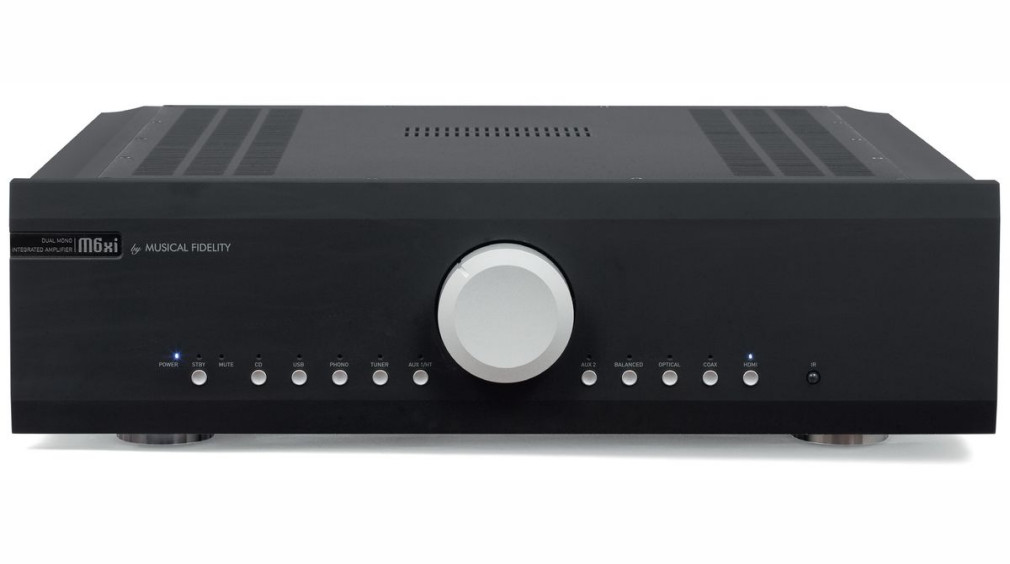
The M6xi is a versatile integrated amplifier that supports numerous inputs and allows you to set up a system geared toward both various types of digital sources and analog sources. It features four RCA line inputs, plus one balanced input and a phono stage whose gain is selectable for MM or MC cartridges via a switch on the rear panel. The AUX1 input can also be configured as direct access to the output stages, without volume attenuation, as if the Musical Fidelity M6xi were a power amplifier. It features one variable and one fixed preamp output. Digital sources can be connected via an optical and a coaxial input. You can also connect a PC via the USB-C input, which supports up to 24-bit/192 kHz PCM. A useful bonus is the HDMI eARC input, which allows you to integrate audio from a TV into your high-end audio system. There’s also a convenient USB-A port for powering an external device (it does not carry data, however). The amplifier gets a little warm but not excessively so and can even be housed inside a cabinet as long as it has enough space to dissipate heat.
Musical Fidelity M6xi: TheListening Experience
The Musical Fidelity M6xi integrated amplifier has a balanced and musical sound signature and delivers impressive power capable of driving demanding speakers in medium- to large-sized rooms. The tonal balance is full, with a solid low end and good extension into the upper register. Its ability to deliver a controlled and deep bass response is combined with an excellent upper-midrange—natural and transparent—which, taken together, creates a beautiful sense of realism. For the test, we used Bowers & Wilkins 804 D3 speakers—accurate but also demanding—which the British integrated amplifier did justice to, fully exploiting their potential in a 30-square-meter living room. Solidity, texture, and excellent control of the woofers allowed it to handle even demanding tracks with truly convincing results—the kind we’d expect from more expensive amplifiers.
Power and good control are complemented by commendable introspective qualities. The attention to detail and refinement observed when using the line and phono inputs are remarkable. The sound texture is refined, and with high-quality sources, the M6xi showcases exceptional resolution. It’s not a tube amp, but it doesn’t lack sensitivity when handling vocals or acoustic instruments with a certain naturalness. This British integrated amplifier makes no secret of its high-end sound ambitions, and during testing it delivered a good dose of emotional impact. It manages to breathe life into classical music, for example, and places no particular limitations on how it drives speakers across all musical genres. Its “refined power” has the ability to deliver current freely while also refining even the most subtle sonic details.
The spatial imaging is also excellent, creating a beautiful sense of three-dimensionality. Instruments and sound sources are precisely positioned on the soundstage and are easily localized not only in the foreground but also in the depth. This is particularly noticeable in orchestral passages, where individual sounds emerge with remarkable clarity. The 3D soundstage and clarity are readily apparent in a soundstage that effortlessly extends beyond the speakers and the walls of the room itself. The result is a very convincing performance with the right genres and recordings.
When evaluating its features, it deserves high marks, especially for the performance of the line inputs and the phono input, which is quiet and accurate. It is certainly more than just a solution for casual listening and can be integrated into a high-quality analog setup. For testing, I used a Technics SL1200G turntable and Ortofon 2M Black LVB 250 and Quintet Black S cartridges, achieving satisfactory results. On the digital side, however, the built-in section performs its task without any particular pretensions. It was clearly designed to offer versatility and convenience—as evidenced by the HDMI port for connecting to a TV—but not to replace a top-tier digital front end . You can also connect a PC, though you won’t reach the highest resolutions currently available, which is its best feature.
From a practical standpoint, it should be noted that the volume level indicator—the notch on the knob—is barely visible from any distance. An LED indicator on the knob, like the one on the B1xi all-in-one, or the digital display on the M6si500, would have been a nice addition.
Concluding Remarks
The Musical Fidelity M6xi is a well-built, well-designed, and high-performance amplifier. The British company has created an integrated amplifier with above-average power, capable of driving even demanding speakers. It combines powerful performance with musical finesse, making it as decisive and refined as we’d expect from a representative of this distinguished British brand. Added to this are high-quality construction, an attractive design, and remarkable versatility in handling both analog and digital sources. All the ingredients for another success are there, especially when we consider that the price (fortunately, this does happen sometimes…) is by no means exorbitant and, compared to many high-end products, might even be a bargain.
Andrea Allegri
Musical Fidelity M6xi: Technical Specifications
- Power: 2x230W into 8 ohms, 2x390W into 4 ohms (1% THD, 1 kHz)
- Maximum peak-to-peak current: 45A
- Damping factor: 49 (8 ohms)
- Output transistors: 2 pairs per channel
- THD+N: < 0.007% typical, from 20 Hz to 20 kHz
- Signal-to-noise ratio: > 107 dB, ‘A’-weighted
- Input impedance: 40 kohm
- Frequency response: +0, –0.1 dB, from 10 Hz to 20 kHz
- Inputs:
- 4 RCA line-level inputs
- 1 balanced XLR input
- 1 eARC HDMI input
- 1 coaxial input
- 1 optical input
- 1 MM/MC phono input with sensitivity (nominal): 3 mV MM / 0.4 mV MC (for 300 mV nominal)
- MM/MC Gain: 40 dB / 60 dB
- Signal-to-noise ratio: >87 dB, ‘A’-weighted
- Input capacitance: 220 pF
- Input impedance: 50 kΩ MM / 1 kΩ MC
- Frequency response: RIAA/IEC ±0.4 dB, 20 Hz – 20 kHz
- 1 USB Type-C connector—up to 24-bit/192 kHz
- Line outputs: 1 pair of fixed RCA connectors and 1 pair of adjustable RCA connectors
- Speaker output: 2 pairs of 4 mm banana plugs
- 1 USB A power output at 5V/2A
- 1 RS232 connector
- Trigger input and output
- Power supply: 115/230 V AC 50/60 Hz (factory default)
- Power consumption: 680 Watts max
- Dimensions: (WxHxD) 440x125x400 mm
- Weight: 18.5 kg
Price: €2,990
Distributor for Italy: AUDIOGAMMA Via Nino Bixio, 13, 20900 Monza MB




GIPHY App Key not set. Please check settings