



 Audio 2G
When it came to Trigon, a German company founded way back in 1996, we mainly remembered a few phono preamps that had enjoyed moderate success several years ago. These were the Vanguard 1 and Mistral models, characterized by high-quality construction and a design that made few concessions to stylistic flourishes. Over the years, Trigon has expanded its product line, and today—following some changes in corporate structure—it boasts an extensive catalog that remains true to the ideals of robustness and simplicity that have defined the company since its inception.
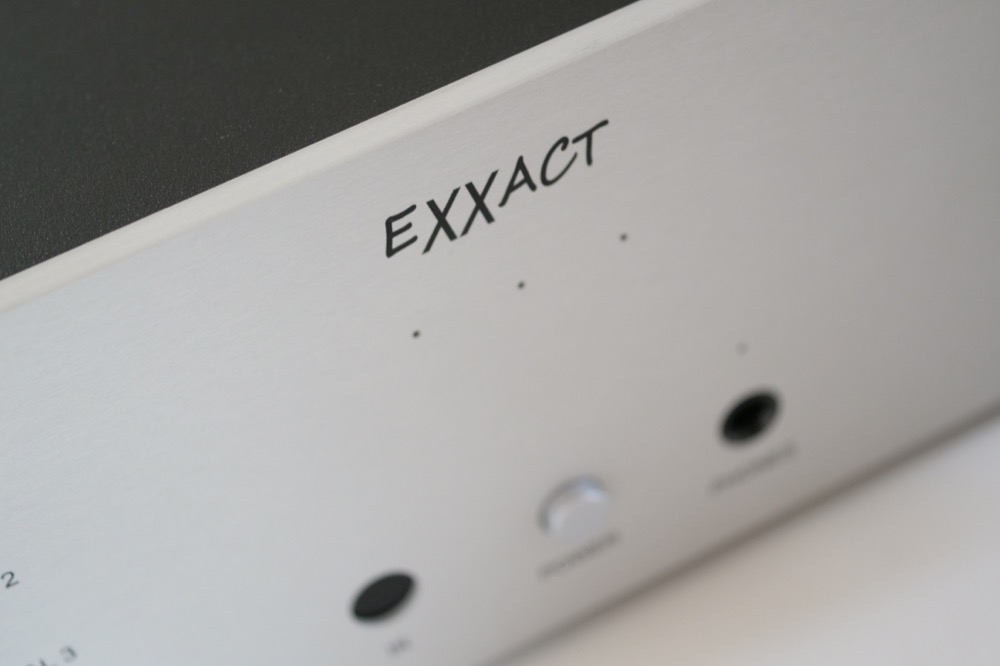
Trigon is a European manufacturer—or rather, “Made in Germany”—focused on the upper-midrange segment of the market. We’re not talking about high-end in the strictest sense, but neither are we referring to the midrange segment currently dominated by Asian manufacturers, who benefit from economies of scale that are difficult to replicate in Europe. Unable to compete on the commercial front, Trigon has chosen to target a high-end segment of the market that emphasizes certain core values: excellent performance, impeccable build quality, and a design that carefully avoids chasing passing trends. The Exxact, the subject of this review, is part of a lineup of five integrated amplifiers and serves as the entry-level model. The other models feature front-panel displays of varying levels of sophistication. The Trinity, the flagship model of the lineup, includes a built-in audio streamer. The Exxact, with its minimalist front panel, is the exact opposite. The philosophy, therefore, is: connect one or more sources, turn on the amplifier, and listen to your favorite music.
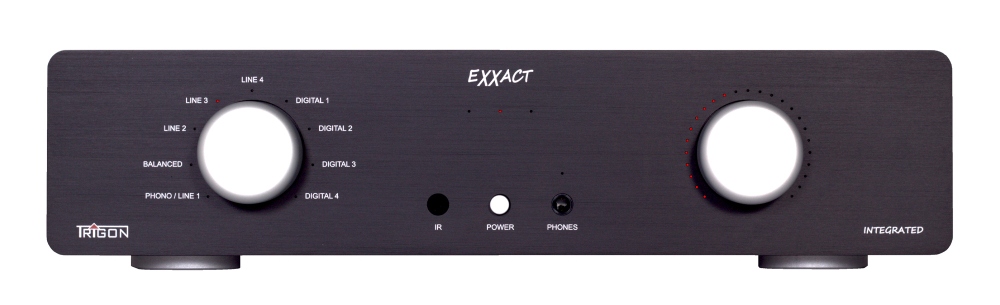
Trigon Exxact: External Analysis
The Trigon Exxact’s chassis is made of sturdy aluminum with an embossed black finish. The front panel is made of 6-mm aluminum, available in silver or black, and features two large knobs on either side. The one on the left is used to select inputs, while the one on the right controls the volume. Both are surrounded by tiny red LEDs that indicate the currently active input and the volume level. While we consider this solution to be well-implemented and effective in practice, we cannot help but note that you must be roughly “aligned” with the unit to see the glow of these LEDs, which are virtually invisible when viewed from an angle.
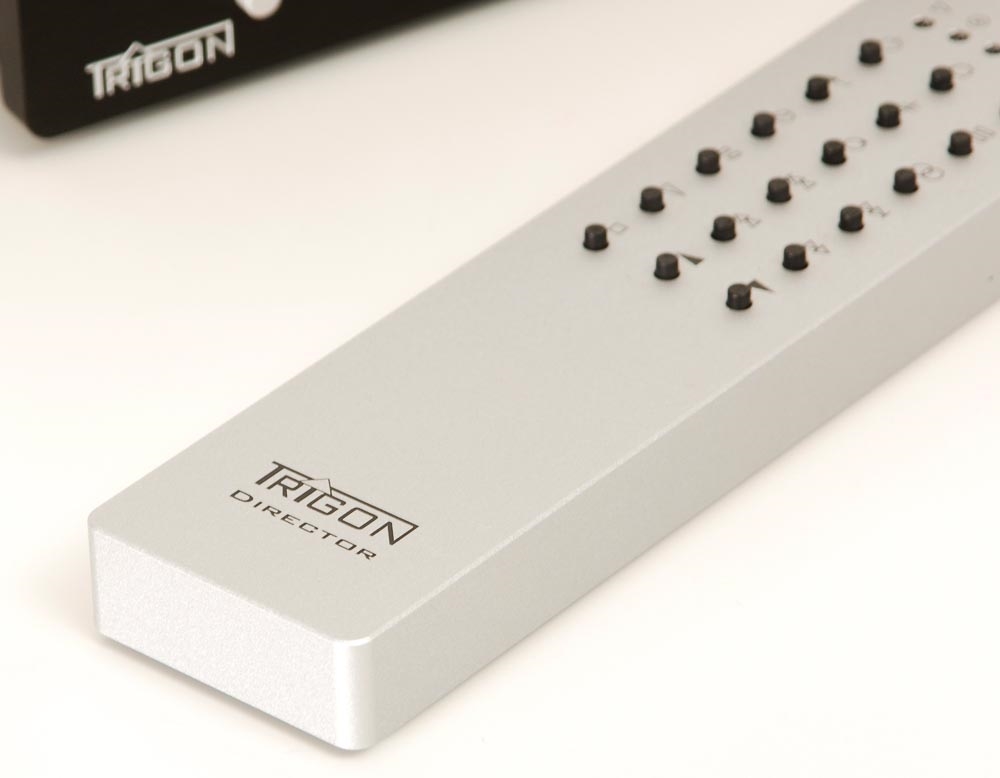
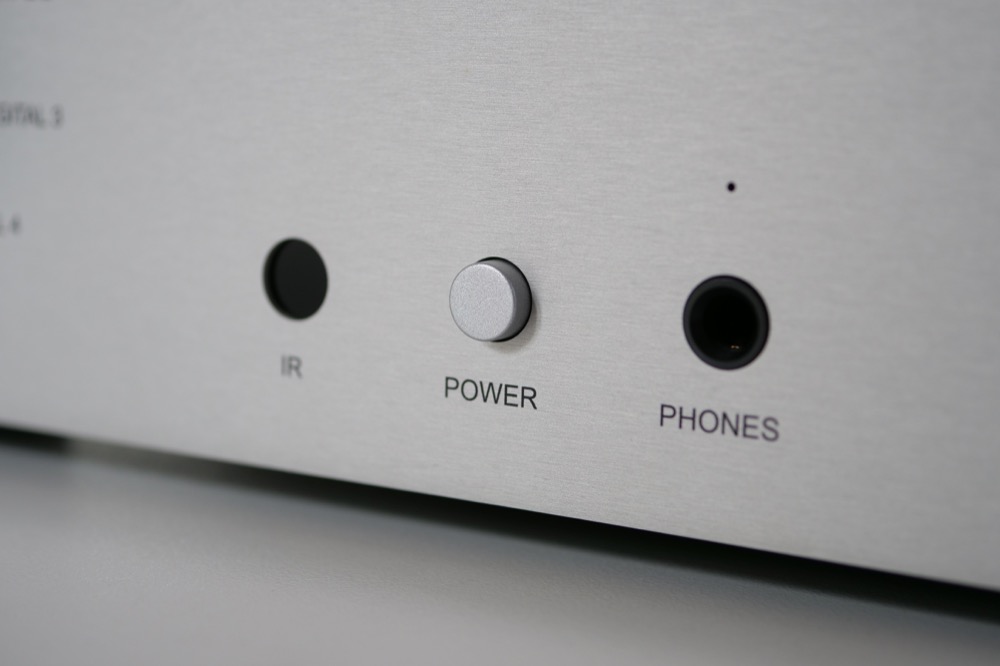
Between these two knobs is the power button, flanked by the headphone jack and the infrared remote control receiver. The latter, called the Director Premium, is quite substantial and beautifully crafted from aluminum, but it has the significant drawback of being sold separately as an optional accessory. As can be seen from the attached photo, it features the essential buttons for operating the unit under review; however, since it is also multifunctional, it includes additional buttons for controlling other devices such as Trigon sources (e.g., a CD player, a streamer, etc.). A red indicator light confirms, both on the remote control and on the amplifier, every time a button is pressed. Kudos to Trigon for the beautiful support feet they’ve designed, which absorb vibrations to protect the audio electronics from mechanical stress that could potentially degrade the sound.
Trigon provides the power cord
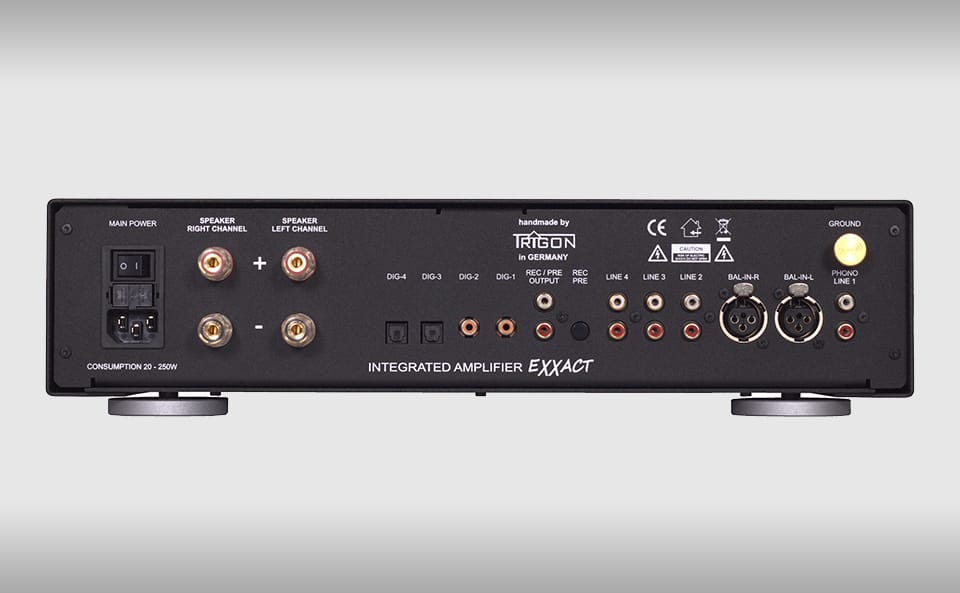
The Trigon Exxact features nine inputs for nine different sources: specifically, there are four unbalanced analog inputs (RCA), the first of which can be equipped with an optional phono module for moving-magnet (MM) cartridges. In addition, there is one balanced (XLR) input. The built-in DAC has four additional digital inputs: two coaxial and two optical. On the output side, there is a pre-out that can be used for a subwoofer or a recording loop, as well as for a headphone amplifier. The speaker outputs are equipped with high-quality connectors but do not support bi-wiring. We were pleasantly surprised that Trigon includes the “Volt” as standard with this amplifier: it is a high-quality power cable manufactured in-house, consisting of three 2.5 mm² pure copper conductors.
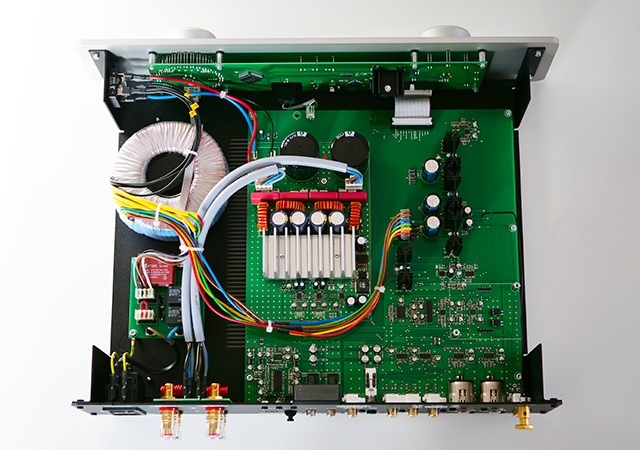
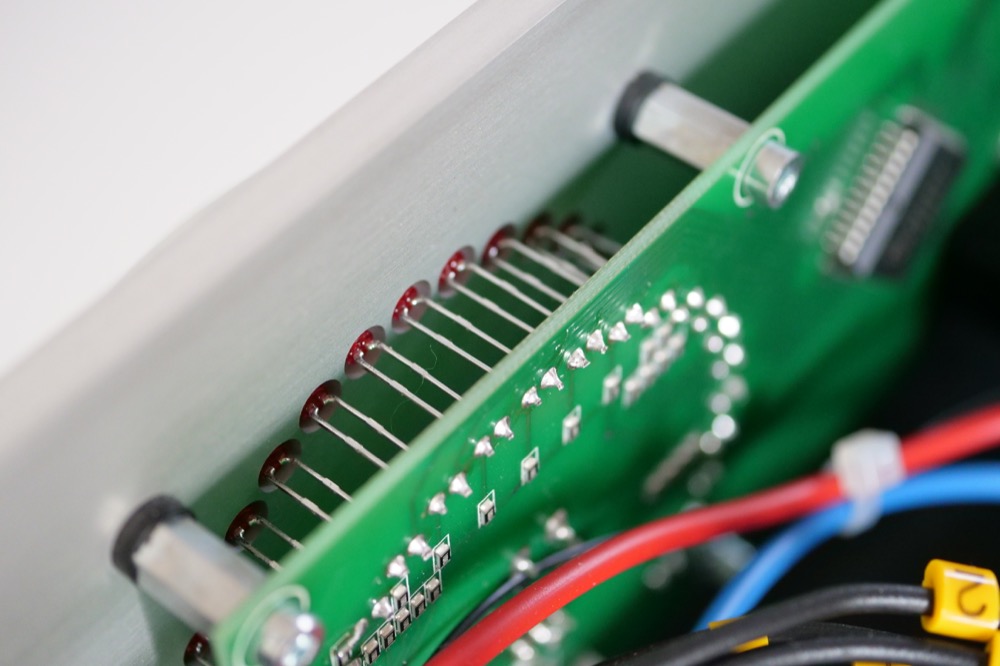
Removing the cover reveals the interior, which—consistent with the exterior design—has a simple and functional layout. Essentially, there is a large PCB that occupies two-thirds of the available space inside the chassis and houses nearly all of the circuitry. This board is logically divided into functional areas. The DAC section is positioned as close as possible to the digital inputs. The Class D digital amplifier section is located in the center and is equipped with two 6,800-microfarad, 80-volt capacitors. The Exxact delivers (2x)120 watts into 8 ohms, which increases to (2x)170 watts into 4 ohms. The power supply is well-designed and relies on a large toroidal transformer. We were quite impressed by the craftsmanship of the vertically mounted circuit board, positioned close to the front panel, which houses the numerous red indicator LEDs for the input selector and volume control.
A wealth of detail and a vast virtual stage
The Trigon Exxact was set up in our listening room, where it drove, among others, the Indiana Line Lira 6 speakers, with which it formed an excellent pairing. As a digital source, we used the Aqua La Scala MKII DAC to test its capabilities in a pairing that was certainly mismatched in terms of price but decidedly revealing. We then used the built-in DAC, driving it with one of our audio PCs equipped with a USB-> -SP/IF converter. Of course, we used the Trigon power cord included with the unit, while the rest of the cabling consisted of Neutral Cable’s Reference series. We can certainly say that the Trigon Exxact amplifier provided us with several hours of truly enjoyable listening. It’s a device with excellent dynamics, capable of gently revealing all the details—even the most subtle ones—in the recordings. The bass range is smooth and incisive, though not particularly deep. This was relatively easy to notice with some jazz recordings where the double bass seemed to have less body compared to other instances in which we had listened to the same tracks with other integrated amplifiers, using the same Indiana Line speakers—which are decidedly well-suited in this regard. The percussion sounds realistic thanks to a remarkable response speed to transients. The mid-to-high range, on the other hand, is impeccable. Vocals are well-defined and clearly separated from the soundstage. The soundstage extends deeply, both in front of and behind the speakers, as well as vertically. All the subtle ambient details that provide clues about the size of the recording venue are faithfully reproduced. In short, we continued our listening sessions for quite some time with great satisfaction, finding the performance of this German integrated amplifier to be excellent—or at the very least on par with that of the best competing products we’ve heard recently.
During this phase of the test, we didn’t ask ourselves any questions about the technologies implemented in this unit, assuming it was a classic Class AB integrated amplifier. The surprise came when we opened it up to take a closer look, realizing that it was actually a Class D amplifier—and not even the very latest generation, since the product has been on the market for a few years now. This left us rather perplexed: the Exxact is one of the least sonically distinctive Class D amplifiers we’ve ever heard. This, of course, sparked a series of reflections that we can summarize as follows: Class D should not be viewed as a technology reserved solely for budget products or those in the entry-level segment of the audio market. It depends on how it is used. In the hands of skilled technicians, it can deliver excellent results. Further consideration should be given to the built-in D/A converter: it performs quite well and is comparable to an external unit in the roughly 1,000-euro price range. However, when listened to with the La Scala MKII DAC, the Trigon Exxact performed much more convincingly, leaving us convinced that this amplifier deserves a higher-quality DAC.
Trigon Exxact: Conclusions
Trigon’s Exxact amplifier is an integrated amplifier with sound quality on par with its price range. It offers excellent dynamics and a low-frequency response that, while not extremely deep, is lively and engaging. The detail in the mid-to-high range is remarkable. The virtual soundstage it produces is wide across all three axes and has a believable sense of scale—provided, of course, that it is paired with high-quality speakers that are properly positioned in the listening environment. Its power handling capabilities, moreover, mean there are no limitations on speaker choice; the decision should be based primarily on maintaining consistency within your budget. From a usability standpoint, we can attest that it is extremely easy to use, thanks in part to its simple, no-frills design. The built-in DAC, though limited by the lack of a USB input, eliminates the need for an additional purchase—at least until you decide you want something better. The only two flaws we’ve identified relate to sound quality and marketing, respectively. The first is a slight lack of solidity in the lower frequencies. The second concerns the decision to sell the remote control separately, which, these days, must be considered an indispensable accessory. Ultimately, the Trigon Exxact is a device that gets straight to the essentials, making you forget it’s even there thanks to its excellent sound reproduction, solid build, and ease of use.
Giulio Salvioni
Specified Technical Data
- Inputs: 5 analog, 4 digital SPDIF at 192 kHz and 24-bit
- Analog input resistance: 47 kOhm
- Input sensitivity: 0.5 V
- Output power: 2x 95 / 130 W at 8/4 ohms
- Damping factor: >100 (referenced to 8 ohms at 1 kHz)
- Total harmonic distortion: (THD + N) < 0.02%
- Outputs: 1x speaker, 1x headphones, 1x unbalanced line output
- Frequency response: 20 Hz – 22 kHz (-3 dB)
- Signal-to-noise ratio: -94 dB relative to 1 watt at 4 ohms
- Weight: 11.3 kg
- Dimensions: 440 x 110 x 380 mm (W x H x D)




GIPHY App Key not set. Please check settings