



 Audio 2G
Close your eyes, and the world around vanishes. Only music remains, alive, enveloping, three-dimensional. This is Yamaha ‘s slogan for the 5000 series, the Japanese brand’s new benchmark. A design created to restore sound in its most authentic, uncompromising form, as if the listener were sitting in front of the artists in the studio or on a concert stage. 5000 Series, these preamp and power amp, a pair of speakers, the NS-5000 and a turntable, the GT-5000, the culmination of the Japanese manufacturer’s experience in the field of reproduction, entirely analog products and built with an independent and balanced structure, designed, in short, according to them, to eliminate any barrier between the music and the listener. And the result -in fact- is an unprecedented level of musical expression, not only in the range to which this pairing belongs, but far beyond. In fact, let us not forget that the approximately €16,000 needed to take home the devices is about the same as that needed to buy one of the many super-integrators available today, but there is a difference ….
C-5000 a prepper like the old-fashioned ones
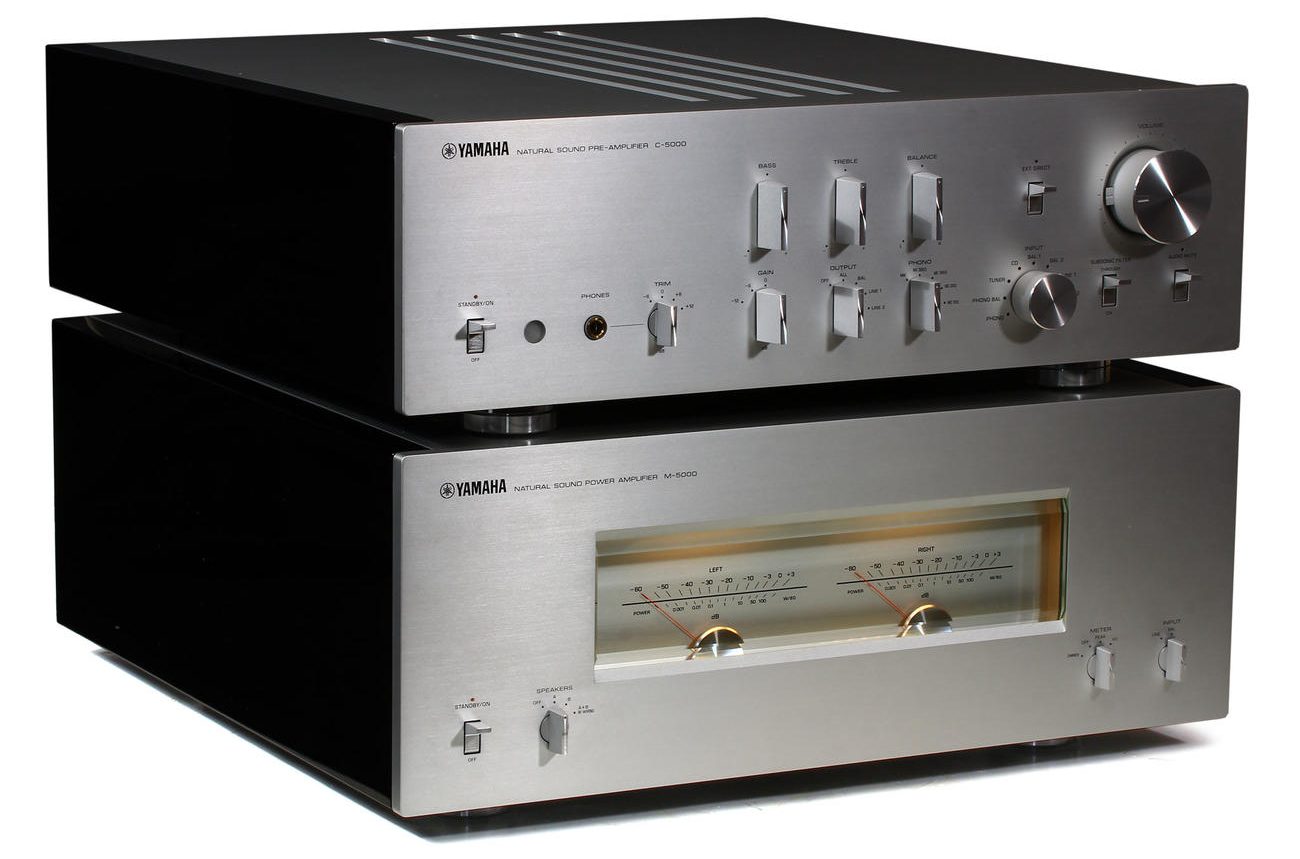
It is a concentrate of engineering and craftsmanship where Yamaha’s patented Floating and Balanced technology was first applied. This solution allows for a stable, smooth and perfectly balanced signal path while minimizing interference. The circuit design, is built with the “worst” manic precision of which only the Japanese are capable. The construction of C-5000 is a masterpiece of symmetry. The “book-matched” architecture, inspired by woodworking techniques, includes two mirrored boards dedicated to the left and right channels.

This design reduces distances between sections, minimizes internal connections and optimizes signal purity. Even the materials chosen-copper screws and lugs, aluminum stabilizing blocks, and newly designed feet-contribute to mechanical stability and sonic consistency. Floating and Balanced technology ensures complete isolation from ground noise, the signal is kept balanced from input to output, and even one of the turntable inputs is balanced.

The aesthetic of the C-5000 is typical Yamaha, understated and beautiful in its absolute classicism. Solid aluminum front panels, polished wood trim, and a very nice volume knob but which unfortunately lacks a position indicator LED, which would allow from a distance to check the position of the knob.
Many special things
That C-5000 is an extremely refined product is little but certain. But some completely or almost completely unprecedented details make us think how much the product is the result of precise thinking, and this in the round, to achieve the best possible sound, but also to make the product extremely versatile, both operationally and in terms of versatility. Let’s start with the muting control, which is not done with a switch into which the signal passes, but rather through an actuator that lowers the volume knob, acting on the motorization, a brilliant idea. The tone control, then, does not have a bypass, which again would be implemented by a switch, instead there are relays that act the moment one of the two tone knobs is turned, in the middle position the signal passes undisturbed, only moving one of the knobs respectively engages only the filter of the treble, bass, or both -congratulations!!-. Then there is the ext.direct, which is a pass-trought for home theater, but also for a preamplified DAC, for example, it heads to a button on the front panel that takes care of bypassing the preamp completely, putting the “ext-in” inputs of course both XLR and RCA directly with the outputs, relays take care of it, which “brutally” take the signal and put it to pass.

The input knob, then, among its many positions also provides for “phono-bil,” which means that C-5000 has an XLR input for turntables, from memory we have never come across such an option, but then again, the 5000 series turntable has balanced outputs, so there was no other way around it. This is to the benefit of quietness. And speaking of Phono always from the front panel you can select the type there cartridge, MM or MC and the MC load between 300Ω/100Ω/30Ω/10Ω something already seen but the some top end products. Then the knob that engages the various outputs, with the off position for headphone listening, all of them, XLR and the two line. Much more interesting is the gain control, 0/-6/-12-very useful for best interfacing C-5000 with any power amp. Tidbit for headphone listening lovers, the “trim,” which increases (+6/+12dB) or decreases (-6dB) the level of the headphone output to fit best with any product. But versatility also extends to the rear panel, as you can choose both the phase of the XLR inputs and the level, with an attenuation of -6dB.
M-5000 a power amp of "only" 100W per channel.
Again applied Floating and Balanced technology applied in a configuration that allows symmetrical push-pull operation. The chassis containing the circuits is spectacular, composed of copper-clad steel sheets, supporting the three main blocks – power supply and power amplifiers – isolating them from vibration. Everything is designed to minimize impedance and ensure a short, linear, interference-free signal path. Attention to detail also extends to mechanical grounding, a concept developed by Yamaha to suppress micro-vibrations that could compromise sound quality. Transformers, capacitors and internal components are balanced with millimeter precision and “grounded” via machined brass feet.

The 1200 VA toroidal transformer is mounted on a brass base plate, and provides an impressive power reserve. The design conveys authority and sophistication with backlit Vu-Meters and a crystal window reflecting the typical aesthetics of Yamaha’s flagship line. Few controls this time, the one on the Vu-Meter that also allows backlight adjustment and speaker selection, two pairs of speakers can be wired in. M-5000 can be bridged by simply moving a switch on the rear panel, and of course by appropriately wiring the speaker output.
The Japanese philosophy of monozukuri
The internal realization is a journey into the Japanese philosophy of monozukuri which is expressed as a perfect synthesis of engineering rigor and craftsmanship sensibility, a form of dedication that transcends mere industrial production to become an act of conscious creation, where every component, every connection, and every construction choice arises from a deep respect for the material, for the sound, and for those who will hear it; just as in the construction of Yamaha grand pianos or wind instruments, where the harmony between wood, metal, and the craftsman’s breath gives rise to a unique and unrepeatable voice, so too in the C-5000 and M-5000 the quest for perfection translates into balance and purity, starting with the architecture floating and balanced which isolates the circuits from any unwanted vibrations, to the completely symmetrical and balanced layout that keeps the signal unaltered from the first input to the final output; the use of shielded toroidal transformers, copper chassis, and solid brass feet not only responds to criteria of electrical efficiency, but reflects a conception of sound as a physical and spiritual entity at once, in which mechanical precision serves musical truth; and just as in the luthier who tunes his instrument to the point of perfect resonance with his spirit, Yamaha’s engineers conceived of this pairing as a living organism, where technique and art, science and emotion, merge into a single creative gesture, embodying the deepest lesson of monozukuri: perfection is not an end point, but an ongoing journey of care, respect, and harmony between the creator, what is created, and the resulting sound
Listening, sound calligraphy
Listening to the Yamaha C-5000 and M-5000 pair immediately returns the feeling of being confronted with a realization that transcends the concept of pure electronics to approach that of a musical instrument. From the first contact, everything communicates an obsessive attention to detail: the impeccable construction, the absolute silence of the controls, the precision of the channel balance, the specific weight of the mechanics. It is an object designed to last, but more importantly to perform over time, like an instrument that improves with the maturity of the listener and the environment. Connected to a LiVE µDAC with µDDC and Aqua La Scala MKII and the now well-known Vivik Kaia S12s, the C-5000/M-5000 duo immediately reveals its sonic identity: neutral, lucid, coherent, yet capable of excitement. The timbre is of a disarming naturalness there is no perceptible coloration, but a tonal balance that returns the recordings to their essence. The middle register is stunning: vocals and acoustic instruments emerge with physical presence, but without ever encroaching. Sibilants are controlled, the high range extends with a brilliance that never hurts, while the bass descends with authority and articulation, always perfectly governed by the power reserve of the power amp.
The C-5000 preamplifier is whisper-quiet, with its fully balanced topology and floating-frame construction, operating like a silent conductor: it does not impose a character, but lets the music breathe, “porting” it for what it is. Channel separation is almost palpable, and the background silence is so deep that normally buried micro-details emerge-the breath of a clarinet, the touch of a plucked string, the natural reverberation of a hall. The M-5000 power amp, for its part, is a lesson in control and dynamics. Its watts, nominally “only” 100 per channel in class AB, seem infinite: the feeling is one of total mastery of the load, with a dynamic reserve that results in a lightning-fast, but always measured, transient response. Energy is never exuberant, but metered with Japanese elegance – like the strike of a perfectly controlled shamisen, in which force and grace coexist in the same gesture. The sound stage is wide, stable, three-dimensional. The instruments are placed in space with almost tactile definition, the central focus is firm, and the side perspectives open naturally, without perspective artifice. The system renders the air around the instruments, the depth of the sound planes and the microdynamics of the harmonics with a transparency like reference equipment. But what is most striking is the feeling of absence of listening fatigue. Even after hours of music, the system never tires: the tonal balance, dynamic coherence and purity of timbre generate a deep, almost meditative pleasure. It is a machine that invites slow listening, progressive discovery, like a sonic calligraphy that reveals new features with each passage. In acoustic or orchestral genres – chamber jazz, string quartets, symphonic music – the Yamaha pairing expresses timbral refinement and harmonic depth of the highest order. But it also surprises on well-crafted rock and pop recordings, where it displays controlled rhythm and exemplary rhythmic solidity. The coherence between the two electronics is total: the signal passes from the preamp to the power amp like a clear flowing trickle of water, without turbulence or compression, keeping every musical breath intact. This is no accident, but the result of the monozukuri philosophy, which permeates the entire design. Just as in the construction of a concert piano, where every string and every hammer is adjusted by hand to achieve the perfect balance, so too in the C-5000 and M-5000 every detail-from the signal path to the placement of transformers, from the anti-vibration mechanics to the internal wiring-has been the subject of almost ritualistic attention. It is in this fusion of science and craftsmanship that lies the soul of the Yamaha sound: a sound that does not seek to amaze, but to restore, with respect and precision, the emotional truth of performance.
A unique experience at a high-end integrated price point
To listen to the C-5000 and M-5000 is therefore to have an experience in which technique becomes poetry: an encounter between the engineer and the musician, between the rationality of the circuit and the spirituality of sound. It is a demonstration of how the Japanese tradition still manages to combine the absolute modernity of technology with an almost sacred respect for the art of making, creating and listening. All this at a price, just over 16,000€ list price (7999 for C-5000 and 8199 for M-5000) that given the countervalue offered seems an absolute bargain.
Technical characteristics:
C-5000
- Line input sensitivity: 200mVrms/52kΩ
- MM/MC phono sensitivity: 2.5Vrms/100µVrms
- Maximum line input signal: 2.8V rms balanced
- Output voltage: 1Vrms/150Ω
- Frequency response: 10Hz-100kHz 0/-3dB
- Total harmonic distortion: 0.01%
- Separation between channels: >110dB
- Signal-to-noise ratio: >110dB
- Headphone output: 35mW at 32Ω
- Power consumption on/stby: 60W/ 0.2W
- Dimensions: 435X142X451
- Weight: 19 kg
M-5000
- 8/4 Ω power: 100/200W (0.07% THD)
- Dynamic power 8/6/4/2 Ω: 125/170/250/500W per channel
- Inputs: XLR/RCA
- Operation mode: stereo/bridge
- Bandwidth: 10Hz-50kHz
- Damping factor: >300
- XLR/RCA Sensitivity: 2/1 V rms
- Total harmonic distortion: 0.0035%
- Signal-to-noise ratio: 110dB
- Power consumption ON/stby: 400W/0.2W
- Dimensions: 435X180X464
- Weight: 26.9 kg
Manufacturer: Yamaha 10-1, Nakazawacho, Naka-ku, Hamamatsu-shi, Shizuoka, 430-8650, Japan
Distributor: Yamaha Branch Italy Via A. Tinelli, 67/69 20855 Gerno di Lesmo (MB)





GIPHY App Key not set. Please check settings