



 Audio 2G
Luxman is a Japanese brand that has been in business since 1925 making audio equipment characterized by extremely high quality standards achieved through obsessive attention to even the smallest detail. Its equipment has always conveyed such a feeling of authority and elegance as to place it in a kind of temporal “limbo.” In my memory, this manufacturer has never allowed itself to be seduced by the fashions of the moment, and that is why today’s Luxmans, to a less than attentive eye, could be mistaken for those of several years ago. TheLuxman L-509Z integrated amplifier we are trying out today, with a purely analog setup, does not deviate from tradition and therefore concedes little to modernity on an aesthetic level. Quite different is the matter with regard to the technologies on board, which are instead state-of-the-art. In short, a concentrate of Japanese “understatement.”
Luxman L-509Z Integrated Amplifier: External Analysis
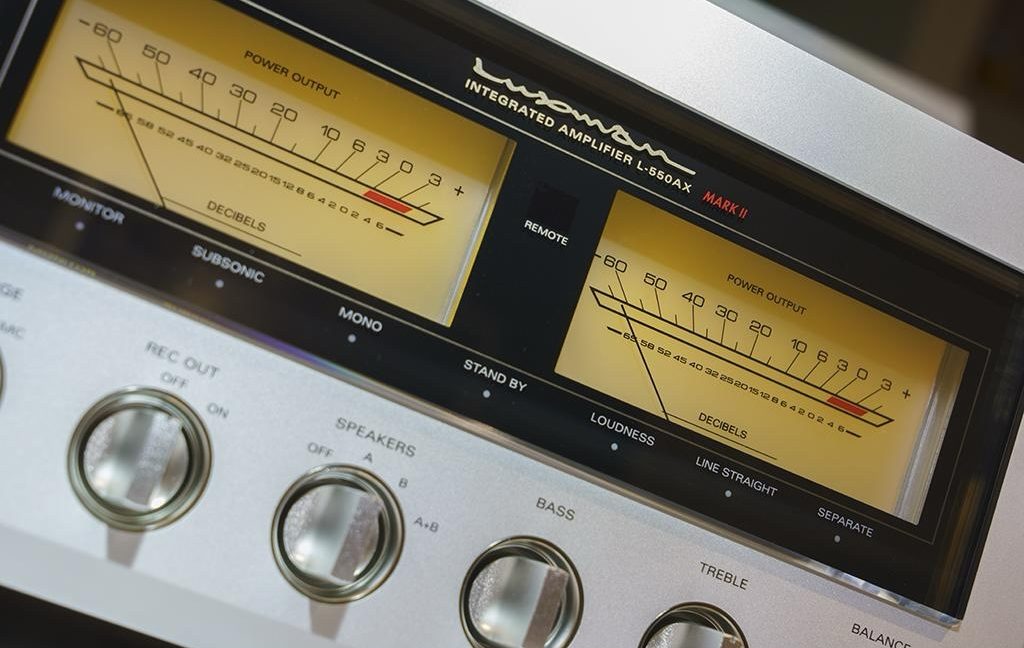
I would begin the description of the Luxman L-509Z integrated amplifier by starting with the front panel. In my opinion, it represents the successful outcome of the search for a timeless aesthetic not conditioned by the fashions of the moment that oscillate between absolute minimalism – sometimes excessive – and technological complacency that often manifests itself in a riot of colored OLED screens sometimes unreadable at home because of their microscopic size. In the center make a fine show of two large VU Meters – real, not reproduced in graphics – with a white background, between which sits an illuminated numerical indicator giving an account of the volume level. On the sides we find the volume knob, on the right, and the input selector on the left. Below the instruments is a large set of controls among which are the tone controls, which are as many as three considering the midrange adjustment, then the balance, the active speaker system sector (A, B, A+B, Off), the phono input selector with two output voltage acceptance values for moving coil (MC) cartridges, as well as the classic MM. Thanks to the Straight button, the tone control section can be completely bypassed, a solution that will please the most purist users (including yours truly). The separate button serves to decouple the preamplifier section from the power section so that the inputs/outputs on the rear panel can be exploited for the purpose of possibly inserting a signal processor or other. The presence of dual 6.5 and 3.5 mm headphone outputs ensures great versatility in that compartment. In this framework, all in all rather traditional, indeed I would say almost vintage, the only aesthetic concession to modernity is the presence of numerous micro LEDs that signal the various functions enabled from time to time.

Applause must necessarily be paid to the top panel, which is characterized by a truly conspicuous thickness, about one cm, and is made of aluminum hollowed from solid with 14 + 14 milled slits, closed at the bottom by a metal grille, allowing heat to escape. A truly spectacular achievement.

We conclude the external inspection by giving an account of the rear panel on which stand out the beautiful binding posts for connecting two pairs of speakers (or possibly for bi-wiring). The two inputs, Bal Line 1 and Bal Line 2, are XLR type with reversible polarity. As a reminder, however, the Luxman L-509Z is not inherently balanced and therefore these inputs are followed by an unbalanced section. Line inputs 1 through 4 are on RCAs with the first two having connectors of much higher quality than the others. Also on RCA we have the two pre-outs, to be used for example with subwoofers, and the main in for connection to the power amp section. The phono input and triggers complete the equipment.





GIPHY App Key not set. Please check settings