

 Audio 2G
Listening
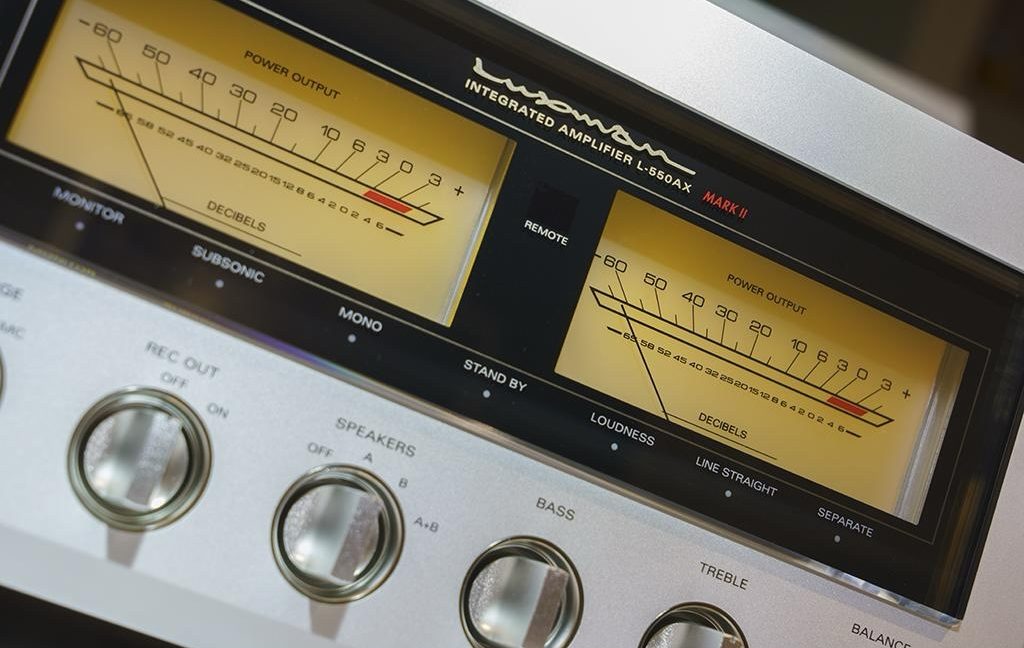
We used Luxman’s top integrated amp in our listening room for several days, pairing it with Vivid Audio’s Kaya S12 speakers and Marten’s Parker Duo speakers. Both are stand-mounted speakers of medium efficiency and very high quality although they have very different sonic personalities. As a digital source we used the Linn Selekt DSM and, alternatively, the Aqua La Scala MKII DAC driven in USB by our self-built server with JCat components on which runs the Audiolinux operating system. A New Horizon 303i turntable with an Ortofon 2M Bronze MM phono cartridge was used as the analog source. Signal and power wiring as well as power supply is from Neutral Cable Reference series.
The first impression, often, is what defines the overall flavor of the entire test, and in the case of this integrated amplifier, too, I can say that this statement proved to be true. True: the L-509Z does not offer particularly high power, but its 120W into 8Ω is more than enough to get away with it in the vast majority of situations. Nevertheless, with both speakers, the first impression was that there was little impact. That timbrally everything was right, but that it lacked the bit of drive that makes the reproduced music come alive. That feeling, which accompanied me during the first few hours of listening, faded as I came into contact, in tune, with the Japanese integrated. It is not in fact a lack of power, that is there and is more than enough, but a very compassed way of delivering the music. What needs to be focused on is not the dynamic swings , but the density of the sound and its color. A very natural sound that should not be compared with the memory of listening with other reproduction systems, but with the live experience. If one makes this mental shift, I think one better understands the intent of the Luxman designers who did not go in the direction of showmanship, but in the opposite direction. That is, that of analysis, even introspection. And boy is there dynamics! But here we are talking primarily about micro dynamics, that is, that ability to bring to light the most subtle details of the touch of a piano key, or the caving of a bow on a double bass. Here, then, we begin to better delineate the design brief to which Luxman’s engineers have responded with the L-509Z: a top-end integrated amplifier, totally analog and totally divorced from an idea of sound as entertainment. Indeed, I would say that this amplifier is particularly rewarding for those who like to go in search of detail that is nevertheless offered in a framework of overall naturalness. That said, it is clear that the downstream and upstream partners must be endowed with the same characteristics. Particularly with the Marten Parker Duo and the Linn Selekt DSM the pairing turned out to be particularly well matched. The Scottish DAC/streamer dispenses detail and resolution, plus its disruptive personality balances out the emotional detachment of the Luxman L-509Z to some degree. Finally, the Swedish speakers, with their timbral balance and ability to descend into the low range, operate a truly exemplary sonic synthesis. Particularly with this pairing, I was able to appreciate a very articulate and deeply layered virtual soundstage, with the various instrumental groups firmly anchored in their positions. Once again, at the risk of being repetitive, I want to point out that here we are at the antipodes of the concept of “muscular expressiveness” or “brute force” as it may be. Here we are talking about grace and elegance.
To conclude a few more words about the phono stage, which showed remarkable qualities of quietness, detail extraction capability and excellent dynamics. We used it with an excellent MM cartridge but not with a MC, so we cannot consider ours an exhaustive test. However, I think I can say that for most potential turntable users this phono stage will make it possible to avoid the purchase of a dedicated external unit.





GIPHY App Key not set. Please check settings