

 Audio 2G
Luxman L-509Z Integrated Amplifier: Technical Analysis
Let me remind you that the Luxman L-509Z integrated amplifier is not equipped with digital inputs, internal DAC, streaming section, in short none of those “modernities” that we now almost take for granted. Indeed, there is the fact that this is a decidedly high-end product, intended for a knowledgeable audience that would probably frown upon any internal device that might be a potential disruptive element in the delicate internal balance. So the DAC or DAC/Streamer is perfectly fine as long as it is external and chosen-possibly judiciously-by the end user.

Looking at the overall image of the interior, one cannot remain indifferent to the order that reigns supreme, highlighting moreover a construction that takes into due consideration the simplification of any maintenance work that may be necessary during the life of the device. In the center stands a power section that employs a large 600 VA laminated transformer with an “E-I” core and eight capacitors for a total leveling capacity of 80,000 uF. On either side are the two power sections whose heatsinks are contained within the cabinet enclosure. Each channel of the L-509Z’s class AB output stage uses bipolar transistors in a three-stage Darlington configuration with a quadruple-parallel push-pull scheme to provide 120 W into 8 ohms and 220W into 4 ohms. The transistors used are the 2SC5200 and 2SA1943.

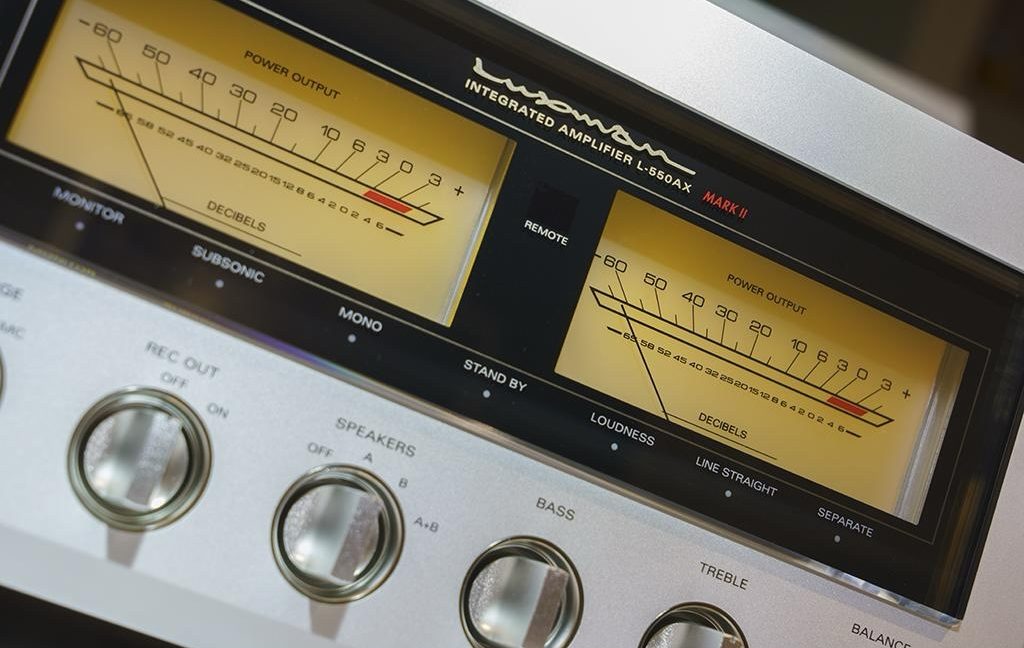
“Fully discrete LIFES” is the new feedback system impiagated by Luxman in this amplifier, replacing the previous ODNF(Only Distortion Negative Feedback). LIFES stands for Luxman Integrated Feedback Engine System and involves the application of selective feedback, which reinjects only the error component rather than the entire output signal. This system, which is used in both the preamplifier and power sections, aims to reduce the undesirable effects of using negative feedback while improving the S/R ratio and distortion. The Luxman L-509Z integrated amplifier includes tone controls for bass and treble, supplemented by the “MIDDLE” knob, which the manufacturer says acts in the frequency band of vocals and solo instruments. There are also Balance, Subsonic, Mute, Mono and even Loudness controls that I have not encountered in many years.

The preamplifier section is located close to the rear panel and is articulated on vertical boards connected to each other by PCBs perpendicular to them and not by the usual wiring made with the usual Flat Cable. Regarding volume control we record the implementation of the “LECUA” system, which stands for Luxman Electronically Controlled Ultimate Attenuator . This is a technology that Luxman has been developing since 2006, which is basically the combination of a high-precision rotary encoder with a newly developed weighted rotation mechanism. All of which allows for great reliability coupled with a particularly natural feel for use. As many as eighty-eight steps of adjustment from 0 to 87 dB, with the possibility of controlling the acceleration curve relative to the speed of rotation of the volume knob, as well as prolonged pressure on the remote control button in order to influence the upward ramp of the volume control.

PCB Technology
The technology used by Luxman to make the PCBs found inside the L-509Z integrated amplifier deserves to be described in a separate section. Normally on a printed circuit board, a thin lacquer-like polymer is used as a solder mask to prevent unwanted accumulation of tin between closely spaced components and solder pads; moreover, such a mask, which is permanent, provides some sort of protection to the conducting tracks during the manufacturing stages. However, it can cause the occurrence of parasitic capacitance, which, according to Luxman, can have a blurring effect on audio signals. In Luxman’s manufacturing process, the mask is removable-and actually removed-eliminating the risk of parasitic capacitance. Another interesting aspect of the circuit boards is the sinuous, curved path of the 0.1-mm-thick gold-plated tracks used for each channel of the L-509Z’s power section and in other internal parts. Again according to the manufacturer, this particular type of tracks results in better sound, optimized current flow, and lower inductance than PCB tracks with right-angle signal path direction changes. All internal wiring is OFC copper, and the last section from the output stage to the speaker terminals uses 3.5 sq. mm cross-sectional copper cable.





GIPHY App Key not set. Please check settings