



 Audio 2G
the Canor Virtus A3 amplifier we are dealing with in this review had been shown to us in prototype form placing special emphasis on the innovative user interface. Today this integrated amplifier has become a reality and we have the pleasure of touching (and swiping fingers) its touch display. But are the innovations limited to that? No, because this is the first tube and solid-stage hybrid made by the Slovak manufacturer, but with a very unconventional circuitry. In short, there are many reasons of interest to read this review, so follow along.
Canor
Canor is a Slovak company that has been in business since 1995, the date of the market introduction of the TP101 tube integrated amplifier, which came out under the EDGAR brand name. The current Canor brand dates back to 2005, when the same model underwent a radical restyling that foreshadowed the guidelines of a design that continues to this day with a consistency that has helped define the company’s image over the years. It is a cleverly constructed look mixing retro elements with ultra-modern ones, while remaining within a good taste that cannot leave one indifferent. I suppose a not insignificant role is to be attributed to the fact that Canor is able to carry out most of the processing within its Presow factory. These include the machining and anodizing of the aluminum sheets from which luminaire cabinets are made. These are activities that other brands often outsource-which is certainly not a cause for blame-and in fact Canor offers OEM services to several other major brands in the audio industry. The philosophy of this company is one of utmost attention to detail; among these, a central aspect for the manufacturer is the quality of the tubes and their selection. Finding nothing on the market that fits its needs, in 2012 Canor developed the

This in-house construction capability is reflected in the perceived quality and in various details, large and small, including-for example-the louvers in the top of the amplifier under test today that have something of an artistic quality, or the mini aluminum remote controls with which the company equips its products-even the Virtus A3-rather than employing the usual dim-looking Oriental products often adopted by competitors.

Virtus A3: design
But back to the protagonist of our test. Where do we start? The reasons for interest and novelties compared to the traditional Canor production are many, however, I do not resist and give priority to the design.
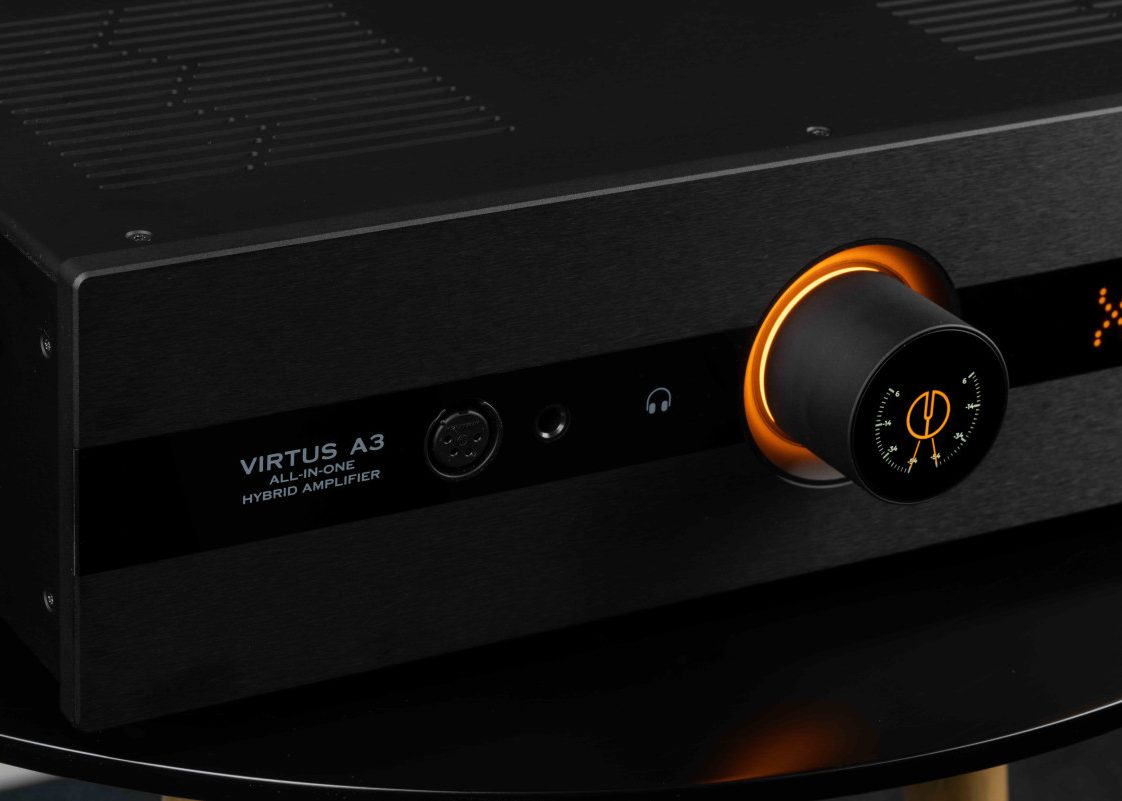
Canor’s well-established design guidelines include a sleek, brushed metal front panel crossed horizontally by a strip of glossy black glass bearing a large volume control knob in the center. On the right, a dot-matrix display, with text in very large font, lends a retro touch while ensuring excellent readability. A soft orange-perhaps evocative of the typical brightness of thermionic valves-is present in both the display and the luminous insert around the volume knob.

the Canor Virtus A3 amplifier introduces a new feature to add to these distinctive elements: recessed in the center of the volume knob is a circular 1.5″ LCD touchscreen. During music playback, the screen displays the Canor logo or, alternatively, a VU meter with two hands. This touchscreen also serves as an on/off button, while the horizontal swipe allows you to change inputs. In some situations the screen provides access to a sub-menu, navigable by turning the volume knob, which includes, e.g., settings and options related to the phono input, rather than selection of the digital output filter. The volume, which operates in the analog domain with 99 Steps, as usual can be adjusted by turning the knob, which features an outer drum that rotates independently of the inside and thus of the display. In my opinion this delightful detail complements a design that skillfully blends retro influences and a modern aesthetic. Exemplary in this regard is the startup screen where a drawing of a valve appears surrounded by a circular crown whose outline is composed as the time required for the two E88CC valves to warm up passes.

Specifications
In a video featured on Canor’s YouTube channel, designer John Westlake points out that the Virtus A3 amplifier packs four devices into a single chassis: a hybrid integrated amplifier, a DAC, a phono preamplifier, and a headphone amplifier. This is unquestionably true and, all things considered, cannot be considered a distinguishing aspect of this product since, in fact, it is shared by many of the All In One integrated amplifiers currently on the market many of which, I should point out, have been tested by Audio 2G. However, compared to most competitive devices, this amplifier does not have an internal streaming platform, consequently it has no network connectivity either Ethernet or Wi-Fi, moreover its amplification section is extremely sophisticated and atypical. So let us start by analyzing the latter for which designer John Westlake was inspired by the Current Dumping configuration that the legendary Peter Walker devised for Quad several decades ago. In this regard, we recall the 405 final which we have discussed extensively in this in-depth technical article.
The input stage is based on the use of high-quality relays that symmetrically feed discrete buffers using Jfets operating in Class A noncountercontrolled. The output of these buffers drives A 99-step analog differential attenuator for precise channel matching. The output of this attenuator is sent to the power amplifier stage. This sees side by side a tube section (balanced differential based on an E88CC tube for each channel) in Class A at low power and one operating in Class AB at high current that provides the “Brute Force” needed at times when the load constituted by the loudspeakers proves particularly heavy. The design makes no use of sonically harmful AC coupling capacitors in the direct signal path.
The manufacturer claims distortion of 0.0002% @ 1W/1kHz, while the power figure is (2x) 140 watts into four ohms and (2x) 100 watts into eight ohms. Since the presence of a stage operating in Class A generates a fair amount of heat, immediately behind the front panel are two large Heath Pipe type heat sinks below which are placed two large fans whose tachymetric control is entrusted to multiple temperature sensors placed on or near the active devices.


The supply of inputs and outputs is superabundant: in total, the Virtus A3 offers five analog and six digital inputs. Of the analog inputs, two are configured as RCA and two as XLR. The remaining connection is the one dedicated to the phono preamplifier for use with the turntable. Note that there are Pre-Out outputs (slaved to the volume control) that take the signal from the Class A section, should one wish to use the Canor Virtus A3 as a control for any active speakers-an unlikely scenario, but not impossible.
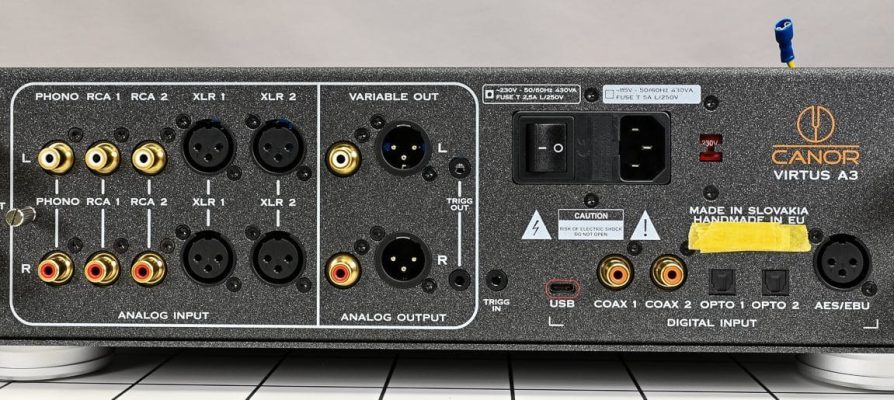
To my memory this is the first Canor equipped with an internal DAC, also because the Slovak company has in its catalog a DAC with tube output (4xEH6922) and dual ESS9038Q2Ms. The digital board, separate from the dedicated phono input board and the main amplifier board, obviously includes a USB port (asynchronous, galvanically isolated with reclocking and RF filtering) that supports PCM up to 768 kHz/32 bit and DSD512. It also has two coaxial, two optical and one AES/EBU digital inputs, which we used to connect our Volumio RIVO streamer. The chipset used is a pair of ESS ES9038 dual-mono with discrete analog controllers. Clocking is derived from low phase noise oscillators with vibration isolation. The analog stage operates in current mode (I/V) for optimum linearity and low distortion. Note that the USB input does not use the usual USB B or A inputs, but USB C, which means that USB cables with “audiophile vocation” that we may eventually have will not be supported, while a normal USB A to USB C cable will work without problems.

We come to the phono preamplifier section, which impressed me with its build quality, versatility, and sonic performance exhibited when listening. Compatibility is assured with both MM and MC phono cartridges, and the gain and electrical load parameters can be adjusted individually so as to find the best interfacing. Specifically, with regard to gain, a value of 40 or 44 dB can be chosen with MMs, and 60 or 66 dB with MCs. Again, adjustments must be made from the touchscreen and cannot be made via remote control.
We close the brief technical analysis with the headphone section where we have a classic 6.3 mm connection and an XLR4 to connect a balanced headphone. When connecting headphones, the amplifier does not automatically turn off the speakers. However, you can mute the speakers for personal listening by pressing the headphone button on the front panel.

Canor Virtus A3: listening
After connecting the Canor Virtus A3 amplifier to the Vivid Audio Kaya S12 speakers, I connected the USB input to the JCat EVO board of my music server based on the Audiolinux operating system. Knowing that the amplifier has a USB C input I equipped myself with a suitable cable for the purpose, which is otherwise easy having quite a few at home, but all strictly not for audio use. First problem: all the cables I had did not work because they were battery charging cables, that is, lacking the data conductors. I did not give up knowing that my friend Giancarlo had a suitable one, in the meantime I connected the LAiV Mirco DAC to one of the XLR inputs and the RIVO Volumio to the AES input of the Canor. This configuration allowed me to evaluate the line section and the internal DAC. Then, of course, I connected the New Horizon 303i turntable with the Ortofon 2M Bronze cartridge to the phono input. In short, there was fun to be had even without the USB. Actually, I didn’t hold back and also connected the Aqua La Scala MKII DAC to one of the unbalanced inputs.
However, I started with the RIVO connected in AES because I thought that the potential buyer of the Canor Virtus A3, as indeed of any all-in-one integrated amp, is unlikely to want to equip himself with an external DAC, breaking the continuity and balance achieved by the designer. That is, unless said user has reached the limit of the internal DAC (but also of the phono preamplifier, at this point) and decides that it is time to turn to something much better performing.
Although disconnected, the reference throughout the test could only be another hybrid, namely my Copland CSA 100, which we have had in the listening room for several years now and which I think I know quite well.
The first consideration, the one that arose after the first five minutes of listening, was: so much joy! How much joy! Often these first impressions produce a kind of emotional conditioning that lasts throughout the test. In the case of the Virtus A3 amplifier this was the case. I will now try to detail my feelings in more detail, but over all remains the memory of a series of listening sessions where “psychoacoustic well-being” took over. Where does this feeling come from? Certainly the bass range has a good grip , and this put the Kaya S12s in a position to express their incredible potential to the fullest, which includes an impressive capacity for timbral articulation that the Canor was able to enhance. Good therefore with Rock tunes and even a certain type of Jazz. That feeling I was referring to a few lines ago, however, stems from the particular set-up of the mid and high range, which has a warmth and its own way of delivering the signal that makes it distinctive. At first one is inclined to think that there is some lack of detail, but as one listens carefully, one realizes that this is not the case. The details are all there, only they are presented with a kind of understatement . It is a bit as if this integrated is telling you, ” Hey, look I’m perfectly capable of extracting everything there is to extract from the signal you’re sending me. I just don’t want to throw it at you. Instead, I want to present it to you in my own way, according to my character.” Well, I mean, I don’t know if that’s exactly what goes through the head of the Canor Virtus A3 amplifier, which then actually doesn’t have a head, but I like to think of it that way. So do not think that the sound of this integrated amplifier is leaning toward that “warmth at all costs” effect, or worse that it is conditioned by the stereotype of the tube amplifier that exudes so much humanity but then, when asked for dynamics and punch, raises the white flag. The Canor Virtus A3, perhaps by virtue of the E88CC tube placed inside it, is certainly capable of infusing some warmth and a pleasant “analog” feel that makes listening enjoyable even for long periods of time, but without overdoing it. Dynamic variations were always handled very well with the speakers I was using, and the Class A bias did its part. In short, we are dealing here with a very successful hybrid, one that hybridizes not only and not so much the technologies but also the sonic character of tubes, Class A, and best solid state. Okay, but something must be wrong, you will say. Well, yes, perhaps the size of the virtual soundstage is not at the top of what I know the Vivid Kaya S12s are capable of. Everything is well proportioned but (perhaps) slightly smaller than with other amplifiers. However, if I refer to the last few Super Integratos that have passed through our listening room, it occurs to me that perhaps that extra ounce of spatiality can be sacrificed in favor of such a joyfully relaxed and satisfying presentation, free of that eagerness to prove at all costs that they are top of the class.
The internal DAC (finally Giancarlo brought me the appropriate cable), when compared with the La Scala MKII, shows its limitations; the sound is a little less liquid, organic and structured, but then again, that’s as it should be, given that the Italian DAC is in a different market segment. Less jarring, however, was the comparison with the LAiV Harmony µDAC, which exhibited comparable performance. However, I would say that the in-house DAC was the winner as it was more timbrally coherent with the amplification section. Incidentally, I recall that there are several filters to choose from. Personally, as always happens to me with DACs equipped with many filters, I found the one that sounded best to my ears and kept it. After all, the Canor’s small remote control does not allow you to intervene on this parameter and so you are inclined to limit your experiments.
The inclusion of a phono stage in integrated amplifiers I consider highly desirable, considering the type of audience these devices are intended for. This means that if, as is possible, one starts with a streamer and then decides to purchase a turntable, there is no need to equip oneself with additional external components. The problem, however, is that often these phono stages are somewhat sloppily made, using nice and done modules whose performance is sufficient but not exciting. In the specific case of this amplifier, on the other hand, compatibility with MC and MM cartridges (and the configurability of their electrical parameters) ensures adaptability to a multitude of usage scenarios. In addition, like everything else in this Virtus A3, the phono preamp works very well and sounds excellent, which for an integrated amplifier is not a given.
Finally, as far as the headphone amplification section is concerned, of which those who usually read me know that I am not a frequent user, I can report that the tests carried out on the two headphones we have on hand were equally rewarding and positive.
Conclusions
Four devices in one, this is what the manufacturer advertises about the Canor Virtus A3 amplifier. All true but, I would add the adjective “excellent.” In addition there is the aspect of the originality of the circuit and the goodness of the realization to add to an overall picture that, at this point, can only be considered strongly positive. The figure requested, in light of what we have set forth, seems to me to be absolutely reasonable not to say inviting. After all, all that is missing is a pair of speakers and a streamer to have a high-level system that can accompany you for years.
My sincere congratulations to Canor.
Giulio Salvioni
Declared technical specifications
- Stereo output power: 2 x 150 W / 4 Ω (IHF dynamic power), 2 x 100 W / 8 Ω (IHF dynamic power)
- Unbalanced headphone output: 500 mW / 30 Ω, 70 mW / 300 Ω
- Balanced headphone output: 500 mW / 30 Ω, 270 mW / 300 Ω
- Gain: 34.5 dB
- Input sensitivity: 550 mV
- Phono Gain: MM 40 dB, MM 46 dB, MC 60 dB, MC 66 dB
- Damping factor: 180 / 4 Ω, 380 / 8 Ω
- Frequency range: 10 – 35 000 Hz (± 0.5 dB / 5 W)
- Input impedance: 50 kΩ
- Analog inputs: 1 RCA pair (Phono), 2 RCA pairs, 2 XLR pairs
- Analog outputs (variable output): 1 pair RCA, 1 pair XLR
- Digital inputs: 2 x COAX, 2 x OPTO. 1 x USB, 1 x AES/EBU
- DAC Configuration: 2 x ESS 9038 (Dual Mono)
- Headphone outputs: 6.3 mm jack, 4-pin XLR
- Total Harmonic Distortion: < 0.005 % / 1 kHz, 5 W, < 0.008 % / 1 kHz, 1 W
- Signal-to-noise ratio: > 90 dB (20 Hz – 20 kHz)
- Tube complement: 2 x E88CC
- Trigger connectors (12 V) : 1 x IN (3.5 mm jack): 2 x OUT (3.5 mm jack)
- Power: 115 / 230 V, 50 – 60 Hz, 820 VA
- Dimensions (W x H x D): 435 x 130 x 460 mm
- Weight (net): 18 kg
Builder: CANOR, spol. s r.o. Družstevná 39 – 080 06 Prešov – https://www.canor-audio.com Slovakia
Distributor for Italy: Audiogamma spa – Via Nino Bixio 13 – 20900 Monza (MB) – Italy – Tel. +39 02 55181610
Price: 6,499 Euro – VAT included





GIPHY App Key not set. Please check settings