



 Fulvio Chiappetta
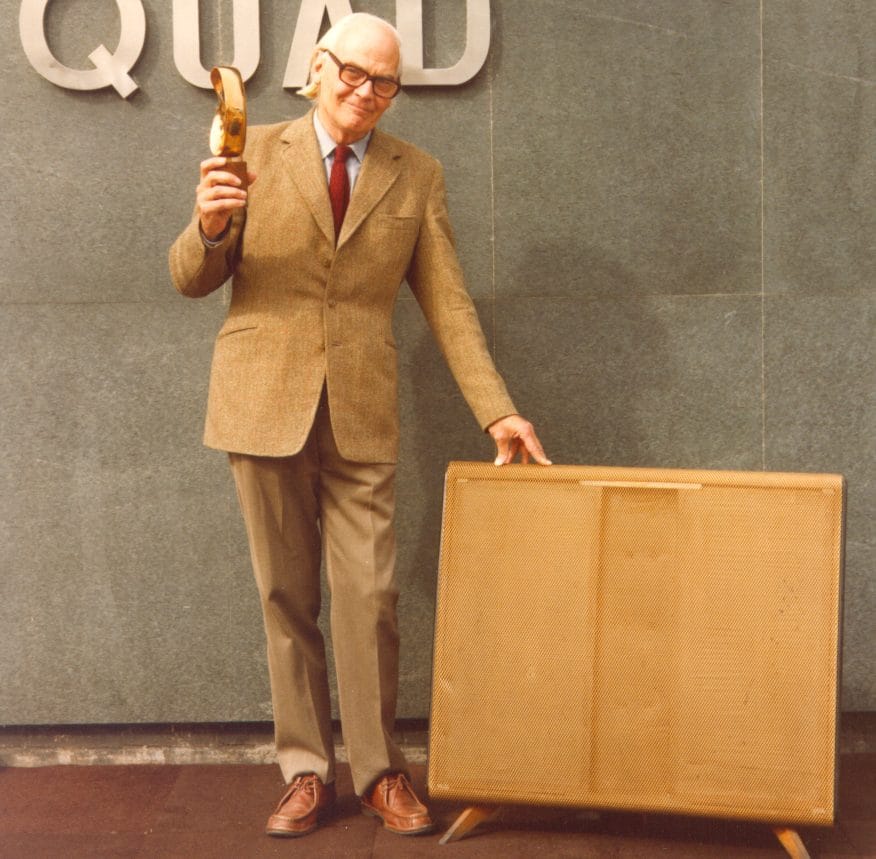
Quad 405 and later 405.2 power amplifiers revolutionized the world of audio design thanks to an ingenious idea of Peter Walker, designer and founder of the British brand: we are talking about Quad’s current dumping.

Quad 405, back in 1975, a real revolution, we discover current damping
Revolution rather than innovation ? Why such a challenging label ? To fully understand so much enthusiasm, we need to drop into the technical realities of the time. Let us premise that, in particular for transistorized amplifications (tube ones had in those times a rather limited diffusion because they were thought to be outclassed by solid state, the then rising star), the moment was one of great ferment and the commercial offer particularly wide : in fact, in terms of laboratory performance, the products were resounding, but sonically the vast majority of them turned out to be rather disappointing. The various realizations, to the technician’s eye, all turned out to be executed more or less by the stencil: profound differences in circuitry were practically nonexistent; the only variations were eminently those related to the sizing of the components according to the power to be achieved and its objective quality. The Quad 405, in a scenario where everyone was more or less the same, was like a bolt out of the blue, and the echo of its revolutionary circuitry literally went around the world: illustrious technicians, at an international level, were interested in and commented on the little monster of the British company, Quad, for whom it was certainly nothing new to introduce a product that so strikingly broke the mould.

Suffice it to say in this regard that the British manufacturer had previously literally shocked enthusiasts with its electrostatic speakers, which were truly incredible (even today, let alone then!). But not only that: although less disruptive, in their own way, the Quad II tube amplifiers were also innovative, if not revolutionary.
The differences between the Quad 405 and the rest of the world
The poor sound fluidity of solid-state amplification, which emerged overwhelmingly in comparisons with valve amplification and generated listening fatigue, was at the time mainly ascribed to crossover distortion resulting from the widespread use of class B. In reality it was later seen that such distortion was not the sole cause of the bad sound of early transistorized equipment. Well, lo and behold, in one fell swoop, Quad succeeds in significantly mitigating, though certainly not zeroing out (as its sales department asserts), crossover distortion and increasing system performance. Incredibly, it devised a technique by which it achieved this goal, not only by avoiding the use of class A, a solution that was indeed not feasible at the time at human cost given the poor performance of the semiconductors available, but even by employing for its power stages a circuitry that required the final transistors, which at the time were very slow and not very robust, to dissipate nothing in the absence of a signal. Such a brand new circuitry was christened by its originator, the volcanic Peter Walker, constantly assisted by a very cleverly chosen team, “Current Dumping”
and its modus operandi was described as follows, “inside the 405 coexist two amplifiers for each channel. One of these is operating in pure class A, characterized by extremely low distortion, but unfortunately penalized by very limited power. The second, on the other hand, configured in class B, is characterized by opposite performances: less refinement, but on the other hand enough power and muscle to allow authoritative driving of the load, together with valid control of the loudspeakers. These two entities operate in perfect synergy, thanks to an innovative circuitry apt to guarantee a total synchrony of operation of the two modules: in particular, the class A one takes care of refining the details of the sound with the utmost precision, while the class B one guarantees the necessary brute force of the output signal.” The winning weapon for the diffusion and resonance, both out of the ordinary, of this new topology was what we might call a real stroke of genius: in an era (although nowadays such behavior is, if possible, even more widespread) in which people tried to keep the electrical circuitry of any new realization secret, even if it was innovative only on paper and in brochures, Peter Walker, after having abundantly protected his gimmick with effective patents, divulged it as much as possible, revealing all its details. In fact, it was he, Peter Walker himself, who began by writing, together with M. P. Albinson

a very interesting article that appeared in the December 1975 issue of the monthly magazine “Wireless World,” a publication that had a considerable, indeed incredible, worldwide circulation, if one reflects on the fact that the globalization of information guaranteed by the Internet, in the 1970s of course, was completely nonexistent. Many technicians, not 100 percent convinced by the manufacturer’s explanations, gave a different key to the way in which the Quad 405 circuit operated; this, rather than tarnishing the product’s notoriety, unwittingly fostered its spread. Entering, albeit only cursorily, into the specifics, we point out that the designer of the Quad, that is, Walker himself, in order to explain how the two different amplifiers, the one of small power in class A and the other in class B endowed with great energy, interacted in the supply of the load, he troubled the feed-forward error correction (patented in 1929 by Harold Black), a vague technique related to the well-known counterreaction (also devised by Harold Black), but which operated in a very different, if you like in some ways dual, manner. It is precisely on this point that the opinions of the technicians diverged: in fact, a good part of the cream of the engineers of the time, without detracting in any way from the merits of a circuit topology that was in any case very valid and entirely novel, asserted that feed-forward had little or nothing to do with it. We are pleased to point out that in the chorus of great scholars who wanted to have their say on the matter, there were also two distinguished Italian figures whom, we imagine, you all know well: Paolo Nuti and Bartolomeo Aloia. The opinions of the two diverged profoundly: for what it can count, we lean toward giving more credence to Bartolomeo Aloia’s remarks. We do not feel it is out of place to emphasize the commercial effectiveness of the far-sighted policy of Peter Walker, brilliant both as a technician and as a strategist.
QUAD 405, the sound
The sonic qualities of the little 405 were, upon its release, immediately apparent. Listening, unlike the average transistorized amplifier of the time, was incredibly restful: no hint of harshness, a warmth reminiscent of that of tube realizations, and an image that, although somewhat disappointing in terms of width and depth, made one cry out for a miracle with regard to the correct positioning of the foregrounds, which were not shot in the face as was often the case with the most common amplifications in circulation. There were basically two weaknesses: modest dynamics, which could not be ascribed to limited energy, but rather to a certain slowness in reproducing faster transients, against which it seemed that the amplifier was continually struggling. The second deficiency consisted of a certain lack of clarity in the high range. In fact, shortly after the appearance of the first series of the 405, QUAD remedied the sonic limitations of the original product by marketing a new QUAD 405, labeled .2

Wanting to evaluate the Quad 405.2 with modern parameters, we can report that the sonorities expressed by it are to be considered overall very good even today: there is no doubt that a perfectly tuned specimen, can be compared with a present-day mid- to high-end realization, as the Quad was at the time of its appearance, and come out with more than its head held high. If it were then compared with what can be bought in the new for the same money at which it can be found, there is no doubt that we should consider its purchase a real bargain. Of course, due consideration must be given, however, to the fact that the years never pass without leaving their mark and that, although the English amplifier was credited with remarkable reliability, malfunctions or, perhaps more likely, the diminished performance made inevitable by the aging of certain components, notably the electrolytic power supply capacitors, can be problems of neither simple nor cheap solution.




GIPHY App Key not set. Please check settings