



 Audio 2G
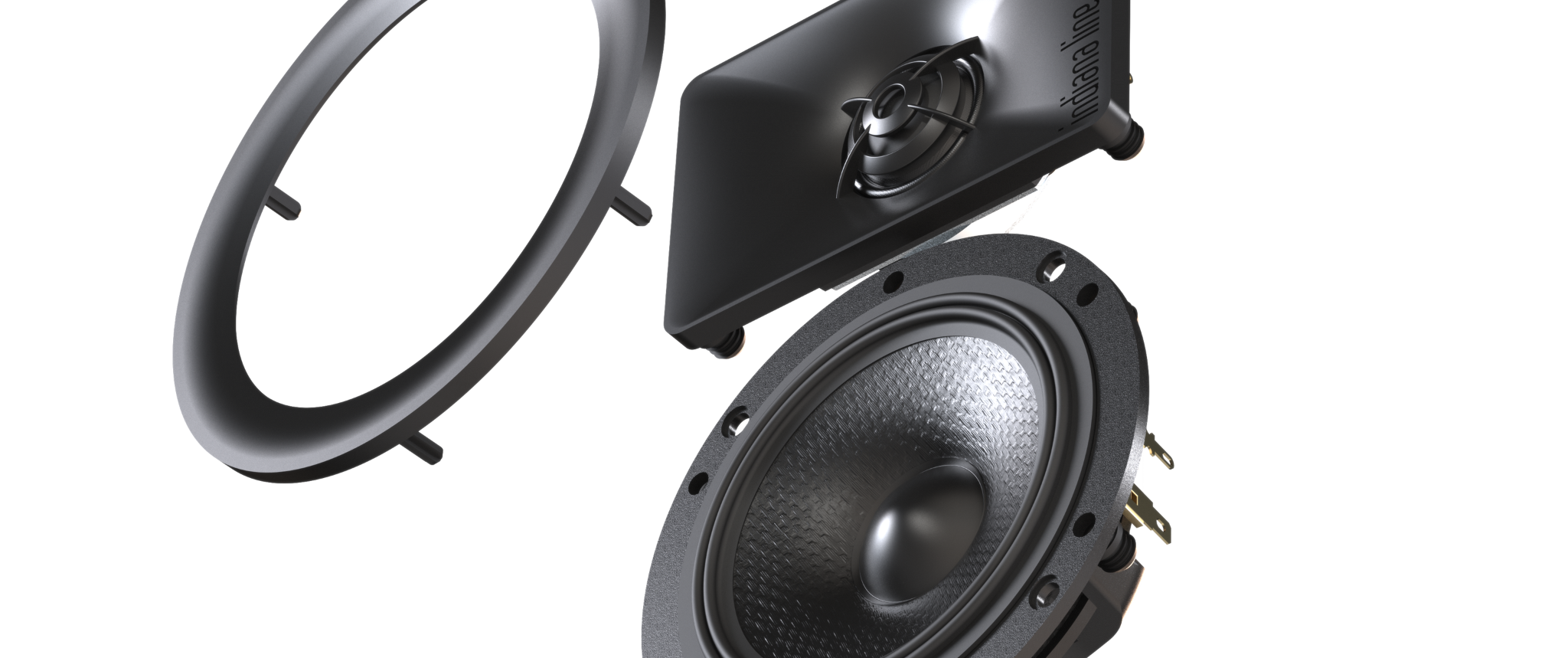
The midrange is handled by a completely new driver. It features a 120 mm cone made of Curv, a composite material created from interwoven polypropylene fibers that are then thermoformed. This material offers a good balance between structural rigidity, lightness, and internal damping, reducing unwanted resonances. The basket is made of die-cast aluminum to ensure high mechanical rigidity and minimize vibrations. The magnetic system uses an underhung configuration with a voice coil shorter than the air gap height, a solution that improves the linearity of the magnetic field and reduces distortion at various excursion levels. The midrange operates in a dedicated sealed chamber, isolated from the volume used by the woofers, to prevent interference caused by the high internal pressures generated at low frequencies.

The bass range is handled by two 175 mm woofers, also from Curv, which utilize large ferrite magnets and an inductance linearization system consisting of aluminum and copper rings inserted into the magnetic circuit. This solution reduces the modulation of the voice coil’s inductance during excursion and helps keep harmonic and intermodulation distortion low. The suspensions have been designed to allow for long excursions while maintaining a smooth response even at high sound pressure levels. The bass-reflex loading uses a port oriented toward the floor. This configuration allows the underlying surface to be used as an acoustic coupling element, improving low-frequency extension and making the distance from the rear wall less critical compared to traditional rear-firing reflex systems. The presence of damped feet also helps limit the transmission of vibrations to the supporting structure.
Listening
For the listening test, we used the Denon PMA-3000NE (review here), an integrated amplifier that proved to be the ideal partner for highlighting the qualities of the new Indiana Line Lira 6. The pairing proved particularly successful thanks to the Denon’s ability to combine energy, control, and tonal refinement, allowing the balanced and transparent character of the Italian speakers to emerge naturally. It is no coincidence that we also used the Lira 6 as a reference during tests of other amplifiers that recently passed through our editorial office: their neutrality and ability to faithfully reproduce the differences between components make them an extremely reliable evaluation tool. From the very first minutes of listening, a sense of sonic completeness and maturity emerges that is rarely found in this price range. The Lira 6s succeed in establishing a convincing balance across all frequency ranges, without favoring any register at the expense of the others. The bass extends deep with authority, yet always maintains excellent control, avoiding any excess or bloating. Electric bass lines are well-articulated and clear, while the double bass in jazz recordings retains body, harmonics, and a credible physical presence within the soundstage.




GIPHY App Key not set. Please check settings