



 Audio 2G
The Indiana Line Utah 8s, the largest model in the series, were sent to us a little more than six months after we published our review of the Utah 5s. The temptation to dismiss these impressive speakers by demoting them to “big brothers” of those already reviewed is entirely justifiable, but it would do them a disservice. Yes, because the differences are several starting with the increase in volume and ending with the components used. The end result, of course, reflects that diversity, placing these speakers in a higher class, which is also evidenced by the price. In short, it is worth following along in the analysis of this yet another interesting product from Indiana Line.
Indiana Line: a bit of history
In the article titled The history of Indiana Line: from Selectra to today, published on this site by F. Taddei, we retraced the most significant stages of this glorious brand. Here I will limit myself to recalling that its birth dates back to the early 1970s, on the initiative of the historic Selectra company of Turin, at that time the holder of prestigious brands such as Revac, which decided to import into Italy the loudspeakers made by the U.S. manufacturer Utah. There is a curiosity that well exemplifies the pioneering spirit of the time: the speakers were shipped to Italy “in pieces,” to be subsequently assembled on site. This was a necessary choice, if one wanted to contain the impact of the heavy customs duties on the import of finished products. Today Indiana Line is no longer an Italian company but a Polish one and manufactures its products in China, thus managing to offer products characterized by an advantageous quality/price ratio.
Indiana Line Utah 8: technical analysis
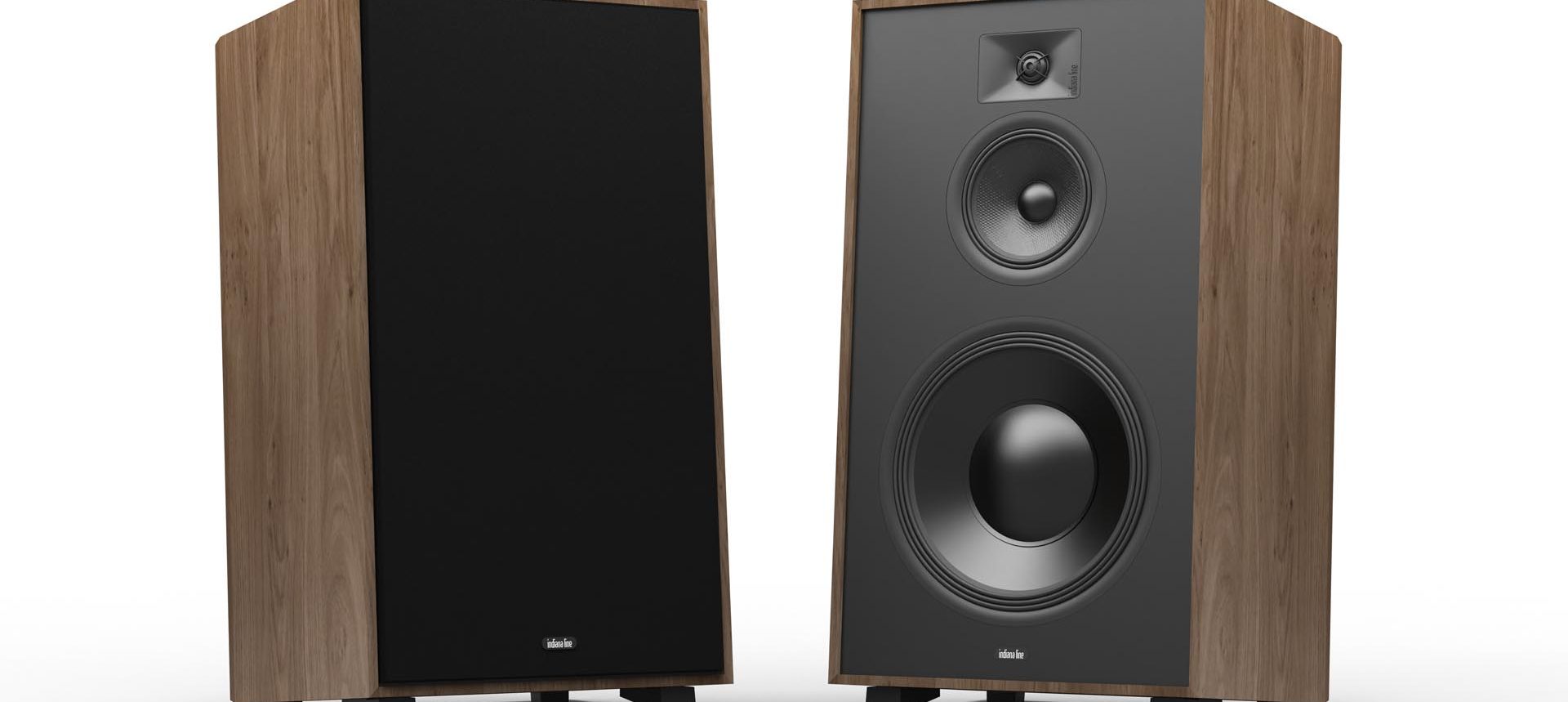
I wrote in the opening that juxtaposing the Utah 8 with the smaller Utah 5 is almost automatic. It is still a three-way bass reflex floorstanding speaker, designed to be placed on the floor in a slightly reclined position. Exactly overlapping is the design intent at the design level: in fact, here again the reference is the large speakers that were all the rage in the 1970s, whose aesthetics are reinterpreted according to a retro-contemporary taste, with wood (Wood) or matte black finishes and a black cloth dust grille magnetically attached to the front panel. We thus think of the iconic designs of JBL and Acoustic Research (AR) from the golden years, but also of ESB’s successful LD series, particularly the 80LD and 100LD models, just to give a few examples. The similarities, however, end there: technically the Utah 8s are a newly designed product and represent a major step forward not only for the Utah series but for the entire Indiana Line range, introducing technological innovations and internally developed refinements never before employed on this company’s loudspeakers.
Drivers
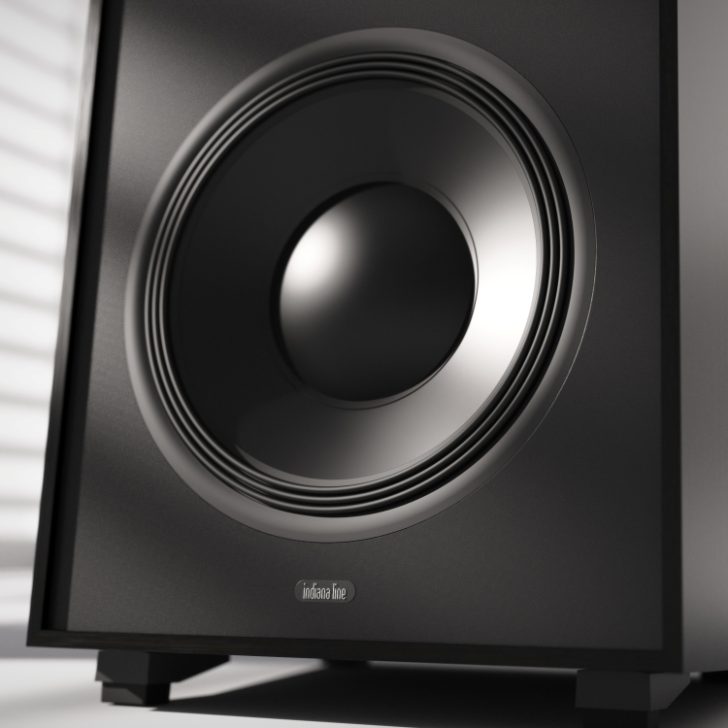
Let’s start with the large 12-inch (307 mm) woofer equipped with a rigid polypropylene cone and newly developed Tri-Wave suspension. The excursion is wide but well controlled; the reflex tuning, achieved by means of two tubes with bottom-panel outlets connected to the bulk of the cabinet’s internal volume, allows the response to extend down to 30 Hz with a well-solid bass presence free of spurious resonances. The midrange is 7″ with second-generation Dual-Wave suspension. The cone is made of CURV, a combination of polypropylene fibers with high stiffness and internal damping, thermoformed into a conical profile that combines the natural timbre of organic materials with the dynamics and precision of rigid membranes. The coil, in an underhung configuration, is completely contained within the air gap, reducing distortion and providing more natural dynamics; this gives the midrange an articulate and smooth performance, even on vocal content and acoustic instruments.

Finally, the tweeter is a 28-mm unit with an aluminum-magnesium dome in front of which a 3D-Guide waveguide is placed. Air-wound coils are used in the tweeter filter to avoid core saturation, and polyester film capacitors to minimize distortion at high frequencies.

The cabinet and the construction
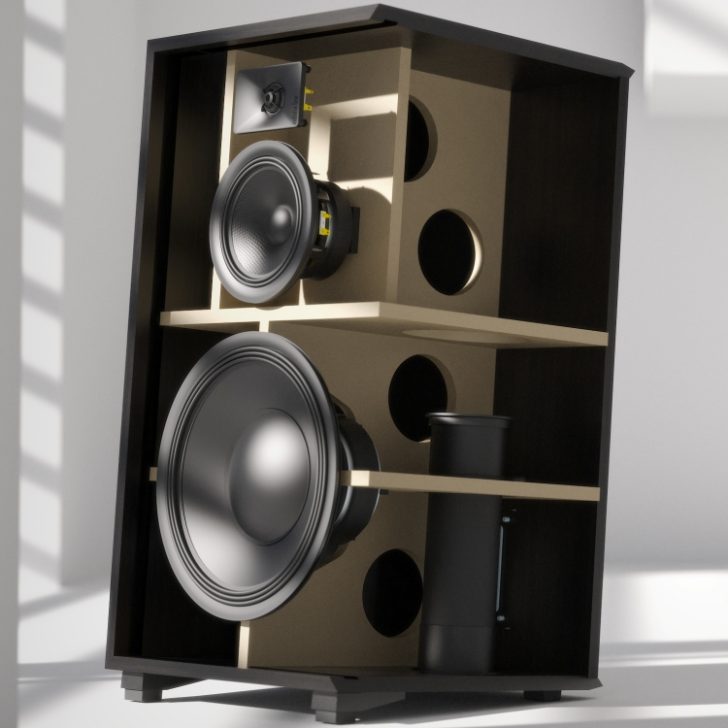
The dimensions, too, testify to the substantial difference between the Utah 8s from the Utah 5s: with a height development of 73 cm and a footprint of 40 x 37.5 cm these speakers certainly do not go unnoticed and, although theoretically usable on the bookshelf, their position must necessarily be on the floor, not least because the weight of 27 kg discourages different solutions. Each cabinet panel is made of high-density MDF, and for the first time in an Indiana Line loudspeaker theDamped Inner Reinforcement System( DIRS) is used. This is a sophisticated system of internal reinforcement baffles whose job is to dampen the vibrations generated by the low and midrange transducers by absorbing the energy at the source through special pads (pads) resilients made of elastomer and a multi-story internal structure, keeping the cabinet inert and preventing unwanted coloration.
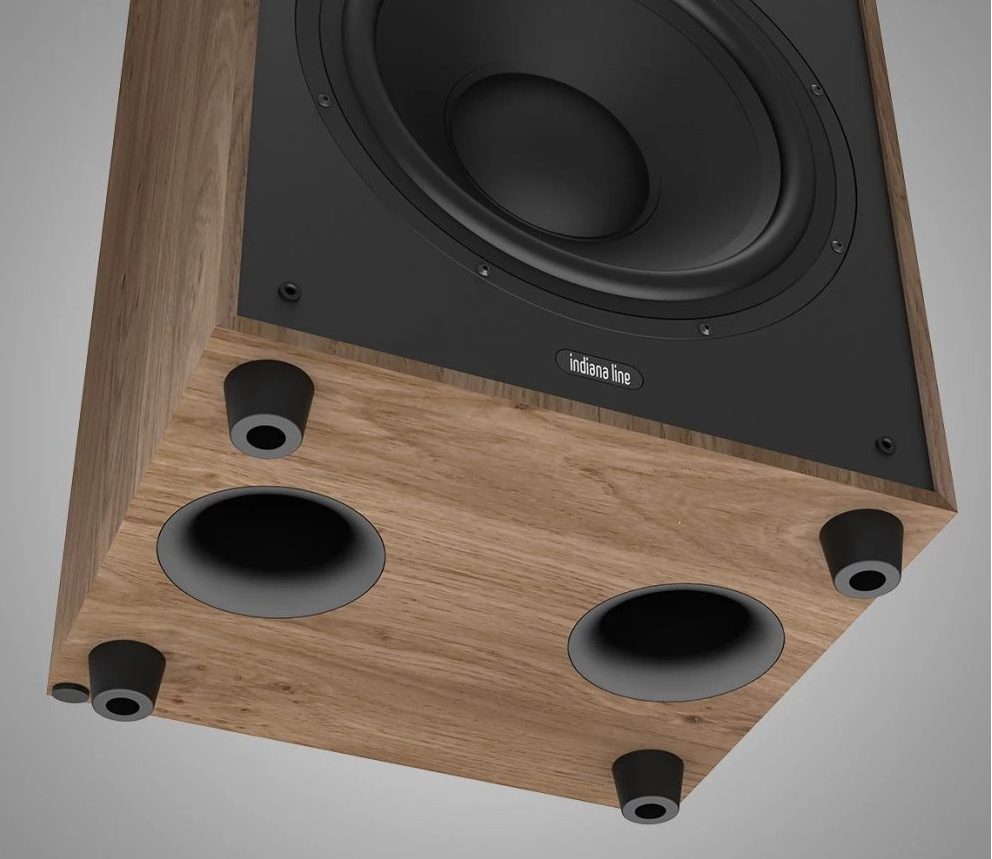
The bass-reflex system is carefully calibrated with two ports located at the base of the speaker, each 75 mm in diameter. Provision is made to partially or completely obstruct the ports by means of special plugs, which is useful for placements close to the rear wall. Four rubber feet isolate the speaker from the floor, providing stability and optimum tilt for a balanced soundstage. Feet are also included in the package to allow vertical placement of the Utah 8s. The power connection to the amplifier is bi-wiring ready.
Utah 8: listening
The Utah 8s were listened to with several amplifiers including the Canor Virtus A3, the Moon River 404-both of medium power (about 50W)-and the more powerful Copland CSA 100 (100W). Placement, on the floor of course, in our acoustically treated listening room, was rather laborious and challenging because of the exuberant low-frequency response. After several attempts we found a good balance about 90 cm from the rear wall (relative to the speakers) and 80/90 cm from the side walls. This resulted in bringing the emission centers of the transducers closer together, which certainly did not benefit with respect to the size of the acoustic scene on the longitudinal axis. The truth is that our listening room is undersized with respect to what the Utah 8s would need. Nevertheless, the acoustic treatment allows them to best express their personality. Yes, because the surprise-at least for yours truly-was to discover a certain refinement at the timbral level that I would not have expected. Said differently: one should not be conditioned by the external appearance of the Utah 8s by imagining a speaker exclusively devoted to the reproduction of a powerful and assertive bass range. Undoubtedly there is that too but, compared to the vintage references mentioned a few paragraphs back, here it is much more restrained and damped. This contributes to the perception of a pleasant feeling of clarity and resolution that was rather lacking in those past products. The other aspect that impressed me pleasantly is the nice connection between the low and midrange, which gives rise to a feeling of “body,” organicity and naturalness that make the reproduction of voices and acoustic instruments credible. Personally, I did not find the same connection between the midrange and the high range which is certainly very extended, but timbrally oriented toward a slightly different sound aesthetic. So that nice feeling of warmth and body to which I referred earlier gives way to a dry stiffness going up toward the high end. This kind of balance can be very rewarding with some genres, rock and pop in primis, but it generates a feeling of estrangement with the large symphony orchestra where the brass is over-emphasized in its metallic component and the woody component of the timbre of the strings is not adequately enhanced. What does this consideration imply? Well, not much really. In fact, I think it unlikely that a devotee of Classical or early music would lean toward a speaker as typologically characterized as the Utah 8. On the contrary, the reference purchaser will be completely gratified both by the “strong feelings” that the Polish speakers are capable of dispensing with full force and by the credibility of the voices.
Utah 8: conclusions
The Indiana Line Utah 8s cost €1,650.00 per pair. So the price difference from the Utah 5 is definitely marked while remaining both models in the realm of affordable audio products. I hope that the public will not make the mistake of considering the model under test “only” a larger version of the Utah 5. In reality, these are two very different products starting with a much more complete endowment of technological contents in the case of the Utah 8. These are loudspeakers that, in order to express themselves adequately, need large spaces within which to operate and a clear idea with respect to the sound they are capable of producing. If these two preconditions are met I believe that the Indiana Line Utah 8 can give great satisfaction, also in relation to the purchase price, which is absolutely adequate. The high sensitivity (93 dB) poses no limits with respect to the power of the amplifier, which can also be quite low. Nevertheless, with a 30 cm woofer, other parameters also come into play that must be carefully evaluated. Once again, my compliments to Indiana Line, which has brilliantly solved the theme proposed by the design brief.
P.S. At this point I am more curious to hear the new Lira, which promises to be the Indiana Line most akin to my ideal of a loudspeaker.
Giulio Salvioni
Indiana Line Utah 8: technical specifications
- Electrical alignment / type: 3-way / floor
- Acoustic loading / tuning: bass-reflex / lower
- Drivers:
- tweeter: 28 mm
- midrange: 175 mm
- woofer: 307mm
- Frequency Response: 30 – 30000 Hz
- Sensitivity (2.8 V/1 m): 93 dB
- Crossover frequencies: 350 / 2200 Hz
- Bi-wiring/bi-amping arrangement : yes
- Impedance: 4 – 8 ohms
- Recommended amplifier: 30 -240 W
- Dimensions (H x I x D): 700 mm (732 mm with feet) × 400 × 375 mm
- Weight: 27 kg
- Available colors: black, wood.
Price: € 1,650.00 the pair
Manufacturer: Indiana Line
Web site: www.indianaline.it
Distributor for Italy: A.S.M. Srl Contrada Cereo 2, 36078 Valdagno (VI)
Mail: info@asmdistribuzione.com




GIPHY App Key not set. Please check settings