


 Audio 2G
LAiV Audio
The LAiV Harmony Dac is a product of a company that was founded in 2023 and manufactures its products in China while designing and operating from Singapore. Building on an extensive background in industrial automation, LAiV Audio aims to revolutionize the world of audio through innovative, user-centered design where technology adapts to us and not the other way around, making products that offer uncompromising audio quality. Among the mission statements we read that:“…quality is non-negotiable at LAiV. The company is firmly committed to providing audio products that not only meet but exceed users’ expectations.” Indeed, from the first moment we started unpacking the unit, it was clear to us that this goal had been achieved!

Design and Build Quality of the LAiV Harmony DAC
The unibody cabinet of the Harmony DAC is machined from a solid block of high-quality aluminum in order to reduce vibration and interference. The internal layout is modular in design allowing optimal signal routing and excellent thermal management. In addition, the modular approach offers flexibility for possible future upgrades and ease of maintenance.
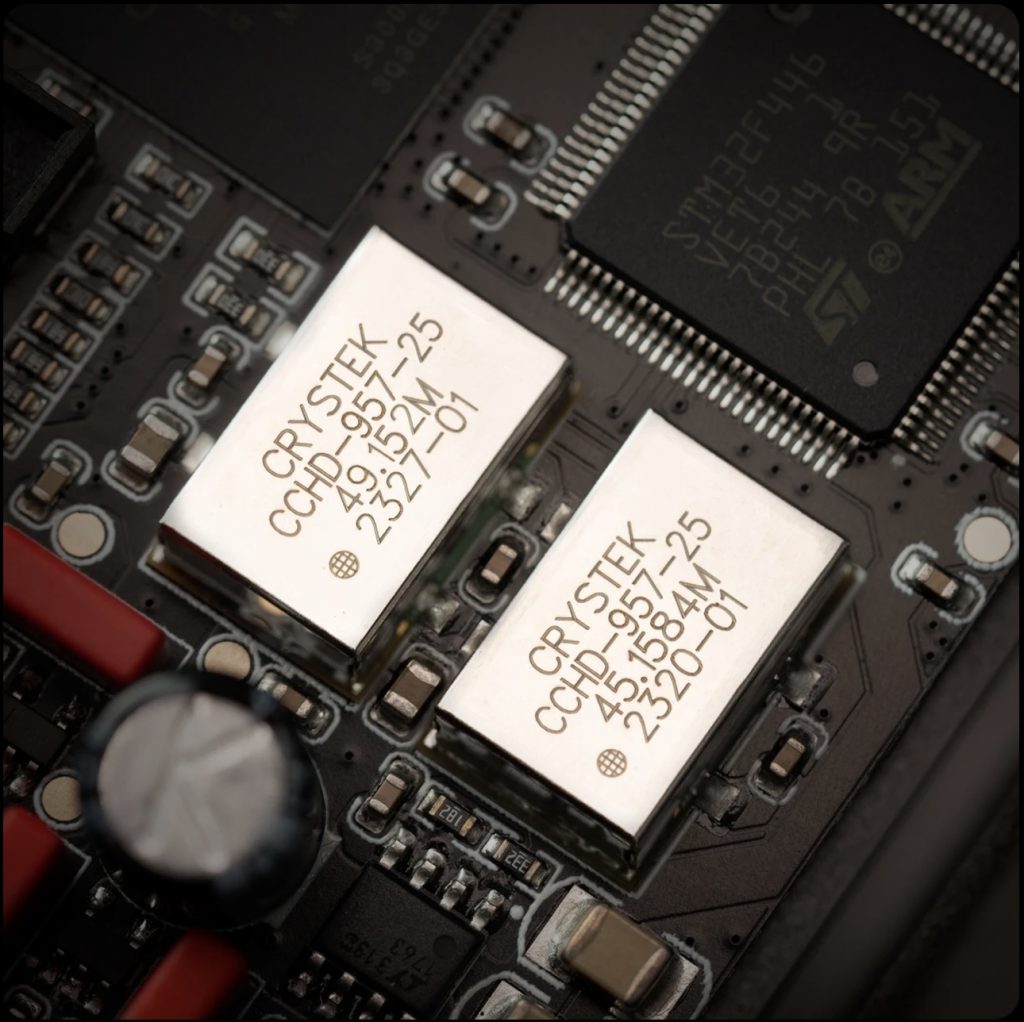
Analyzing the inside of this DAC both the construction logic and the signal path are revealed with immediate clarity: the supply voltage selector is followed by a massive toroidal transformer housed in a Mu Metal-clad compartment, then DC input and DC output stages equipped with filters and regulators. The digital input board bears not only the receiver chip, but also an ARM CPU and an Intel® Altera Cyclone IV FPGA. As for the clocks, two Crystek CCHD-957 Femto elements are used, and the whole is complemented by copious amounts of Rubicon ZLH capacitors and a quartet of Audio Note Kasei bi-poles.
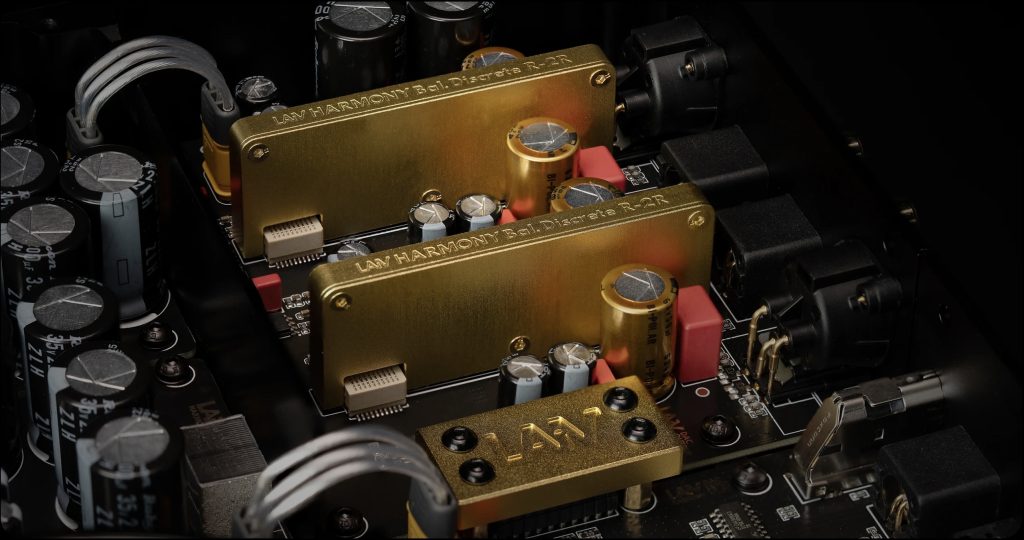
R-2R ladder networks are placed inside gold-plated metal containers, and each individual resistor is selected with a tolerance of 0.05%.
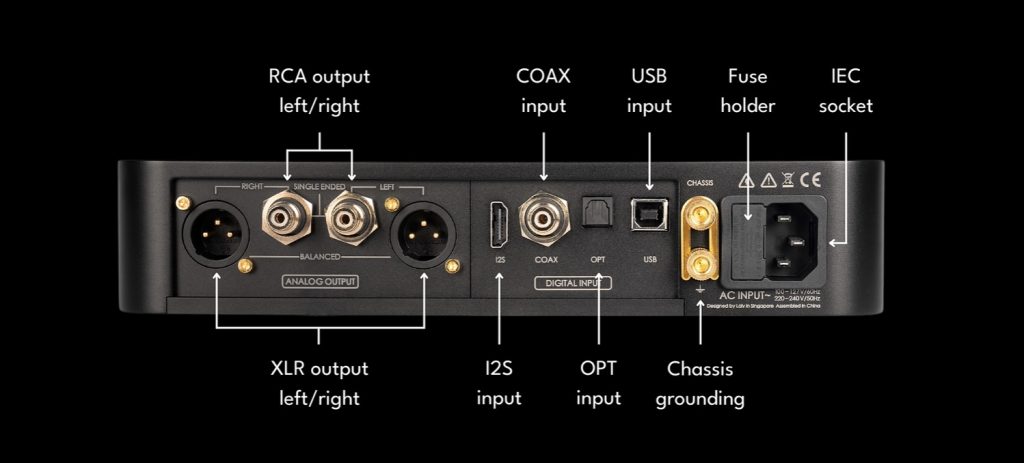
Analog outputs are either unbalanced RCA or balanced XLR (the manual indicates that it is best not to use both at the same time). Digital inputs are: I2S, S/PDIF to Coax, TOSlink and USB, with supported sample rates ranging from 44.1kHz to 192kHz PCM via TOSlink and Coax, and 44.1kHz to 768kHz PCM and DSD64 to DSD256 via USB and I2S. A somewhat unusual but very practical detail: this DAC offers chassis coupling or decoupling from ground. The I2Sinput boasts an interesting feature: you can choose between the internal clock or that of a possible source on I2Sfor even greater precision. Thanks to intelligent auto-configuration, the Harmony DAC automatically synchronizes by choosing the most suitable from the eight stored I2S pinouts. Certainly welcome is the “bonus” consisting of the decoding of CD track information when it is read from a transport connected via the S/PDIF input.
The front panel is dominated by a 3.83-inch diagonal 16-bit grayscale monochrome white OLED display with a resolution of 320×132 pixels, which shows relevant values in extra-large font, so it is well readable even from a considerable distance.

Checks
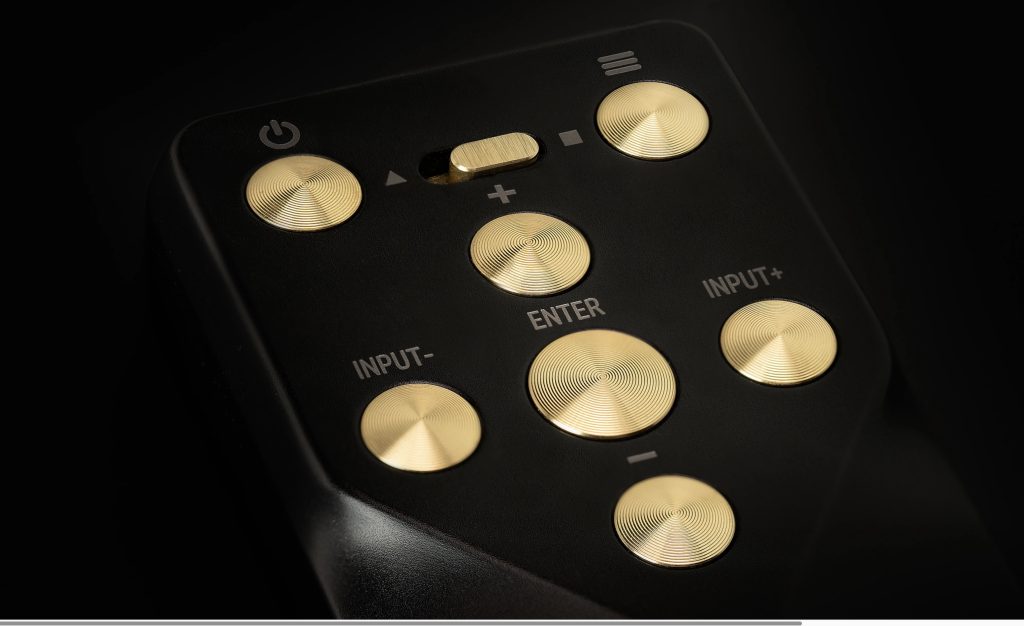
The LAiV Harmony DAC can be controlled via the rotary encoder embedded in the right corner of the front panel and the Menu button. Alternatively you can use the beautiful metal remote control that, thanks to a small switch, can also control a second device from LAiV, such as the announced streamer or the already available preamp/headphone amp. Remember that, contrary to what appearances might suggest, this DAC does not have a volume control; its output voltage is fixed at 4.15V rms on XLR and 2.07V rms on RCA.

Unboxing Experience of the LAiV Harmony DAC
We assume that the unboxing of the LAiV Harmony DAC was designed by the company with the same care as the DAC itself, so as to provide the user with a very rewarding experience. Inside the sumptuous heavy cardboard box stand out, among others, the Certificate of Authenticity, which is not a simple sheet of paper or plastic, but a substantial aluminum plate on whose surface are written the serial number of the unit, the date of inspection, and the signature of the quality control manager. Then there is the mysterious cardboard triangle, adorned with gold circles that is, in our opinion, a stroke of genius: this seemingly simple tool is a template for aligning the heavy metal underpins provided, without risking damage to the surface on which the Harmony DAC will rest. The “quick guide” is also a work of art, elegantly illustrated, that accompanies the installation phase while instilling a sense of joy and anticipation. Finally, the protagonist-the Harmony DAC itself-exudes quality, starting with its sleek lines and ending with the solid, visually striking remote control. LAiV is certainly aware that the “magic” begins long before playback begins, demonstrating its commitment to every aspect of the user experience.
Listening Notes
Contrary to what we have experienced with some budget or mid-range R-2R DACs that we have had the opportunity to try in recent times, this Harmony DAC stands, from the very first notes, on a different plane by flaunting sounds that are quite unexpected compared to its budget end of the spectrum.
Indeed, in the context of R-2R DACs we have often encountered the need to compromise between “warmth/softness” and “resolution,” with the cheaper devices seeming to tend to favor the former. This LAiV Harmony DAC seems to eschew that custom, offering an impressive level of transparency and clarity, such that it challenges the idea we had of what a still affordable R-2R design can achieve.
Beyond that, from the very first bars, we were struck by a far more articulate and wide soundstage than the less satisfying perspective associated with the cheaper R-2R DACs. This relentless and meticulous pursuit of detail allows the small Singaporean DAC not only to offer an almost holographic listening experience, but also to reveal details and nuances that had hitherto eluded us even in tracks heard so many times. Where the more budget-oriented R-2R DACs tend to propose easy listening by virtue of a smooth sound, the Harmony steers clear of such gimmicks by favoring the presentation of information as pure as possible. There is never a bias toward “warmth,” toward “sweetness,” or toward artificially favoring any one frequency range. Rather there is a feeling, satisfying to us, of a flow of sonic information always proposed with surprising clarity. Particularly impressive was the ability of the Harmony DAC to untangle itself with the most challenging tracks, avoiding that harsh gloss that we sometimes associate with digital, but proposing with apparent ease even the most complex sounds with highly articulated harmonic textures. This resilience, combined with the aforementioned ability of the DAC to recreate a vast, three-dimensional virtual stage, led us to conclude that LAiV has achieved with this its debut product a result that immediately places it among the best in class.
Strongly recommended.
| Technical Specifications | |
|---|---|
| Product Type | R2R DAC |
| Inputs | 1x USB-B 1x Optical 1x Coaxial 1x I2S |
| Outputs | 1x Stereo XLR 1x Stereo RCA |
| Processor | Intel Altera Cyclone FPGA |
| Supported frequencies | USB : up to PCM 768kHz DSD256 Optical : up to PCM 192kHz Coaxial : up to PCM 192kHz I2S : up to PCM 768kHz DSD256 |
| Screen | 3.83″ OLED screen |
| Internal Clock | CRYSTEK CCHD-957 |
| Frequency Response | 20Hz-20kHz ± 0.25dB |
| Total Harmonic Distortion (THD) | 0.0035% |
| Crosstalk (Crosstalk) | 110 dB |
| Signal to Noise Ratio (SNR) | 123dB |
| Dynamic Range | 110dB |
| Output impedance | XLR : 1200 Ω RCA : 600 Ω |
| GENERAL | |
|---|---|
| Power supply | 100V – 127V AC / 220V – 240V AC |
| Weight | 4.3kg |
| Dimensions | 75x250x255mm |
| Finishes | Available in Black or Silver |
Price: 3.300,00 € VAT included
Manufacturer: LAiV Audio




GIPHY App Key not set. Please check settings