



 Andrea Allegri
Modules…Modular
The device has a sophisticated and relatively complex construction. The frame is composed of “solid” aluminum parts, such as the eight-millimeter-thick bottom and the roughly five-millimeter-thick lid, assembled with the sides so that there are no bent sheets. Both are then machined internally to carve out housings and openings such as the lid louvers (which resonate slightly like the strings of a harp). All mechanical elements are solid, even the lids of the slots set up for the modules are heavy. The unit rests on three points, turned metal feet with a rubber damping O-ring.
Inside, the circuit has an extended motherboard, made of SMD components, which has multipole connectors of various types and in various locations. On some are horizontally applied analog input boards, others are free to accommodate different types of inputs.

Behind the front panel is a sandwich of two boards, the outermost one is related to the display while the innermost one is labeled Exakt and serves as the interface between the mainboard and the various add-on modules due to the presence of three multi-pin connectors for the optional expansion modules.
The analog output module on which the DAC board is applied consists of a printed circuit board almost as long as the entire depth of the device. At one end is the multi-pin connector for insertion into the slide of the Selekt DSM, at the other the RCA and XLR outputs. Everything is included inside a folded sheet metal enclosure closed on one side by a smoked-colored plastic lid. In the center is a window for housing the DAC board, closed in turn by a plastic lid.
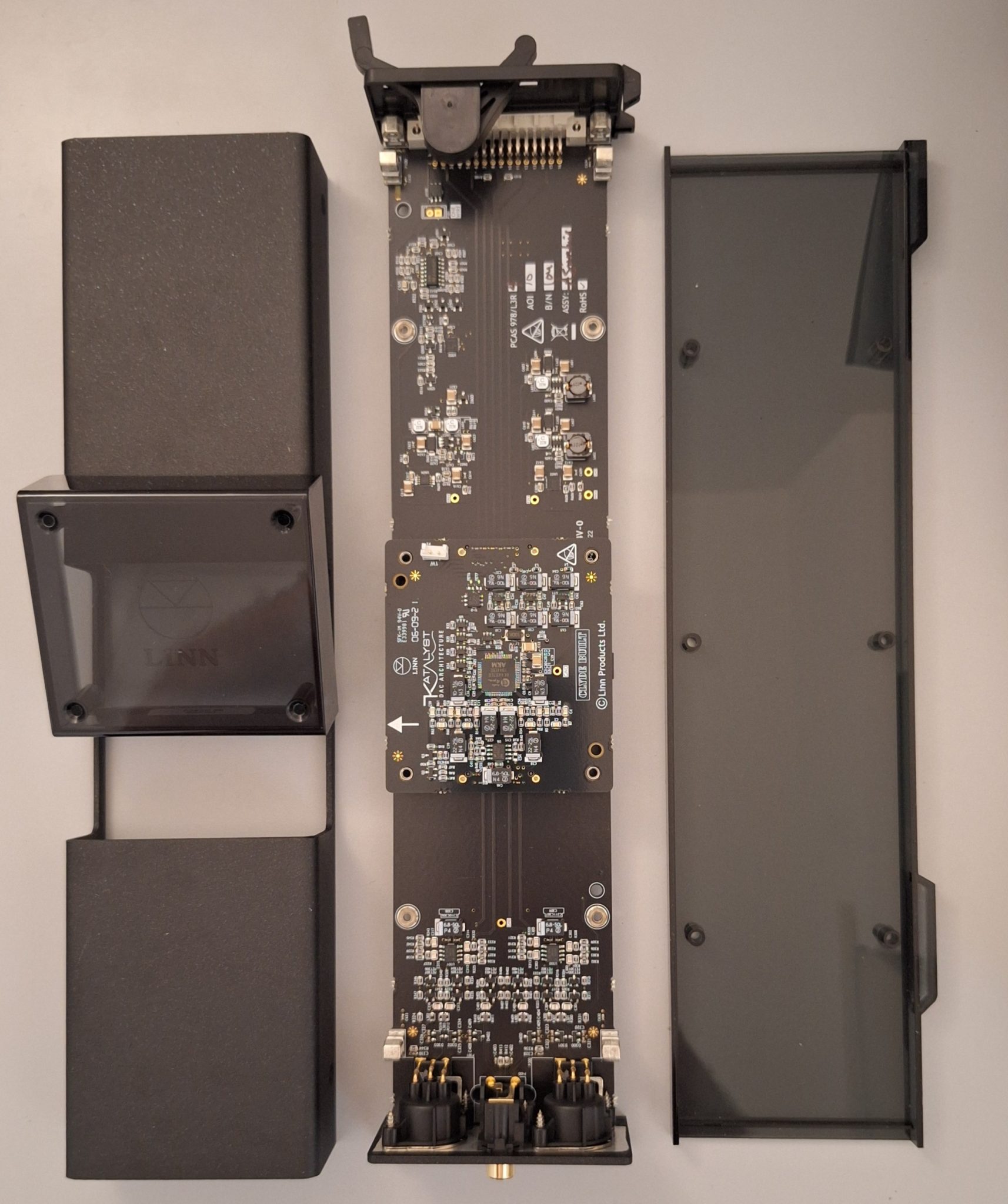
The Standard DAC is based on components manufactured by third parties as is the next level Katalyst which adopts a higher level chip, the AK4497EQ, and integrates dedicated power supplies that are more carefully tuned to make the clock, data flow, and signal more stable and the signal cleaner on the output – analog filter. The components are SMD and the circuit almost entirely discrete transistors except for a very good OPA1612A for each channel placed near the output.

The Organik DAC, on the other hand, has a discrete-component architecture that differs from most current integrated sigma-delta DACs. It always exploits digital sigma-delta modulation but applies a subsequent PWM(Pulse Width Modulation) modulation to generate a digital data stream that is then reconstructed using an AFIR(Analog-Finite-Impulse-Response) filter formed by high-precision discrete-component current DAC elements. The Organik DAC module is implemented on two overlapping boards, and on the outermost one we find an ARTIX-7 FPGA from AMD that takes care of signal-processing. Much attention has been paid to the design of the circuit board tracks. Those for the clock, for example, follow paths that coincide with tolerances of fractions of a millimeter to avoid delays between different sections in the DAC. The power supply for the conversion circuit was also made of discrete components.

Management and control: Linn’s magic eye
The Selekt DSM is a versatile machine that obviously requires some time to become familiar with the various functions. A streamer is controlled mainly through an app, which in our case is called precisely Linn App (Android and iOS). The app is intuitive and smooth, and I personally found it practical and also very fast in managing libraries from NAS over a home LAN. It is compatible with Tidal, Qobuz, Spotify Conenct, Roon, Airplay. USB-B connection with a PC does not involve ASIO drivers but only those of the operating system, reasoning that manageable files arrive in PCM at 192 kHz. DSD files up to DSD256 are streamed instead.
We also have physical controls such as the nice rotary control, a sort of Linn’s magic eye that vaguely brings us back to the tube radios of yesteryear. Inputs are given by rotating it and pressing in the main cardinal points while information scrolls on the large display on the front.

Somewhat at odds with this seems to be the alphanumeric display itself, which has no touch controls. On the center front profile, however, there are six physical buttons that can be programmed with the functions that each person deems appropriate.
The manageability of the device is very broad when one considers the ability to turn off functions that are of no interest, for example if one is not using the phono input or Bluetooth, and to reactivate them only when needed. One can then create one’s own Linn Account with which to manage the configuration of the Selekt and any other Linn equipment three hundred and sixty degrees via web browser. Among the various possibilities should be noted Space Optimization, a proprietary acoustic correction system with which to build a model of one’s room by entering geometries and applying the characteristics of one’s speakers from an archive of models measured by Linn.
The best way to take “full ownership” of the Selekt DSM is to follow the instructions found on the Linn Docs website(https://docs.linn.co.uk/wiki/index.php/Products), a veritable “Linn-pedia” dedicated to the Scottish company’s creations.





GIPHY App Key not set. Please check settings