

 Audio 2G
Launched toward the end of last year, the North Collection, of which the Moon 641 integrated amplifier featured in this test is a part, constitutes a change in the Canadian manufacturer’s course from the recent past, aiming to achieve sometimes seemingly conflicting goals.
Multifunctionality
Scrolling through the North Collection catalog, the first thing that jumps out at you is the way the different features to be associated with the various components have been chosen. Nowadays many users, and I include among them more mature audiophiles, tend to reduce the number of chassis in their audio systems, aiming for more compact and integrated systems. To go along with this trend, the North Collection aims to make every component (except power amplifiers) multifunctional. This means that-at least in intentions-users should not need more than two chassis to meet their needs. For a company whose flagship products have historically been separate components, this is a not insignificant change
The series begins with the641 integrated amplifier, the star of our test, and the 681 DAC/streamer its natural partner. Moving up a level, the collection divides into two categories: a series of complete front ends , such as the 791 DAC/linestage/streamer/phono-stage and power amplifiers.
The performance of the North Collection, which I recall is Moon’s current flagship , obviously could not fall short of its previous separate products. Given the premise this is not an easy goal to achieve, since putting several functions in a single chassis tended to compromise performance. However, the new Moon components meet this challenge on the strength of a number of technological solutions thanks to which, according to the manufacturer, not only is performance not compromised in any way, but even allows for the improvement of what was possible from the separate components.
MDCA: Moon Distortion-Cancelling Amplification
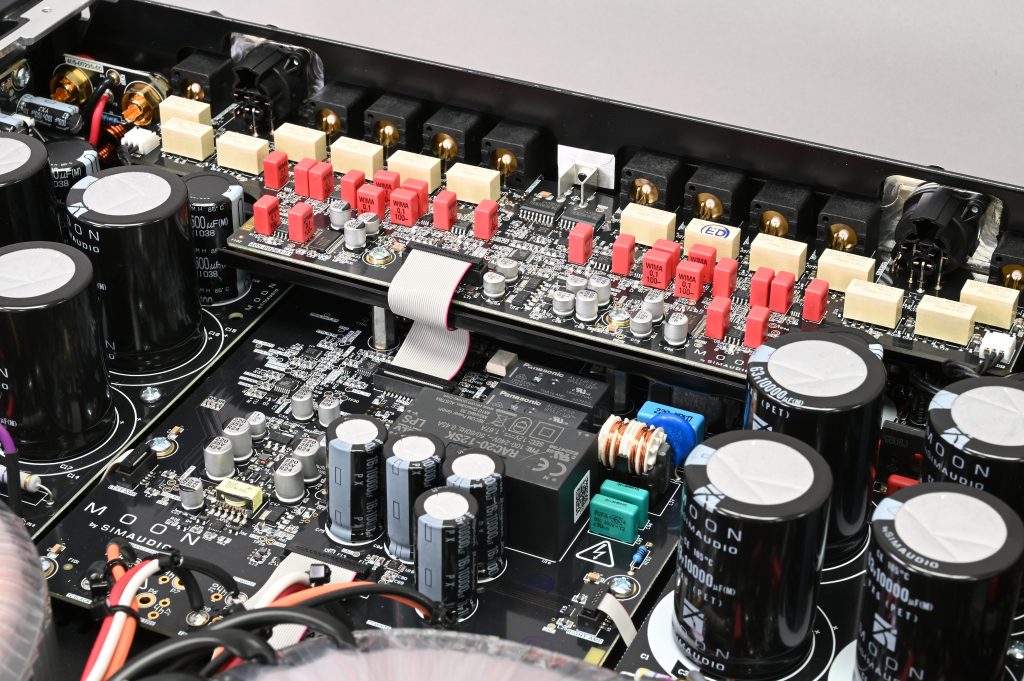
At this point we can introduce one such technology called MDCA. This is a gain module that replaces the classic global feedback circuit. Instead, a circuit completely external to the signal path is used that analyzes the input signal and makes precise corrections to eliminate any distortions detected at the output. These corrections are injected into the signal at the output stage. Here is a link to a small animation made by Moon that describes the process better than many words can.
The aesthetics of the North Collection
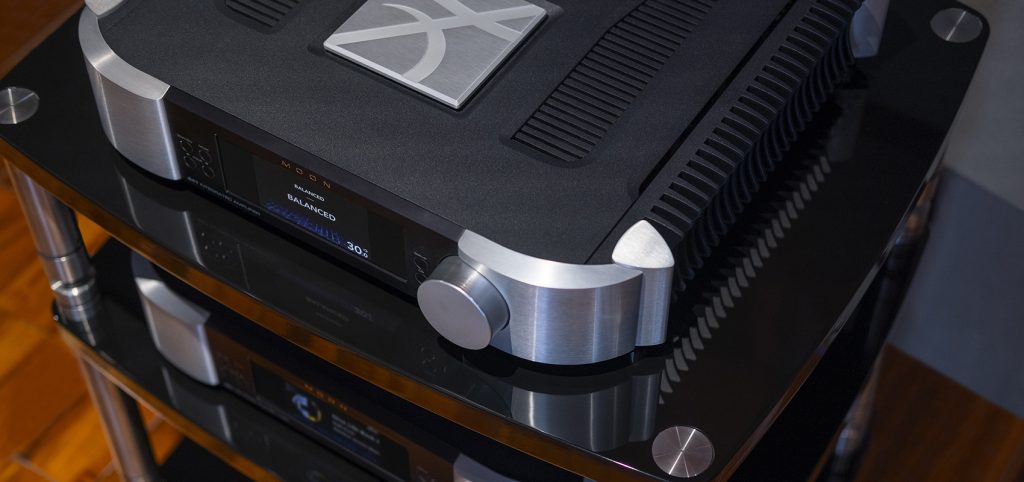
Among the various goals the Canadian company wanted to achieve was to differentiate the new Moon components from the previously made separates. The idea was that the relatively uncluttered North Collection units would likely be placed in multifunctional home environments such as living rooms or living rooms, rather than in dedicated listening spaces. In such use scenarios, aesthetics become a top priority. The overall design and finish of these products is exemplary: the control surfaces (particularly the use of rotary controls on the Moon 641 integrated amplifier and accompanying BRM-1 remote control) are outstanding, and the 4.3-inch color LCD widescreen display is well readable thanks to graphics that never overstep the boundaries of good taste. This is a strong differentiation here from the red LED displays used previously. It should be pointed out that although one might be led to believe that this is a Touch screen given the large size, it is in fact not. The user interface is based on the use of the two aforementioned rotary encoders and a few small buttons. In general, however, usability is within the reach of any user.
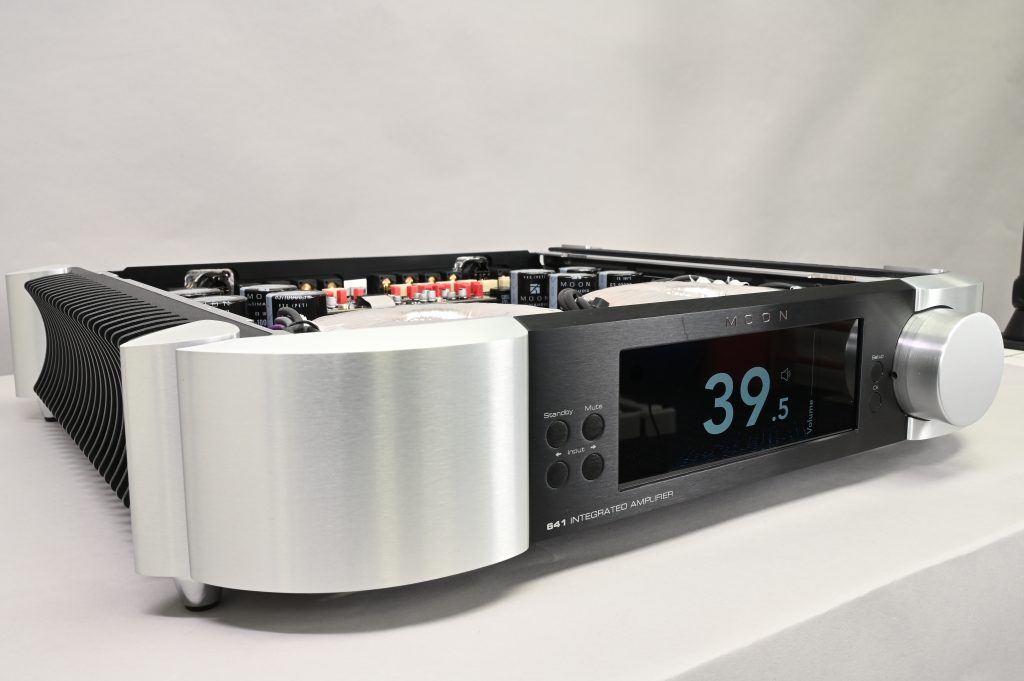
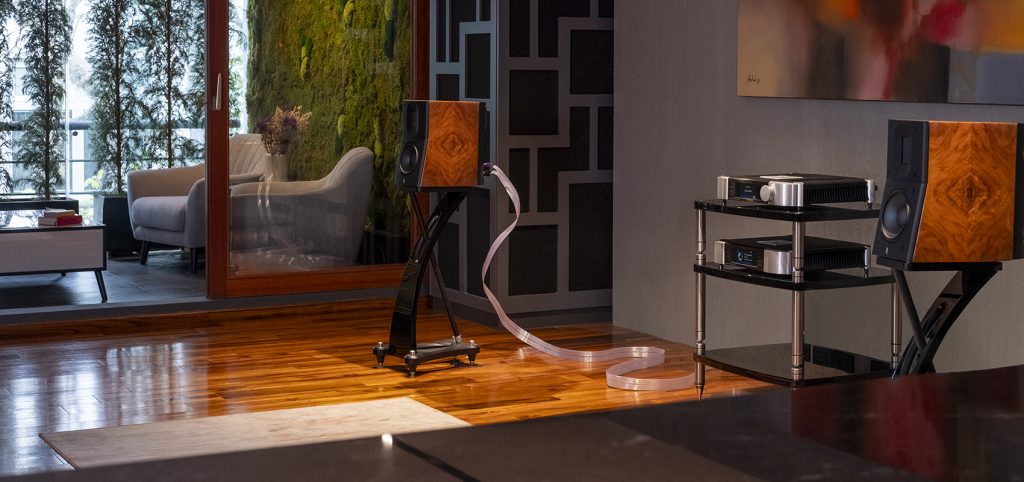
Moon 641 integrated amplifier: technical analysis
Before delving into the tale of the technical specifics of this Moon 641 integrated amplifier I think a small preamble is necessary: in my opinion it is desirable for an integrated amplifier with a High End vocation not to have too many additional features such as headphone jacks, digital inputs, tone controls, and switchable speaker outputs. And indeed the Moon 641 has none of these features. I realize that this statement probably contrasts with the expectations of those who would like the device to have every good thing on board. We have evidence of this orientation by reading the sometimes scathing comments that accompany our tests on the Audio-2G YouTube channel. However, I consider these criticisms to be questionable, given that the one, true purpose of these integrated amplifiers with High End ambitions is to offer sound performance of absolute excellence within their price range. Even with regard to the presence-absence in this case-of a phono input, I think it is fair to point out that most people who own a “turntable system” capable of taking full advantage of the capabilities of an amplifier of this level will use their preferred phono stage. I suppose that is why the 641 does not have one. In light of the above, it should be clear that Moon has developed this amplifier to work in conjunction with the 681 DAC/Streamer with which it communicates via Ethernet using the proprietary MOONLink protocol that allows the two interconnected devices to function as if they were a single unit through seamless integration, moreover taking advantage of the same BRM-1 remote control of which I will report later.

Having clarified this, let us proceed with the description by recalling that the manufacturer Simaudio describes the Moon 641 integrated amplifier as a preamplifier and a dual mono amplifier placed in a single chassis. The unit is capable of delivering 125 W in class A/B per channel into eight ohms, and that power doubles on a four-ohm load. Credit for this must be given to a pair of mighty transformers. 1KVA and to a very well-designed power supply section, split for the two channels. The 641 is balanced all the way to the output stage. Balanced inputs go to the preamp section, which is balanced. One of the strengths of Moon’s amplifiers has historically been the volume control circuitry. The 641 is no exception, although it is based on a new circuitry that Simaudio calls M-VOL3. This volume control operates in 1 dB increments up to level 20 and 0.5 dB increments up to maximum level 80. Each of the five inputs (1 XLR and 4 RCA) is configurable and includes home theater bypass options.
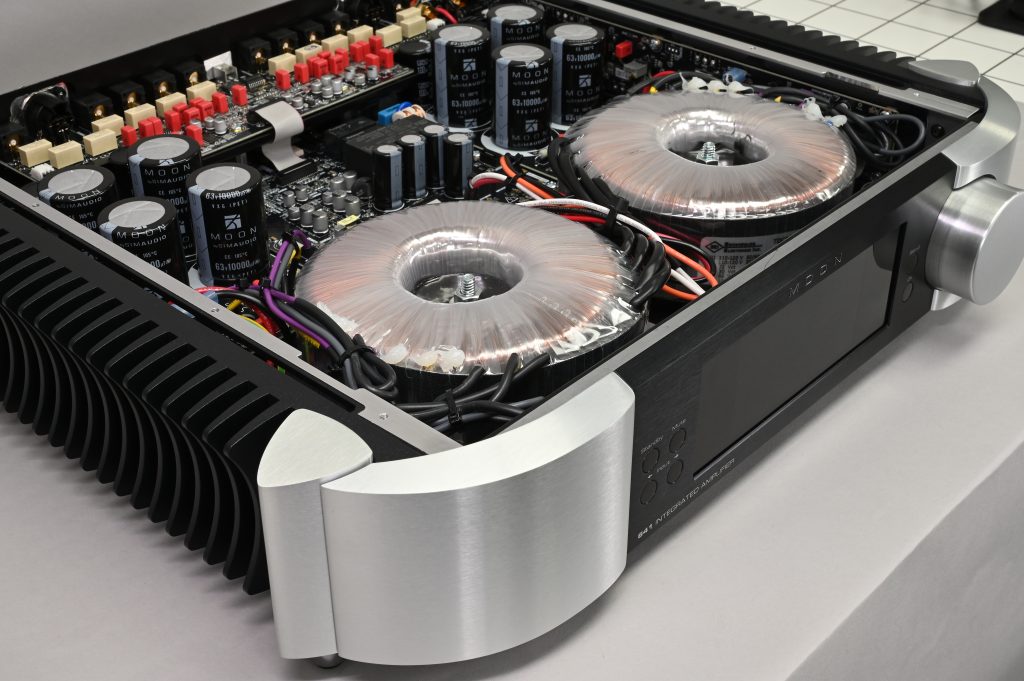
With the North Collection Moon has further improved its already high standard of construction. I particularly appreciated the complex design of the side heat sinks, which are assisted in their work by a clever use of the channelization of hot air flows that are extracted, without any motorized fans, through the plate bearing the Moon logo placed on the top panel of the cabinet. This is basically a kind of “chimney” that helps maintain operating temperatures that are never too high. Very nice and effective are the support feet that provide excellent mechanical insulation and the metal inserts with chamfered edges that lighten the look of the cabinet. As for the finish, the components of the North Collection range are available only in the two-tone version, visible in the photographs attached to this article. Before moving on to the listening evaluations, I would like to worthily celebrate the BRM-1 remote control, which-I state this without any problem-is the best I have ever used. It features a rotary volume control, similar to that of the amplifier it controls, and a display with very understandable indications. Its use becomes intuitive after only a few minutes of use. The BRM-1 works via Bluetooth, providing a wide range of operation.

Moon 641 integrated amplifier: Listening
The unit that was sent to us for testing was new and sealed, so it needed some break-in before it could express itself to the best of its capabilities. The thing after all is clearly stated in the user’s manual, which suggests running the Moon 641 integrated amplifier for a hundred hours before experiencing any critical judgment. This personally does not surprise me, having experienced over the years the need, greater or lesser depending on the equipment, for a break-in period. I do note, however, that this topic is one of the many used on the Web to “set fire to the dust” by fueling sterile and useless polemics. Here I will limit myself to writing that the Moon 641, after about one hundred hours, expressed its potential to the fullest in the low range, something it had not done in the first few hours. Let’s be clear: we are not talking about an amplifier that makes “gut punch” its stylistic hallmark. The low range of the Canadian integrated amp should be listened to and savored carefully because it is elegant, fast, timbrally rich but at the same time neutral. That refinement typical of the device that does not want to stand out at all costs (a most annoying tendency for yours truly), yet in times of need the Moon 641 knows how to make itself heard. As I write this I have in mind the first movement of Mahler’s Fourth Symphony in which the entry of the timpani and the “fullness” of the brass literally made me jump. For the sake of completeness I will report on the context in which the test was carried out: as sources we resorted to our ever-present Aqua La Scala MKII DAC in turn connected to a DIY Audio PC with JCat components on which Audiolinux was running in HQPlayer NAA mode. The Server was the Antipodes Audio K30. Alternatively, we also used the Esoteric N-05XD Streamer DAC directly connected to the LAN. As speakers we used the Vivid Audio Kaya S12 and Kaya 90 as well as, alternatively, the Opera Prima V2. Analog signal and power wiring, as well as power supplies, were Neutral Cable Reference Series in Room 2 and various AudioQuest Mythical Creatures in Room 1.
Having said that about the low end, let us move on to provide some additional information to help our readers get a feel for the sound of the Moon 641 integrated amplifier. Personally, I was fascinated by its Flow or, to put it otherwise, by its ability to draw you into the flow of music-any music, mind you-without forcing you into strenuous concentration. Everything here is very simple by virtue of an organic, natural sound that is never artifactual. The effect of such an attitude is to make you want to keep the system on all the time with the music going, as if it were a background to daily activities, but at the same time enjoying high-quality reproduction. The Moon 641, in my opinion, thus succeeds in reconciling two opposites: disengaged listening and “studio” listening. And this is by no means a trivial fact, since it implies a deep understanding of the dynamics underlying our auditory perception. To the classic question, “To what music is it best suited?” The answer can only be, “To all that beautiful.” Whether it is Classical, not only symphonic but also chamber, or Jazz or Pop/Rock, the Canadian electronic always gets away with momentum and with great class, giving intense emotions, always “disappearing” in the most absolute respect for the nature of the tracks it is called upon to reproduce. Nothing of note to report on the interfacing front with the speakers we matched it with, except that the 4+4 woofers of the Vivid Audio Kaya 90 have (obviously) appreciated its energetic drive.
Conclusions
At the end of this test, if I may be honest, I am left with the regret that I did not get a chance to test the partner of choice of the Moon 641 integrated amplifier, namely the 681 DAC/Streamer. You may have already guessed why: these are two machines designed in parallel to work synergistically. Abstracting the amplifier from the combo probably means not fully grasping the design intent behind it, which, moreover, is the founding motif of the Moon North Collection. Nonetheless, the 641 is an amplifier of the highest order, delightful to listen to, capable of driving any speaker at levels amply sufficient to spark a condominium argument and, what is far more interesting to me, with absolute refinement. The pleasure it brings to the eye of theindustrial design lover must also be included in the evaluation of a price that, while high in absolute terms, is certainly not exaggerated by today’s High End standards.
Giulio Salvioni
Technical specifications.
- Output power: (Stereo 8 Ω) 125 W
- Output Power: (Stereo 4 Ω) 250 W
- Input sensitivity: 300 mV – 6 V
- Input impedance: 22 kΩ
- Gain: 37 dB
- Frequency response: 2Hz-90kHz (+0 dB/-3 dB)
- Crosstalk: -109 dB
- Signal-to-noise ratio: 109 dB
- Total harmonic distortion + noise (@ 1W). 0,008 %
- Total harmonic distortion + Noise (@ 125W): 0.003%.
- Intermodulation distortion: 0.06%
- Damping factor: 700
- Dimensions (W×H×D): 48.1. × 10.2 × 46.5 cm
- Weight: 26 kg
Price (at the time of testing): €13,500.00 (inc. VAT)
Distributor for Italy: LP AUDIO – Via della Tesa 20, Trieste 34138
Italy
Phone: +39 040 569824




GIPHY App Key not set. Please check settings