



 Audio 2G
The new Opera Prima V2 bookshelf speakers, part of the Classica line of the Treviso-based manufacturer. Container shape, speakers full of technology, extremely convincing sound, skillful design. This in a nutshell is the new product that we will use as a reference for future tests for how much we liked it.

Opera is an Italian company of great tradition. It was born in the late 1980s from the genius of Giovanni Nasta, whose approach to quality reproduction is expressed in these few words that stand out on their website, “Our intent is to create acoustic loudspeakers with a fair quality-price ratio, pleasant to listen to and beautiful to look at.” The first speaker created, the Caruso, immediately made that thought material. It was a skillful fusion of the old and the new, of traditional cabinet craftsmanship and the most advanced acoustic technologies, and all at an inviable value for money. Many years have passed, and the product lines have grown, now two, the more ambitious Callas, and the Classica, born in 2015 and renewed now, with the new V2 versions
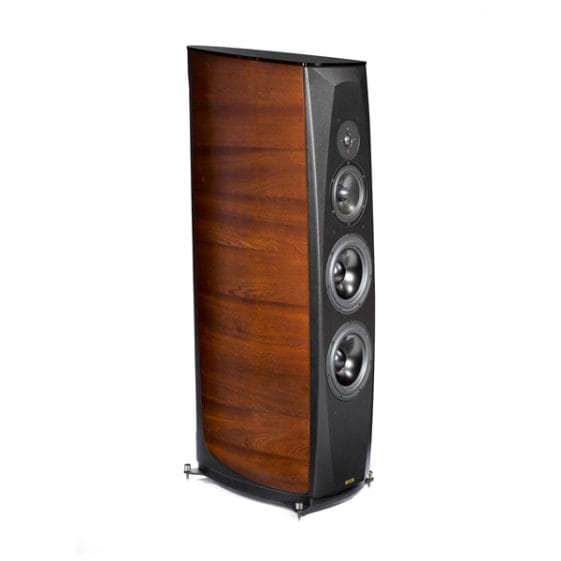
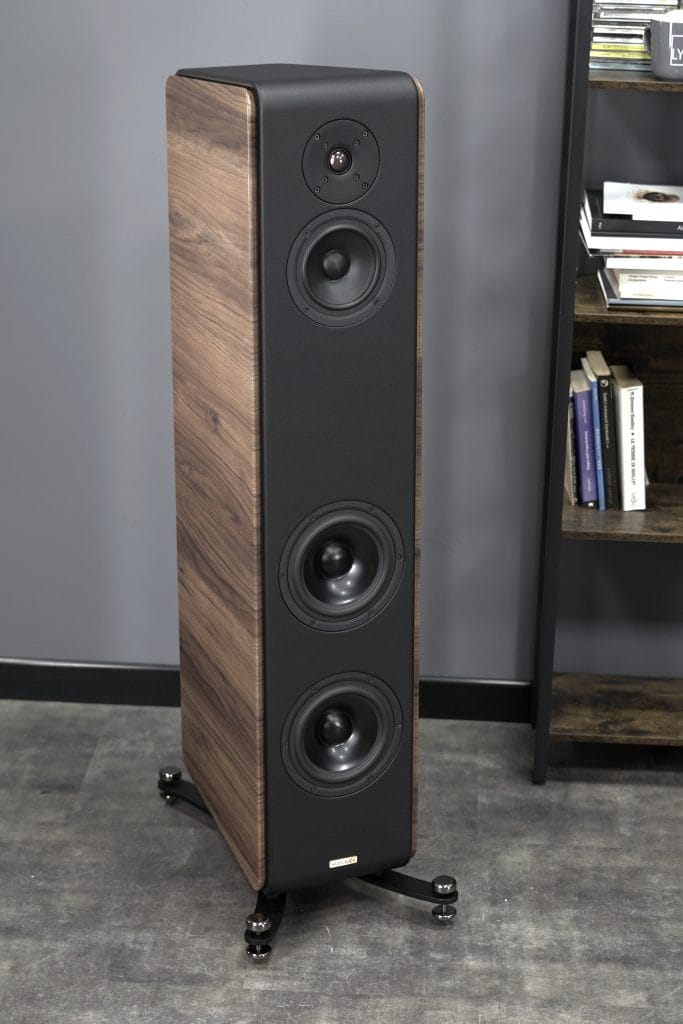
For now, the Opera Prima, the subject of this test, and Quinta make their debut. The former is a generously sized (237x428x390) two-way bass-reflex stand-mount loudspeaker with an 18cm mid/woofer and 2.6cm dome tweeter while Quinta is a large floorstanding loudspeaker with dual 18cm woofers and the same high-frequency driver as Prima. Gradually the line will be completely revamped, and thus will debut the new Central Center, the Mezza, which is a small bookshelf, and Grand Mezza which is its floorstanding counterpart.
Made in Italy
What immediately jumps out at the eye is the splendid container of the Opera Prima V2, which definitely departs from the usual, from the already seen. Guaranteed parallelepiped shape, albeit irregular, but with a stylistic figure, which although relatively close to the primitive Prima, definitely stands out for its originality and beauty. Looking at it, anyone would swear it is the dowry of Italian ingenuity. And indeed it is. It is finished in black marine-grade faux leather so as to ensure moisture rejection and lack of maintenance, which is instead necessary in speakers finished in real leather while the two side panels are made of high-quality hot-molded PVC. At first glance, it is absolutely impossible to distinguish this workmanship from natural wood, due to the presence of the typical raised grain and characteristic color spots. You have to know and touch them to realize that it is not real wood. Very original, by the way, is the edging, the border region between the faux leather and PVC made embossed, with a totally original design.

Internally, the care is utmost, and it is noticeable that nothing is left to chance. Modified from the Firsts that retire the cabinet size ratio, so as to further reduce resonances, the internal absorber is then a polyurethane material with a much higher density than previously used, and the points of greatest stress have been more reinforced with round baffles and top and bottom walls made with special attention to relative angles, so as to interfere with each other as little as possible. Another novelty is the components used, the result of an active collaboration with Scan Speak (a company that certainly needs no introduction). Rather than relying on custom builds, in fact, both the woofer and tweeter are the result of the experience of both companies and optimization work done together.
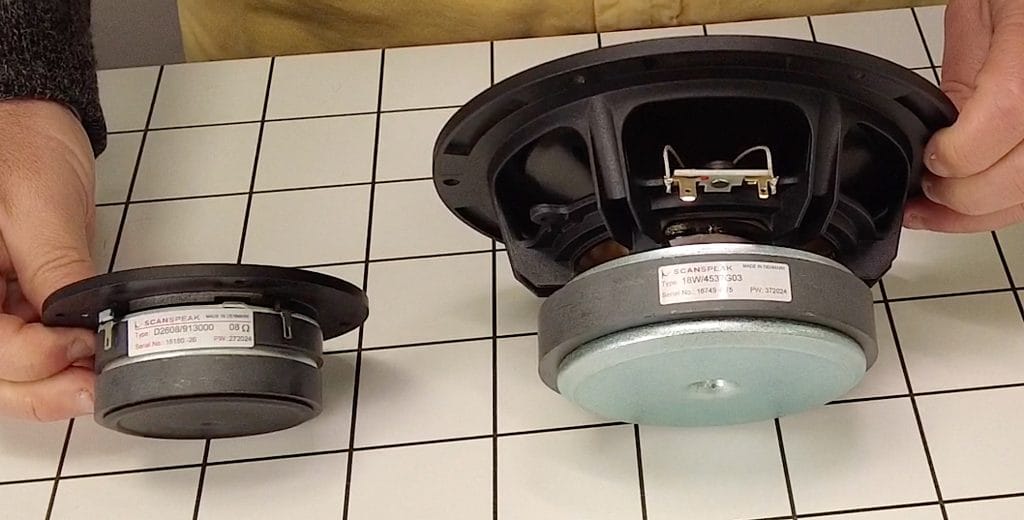
The former represents a remarkable collaboration with the Danish manufacturer; with an aluminum cone, it provides extremely generous excursion and remarkable dynamic linearity due to the special design of the polar terminations and the generous force factor. The soft-dome tweeter, on the other hand, has been optimized especially with regard to the materials inside the rear chamber, which is soft and damped so as to absorb the entirety of the emitted rear energy. The crossover filter with cutoff at 2500 Hz uses Vishay resistors to impasto Mundorf capacitors, simple in design has undergone numerous modifications so as to ensure the best acoustic performance.

Listening and conclusions on Opera Prima V2
We tested the Opera Prima V2 with many different amplifications. The Vitus R101 MKII, first of all, a kind of “powerhouse” with endless drive current. But then came the Copland CSA100 companion of all our adventures, and finally Marantz Model 60n. In short, 3 products of different level and sound that allowed us to better evaluate the Treviso speakers. Small tricks, of course, must be put in place to make them sound their best, a not too pronounced toe-in, the right space between back wall and sides, in short, nothing more than the standard. Full, full-bodied, solid, textural, the sound of these Prima V2s seem to approach a speaker of quite a different cost. Spatial reconstruction is also assured, as is a very well extended low register if one takes into account the woofer’s liter and diameter. In short, a universal loudspeaker of great quality, supported by an efficiency of 90dB and impedance of 4 ohms that allow it to interface even with not very powerful amplifications. Very suitable could be for example a tube amplifier, not of very low power, but from 15/20W. In short: really convincing speaker.
Technical characteristics of Opera Prima V2
- Type: rear bass-reflex
- Tweeter: 26mm soft dome, with double ferrite magnet
- Woofer: 18cm with aluminum cone
- Efficiency: 90dB
- Frequency response: 50Hz-21kHz
- Impedance: 3.8 ohms
- Maximum power: 100W undistorted
- Recommended power: 25-100W
- Crossing frequency: 2500Hz
- Dimensions: 237X428X390
- Colors: Light Walnut or Rosewood
- Price: 3,000€ the pair
OPERA Loudspeakers, Via Barone 4, 31030 Dosson di Casier (Treviso), ITALY
Tel. +39 0422 633547




GIPHY App Key not set. Please check settings