



 Audio 2G
In today’s market, entry-level integrated amplifiers often try to do everything to please everyone by including digital inputs, Bluetooth connectivity, and basic-level DACs. The Rotel A8 takes a different approach: priced at 399 euros, it focuses exclusively on what matters most, which is to offer quality analog amplification without the added burden due to the cost of mediocre digital circuitry.
Design Philosophy: Less is More
Rotel’s decision to make the A8 a pure analog amplifier deserves, in our opinion, applause. Although competitors in this price range often include basic DACs and digital inputs, such features almost always involve compromises in the quality of the analog section. By foregoing digital features, Rotel has been able to invest the entire budget where it matters most: in the sound quality of the amplifier. With this focused approach, users can use any digital components they may already have (e.g., CD player) or, more importantly, choose a dedicated DAC that meets their needs and budget when they are ready to make a new purchase. This is a modular approach that makes more sense in the long run, as digital technologies evolve faster than analog amplification.
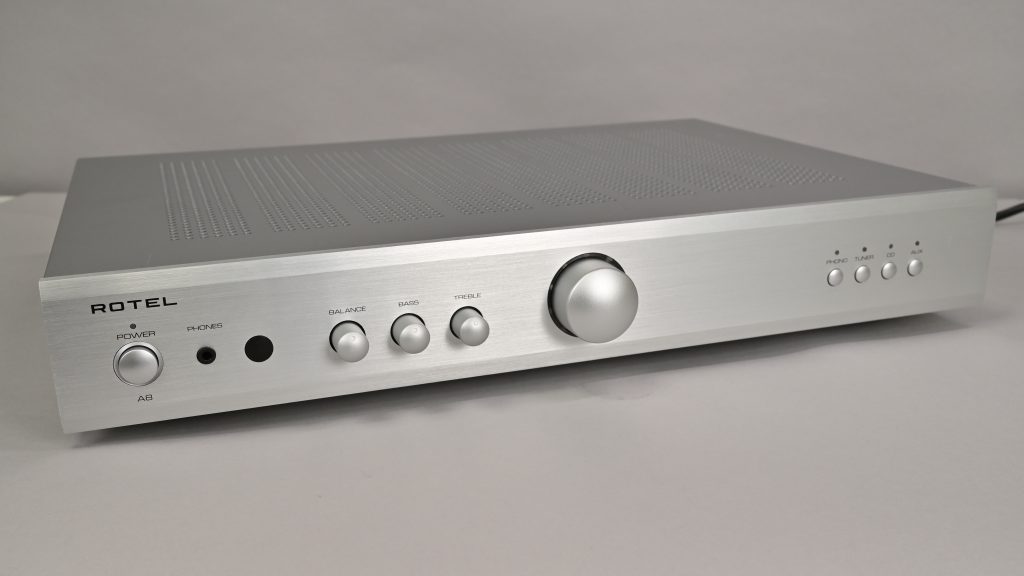
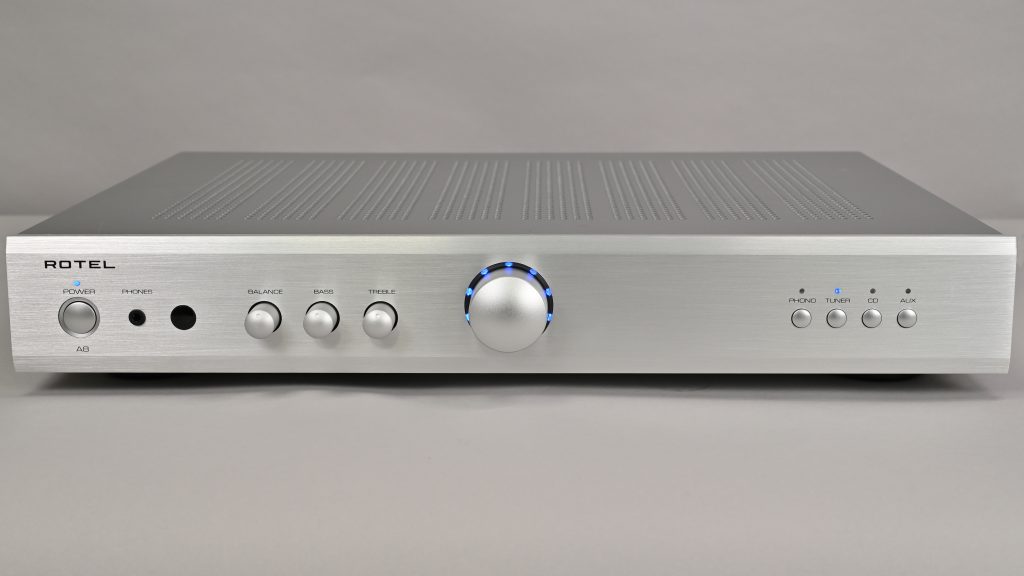
Technical analysis and main features
The A8 delivers 30 watts per channel into 8 ohms and 40 watts into 4 ohms through a well-designed Class AB amplifier stage. Such powers are undoubtedly modest, yet the absence of digital circuits means that the budget has been allocated to quality passive components, careful circuit design and a robust power supply section in which a well-sized toroidal transformer made “in house” by the Japanese company stands out.
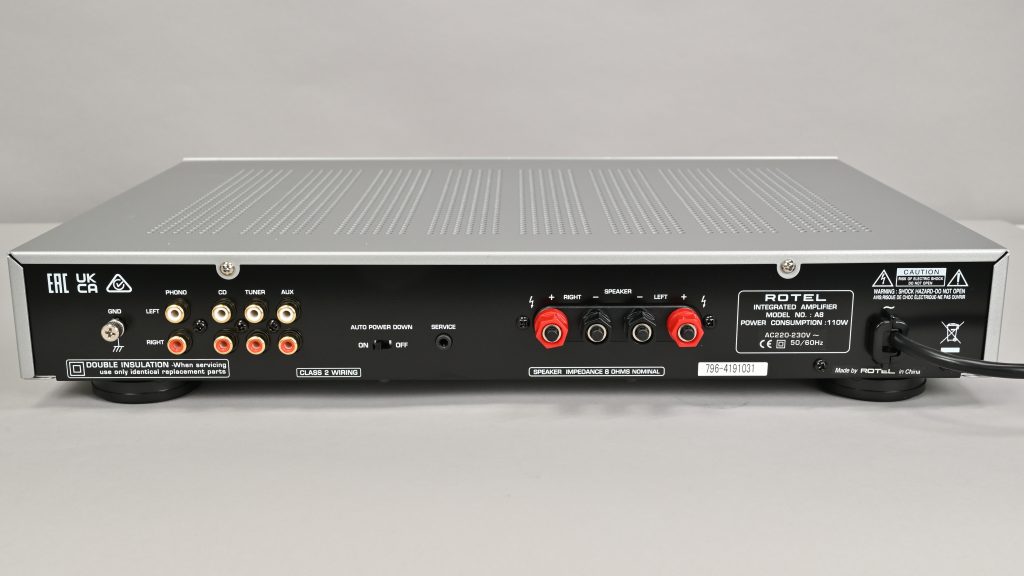
Connectivity includes:
– 3 line-level RCA inputs;
– 1 phono(MM) input;
– 3.5 mm headphone jack.
An interesting new feature for Rotel is the ability to customize the color of the circular LEC crown surrounding the volume knob. Four colors are available: red, green, blue and purple.
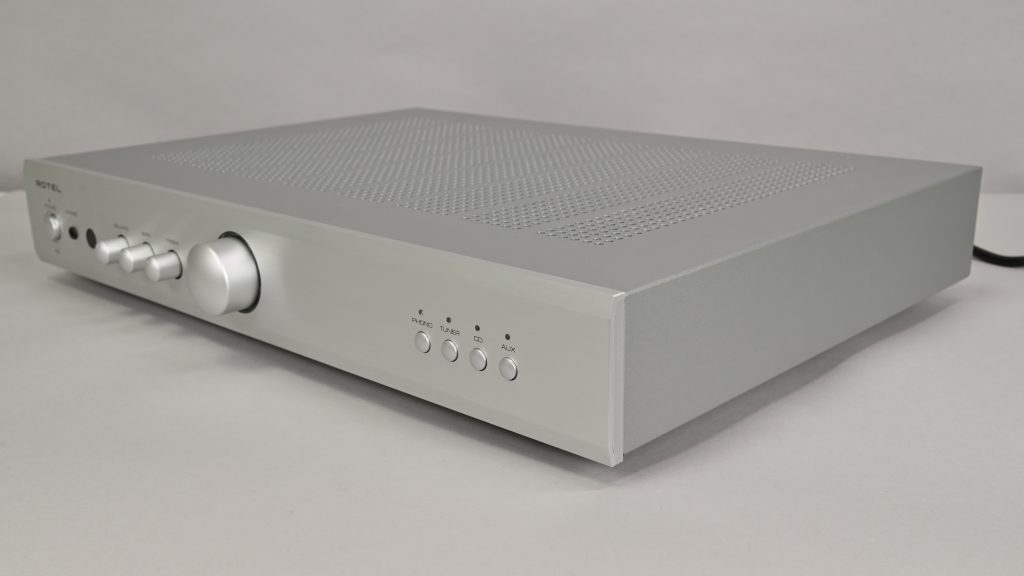
Another now-rare feature, especially in this price range, is the inclusion of tone controls for bass, treble, and channel balance on the front panel. The A8 also comes with an infrared remote control that allows volume adjustment and input selection. For those who own a Rotel CD player, the remote can also control the main functions of the CD player, adding further convenience.
Design-wise, the A8 concedes nothing to the affectations to which some competing products have accustomed us, yet its understated, solid look makes it more of a listening instrument than a piece of furniture. And we liked that about it.
Phono stage: A real bonus
The moving-magnet phono stage is another advantage of the pure analog design. Without the need to share PCB space with digital circuits-and consequently without the need for proper shielding-the phono preamplifier proved surprisingly quiet and musical. Pairing the A8 with our New Horizon 303i turntable equipped with an Ortofon 2M Bronze cartridge proved that this phono input is capable of working with sources well beyond its price range. The 2M Bronze is a high-performance moving magnet cartridge known for its detailed and dynamic sound. Although the A8’s phono stage cannot extract every single nuance that this excellent cartridge can offer, it nevertheless rose to the occasion, maintaining good separation and detail without introducing noise or coloration, thus allowing much of the cartridge’s refined character to emerge. This suggests that this phono stage will be more than adequate for cartridges in the typical price range of this amplifier, while being able to handle future upgrades without ever becoming a bottleneck.
Break-in
An interesting aspect of our test experience with the A8 was the noticeable change in character during the initial break-in period. Right out of the box, the amplifier had an overly dry and “mechanical” sound signature that contributed to a presentation that was not particularly engaging, with a tendency to offer an aseptic sound that failed to convey the natural flow of the music. However, after about 72 hours of operation, the character of the A8 evolved significantly. The sound opened up, becoming more natural and engaging. The initial feeling of a mechanical pacing gave way to a far more organic presentation with greater fluidity and better timbral balance. This transformation was particularly noticeable in the midrange, where voices and acoustic instruments acquired a more natural timbre and better three-dimensionality, allowing us to recognize the excellent qualities of the Paradigm Founder 40B bookshelf speakers.
Performance with Line-level sources
Our test setup provided an interesting opportunity to evaluate the A8’s performance with different levels of source quality. Pairing a 399-euro amplifier with the excellent Aqua La Scala MKII DAC might seem unorthodox, yet it revealed much with respect to the A8’s capabilities.
The high-end digital front-end – consisting of the NUC i7 with JCat USB XE card and DIY external power supplies that supplied the digital signal to the Aqua La Scala MKII DAC-allowed us to probe the transparency of the A8. Surprisingly, the amplifier proved capable of enhancing the superior qualities of this source. The sophistication of the analog output stage of the La Scala MKII, with its sophisticated tube design, was not lost with the A8. The amplifier demonstrated sufficient resolution to convey the natural tonality and three-dimensional presentation characteristic of that DAC, even within its power limitations.
We then tested the A8 using the internal DAC of a WiiM Pro Plus, a much better source from the standpoint of economic compatibility, which provided an illuminating comparison. Although the streamer’s built-in DAC is entirely respectable, the transition from the La Scala MKII was clearly audible through the A8, proving that this amplifier is transparent enough to reveal significant improvements in the digital chain. This comparison confirmed the correctness of Rotel’s decision to omit an entry-level DAC in the A8: in fact, the WiiM Pro Plus’s DAC is already superior to what could reasonably be included in an amplifier of this price.
Conclusions
The Rotel A8 proves that sometimes less is more, especially for entry-level prices. Focusing exclusively on analog excellence, it offers superior performance in its core function over its more feature-rich competitors. Although its modest power output requires careful speaker matching, the pure analog design delivers clean, engaging sound that serves as an excellent foundation for a growing hi-fi system.
The lack of digital inputs should therefore not be interpreted as a limitation but as a strategic advantage. It allows users to invest in better quality external digital components rather than being forced to use low quality integrated solutions. For those who are building a serious audio system on a limited budget, this focused approach makes more sense than an all-in-one solution with inevitable compromises.
Pro
- Analog design without digital compromise;
- Excellent build quality relative to the price;
- Clean and detailed sound signature;
- Quality phono stage;
- Competitive price;
- Customizable LED volume indicator;
- Tone controls;
- Infrared remote control included.
Against
- Limited power output;
- It requires careful speaker matching.
Technical characteristics
- Continuous output power: 40Wx2 (4Ω), 30Wx2 (8Ω)
- Total harmonic distortion: <0.03%
- Intermodulation distortion (60Hz:7kHz, 4:1): <0.03%
- Frequency response:
Line inputs: 10Hz – 100kHz, -0.5dB +0.05dB
Phono input: 20Hz – 20kHz, -0.5dB +0.03dB - Damping factor (20Hz – 20kHz, 8ohm): 80
- Input Sensitivity/Impedance
Line Inputs (RCA): 180mV / 60kΩ
Phono Input (MM): 2.5mV / 40kΩ - Input overload level
Line inputs (RCA): 4V
Phono input (MM): 50mV - Signal-to-noise ratio (IHF “A” weighted)
Line inputs: 90dB
Phono input: 80dB - Bass / Treble tone controls: ± 6dB at 100Hz / 10kHz
- Dimensions (W×H×D): 430×73×347mm
- Weight: 5.8kg
- Power supply: 230V/50Hz
- Power consumption: 110W
- Standby power consumption: <0.5W
- Available in finishes: black or silver
Price: €399.00 including VAT.
Distributor for Italy: Audiogamma spa – Via Nino Bixio 13 – 20900 Monza (MB) Italy
Tel. +39 02 55181610
web: www.audiogamma.it




GIPHY App Key not set. Please check settings