



 Audio 2G
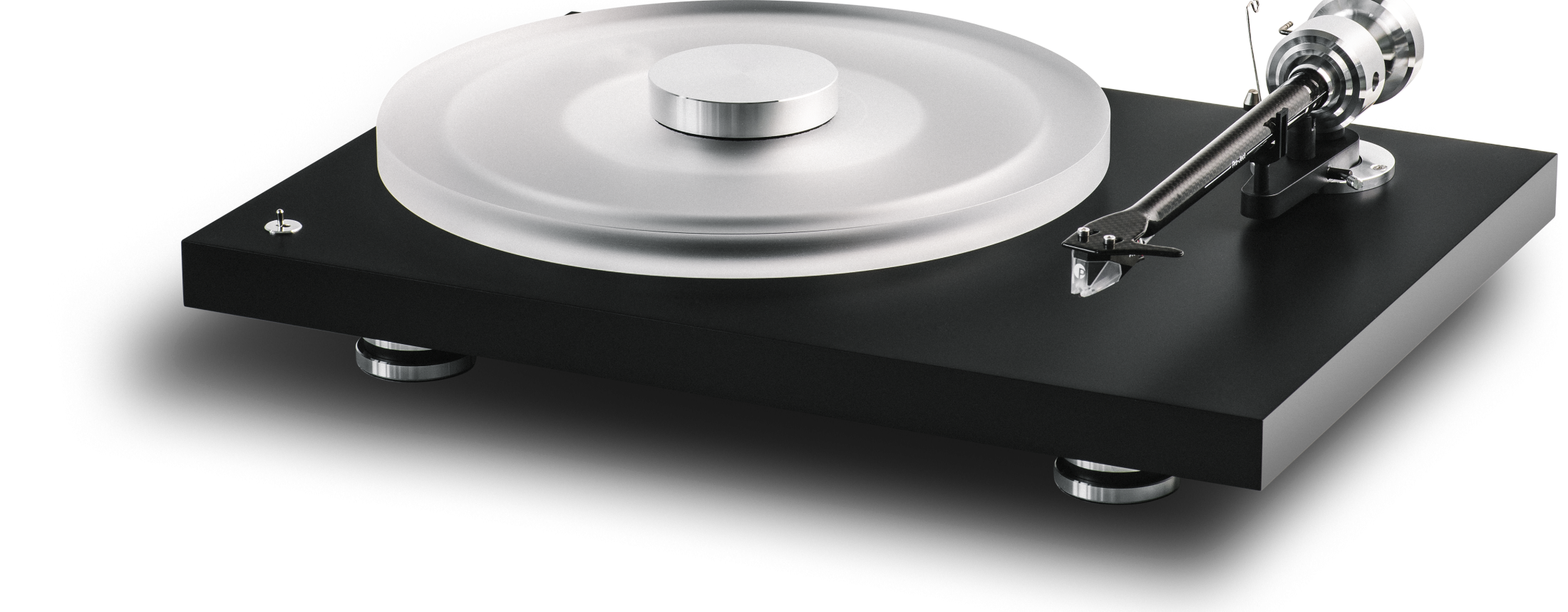
Pro-Ject has steadily evolved the Debut series over the years, transforming it from an entry-level line to an outsider for more important models. The latest addition is the Reference 10, a name that leaves little doubt as to the Austrian brand’s intention to make a reference turntable in its range. The eldest of the Debuts retains the down-to-earth and effective approach of the best-loved Pro-Jects while flanking solutions derived from the top models.
Technical analysis: minimalist and advanced
The established success of Pro-Ject turntables comes from rational construction and undoubted sonic effectiveness. Careful designs, attentive to the construction elements most influential on performance that progressively improve as they move up in the various categories. In the vast Austrian catalog, the Debut series is in an intermediate range. It consists of a basic platform with a rigid frame made of MDF and belt drive on which different solutions are implemented. The Reference 10 is an evolution of the PRO models that follows their main aesthetic features. It is equally finished with matte black paint that chromatically detaches with other elements, such as the translucent acrylic platter or machined metal parts. Highlighted, for example, are the arm joint and the three support feet, which are adjustable and constructed from turned aluminum discs into which is inserted a TPE vibration damping element on which is applied a layer of felt to protect the support surfaces.

On the majority of models Pro-Ject employs the short-belt drive, which ensures optimal utilization of torque and quietness of the mechanism. On the most popular versions a plastic underplate is implemented while in this case there is a pulley made of machined billet aluminum that provides greater rotational mass. A polished steel pin is inserted in the center that will fit into a brass bushing attached to the frame. The mechanism includes a ball at the bottom of the channel, where the weight of the pin insists, to reduce friction and ensure quiet operation. The motor is located a short distance from the axis of the pivot and remains covered by the plate for the benefit of a clean design. It, too, has an aluminum pulley, with two grooves to accommodate both a flat belt for 33.3 and 45 rpm speeds and a round section belt to be used eventually for playing 78 rpm records. The motor is easily attached to the chassis through a flange with four screws to which vibration-isolating o-rings are attached.

The plate is made from a disk of translucent acrylic three centimeters thick. It is machined internally to make room for the underplate. Included is the felt mat and an aluminum clamp, also with felt. It is not designed to flatten corrugated discs but serves to increase the rotating mass. Rotation however is electronically controlled by a circuit that transforms direct current, supplied by a wall-mounted power supply, into clean, stable alternating current for the motor. The claimed wow & flutter values are quite reassuring. With this system, moreover, speed change is done electronically, simply by operating a toggle switch on the left side of the frame. The tonearm is the element that most distinguishes the Reference 10 from the other models in the Debut series. A straight-barrel component was developed for this turntable, ten inches long (254 millimeters effective) with an integrated shell. The length is longer than that of its other siblings factor that limits radial reading error and thus improves tracking of the innermost grooves. The effective mass is 16 grams, a value that makes it suitable for heads of medium compliance. The tubular is made of a sandwich of carbon fiber and aluminum. The combination of two materials provides rigidity, lightness and control of unwanted vibration. Much attention is paid to the articulation, made of turned aluminum parts, a kind of concentric coupling between tubulars whose movements are entrusted to high-precision bearings. Reading weight adjustment is achieved with a counterweight that moves along a threaded rod, a solution introduced in the Pro-Ject Evo tonearms of the new Premium series. Compared to models with a smooth rod, it allows for greater precision in adjustment and stability of the counterweight without the need for tightening screws. In fact, the weight hole has two o-rings internally that provide a firm seal while acting as resonance dampers. There are no graduated scales, and the reading force must be measured with the supplied scale, a plastic bascule that is as simple as it is effective. The antiskating is as usual Pro-Ject flush. The tonearm collar, also made of turned aluminum, allows VTA adjustment via an Allen screw that tightens the tonearm engagement tube. Included is a complete set of tools for intervening at every “strategic” point on the arm as well as a paper template for accurate cartridge mounting and a cable of superior quality to the basic red-and-white.




GIPHY App Key not set. Please check settings