



 Giulio Salvioni
The history of audio recording, which has been heavily influenced by factors related to the development of enabling technologies, can be approached in a number of different ways. In this brief chronology, we will simply identify, in chronological order, the main events and personalities that shaped its history.
Although there is no official historiography of audio recording we will propose a four-phase chronology of the events:
- Acoustic period (1877 – 1925)
- Electric period (1925 – 1945)
- Magnetic period (1945-1975)
- Digital period (1975 – to date)
The Acoustic Period (1877 – 1925)

Once the system was in motion, the undulations of the foil caused the stylus to move back and forth, this in turn caused the diaphragm, thereby moving, which in turn moved the air in the mouthpiece to reproduce the sound. The result was barely audible and Edison quickly discarded the project to focus on other inventions, such as the light bulb for which he later acquired fame. It’s worth remembering that Edison’s phonograph was not intended to reproduce music, but was designed as a form of voice memo recorder for office use. Being totally deaf, the idea of recording music did not interest him.
Almost ten years later, Edison’s invention was further developed by the inventor of the telephone Alexander Graham Bell and Charles Tainter, who realized that the phonograph was too impractical, the sound quality was terrible and the recordings deteriorated almost immediately. Their research and development led to a new phonograph with a removable wax-coated cylinder that replaced the fixed tinfoil-covered drum. In addition, the record/playback unit moved over the rotating cylinder rather than vice versa. These improvements made the recorded sound more recognizable. Meanwhile, a new, highly competitive system had been introduced: the Gramophone.
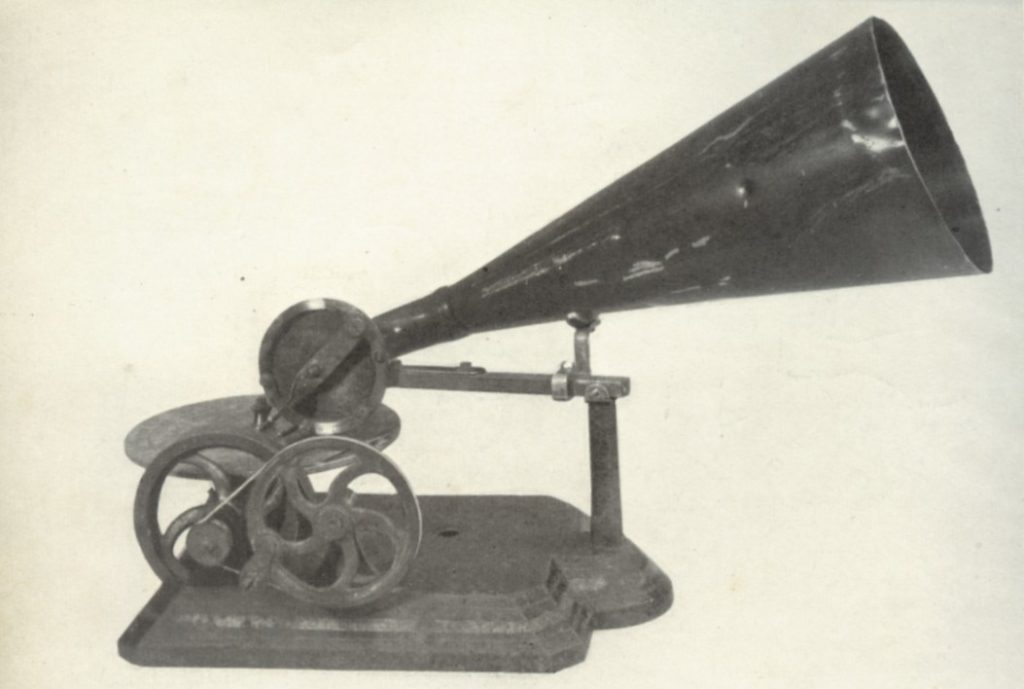
This device was simpler to use and suitable for low-cost mass production. It was developed between 1887 and 1893 by Emil Berliner in order to circumvent Edison’s cylinder patent. Again, the stylus moved over the recording medium, now a disc rather than a cylinder. The recording was made by a stylus attached to a vibrating diaphragm which engraved a spiral groove from the outside to the inside that oscillated in the horizontal plane (from side to side) rather than the vertical plane (up and down). The sound was produced by a thin layer of black carbon covering the metal disc. At the end of the recording session, this disc was placed in an acid bath, which etched a groove where the stylus had removed the carbon and exposed the metal underneath. The end result of this mechanical/chemical process was a “positive” recording that could actually be played. Berliner was aware, however, that the individual recordings obtained by Bell and Tainter’s wax cylinder process was a huge obstacle to large-scale commercial exploitation of the invention. To overcome this limitation, he developed a process of copying his records by electroplating the original in order to produce a negative version with “ridges” instead of grooves. This metal negative was used as a mould for making copies in a printing press.
Compared to the previous systems, Berliner’s discs were cheaper to produce and allowed for greater volume during playback. In addition, as Donald Norman notes in his The Invisible Computer1“The real use of the phonograph record, discovered after much trial and error by a variety of manufacturers, was to provide prerecorded music. Emile Berliner moved quickly to exploit this an his company rapidly picked up a dominant share”.
D. A. Norman: The invisibile computer, 1998. MIT Press pag. 10, the fact that they had devised a lightweight, easily transportable and relatively durable medium made it possible to shift the focus from the function of a voice recorder to that of a machine for the home reproduction of music. Berliner’s first records proved that music’s recording could be a profitable business, but the process of making the discs paired with the still provisional nature of the gramophones themselves meant that recording “serious Music” was still not yet viable.
The necessary improvements were made in 1901, using the same technology developed by Bell and Tainter. Wax was the ideal medium on which to make recordings, far superior to the black carbon used by Berliner. Once the problem of galvanic wax moulding and the (not insignificant) matter of Bell and Tainter’s patents had been solved, the gramophone could then assume its role as a music player.
The Birth of the Record Industry
These technological improvements greatly increased the fidelity of reproduction and were the required step forward which convinced some important artists to make recordings. For instance Caruso, Chaliapin, Nellie Melba, Adelina Patti and others brought greater esteem to the gramophone as a cultural instrument as opposed to its previous perception as little more than a toy. Another contributing factor was the increase in the size of the disk which went from 7 to 10 inches (and soon after to 12 inches), consequently increasing its duration.
After the introduction of this new recording technique, some entrepreneurs began to exploring the economic potential of the recording business. From 1901 onwards Brothers Will and Fred Gaisberg (Berliner’s agents, operating on behalf of the Gramophone and Typewriter Co. which later became HMV and then EMI), made a series of recordings in atypical environments such as hotel rooms across Europe and later in Russia and Asia. These recordings were mostly opera arias sung by Francesco Tamagno, Battistini and other stars of the Imperial Russian Opera including Chaliapin, Nikolai Figner and his wife Medea Mei-Figner. Records were made from these takes that sold quite well in Russia but had little impact elsewhere. In 1902 amidst the immense popularity of the verismo operas by Puccini, Leoncavallo and Mascagni, Caruso became their ideal interpreter and recorded these best selling works for the first time. As such, the gramophone became the means to convey classical music to a wider audience.
“We paid Caruso the hundred Lire requested directly on the spot. I was stunned by the ease with which such a huge amount of money was earned, but I could not foresee that, as a result of that contract, Caruso would earn almost $5,000,000 over the next twenty years and the record industry twice that amount. Nor could I predict that these records would bring down all the barriers of prejudice that the great artists had towards the recording”.

Caruso had no difficulty during the recordings and in his first session ten very famous arias accompanied on the piano were recorded in two hours. The sound of his records was rich enough, even on the primitive gramophones of the time. Such was the popularity of these records that some of the master recordings ended up wearing out due to too many copies pressed, forcing them to be re-recorded.
This happened before the technique for making multiple templates from a single master was developed.
During this first period vocal and lyrical records dominated the classical sections of record catalogues. Orchestral recording was quite rare due to the technical difficulties related to this genre. However, in 1913 the London Symphony Orchestra under Artur Nikisch did make a few discs, including an eight-sided version of Beethoven’s Fifth Symphony. Technically the results began to became acceptable and over time other important names approached the registration, among these were Elgar and Toscanini.

Recording in The Acoustic Period
During the Acoustic era recording technologies were based on mechanical devices that replicated the Edison phonograph, suddenly increased in scale. A huge reversed horn was used to capture and focus the physical pressure of the air generated by the sound waves produced by the voice or musical instruments. Also in this case a membrane located in the throat of the horn was connected to a stylus that, when the air pressure moved the diaphragm back and forth, scratched or hit the recording media.
Due to technology’s limitations, these were poor quality and low dynamic recordings. In addition they captured only a limited part of the audible sound spectrum – from about 250 Hz up to about 2,500 Hz – which required musicians and engineers to adapt to these technical limitations. Ensembles of the time preferred the most powerfully emitting instruments such as the trumpet, cornet and trombone. The double bass, which is too low in frequency to be properly recorded, was replaced (or doubled) by lower register brass such as the tuba and euphonium. The artists also had to strategically position themselves around the horn to balance the sound, playing as loud as possible. The horn also generated some internal resonance and this required the use of heavy tapes of cloth in order to dampen them.
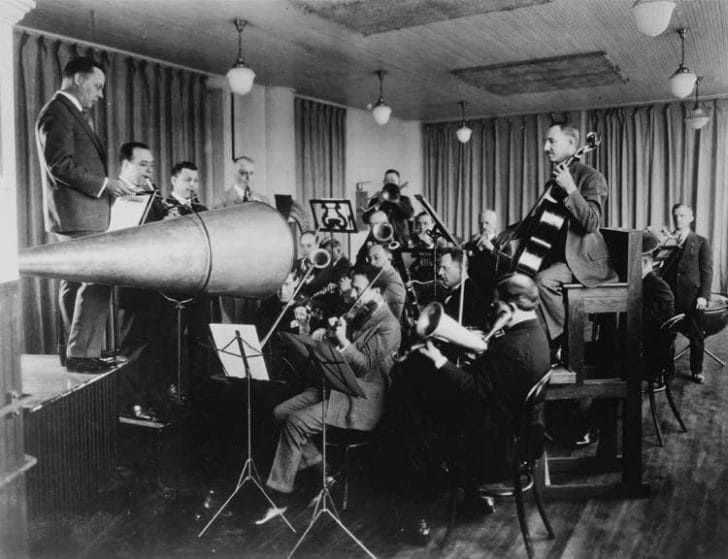
Thanks to its directionality, the human voice was the most important subject during the first twenty years of recordings. The bottom panel of the vertical piano that usually accompanied the vocals was removed and the piano itself placed on a scaffold, so that the stringer was in front of the horn of the engraving machine. Wind instruments, especially brass, were the most “phonogenic”, while strings with their minimal directionality, were banned from studios. It was thus that the recording techniques, conditioned by the available equipment, heavily conditioned the instrumentation of the orchestra and its repertoire.
The orchestral scores were rewritten entirely by winds, replacing double bass with tuba, cellos with bassoons, violins and violas with flutes and clarinets. As such, Augustus Stroh’s 1899 invention of a heavily modified violin was universally acceptation. Stroh replaced the body of the violin with a simple piece of wood to support the jumper which was connected to a metal diaphragm and whose vibrations were amplified by a metal horn. Its dispersion characteristic, similar in directionality to brass, once again made possible the use of violins in the recording sessions.






GIPHY App Key not set. Please check settings