



 Audio 2G
Yamaha literally launches a challenge in the high-end headphone amplifier market with the HA-L7A, a product that promises to revolutionize the listening experience. It’s not just about power or audio quality: this is about completely rethinking how we experience music through headphones.
Yamaha, a story that goes way back
And this from Yamaha, a historic company whose journey goes back a long way, when its founder, Torakusu Yamaha, repaired a reed organ-it was 1887. Soon after, he successfully tried his hand at the manufacture of his first musical instrument, while the production of the first HiFi equipment came many years later, in 1954. You can read the full story here

When we stood in front of HA-L7A at the Munich Hi-End Fair, 2025 edition, we were speechless. The product is not strictly new, and we had seen it in passing before, but never live, in front of us, and just looking at it is a journey, between design and technical fact that left us speechless. So we had both the amplifier and Yamaha’s flagship headphone, YH-5000SE, shipped to us. Once the HA-L7A was connected we tried it, having an excellent class A power amp (Esoteric S-05) at our disposal, discovering its exceptional qualities even just as a PRE/DAC and so we conducted the test on our YT channel in that mode, here you will find a more detailed test evaluating it also as a headphone amp
An original design
The first thing that strikes one about the HA-L7A is its unusual L-shape, which totally breaks the mold of classic form factors. “It’s not an aesthetic quirk,” explains Ryota Sato, head of design. “Every curve has a technical reason.” In fact, the two toroidal transformers are mounted vertically above the power supply board, minimizing electrical paths and background noise. The 8mm-thick sandblasted aluminum body weighs over 5 kg, and even the volume knob, machined from a block of aluminum, conveys a feeling of precision and solidity.
When the Japs decide....
Under the hood of HA-L7A is the best of modern audio technology. The digital-to-analog converter is an ESS9038PRO considered one of the best with its 8 dacs, which are used 4 by 4 in differential configuration, and in fact HA-L7A is fully balanced and hides within it a complex architecture designed to eliminate all forms of electronic and mechanical noise. Yamaha has divided the internal circuits into three sections: the main board for audio signals, the amplification section, and the power supply.
The main board, where audio signals are processed, uses a multilayer structure that keeps the different types of signals physically separated. The complete elimination of ground loops is another key aspect of the design, since they can turn into antennas that pick up external noise, raising the noise mat and causing some of the signal to be lost. Volume control is then entrusted to the MUSES72323 integrated circuit, used in both consumer and professional HiEnd level products, we have for example encountered it in the Marantz Model 10. The power supply uses a special Analog Devices integrated, designed specifically for high quality audio applications and has high rejection capability. Obviously, all components are rigorously selected, but not just by looking at measurements, but through a series of comparative listening tests, an empirical approach that takes months of work, but allows us to identify the components that “sound” better than the circuit design. Beautiful are Yamaha’s typical light blue polyester capacitors, which the company has built in Japan to specifications and which characterize all top production.
The DSP effects
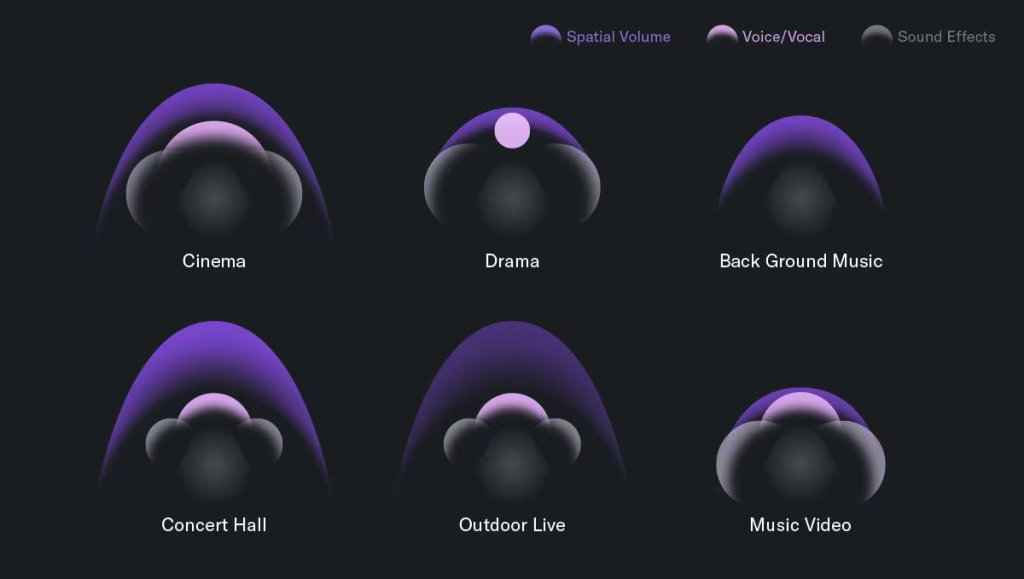
This is where one of the HA-L7A’s most interesting technologies comes into play: the Sound Field system. Yamaha has taken its 30 years of experience in home theater receiver design and adapted it to the world of headphones. Six different modes make it possible to recreate the acoustics of real environments: from the concert hall to the small jazz club, from the recording studio to the rock arena. “The trick,” explains Yusuke Konagai, DSP designer, “was to never betray the original sound. We want to enrich the experience, not distort it.” For purists, there is always the Pure Direct mode, which completely bypasses any digital processing. An interesting video explaining from the mouth of the HA-L7A DSP designers included can be found here:
Connections for all tastes and all headphones
The HA-L7A does not discriminate: two balanced outputs (XLR and 4.4mm Pentaconn) for the finest headphones, plus a classic 6.3mm jack output with gold-plated contacts. On the input side, the variety is impressive: USB-B for computers, coaxial and optical for CD players, analog RCA for turntables. The USB DAC supports DSD files up to 11.2MHz and PCM up to 384kHz/32bit. Pre-outs can be XLR -preferable- or RCA

Exciting listening
After weeks of testing with different headphones-from the Yamaha YH-5000SE to the Sennheiser HD800S-one thing is clear: the HA-L7A is not just an amplifier, it is an invitation to rediscover one’s music collection. The bass has a control and depth that amazes, the mids are crystal clear without ever being obtrusive, and the treble shines without fatigue. Most importantly, there is that feeling of “presence” that distinguishes a good system from an excellent one. The power output seems “little,” 1 W, but do not be misled by these figures. 1,000 milliwatts is more than enough power for most headphones; unlike loudspeakers, headphone amplifiers do not have to deal with large impedance fluctuations. Headphones generally have a very linear impedance curve. The L7A provides a much more than adequate level even with high-impedance headphones up to 600 ohms, as long as their sensitivity is not too low. An example is the beyerdynamic T 1 (second generation) with an impedance of 600 ohms and a sensitivity of 102 dB/mW, these headphones are among the most demanding on the market as far as the connected amplifier is concerned but the Yamaha was able to drive them great, a sign perhaps that the claimed W is as always in Japanese “series” specifications extremely conservative. Let’s move on to listening impressions of the effects, which should not be confused with what, for example, Apple offers with its AirPods with 3D audio, which require encoded music and allow true directional localization through the headphones -within certain limits-. Yamaha’s Soundfield technology does not require the track to be heard to be treated, but only simulates certain acoustic environments, such as the reverberation of a concert hall. Soundfield effects can only be used through the headphone outputs, not through the pre/line output of course, and to be honest what we preferred was the pure stereo playback, although some soundfield effects are really impressive with certain tracks, some classical tracks become really interesting with the Concert Hall effect, giving just the feeling of being sitting in a seat in the Parco Della Musica, although then the feeling of artifacting at certain times is heard quite clearly. Missing is a crossfeed function that could easily have been implemented. After all, the DSP’s work on the digital signal was already done, and trying to correct those very left-right biased recordings through an adjustment could have been a very good idea; it would have centered the scene, and minimized the headphone effect that can sometimes seem unpleasant. The price? It’s certainly not for every budget, but when you consider that Yamaha has invested three decades of research into this product, it adds up. It is an amplifier designed to last for years and to make you fall in love with music every time you turn it on.
Technical characteristics:
- Frequency response: 4Hz-80kHz
- Power: 1 W 0.01% THD
- Headphone impedance: 32Ω/600Ω
- Distortion: <0.003%
- S/N ratio: >120dB
- Maximum resolution supported: 32/384, DSD 11.2 Mhz
- Dimensions: 333X133X189
- Weight: 5.3 kg
Price: €3899
Manufacturer: Yamaha 10-1, Nakazawa-cho, Chuo-ku, Hamamatsu-shi, Shizuoka, 430-8650, Japan
Distributor: Yamaha Italia, Via Tinelli 67/69 Gerno di Lesmo MB




GIPHY App Key not set. Please check settings