

 Audio 2G
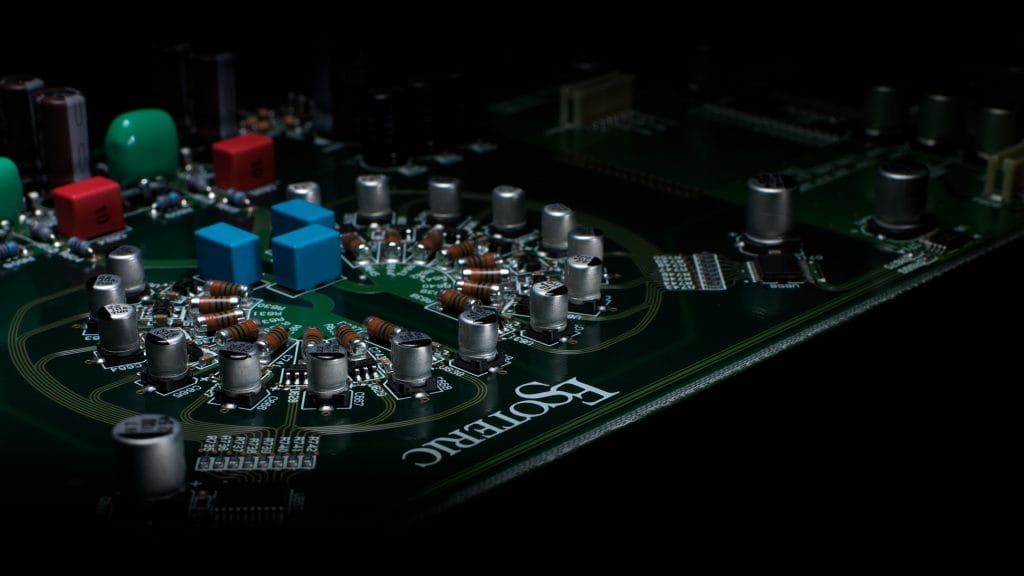
The technology used by Esoteric for digital-to-analog conversion in all of its DACs, and declined in complexity according to the level of the product, is called Master Discrete Sound Dac, and it effectively replaces the single chip we found in previous realizations. Fully understanding its operation was by no means simple. In fact, the heart of the system consists of a network of discrete components-so there is no use of conventional DAC chips-and a Delta-Sigma modulator, designed and built within an FPGA, or programmable circuit, in this case belonging to Xilinx’s Spartan series. This modulator is capable of working at a depth of 64 bits and at a frequency of up to 512 times the sampling frequency of the original audio. Put simply, if, for example, we are listening to a 96 kHz audio file, the system can process it at an internal frequency of 24.576 MHz, multiplying the original frequency by 512. This architecture might suggest a monobit system, such as those used in more traditional types of DACs based solely on Delta-Sigma modulation. In reality, however, this is not the case.
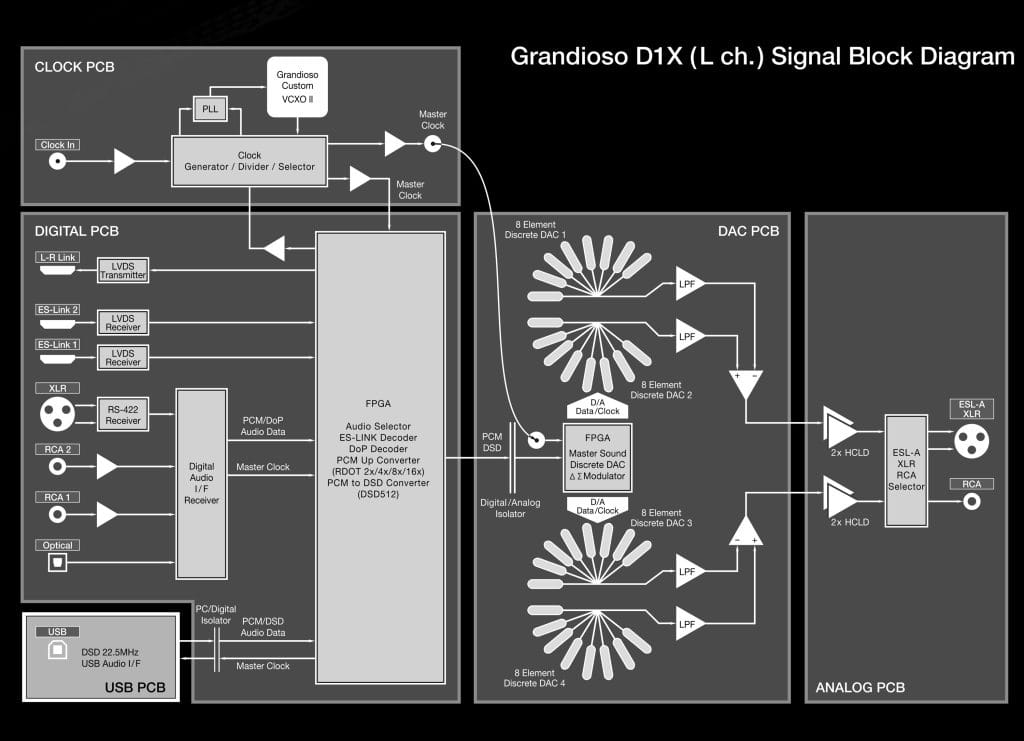
After the Delta-Sigma modulator, the signal is sent to a structure composed of sixteen discrete elements for each channel, which generate binary signals (i.e., 0 and 1) but in a parallel manner. Since each channel can go up to 16 bits through four blocks of 16 elements each, the overall resolution can reach 64 bits, making this DAC a far more complex and articulated system than a simple monobit converter.The DAC also allows for some customization in listening. From the menu it is possible to choose between two types of digital filters to be applied to PCM files, while a dedicated filter is provided for DSD format files. It should be noted, however, that the device’s default setting is to turn these filters off, thus leaving the sound more natural and transparent-or at least that is the designer’s intention. As for compatibility, the DAC is perfectly capable of handling the highest resolutions available on the market today. It supports PCM files up to 384 kHz at 32 bits and goes so far as to decode DSD files up to the impressive frequency of 22.5 MHz. In other words, it is a converter designed not only for the audio of today, but also for the audio of tomorrow.





GIPHY App Key not set. Please check settings