



 Alessandro Catalano
Audio Analogue was born over 20 years ago, in 1995, debuting in good living rooms a few months later with a prototype of the Puccini at CES in Las Vegas in 1996. In the following years the catalog expanded rapidly with the Puccini SE, the Bellini preamplifier, the Donizetti power amplifier, and the first Paganini and Maestro CD players. In 2001 the entry into the high-end world with Maestro Integrated and Maestro CD, from here a new design phase was born that led to the creation of three lines: Primo, Composers and Maestro. In 2008 came more affordable products, Verdi Cento and the Armonia line. Then the meeting with Airtech, leading to a new generation of products featuring audiograde components, aesthetic improvements, and a further leap forward in sonic performance.
A concrete partnership
Airtech and Audio Analogue are linked by a close technical and design partnership based on a shared vision of audio quality. Airtech was founded as a company specializing in the study of materials, audiograde components, and the design of high-performance cables, maturing over the years a deep scientific and engineering expertise in audio signal processing. This experience has been integrated into the development of Audio Analogue products, giving rise to a concrete synergy: Airtech contributes directly to the electronic design, choice of materials, internal components and circuit solutions, going beyond the simple role of technological partner. The result is a line of Audio Analogue’s signature products with Airtech technology, in which the scientific approach, materials study and signal care merge with Audio Analogue’s design tradition and musical philosophy, creating devices that combine research, engineering and sonic identity into one coherent project.
An uncompromising integrated
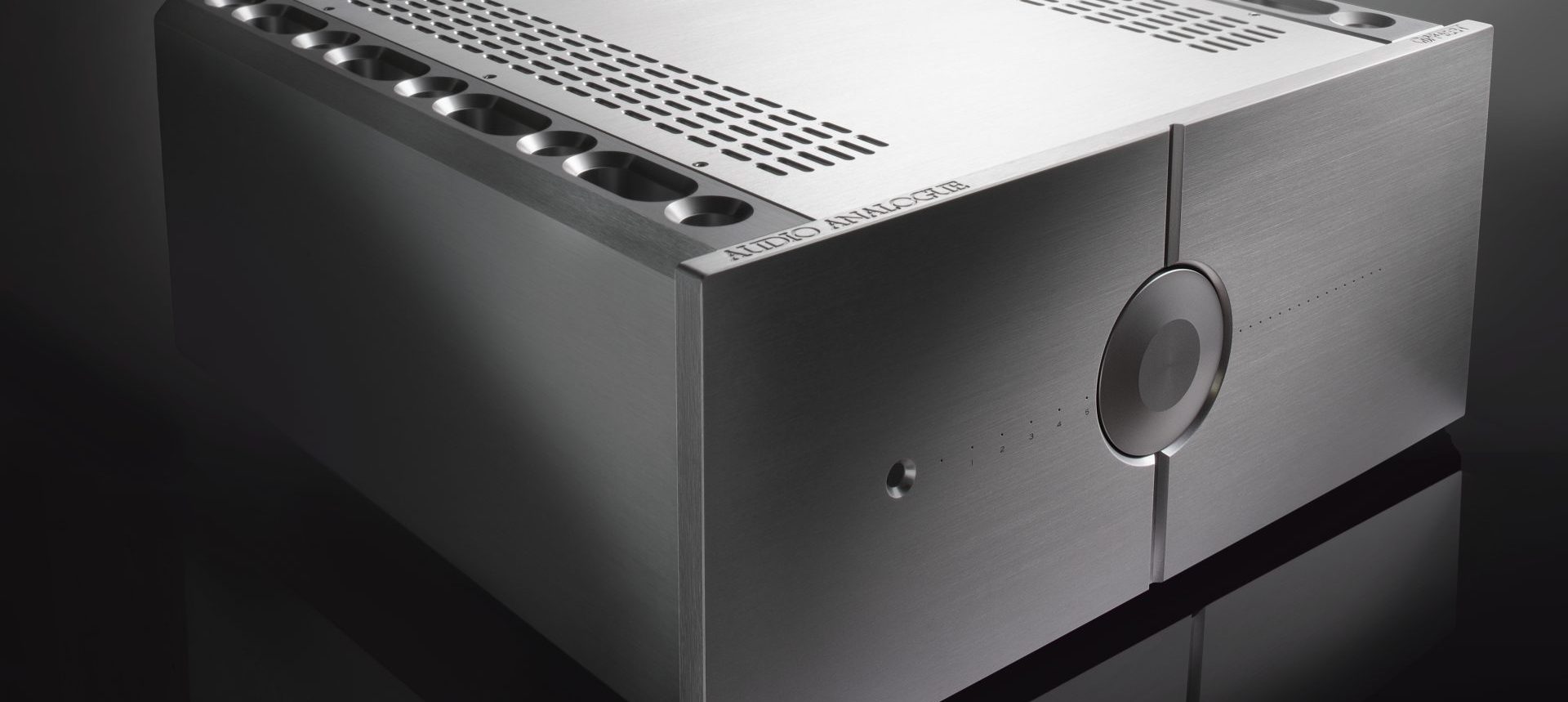
The Maestro 2.0 integrated amplifier represents the most recent and mature expression of Audio Analogue’s Anniversary line, standing as a natural evolution of the Maestro Anniversary and definitely improving on every aspect. Developed by the Airtech team, the Maestro 2.0 was born with a clear objective: to fuse refined and natural musicality in a single unit with a virtually unlimited power reserve, capable of driving any loudspeaker with authority, control and smoothness. Aesthetically, the Maestro 2.0 features compact, elegant and timeless lines, and is available in silver and satin black finishes, making it perfectly integrable in any setting, from the most modern to the most classic. The billet aluminum remote control completes a design that is not only technical, but also aesthetic and sensory, immediately conveying a feeling of solidity, prestige and craftsmanship. In terms of versatility, 5 inputs, 3 RCA and 2 XLR, with an AV pass-trought (the 3 RCA input) with a volume control equipped with 3 customizable curves so that you can adapt the progression to the efficiency of your speakers.

The design philosophy remains faithful to that which made the Maestro series famous. In this new version it uses stages without global feedback, a technical choice that undoubtedly favors naturalness. Output power has been increased to 200 watts into 8 ohms (as opposed to the Anniversary’s 150W), with a major downsizing of the driver and power stages, which now employ four pairs of transistors per channel(MJ1302 and the complementary MJ3281). This allows not only a high power delivery, but more importantly an extraordinary ability to control even complex loads, with a response that grows linearly as impedance decreases, always maintaining stability and control.
The Cascode in reverse
The circuit configuration is based on an inverted cascode, which is a special inverted logic configuration. In the classical circuit, you have two active devices (transistors or tubes) stacked on top of each other: the first amplifies the signal, the second works as an isolation and voltage stabilizing element. This reduces parasitic capacitance, increases bandwidth and improves linearity. In the inverted cascode, the upper device performs the main function of voltage amplification, while the lower one works as a control and stabilization element for the operation of the former. In practice, instead of having an amplifier “followed” by an isolation stage, you get a structure that behaves as a single very linear gain stage, followed by an output buffer. From a sonic and design point of view, this configuration allows for high linearity, very low distortion, great stability, and natural dynamic behavior, without resorting to global feedback. The stage is likened to a single gain block followed by an output buffer, an elegant and refined solution

Solid and heavy
In terms of construction, the Maestro 2.0 is a true exercise in high-level audio engineering. The circuitry is fully balanced, with an entirely dual-mono structure starting with the two toroidal transformers of 670 VA each, dedicated to each channel, encapsulated and arranged at a slight angle. Each amplifier stage is housed on a dedicated board, for a total of six separate boards, connected together by 7N OCC copper conductors, the same used in Airtech ‘s higher-end cables. This choice is not only technical, but also philosophical: to minimize interference, loss and contamination of the signal, preserving its integrity and purity throughout the audio path. Speaking of connections, a high-end Airtech network cable is supplied. Great attention has also been paid to the RR volume control, an extremely sophisticated solution that combines the reliability and precision of a digital system with the purity of analog signal processing. The volume is handled by relays and ultra-high-precision CMF series metal-film DALE resistors. The choice of components follows an uncompromising logic: audiograde capacitors, oversized components specifically selected to ensure not only reference sound performance, but also reliability and stability over time. Every detail is designed to work in synergy with the whole, in a coherent and deeply quality-oriented design vision.
Listening, a good trip
Listening to the Maestro 2.0 is an experience that to call immersive would be an understatement, because it immediately highlights the maniacal attention with which every detail of the audio chain was designed. The sound is remarkably clean, with a tonal coherence that allows every microinformation of the original signal to be perceived. Every note emerges with clarity and naturalness, as if the musical object were in front of the listener, without additional filtering or coloration. The delicacy of the sound output does not detract from the strength and authority with which the Maestro 2.0 tackles even the most complex passages or tracks with extended dynamics: the bass drops in with absolute control and definition, the mids show themselves rich in tonal nuance, and the high frequencies are transparent and never annoying, perfectly integrated into the soundscape. The musicality of the Maestro 2.0 can be felt at all times, whether in quick, punchy attacks or longer, sustained notes, returning a sense of naturalness and continuity that envelops the listener. Dynamics are impressive, with the ability to render contrasts between pianissimo and fortissimo realistically and without artificial compression, while the transparency of the sound makes it possible to clearly distinguish each instrument, its position in space and harmonic interactions with other elements of the recording. Listening is never fatiguing: even prolonged sessions reveal enough coherence and tonal balance to never tire, allowing you to pick up details that often go unnoticed with less refined amplifiers.

What is even more striking is the Maestro 2.0’s ability to combine power and control with an almost handcrafted refinement: transients are returned with surgical precision, even if it loses a little warmth in some passages.Lovers of soft tube refinement or class A should look elsewhere, but that is the character of the Maestro 2.0, which like all prima donnas knows how to impose its character gently but at the same time firmly. The overall impression is that of an amplifier capable of interpreting music, rather than limiting it to mere reproduction. Every nuance becomes perceptible, every musical phrase is rendered with realism and depth, and the sound scene comes to life with a surprising three-dimensionality, in which the separation between instruments and voices is clear, precise, and yet never contrived. The Maestro 2.0 manages to combine authority and finesse, making evident both the power needed to master complex systems and the sensitivity required for more intimate and detailed listening. Its driving ability is evident in even the most demanding speakers: it handles demanding loads without any sign of fatigue, maintaining stability, control and musicality under all conditions. Ultimately, the listening experience with the Maestro 2.0 is that of an amplifier that does not just deliver power or precision, but creates a direct dialogue with the music, allowing you to experience each piece with emotional involvement, clarity and intensity, returning the feeling of being immersed in a real, authentic and surprisingly alive performance.
Conclusions
Maestro 2.0 is a beautiful synthesis of advanced engineering, audiophile philosophy and musical culture. It is a device capable of combining power, control, refinement and musicality in a very rare balance, offering listening that is authoritative yet natural, analytical yet emotional, precise yet engaging. An amplifier that aims not only at technical performance, but at the listening experience in its deepest meaning, perfectly embodying the Audio Analogue and Airtech vision. Great product, indeed !
Technical characteristics:
- Input impedance: 47kΩ
- Maximum input signal: 6Vrms
- Power on 8/4Ω: 200/400Wch
- Sensitivity: 720mVRMS
- Frequency response: 90kHz
- Output resistance: 0.2Ω
- Noise level: 20µV
- S/N ratio: 100dB
- Stby power consumption: 0.5W
- Dimensions: 450X465X205
- Weight: 47.5 kg
Price: €17,990
Manufacturer: Audio Analogue
Distributor: Audio Analogue




GIPHY App Key not set. Please check settings