

 Audio 2G
The Fosi ZP3 has a very ambitious goal with respect to its price: in fact, it aims to be a balanced analog control center for desktop and small systems, offering XLR and RCA inputs, balanced, unbalanced and sub outputs with high-pass filter and tone controls. This is an almost obligatory choice for Fosi, given also the introduction of the Luna turntable, an additional source to the many DACs Fosi produces, and one that certainly needs a switch/buffer and volume control to be heard. A long and attractive “shopping list” that of ZP3 but which then runs up against a slightly different reality. The promises are high dynamics, low noise floor, in essence first-in-class measurements, but in practice we found many of the compromises typical of products that try to offer too much on the cheap, resulting in a large gap between perceived value and actual quality. The nameplate data – SNR, THD+N, frequency response – are indeed impressive on paper, and this is just a reminder of the fact that measurements are never subjected to any reference standard, and so everyone makes them according to their own criteria, which are too often extremely optimistic.

A beautiful dress
The exterior construction is convincing: aluminum body, clean panels, remote control included, and a “serious” appearance that creates a good first impression. But the inside tells a slightly different story. The topology is based on well-known, inexpensive opamps the NE5532s with the sole exception of the output stage, which adopts socketed LME49720s, which can be changed. But this operation, although advisable-it would certainly bring an improvement in sound-is not easy to do. Disassembly is rather complicated, it is necessary to remove as many as 32 screws in addition to the sides with the danger of ruining them (they have a glued panel that must be removed to unscrew the 4 screws that secure them) and it certainly cannot be done too many times and/or easily. It is not, in short, like all other Fosi electronics, where there are only two screws that have to be removed in order to do the swap.

The components and PCB layout show a bias toward cost containment rather than optimization for sonic purity, although the use of relays instead of solid-state ICs for input switching is to be commended. The power supply deserves its own paragraph. The ZP3 uses integrated mains power (100-240 V range), which simplifies installation but introduces inevitable limitations compared to solutions with dedicated linear power supplies or quality toroidal transformers, whether external or internal. Network noise and interference management are mitigated to a certain extent, so the actual performance is highly dependent on the electrical environment in which ZP3 is installed. In desktop systems with nearby switching power supplies or unshielded cables, the noise for sure rises exceedingly, but it is a matter of tradeoffs: internal power supply at these price levels lowers cost and increases convenience, but limits performance. The balanced connectivity is to be commended, although it was a forced choice for Fosi, as a good part of the company’s “premium” electronics have that connection, such as the ZD3 DAC and the V3 power amps we used to do the test and have already been the subject of our test as individual products, and that also makes it attractive for those with balanced electronics of other brands.

One of the most useful features and one that is practically impossible to find in other products in this range, which is very useful for those wishing to integrate a subwoofer into a stereo system, is the ability to apply a cutoff on the low frequencies. This function makes it possible to lighten the load on the speakers, preventing them from reproducing frequencies for which they are not optimized, and at the same time allows the subwoofer to work in the range where its presence brings real benefit. This is always useful in any system, but especially in those devotedly desktop systems in which it is virtually certain that the main speakers are very small. Indeed, cutting the low frequencies becomes essential in those cases, absolutely unable to handle the deeper portions. ZP3 allows through a switch on the bottom, to adjust between bypass and two other positions, the first applying a filter at 80Hz, the second at 120Hz. This cutoff (of which we completely ignore both the slope and the type) is found on the “sub” RCA pin located on the rear panel.

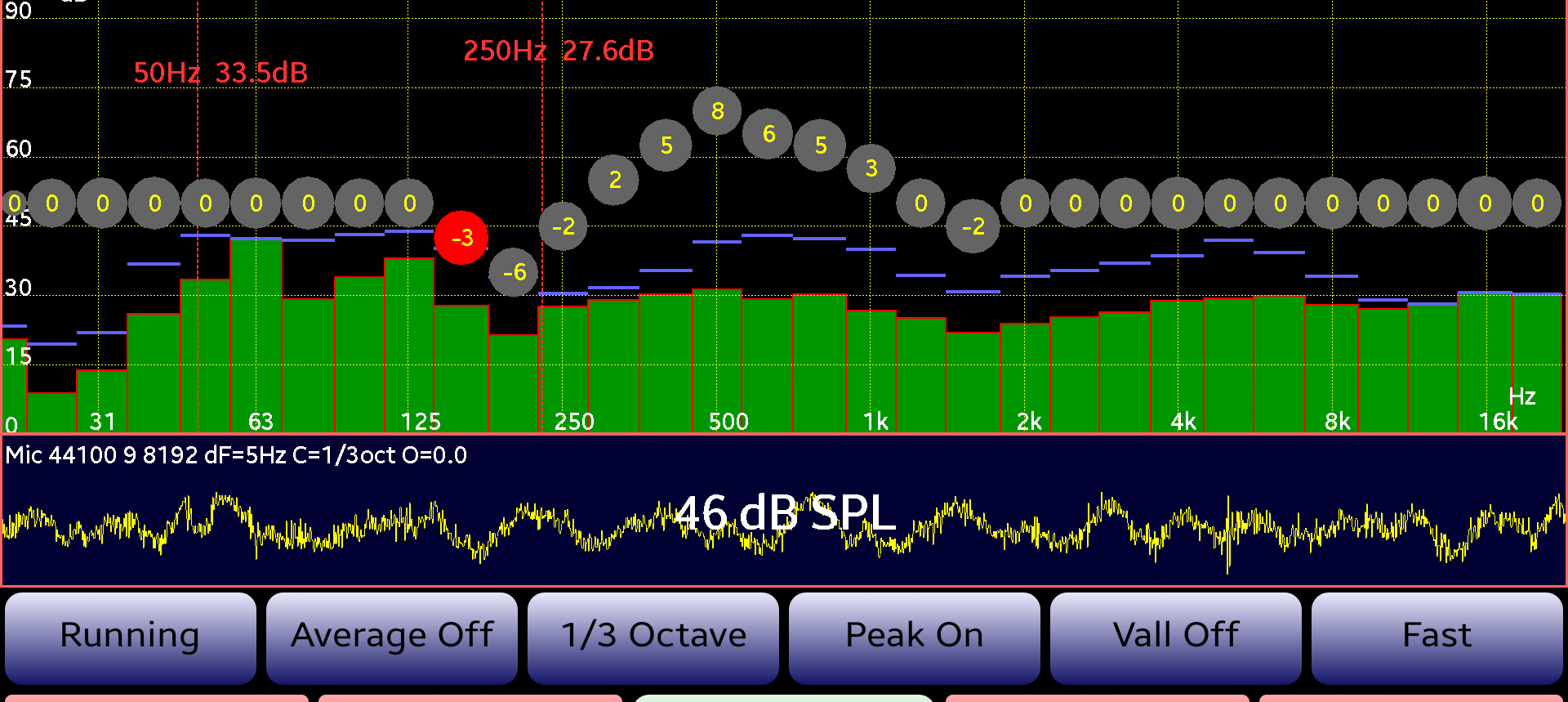
This flexibility also makes it possible to optimize the system according to the environment, and it serves the satellites more than the sub. The latter, in fact, in 99% of the cases already has the adjustment of the intervention frequency, and therefore is already able to operate a filtering on the signal, which is normally impossible on satellites. The only advice we can give is to adjust for example at 80Hz the preamplifier and a little above the subwoofer, 90Hz or a little less, without being afraid of creating a hole of a few Hz, since both the filter of the pre and that of the sub attenuate with a probably very gentle slope, the first from 80Hz up, the second from 80Hz down and therefore precisely at that frequency there could be an overlap with consequent emphasization, but these are considerations to be made supported possibly with a measuring instrument. Within everyone’s reach might be “audio tools,” a very effective app that makes a credible detection and that you can observe in real time on the display of your smartphone.
"Invisible" volume
While it is certain that at a little less than 200€ one cannot expect too much, on the other hand it would have been very appropriate to give feedback of the reception of the commands by the remote control, when adjusting the volume there is no return of the command except for the change of level, since the actuator is a decoder and not a motorized potentiometer, the knob therefore does not move and on the ZP3 nothing happens: it would have been appropriate and very inexpensive to make the input selection led flash for example. So two RCA inputs, an XLR also 6.3mm jack, RCA/XLR and subwoofer outputs, trigger in/out for on/off chains on 3.5mm minijacks, on the front panel power/input selection button, with miniled, IR sensor, balance and tone controls done in analog (and excludable through a switch on the bottom next to the crossover one), and then the big orange knob, typical color of the Chinese manufacturer for volume.
Listening
ZP3 was connected to its ZD3 DAC on which the op-amps had been swapped with Sparkos and a pair of unmodified V3 mono power amps with 48V power supply; Indiana Line Tesi 6 speakers were connected to it. The first impression is a lack of tonal cohesion, with bass that sometimes appears vague and poorly controlled and treble that tends to be unnaturally emphasized, a combination that negates the feeling of naturalness and flattens the overall timbre. Dynamics also suffer: more complex passages are not handled with the necessary precision, and the music loses the impact and body that should be the basis of satisfactory reproduction. The soundstage is compressed and not very three-dimensional, elements overlap rather than arrange themselves coherently, and this negatively affects the system’s ability to engage the listener. The ergonomics and connection options may seem sufficient on paper, but practical limitations emerge in daily use, such as an unintuitive interface and a level control that is not always precise or stable. Minor problems – hums, albeit barely noticeable, or sporadic variations in background noise – end up being noticed more than they should in a device intended to enhance the listening experience. Such flaws become especially noticeable with high-quality recordings or with speakers that require a more transparent and controlled chain. The product’s marketing positioning is also questionable: marketing sometimes presents it as an all-rounder capable of solving various problems, but in practice the sum of its limitations means that the ZP3 excels at nothing. It is not a specialized component-and indeed it is neither phono nor tube-but neither is it such a successful generalist solution that it can be recommended as a first purchase or a sensible upgrade. In a market full of alternatives, many of which offer greater tonal clarity, better construction, and a more polished user experience, the ZP3 struggles to find a raison d’être. Those who already have a well-balanced system and are looking for a discernible improvement are likely to be disappointed; those just getting into audio might find more coherent solutions and less compromise than the ZP3. It is an unconvincing product: it promises practicality but betrays expectations about sound, has modest build quality, and does not offer the added value that should justify the purchase. If the goal is to achieve more natural, more dynamic and more stable musical reproduction over time, the Fosi ZP3 is not the ideal choice and should be evaluated with caution in the face of alternatives that, for similar cost, more effectively pursue those same results.
Technical characteristics:
- Frequency response: 20Hz-20kHz (+/-0.2dB)
- Tone controls: bass +/-6dB, treble +/-12dB
- High pass filter: selectable 80/120 Hz
- Sub output: 20Hz-200Hz
- S/R XLR ratio: >112dB
- S/R RCA ratio: >115dB
- Distortion THD: 0.0007%
- Noise mat: <6µV
- Power supply: 100-240 VAC 50/60Hz
Manufacturer/distributor: Fosi Audio, WhatsApp: +8613716612254, support@fosiaudio.com





GIPHY App Key not set. Please check settings