



 Audio 2G
Rotel recently launched the DX-5 power amplifier and the DX-3, namely the first headphone amplifier in the brand’s more than 60-year history and the first model with a different form factor than the standard one. The Rotel DX-3 is not only a headphone amplifier, it is also a DAC, has built-in Bluetooth, digital and analog inputs, and can be used as a preamplifier.
A bit of history
The history of Rotel shows how, behind many hi-fi brands, there are individual visions and bold entrepreneurial choices. Today Rotel is an established brand, but its roots go back to Japan in the 1950s, when the company-then called Roland-produced components for Sylvania televisions destined for the U.S. market. The need to adapt those products to Japanese electrical standards allowed it to develop engineering skills that would later define the brand’s DNA.
The turning point came in 1961, when founder Tomoki Tachikawa reorganized the company and decided to focus exclusively on quality audio. Rotel was born, with a clear philosophy: to create concrete, reliable and musically rigorous equipment. Design was carried out in Japan, while the selection of major parts and final tuning took place in a branch located in England, thus helping to define the balanced sonic character for which the brand is known.
International recognition came in 1982 with the award-winning RA-820B integrated amplifier. From that time Rotel became synonymous with affordable, quality hi-fi. The same period also saw the birth of the partnership with Bowers & Wilkins, which handled its distribution in Europe and North America for more than two decades. Despite the growth, Rotel remains a family business. Bob Tachikawa, son of the founder, brings an international outlook to the 1980s and 1990s, opening up to the world of home theater, DVD players, and multichannel amplifiers. Current CEO Peter Kao, Bob Tachikawa’s grandson, who joined in 1995, drives global expansion with the opening of the Hong Kong offices and the development of the modern Zhuhai manufacturing hub, now the heart of operations.
DX-3: Technique
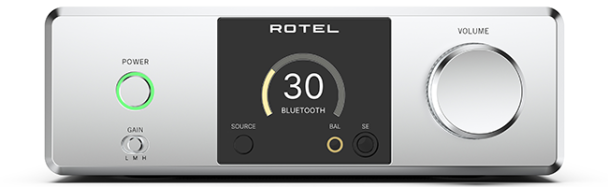
On its website Rotel presents the DX-3 as “The ultimate Personal Audio companion.” Indeed, its small footprint is an attraction for those who want a high-quality audio component but have limited space. It measures 7.6 cm x 21.5 cm x 24.7 cm, which is only slightly larger than the WiiM Ultra streamer we tested on our YouTube channel. The aesthetics of the DX-3-shared with the DX-5 power amp-with its sculpted design that deviates sharply from the usual Rotel lines, conveys a feeling of refinement and solidity. Rotel wanted to give this new line an innovative look and to that end involved an Italian design studio in the design. I suppose the design process was very meticulous as evidenced by some certain details such as, for example, the beveled edge of the front panel, the knurling of the large volume knob, or even the side ventilation grille whose diagonal slits run along the entire length of the right side-an unusual and surprising position-recapturing the same aesthetic/functional motif of the volume control. In short, every detail has been taken care of with the utmost attention. The cabinet and remote control, both with a minimalist, understated look, are made of brushed aluminum with the finish available in two colors-silver and black. When the DX-3 is in standby, the display is off and the subtle green light surrounding the power button is the only sign that the unit is on.

The color display is sharp and the brightness can be controlled from the remote control. Because only the selected source is visible, the display is neat and easy to read even from a distance. On the front panel, in addition to the volume knob, we find a sliding gain switch and the two headphone jacks: a 6.5 mm single-ended and a 4.4 mm balanced. Probably due to lack of space, an XLR connector is missing. However, the 4.4 mm jack provides the same power that an XLR connection would provide. On the lower left side of the display is a source selector which, when pressed, lights up showing a large graphic symbol of the selected source.
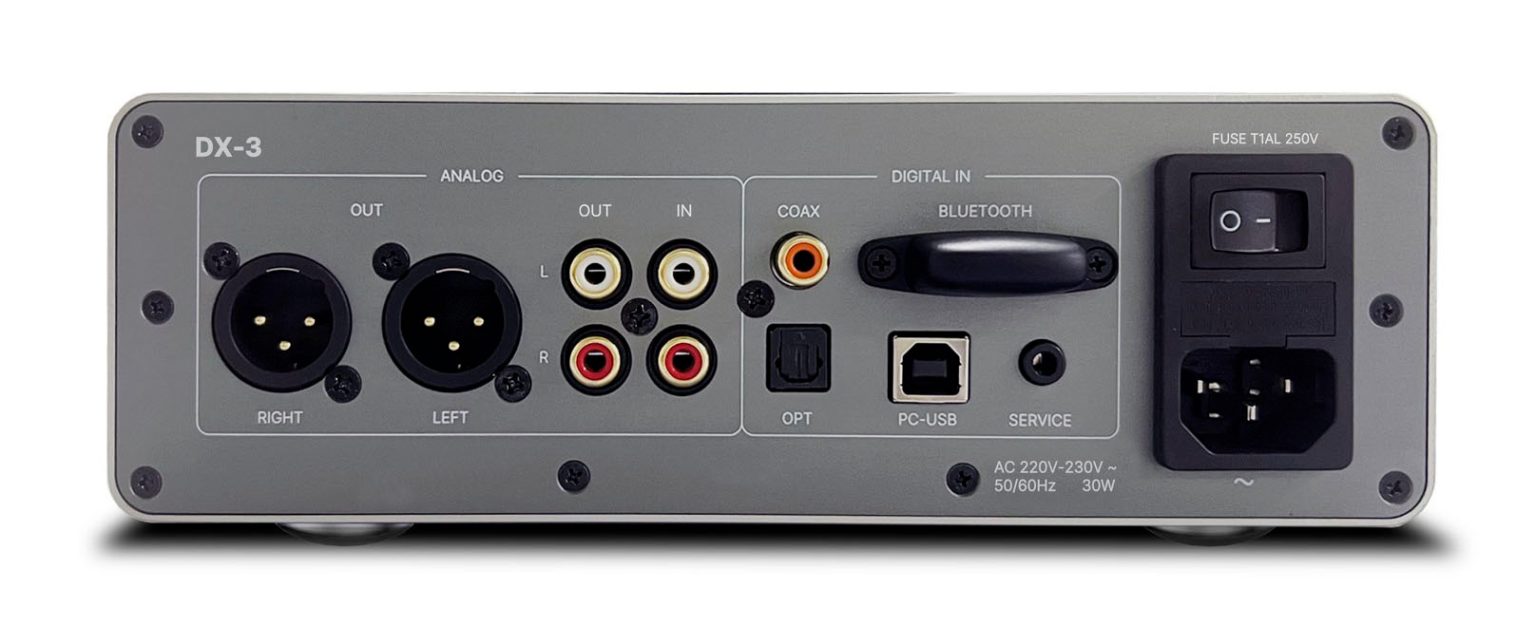
We now come to the rear panel where there are both analog and digital connections. The analog section, located on the left, has XLR and RCA output and input connectors, while for digital input connections there are: coaxial, optical, PC-USB, and Bluetooth. The RCA analog input allows you to connect, for example, a phono preamplifier. As a reminder, the Rotel DX-3 can function as a stand-alone DAC or as a DAC/preamplifier.

The Rotel DX-3 has a fully balanced differential signal design from the DAC, through the volume encoder, to the Class A headphone amplifier stage, consistently supporting both single-ended and fully balanced headphones. For the choice of the DAC chipset, the engineers opted for the ESS Sabre ES9028PRO since it integrates best with the rest of the design. I would like to emphasize, again, our belief that the DAC chipset is not solely responsible for the final sound output, which is instead shaped by the entire chain of boundary components, from the filters down to the power supply. I write this not at random since Rotel is known for the care it takes in selecting the components that populate its equipment and, especially, for its in-house, custom-made, shielded toroidal power supplies with high-current drivers. As we personally witnessed during a visit to Rotel’s Chinese factory, the copper used comes from selected suppliers who certify the purity of the metal. The metal is then processed into sample cables that are tested before being inserted into the transformer. Each transformer core is assembled, wound and stress tested.

The volume knob on the Rotel DX-3 deserves careful description: when you turn it, it has very precise “clicks” that, at low volume, make rather large adjustments, while at higher volume they press small, precise adjustments. This is all handled by an audiophile-grade NJW1195A differential analog controller manufactured by Nisshinbo Micro Devices of Japan. There are two user-selectable modes, each designed to meet different preferences. These settings are available either in the configuration menu, using the front panel display, or on the remote control. The default setting is a numerical volume adjustment mode represented by a scale ranging from MIN (level 0) to MAX (level 97). At the lowest volume levels, the increments are relatively large, about 7 dB per click, and become progressively smaller (6 dB, 5 dB, 4 dB, etc.) as the volume level increases, until they become ultra-precise 0.5 dB increments. I suppose the reason for this pattern is based on the logarithmic nature of human hearing. Sound pressure levels determine how we perceive volume. Because we perceive sounds in a logarithmic, nonlinear manner, greater increases in power are required, thus greater increments at lower dB levels to perceive an audible change. As volume increases, the ear becomes more sensitive to smaller changes, so more precise dB increments allow for smoother adjustment. However, for those who want more precise control, the second mode offers fixed increments of 0.5 dB across the entire volume range. In this mode, the volume scale starts at -99 dB with almost full attenuation of the signal, and increases toward 0 dB, which is then full power. This mode could be useful when particularly sensitive headphones are paired.
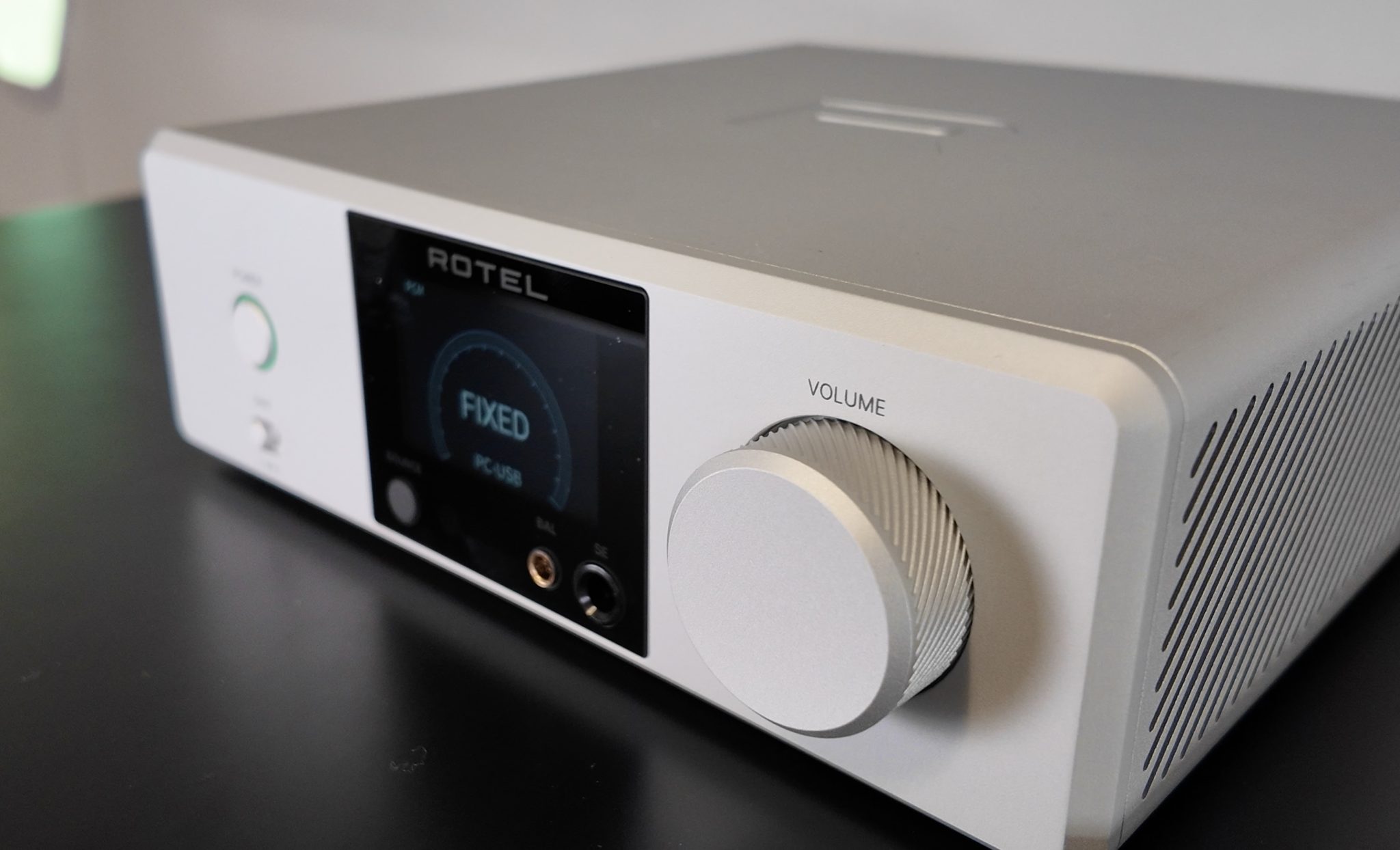
Finally, the Rotel DX-3 offers a fixed volume output setting that allows integration with audio sources or powered speakers that have their own volume control. When this setting is selected, the DX-3 bypasses its internal volume control and outputs a fixed level signal. The level is user selectable depending on the source. For example, if using Bluetooth via a phone or tablet, the user can set a controllable level from that device, or if using USB from a computer, the volume is controlled by the computer. If the source does not have a volume control, the setting will be put to Variable by enabling the front volume knob or remote control. Again, these various settings are found in the configuration menu, which offers a surprising number of options for fine-tuning the device.
Listening
I placed the Rotel DX 3 in a system consisting of the following: Canor Virtus i3 integrated amplifier, Martin Logan Motion XT B100 speakers, digital transport consisting of a DIY Audio PC with JCat components and Audiolinux operating system, Neutral Cable and AudioQuest wiring.
In this configuration I evidently did not use the Rotel DX 3 as a preamplifier but only as a DAC/headphone amplifier.
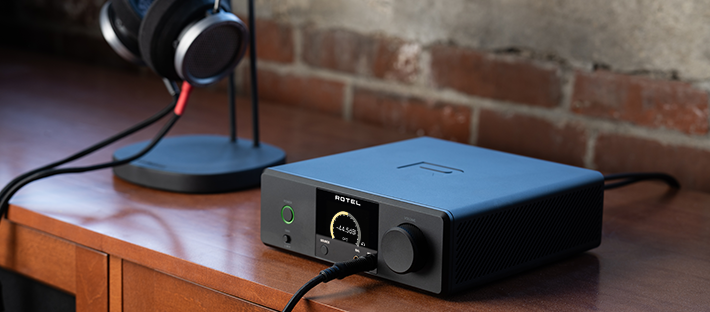
As most of my readers are well aware, I am not a regular headphone listener, however the device under test is primarily an amplifier dedicated to such a listening system and therefore I felt I had to start the test in this way, immediately realizing something that – I confess – surprised me. From the very first track I listened to with one of the two headphones we had in the rehearsal room for the occasion, I noticed an eerie “blackness” placed in the background and between the notes that made me wince because of its palpable texture that I would tend to call “velvety.” I don’t recall ever having this experience listening to any other headphone amplifier as quiet as it was. With the Rotel DX3 it is as if the silence has a vivid presence of its own by becoming part of the dynamic range it expresses. Put another way: the contrast generated by the deep silence before which the musical signal stands out generates a three-dimensional space within which the music comes alive. This is regardless of the track being played. A decidedly intriguing sensation.
Returning to use as a DAC, I was able to appreciate how the DX 3 manages to transfer, at least in part, the same characteristic to a speaker-based listening system. This means that, even in this case, silence and wide dynamic range are the elements that immediately come to the listener’s attention. In addition, not having the embarrassment and anxiety of choosing the digital output filter contributes, as far as I am concerned, to the pleasantness of the listening session.
Perhaps at home with the quietness to which I referred earlier, the DX 3 enabled me to have some interesting listening sessions of baroque music where the sonic textures of ancient instruments were revealed with great accuracy and detail. On a completely opposite side, I had a lot of fun with some forays into rock territory, abetted by the aggressive and dynamic ribbon tweeter of the Martin Logans, which, taking on the generous 16, 5 cm woofer, seemed to get along particularly well with the chain placed upstream, DX 3 included.
Conclusions
Frankly, I did not think that the testing of a headphone amplifier would appeal to me, but instead the Rotel DX 3 has caused me to revise this prejudice. Certainly it is an excellent DAC that can be best employed with powered speakers or in combination with its reference power amp Rotel DX 5. Beyond that, however, I think it is fair to point out that its role of choice is as a headphone amplifier. As much as I do not consider myself particularly expert in this specific segment of audio, I can say that listening to it excited me.
Giulio Salvioni
Price: €1,599.00 including VAT.
Distributor for Italy: Audiogamma spa – Via Nino Bixio 13 – 20900 Monza (MB) Italy
Tel. +39 02 55181610
web: www.audiogamma.it
Technical specifications.
OUTPUT POWER (THD+N < 1%)- 765 mW (16 Ω)
- 383 mW (32 Ω)
- 41 mW (300 Ω)
- 2.8 w (16 Ω)
- 1.4 w (32 Ω)
- 150 mw (300 Ω)
- < 0.008% @ Outputs=70 mW
- < 0.004% @ Outputs=280 mW
- 20 Hz – 20k Hz, +0 dB, -0.2 dB
- 10 Hz – 20 kHz, +0 dB, – 0.5 dB
- 20 Hz – 20k Hz, +0 dB, – 0.4 dB
- Unbalanced: >100 dB
- Balanced: >110 dB




GIPHY App Key not set. Please check settings