

 Audio 2G
Pre and power amp QUAD 44 405.2 constitute a high-performance pre and power amp pairing that is still highly relevant, despite nearly 50 years since its debut.
Quad, an acronym for Quality Unit Amplifier Domestic was born in 1936, from the idea of a budding young saxophonist, Peter James Walker, who started the Acoustical Manufacturing Company Limited, moved by a personal need to amplify his outdoor concerts. So he develops a set that includes a 7 W amplification, a microphone and two cone speakers priced at only 26 pounds. His experience in that type of application moves him and publish a manual devoted to pro sound systems (“Addressing the Public”) full of tips and standards for properly installing and operating a sound system. In 1939 he brought to market 30W C25 and dual mixable microphone inputs, as well as a dedicated home listening system comprising a preamplifier, power amplifier and tuner. After World War II, from ’48 onward, Peter devoted himself exclusively to high fidelity with the H.R.1 two-band AM tuner, the QA-12/P integrated amplifier, and his first revolutionary loudspeaker, the Corner Ribbon Loudspeaker, totally horn-based, with a GOODMANS mid-bass and a self-made ribbon treble unit. In 1951 the name QUAD. marking the final name change; in ’53 preamp and power amp were upgraded and improved to become QC-II and QUAD-II.

a pair that has become historic and highly sought after by collectors and amateurs. 1956 marked the debut of the House’s first electrostatic loudspeaker, the ESL, a two-way composed of a pair of side panels for the low range and a central one for the high range.Because of its characteristics of reliability, compactness and economy, it would be the product with the highest number of units sold (54,000) and for the longest time (27 years). The 1960s were marked by the debut of transistors, Peter very sensitive to innovations, perfected the 303, a 45W/ch stereo power amplifier with a long, narrow shape


combining it with the 303 preamplifier, the first with modular construction. 1981 was the year of the presentation of one of QUAD’s milestones: the electrostatic ESL-63, named “FRED” (Full Range Electrostatic Doublet), the frequency extension and phase are very regular, the impedance predominantly resistive and the distortion extremely low; it also adopts a protection circuit that sets the maximum SPL at 100 dB. For its musical qualities it will be hailed by critics and amateurs and considered among the best loudspeakers in the world. The rest of the QUAD, also not to dwell on it too much, can be found at this link on the company’s official website

The historic moment in which the QUAD 44 405 pre and power amp debuted.
The 1970s were marked by Japanese supremacy, and thus a great challenge for QUAD and for Walker. At the 50th congress of the A.E.S. (Audio Engeneerig Society), in 1975, to combat overseas competition he presented the 405, a 100 W/ch stereo power amp with revolutionary Current Dumping circuitry, the subject of much discussion. For an in-depth technical discussion you can refer to the piece by Eng. on this same site that outlines its technical contents and personal listening notes. The same year also saw the release of the 44, a very versatile modular preamplifier employing specially designed tone controls and phono input, with digital signal switching. It was the Hi-Fi boom, which we can compare to that of the Plasma TV of the 1990s or today’s smartphones; every family wanted a playback system, it was every family’s status symbol, and the market was booming. The electronics were all 43 cm wide, with buttons, Vu-Meter, versatility and often unnecessary functions, distortion by many zeros after the decimal point, and lots of marketing. On the other side were the Hi-End electronics, mostly American, big, sometimes huge, bombastic.

The QUADs were 30 cm wide, the amps did not even have a power button, no useless indicator lights, and in 44 rather than putting the usual tone controls, Walker invented three different interventions, which for goodness sake probably made more sense than the conventional Bass and Treble, but were rather difficult to interpret by the general public. Price was another very interesting feature, the QUADs were not cheap but neither were they too expensive, they were a “strange” middle ground, in short, they were not candidates to be “Hi-End” electronics on a par with Krell, Mark Levinson or Jeff Rowland, just to name three high-sounding names. So, as is also the case today, the public failed to give them the importance they actually had instead, and no doubt their small size did not help them stand out on the shelf.
Plug&Play ante-litteram
Another concept that Walker loved so much was simplicity in connections, so much so that he used DINs instead of the RCA PINs that prevailed in other electronics. Actually he also had space problems, with small electronics and so many connections, the DIN was much simpler though it did not give the possibility of playing with cables, likewise the power was drawn from the preamplifier for the power amp, which had no power button, those, therefore, who wanted to use the power amp with another preamplifier had to make do with a makeshift switch derived directly from the cable. But then again, the clean, streamlined line of 405 or 303 did not allow for the possibility of inserting a button, which in addition to not physically fitting would have ruined the design. Those who used the QUAD pre and power amp solution, however, were extremely facilitated in connections and usability, usability that, however, was not matched in the 44 for complicated tone controls.

Quad 44, a particular pre
The 44 was modular; in the first series it did not have a named CD input, but only Disc (i.e., the turntable), Tape, Radio & Aux; in the MKII version that we tested, on the other hand, there was a CD input. On the upper left side we find a brown Plexiglas flap, matching the cabinet, which conceals some sensitivity controls, very advanced for the time, with intervention possibilities for both phono and Tape inputs. Basically, the turntable module was a very versatile MM, with 3 different sensitivities, 1mV, 3mV and 10mV, classic impedance of 47kΩ and the possibility of inserting a 180pF capacitance (which is in addition to the internal 150pF capacitance).
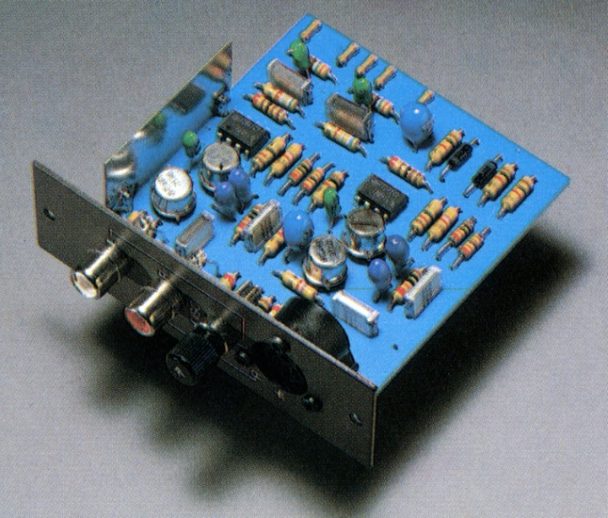
Optional is the MC module, which introduces a gain of 20dB and thus fits perfectly even with low-output cartridges. As for the TAPE inputs, as many as 2 modules were included as standard, with both DIN and PIN connections, and a wide variety of interventions, both in head to level and impedance. After all, the DIN standard had specific parameters that had to be respected, while for RCA there were and are no precise constraints, and so the adjustments take into account precisely these differences. The outputs, with a double DIN 4-pole, and 500 mv output in the first version, while the test sample has a different module, with a DIN and double RCA output, one with 1.6V rms output level and the other with 5V rms output level to fit any power amp.

Tone controls, it is worth returning to, were extremely different from those that might be found on any product either of the time or today. Tilt Control produces a very gradual change without changing the overall level. When set to +1-1 or more, there is a gradual 2 dB drop from bass to treble; the sound will not suffer coloration but in Walker’s intent was to add warmth. In contrast -1+1 (or even -2+2) increases detail and was very useful in bad recordings .

Bass control acts through smooth progressive increase or decrease. In Step mode it is a step filter, producing a 5 dB reduction centered on 150 Hz or 300 Hz; in LIFT mode it increases the entire low range of the stated dB.

Filter is much more complex. It consists of two concentric controls, one selecting the frequency at which the filter operates, with a bypass position that excludes all controls except Volume and Balance, while Slope changes the rate at which the filter attenuates frequencies above the selected operating point. Three filter values are available, 5kHz, 7kHz and 10kHz, and the Slope control varies the attenuation rate from OdB to 25dB per octave. For example, with the 7k position selected and the Slope control set to 10, the Quad 44 output level will be reduced by 10dB at 14kHz.

In short, these were completely unconventional tone controls and rather than making the 44 more interesting (this was probably Walker’s intention) they made it less attractive to the much public of the time who expected something simpler and especially less cryptic for those who were not technicians. Those who want to delve deeper can do so at this link, where the manual and wiring diagrams of the entire preamplifier can be downloaded.
405 e 405.2
100W per channel into 8 ohms the available power, normally equipped with DIN input only, but it is easy to have a technician make a modification, holes for RCA being already available. It has a protection circuit based on a load-sensitive, time-dependent current limiter; it is sized to deliver a maximum instantaneous current of 8.5A. If the load is too reactive or has a resistance of less than 4Ω, the current limit is gradually reduced to a value that allows the transistors to remain within their operating area; in the case of a short circuit the system protects itself; if, on the other hand, the state persists for both channels for a long time-the manufacturer mentions minutes-the terminals blow and the fuses blow. It is peculiar to note that for both the preamp and the power amp, it is directly Peter Walker who intervenes in the manual in describing his circuitry, you can find the manual for the power amp here

Thanks to Current Dumping 405.2 does not get very hot, the relatively modest front cooling fin gets cooler, and thus 405.2 does not create thermal problems. You can learn more about the difference between 405 and 405.2 in Fulvio Chiappetta’s article on this same site, and it is still in chief a higher power delivery capacity. There is a single red LED on the front that attests to proper operation; neither 405 nor 405.2 have a power switch, so if you want to use them with a preamplifier other than the 44, you must provide power along the power cord.
Listening
The pair sounds modern. There is no feeling of listening to a product with more than 50 years on its shoulders. The only difference a less readiness in following the transient, readiness that by now with modern machines is a habit. The sound is very elegant, never excessive, very pleasant, composed, timbrally correct. In short, listening flows smoothly, pleasantly, with any genre and even “squeezing” the power amp with difficult loads. Interestingly, both the preamp and the power amp use extremely dated op-amps, TL-071 or TL072, among the first ones that debuted on the market, and much less performing than the many that are offered today, yet the listening is extremely pleasant. The suond-feeling is somewhat that of British electronics, we had heard it, albeit “modernized” on Exposure’s 2510 to great satisfaction; it is never excessive, bombastic, but rather compassed and gentle, respectful of the whole and not of detail, loving rhythm, involvement, rather than spasmodic focus. The tone controls are not only slightly cryptic in understanding, but also relatively “useless”-they act better and more intelligently and timely than simple Bass & Treble or Loudness, but after trying a few positions, we preferred and used the bypass one. Wanting then to mention the design, not only is it timeless, but it is really beautiful, in colors, in organization, in size. Many, almost all the products of the 1980s have passed and we don’t remember them, the QUADs have left and leave an indelible mark. In short, 50 years and not feeling it, and if it were not for the volume control without remote control, rather anachronistic nowadays, they could without any problem be at the center of a mid/high level audio system! An amateur could compose beautiful pairings, perhaps all British, perhaps with a pair of Harbeth or Rogers….. Great trip !
QUAD 44
- Frequency response: 30Hz-20kHz
- Total harmonic distortion: 0.05%
- MM/line sensitivity: 3mV, 100mV
- Signal-to-noise ratio: 86dB
- Output level: 100mV REC, 0.5/1.6/5 V line
- Dimensions: 103 x 321 x 207mm
- Weight: 4kg
- Power supply: 110/120-220-230V, 50/60Hz
QUAD 405.2
- Output power: 100W/8Ω
- Frequency response: 20Hz-20kHz
- Total harmonic distortion: 0.05%
- Sensitivity: 0.5V
- Signal-to-noise ratio: 95dB
- Speaker impedance: 4/16Ω
- Dimensions: 115 x 340.5 x 195mm
- Weight: 9kg
- Power supply: 110,120,130,220,230,240V, 50/60Hz
- Power consumption: 30-350W
Manufacturer: Teh Acustical Manufacturing Co. Ltd. Huntigdon, Cambs.
Current distributor: High Fidelity Italia srl, Via Carlo Collodi 20070 Cornaredo info@h-fidelity.com
Current value 44/405.2 in excellent condition: about €1000




GIPHY App Key not set. Please check settings