



 Audio 2G
The “hardcore” audiophiles tend to regard the subwoofer with a mixture of skepticism and suspicion. Who knows, maybe some sort of short circuit occurs that brings to their minds those systems in cars that make a tremendous racket at traffic lights or, worse, those plastic subwoofers that are sold in department stores paired with the cheapest soundbars. Until a decade ago I too had the same attitude, but it was just ignorance. Later I approached the subject systematically, reconsidering myself and becoming a fan of subwoofers in general and RELs in particular. In this review I will discuss one of the British specialist’s most successful models, the T/7x.
The why of the subwoofer
Let us begin with an initial clarification: in two-channel audio the task of a sub is different than in home cinema, since it does not have to work on a dedicated channel. In our domain, the subwoofer is required to integrate as seamlessly as possible – and we will see later what that means – with the two main speakers by complementing their output. Complementing means allowing the main speaker system to express itself to the fullest, widening the virtual soundstage, making the midrange clearer and more open, improving focus, and yes, of course, also increasing the bass range. This must be done with maximum respect for the timbral characteristics of the main speaker. To make a point: there is no point in flanking a pair of fine mini-speakers with a pair of mighty subwoofers in the hope of achieving a system that combines delicacy and “punch in the gut.” Then there is another consideration to be made: a full-range loudspeaker should be placed in the room trying to obtain the best timbral balance and maximum spatial articulation that it is capable of giving back. Often, however, that position is not the best in terms of bass intelligibility. The subwoofer, by relieving the main system of the burden of reproducing the lowest end, allows optimizing the positioning of the source operating in that frequency range. The matter therefore is complex and delicate. And this leads to the painful notes, which are such for some but a source of amusement for others, including yours truly: subwoofer tuning is a true “art” to which one must approach with due calm and seriousness, trying to act methodically, understanding exactly what one is doing. Actually, the parameters on which there is to intervene are not too many: positioning in the listening room, phase adjustment, crossover frequency and gain. Four elements that one must understand and know how to govern; parameters certainly present on this REL T7/x subwoofer (well, positioning is not “proper” to this sub, but to all of them). The effort required is amply repaid by the results; guaranteed.

REL T/7x: construction
We manufacture subwoofers. That is all. Nothing else. No distractions. Nothing to distract our attention. No kidding ourselves that we can be good at everything. No attempt to conquer the whole world. We just do our best to conquer our part.
This is what you will find written on REL’s website in the Our Purpose section, and indeed this company has been in the market since 1990, producing only subwoofers and consistently pursuing certain choices; among these is the adoption of the high-level connection, that is, deriving the input signal to the sub from the final output stage of the amplifier driving the main speakers. This, according to REL, ensures the best quality that comes from the consistency, both timbral and temporal, between the signal sent to the sub and that sent to the speakers. Other key points of REL’s designs are: the use of high-current internal amplifiers, the zeroing of internal cabinet resonances by means of a complex stiffening system, and the use of high-rigidity materials for the cones (carbon fiber and metal). Also very sophisticated filters and the choice not to rely on a DSP for automatic calibration of the subwoofer.

The REL T7/x subwoofer is not particularly bulky. The shape is only seemingly cubic, and the finish, in the REL tradition, is superb; the white of the version I received for review is dense and the lacquer perfect; the vertical edges are rounded, while the horizontal edges are straight. The front speaker, equipped with a long-stroke suspension of imposing dimensions, is protected by a removable fabric grille, while the passive one, located on the lower face, obviously has no protection being hidden from view and also from dust. The cabinet is spaced from the ground by four metal supports bearing the REL logo, the height of which was calculated to allow the passive radiator to function properly.
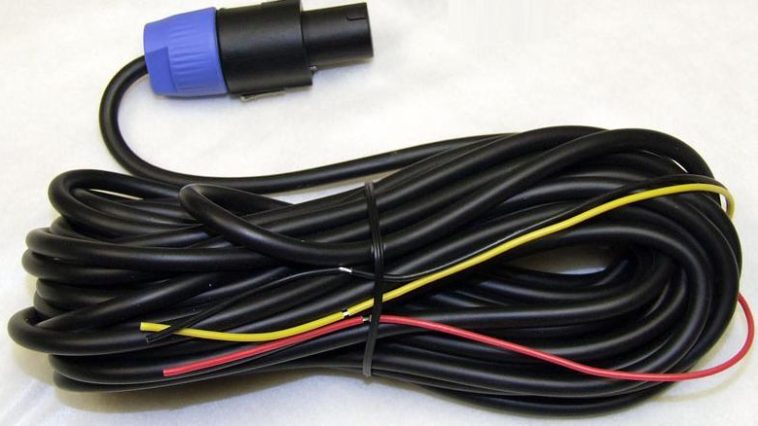
The rear panel is largely occupied by the large metal finning of the heat sink of the 200 W Class A/B amplifier section, which in use never reaches high temperatures. In the upper right corner we find the “trio” of rotary adjustments consisting of: gain (for both high-level and low-level input), LFE channel gain(in home theater the LFE channel is a band-limited audio track used to reproduce sounds in the 3 -120 Hz range) andcutoff (crossover) frequency. The three controls have clicks or clicks, which is a blessing in tuning since it is the number of clicks that one relies on to make the necessary adjustments. Relative to the crossover one, it is worth noting that the REL electronics do not pass higher frequencies to the main speakers. The control only affects where the sub intervenes, and is variable from 30 Hz to 120 Hz. In practice, the crossover level control is used to define the upper end of what is reproduced by the subwoofer. That said, as a general impression I have noted with different pairings, to achieve the best integration it is preferable to go as low as possible with the main speakers while consequently making the sub go up as little as possible. Relative to the inputs we have: low-level input via RCA connector, LFE input also via RCA and finally high-level input via female Speakon Neutrix connector. As for the latter in the package there is a three-pin cable (red, black and yellow) terminated with the male connector, long enough to cover most needs (we are talking about several meters). In the setup section we will see that the use of this type of connection is the one advocated by the manufacturer. At the bottom right we find the power switch, whose operation can be slaved to a toggle switch to enable the standby function that detects the presence of an incoming signal, we then have the IEC tray for the power cord. Finally, inside the crown molded next to the initials T/7x, we find the toggle switch for phase selection between 0° and 180°. One wonders if REL considers this a more important parameter than the others, so much so as to assign it such royal status.

REL T/7x: setup
Aware of the difficulty of the task, REL, in the person of owner John Hunter, is lavish with advice on installing and setting up their products. Not only is the accompanying user’s manual well done and a mine of information from which to draw, but on the company’s website there is a long series of very well-crafted articles and videos where all the step-by-step procedures are explained. There is also a section where you can choose the make and model of your main speakers, the size of your listening room (between small, medium and large), and whether the system is two-channel or home theater; based on this information, the REL model that best meets your requirements is suggested, as well as possible room placements shown.

In addition to suggesting the use of the high-level connection with the supplied cable (with two of the three leads connected to the left and right positives and one to a negative of the amplifier), and unless there are technical impediments, the manufacturer recommends placing the sub near the corner behind the main speakers with the front driver oriented on the main diagonal of the listening room, so that its longer dimension can be taken advantage of. To carry out the setup, it is recommended to use, at the highest level reasonably expected by the system, a track that has a repetitive bass line at a very low frequency; as an example, track number 4 from the soundtrack of the movie Sneakers (Columbia CK 53146) is suggested, which has a repetitive kick drum that gives quite a bit of time to move the subwoofer in search of the best position; moreover, having been recorded in a large room, the bass is deep and large. There are many methodologies for the correct configuration of a sub, and REL describes its in great detail and with examples. All of them make it possible to avoid gross errors, however let me say that achieving the optimal result, the one in which the sub disappears giving the illusion that the sound comes only from the main diffusers, is achieved only after a long process of refinement based on listening. In this I agree completely with REL, which urges its customers to trust their ears and exercise their critical sense.
REL T/7x: listening
This was not the first time that a REL T/7x subwoofer appeared in my listening room. The difference was that in previous rounds I had only had one available, while this time no less than two were sent to us. My installation notes, which I had kept, proved to be a good starting point but, of course, much more testing was necessary. In this case, we also made use of instrumental analysis using REW(Room Equalization Wizard) software and a calibrated UMIK 1 microphone. The pair of T/7x was paired with two different stand-mounted speakers and one floor-standing speaker: the Vivid Audio Kaya S12, the KLH Model 5, and the Davis Acoustics The Pledge. Very different speakers that however – some more, some less – have all benefited from the “subwoofer care.” Those of you who follow us know how much we appreciate Vivid Audio’s mini-booth speakers and how their bass range is particularly well suited and easy to tune to our small acoustically treated rehearsal room. That said, I am the first to be aware that, with their 10 cm woofer, the Kaya S12s cannot produce a particularly dense and deep bass range. So pairing them with a subwoofer is certainly desirable. The problem, if anything, is how to do it without distorting its elegance and magic. Here, the REL T/7x achieves that. How, basically by disappearing. Let me explain: it is very easy to notice the presence of a sub by using the helicopter from Pink Floyd’s Another Brick in the Wall ; a mini-speaker, as good as it is, cannot physically go that low, and if instead the walls are shaking, it means that something is making them tremble. It is a different matter if the track to be reproduced is a piano-only recording, as in the case of the tests I carried out where I used, among others, some tracks in DXD format from a recording session made at the Auditorium Parco della Musica in Rome that I had the privilege of attending. With those tracks the REL 7/x subwoofers were able to infuse a greater body to the notes played by the left hand of our friend maestro Stefano Greco, but above all it was able to restore the sense of space, complexity and harmonic richness of the Steinway gran coda played by him. This is very easy to notice by doing a simple test that consisted in turning off the sub while the track was playing: to a distracted listener it seems that not much happens to the sound of the system, but if you pay attention you realize that the sound is as if “collapsed” becoming inconsistent. If you turn the sub back on the bass does not immediately become apparent, in fact it almost seems not to be there, and yet that bass that “almost isn’t there” makes a huge difference. So the sound of the Kaya S12s has not been transformed or distorted, there has been no distortion of their sonic nature.
What about the other speakers? Well, as I said more or less everyone benefited from the presence of the REL 7/x; unexpectedly even the KLH Model 5s, which, at least on paper, seemed not to have to benefit from the pairing, but instead found in the speed of the English sub a valuable ally.
Conclusions
I consider the REL T/7x a virtually perfect subwoofer. For a relatively small size and at a still affordable cost, it is capable of adding that little bit of speed and weight in the low range that we normally associate with more demanding and expensive speaker systems. While on the concept of speed I don’t think there is any risk of misunderstanding, on that of “weight” I would like to specify, for once again, that the purpose of a sub, even this sub, is not to make a small speaker sound big, but to make it be better, as much in the low range as-perhaps especially-in the midrange.
Strongly recommended for those who have a desire to expand their audio horizons by experimenting with tenacity and humility.
Giulio Salvioni
REL T/7x: technical features
- Type: Air suspension amplified subwoofer with passive radiator;
- Active driver: ø200 mm long excursion front with inverted dome and cone made of metal alloy and FibreAlloy™ mineral fibers;
- Passive driver: on the bottom panel, ø 250 mm with inverted dome;
- Crossover frequency: variable from 30 to 120 Hz;
- Amplification: 200 W in Class A/B;
- Inputs: for high level Neutrik Speakon, for low level single RCA, LFE single RCA;
- Phase: 0/180°.
- Cabinet dimensions: 35.6 x 32 x 36.3 cm (WxHxD).
- Weight: 17.5 kg
- Finishes: High Gloss Black, High Gloss White;
- Notes: wireless setup via optional Arrow Transmitter module ($299.00).
Price: €1,299.00 – VAT included
Manufacturer: REL Acoustics, Ltd. North Road Bridgend Industrial Estate Bridgend CF313TP. Web: https://rel.net/
Distributor for Italy: Audiogamma S.p.A. – Via Nino Bixio 13 – 20900 Monza (MB) – Italy – Tel. +39 02 55181610. Web: https://www.audiogamma.it




GIPHY App Key not set. Please check settings