



 Audio 2G

The difference between air suspension and bass reflex is one of the classic themes in audio because it directly affects the way a speaker reproduces low frequencies and, consequently, its sonic character. It is not only a technical choice, but also a design philosophy that affects accuracy, extension, efficiency, and interaction with the environment.After all, they differ profoundly in “quality” of reproduction, if only because the closed-box has a smooth bass decay, at 12 dB/oct, while the bass-reflex at 24 dB/oct, thus much more assertive, although the latter, with the same parameters, drops more in frequency.

Air suspension, also often called a closed cabinet, is a system in which the woofer works within a completely sealed volume. The air contained in the cabinet is not a mere “filler,” but becomes an active part of the speaker’s operation. When the cone moves forward or backward, the air inside compresses or expands, behaving like a real elastic spring. This air mass controls the movement of the cone, limiting its excursions and making the woofer ‘s behavior predictable and linear. The acoustic suspension is an interpretation of the closed box, invented by Henry Kloss, in which the air contained in the cabinet is designed to be the dominant elastic element of the system, more rigid than the mechanical suspension of the woofer.
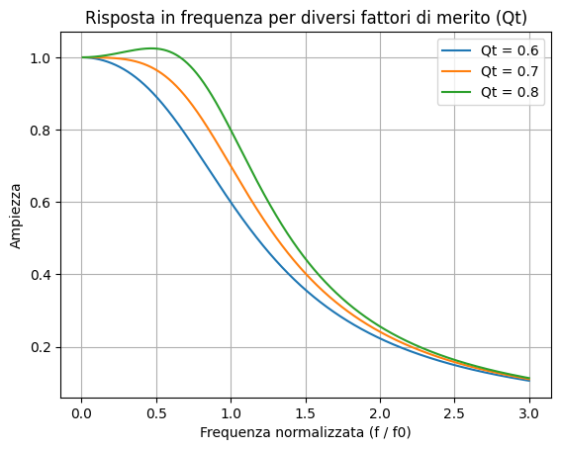
All acoustic suspensions are closed cases, not all closed cases are true acoustic suspensions. A simple closed box may have a woofer with a mechanical suspension that is stiffer than the internal air volume, and where, precisely, the air in the cabinet plays a secondary role. In the acoustic suspension, on the other hand, it is the air in the cabinet that controls the movement of the driver, providing more linear, controlled, and resonance-free bass. In a closed box, the merit factor Q (often referred to as Qtc) describes how the system responds to low frequencies, that is, how controlled or “resonant” the bass sound is. A low Q indicates a very damped response: bass is clean and controlled, but less deep and energetic, while a high Q indicates a more resonant response: bass that is more energetic, but bloated and less accurate. The Q value = 0.7 is considered the best because it represents the right compromise between extension, control and naturalness of sound. With this value, the frequency response is very linear, and the system follows the musical signal in the best possible way, with balanced behavior over time-in short, the cone stops quickly when the signal ends.

A Q = 0.7 (also called Butterworth alignment) provides deep, clean, realistic bass, which is why it is often chosen as the ideal reference in the best closed speakers. When the Q is lower than 0.7, with values of 0.5-0.6, this is called a Bessel alignment. In this case the response is very damped and extremely smooth over time: the bass is controlled and free of resonance, but the extension is reduced, while above 0.7, around 0.8-1.0, we enter a Chebyshev-type alignment, also called underdamped. Frequency response is emphasized in the low range, with greater impact and depth, but at the expense of accuracy, with slow and poorly controlled bass.
Sonically, the closed box, of whatever type, returns bass that is generally drier, quicker and more accurate than the bass-reflex. The frequency response tends to drop gradually, without unnatural peaks or emphasis. The bass of an air suspension is usually more realistic, especially with acoustic instruments such as double bass, cello or bass drum. However, the closed box is less efficient. For the same woofer size and applied power, it produces less sound pressure than its bass-reflex counterpart, so obtaining deep bass requires high-performance woofers, more powerful amplifiers, and/or higher internal volumes.
Bass Reflex
The bass reflex, in contrast, uses a tuned duct or port that connects the inside of the cabinet with the outside. This port is tuned to a certain frequency, the Fb, so that the air inside it resonates and contributes to the production of low frequencies. In practice, some of the energy generated posteriorly by the loudspeaker with its movements and which would otherwise be lost, is recovered and harnessed to increase the output.
Physically speaking, below the tuning frequency Fb, the woofer is less controlled than in a closed box, while around that frequency the system reaches maximum efficiency. Fb in short is the frequency at which a bass reflex system is “tuned,” at which the pipe resonates with the air in the box. The air in the tube vibrates particularly efficiently and contributes significantly to the sound output, reinforcing the bass. But one important thing happens around Fb above all: the speaker moves less, and it is the duct that emits most of the sound. This allows for deeper bass, better performance than a closed box of the same size, and the system represents a smaller load on the amplifier. Fb is therefore the point at which the bass reflex works at its most efficient. The main reason why bass-reflex is now the system of choice is that it allows “seemingly” more extended bass to be obtained even from relatively compact cabinets. The disadvantage is a less rigorous transient response: the port continues to “ring” even when the signal ceases, and this can make the bass more bloated, less defined, as well as being more sensitive to placement in the room: distance from walls and corners can significantly affect the performance. Another very important aspect is the behavior below the tuning frequency. In an air suspension, the woofer always remains controlled by the internal air, reducing the risk of excessive excursion of the driver. In a bass-reflex, on the other hand, below the Fb tuning the control decreases dramatically and the woofer moves a lot, with possible distortion due to both mechanical stress and reached amplifier power limits. In particular, the impedance of the driver drops sharply because in this area the system loses the acoustic loading effect of the conduit, and the driver behaves more and more like a speaker in free air. The amplifier then finds itself driving a less damped load, with greater current demand precisely where acoustic efficiency is now reduced. The loudspeaker is then forced into very large excursions: the cone moves around a lot chasing frequencies it cannot reproduce, and this leads to increased distortion and, in the worst cases, the risk of exceeding the mechanical limits of the loudspeaker and/or amplifier power with dangerous avalanche effects.
From the point of view of the amplifier
In a closed-box system, the efficiency towards the amplifier is generally lower than in a bass reflex. This means that, for the same speaker and desired sound level, the amplifier must provide more power to achieve the same volume at low frequencies
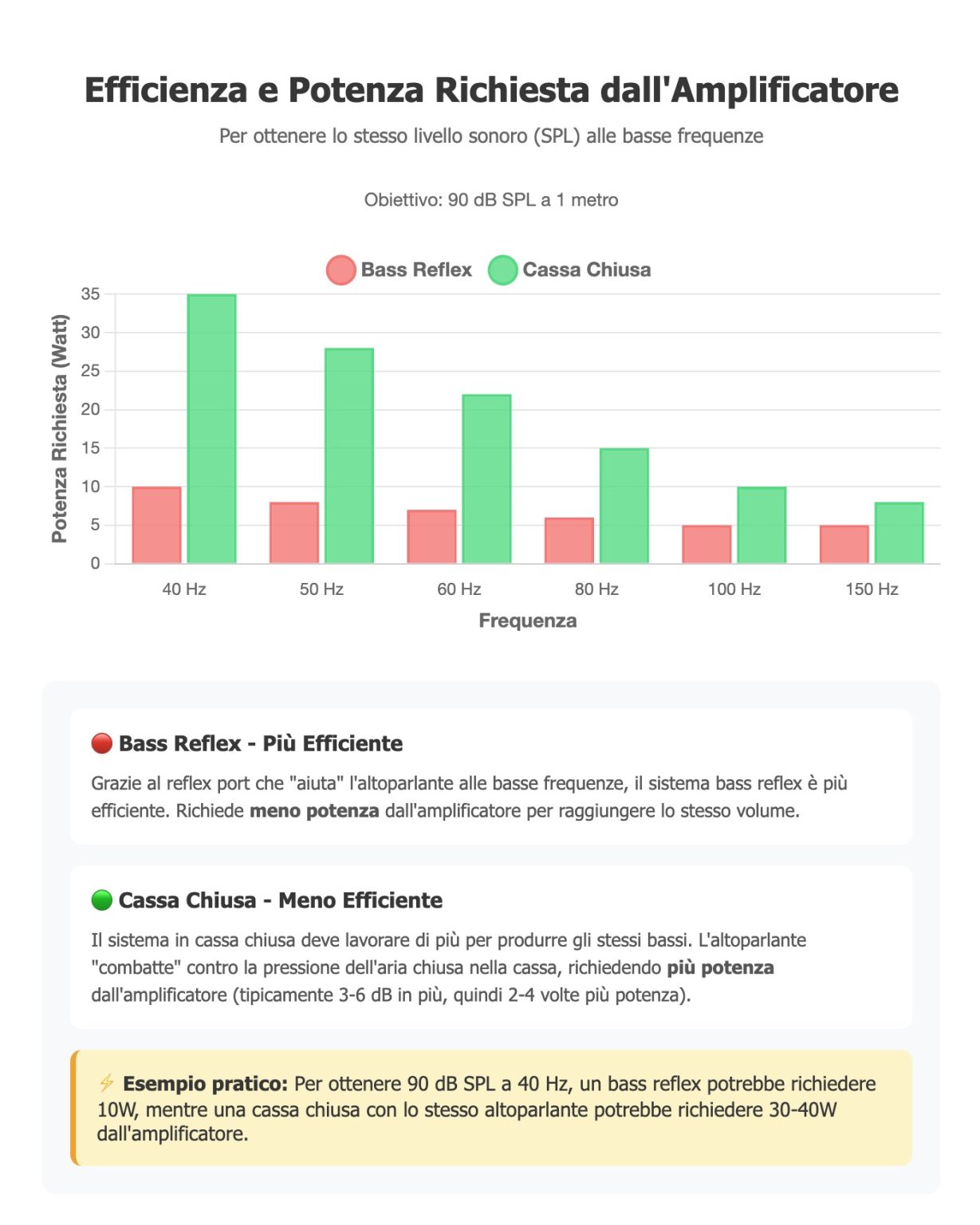
In the closed box, the speaker always works against the compressed air inside the cabinet, which acts as a spring and limits the movement of the cone: this provides good control but requires more electrical energy to move the air and produce sound pressure. In the bass reflex system, however, a large part of the work is done by the tuned port. Around the tuning frequency Fb, the contribution of the pipe increases the sound output without requiring a corresponding increase in power from the amplifier. As a result, the speaker is more efficient in the low range and is able to produce more intense bass with fewer watts. In addition, just near the tuning frequency, the excursion of the cone decreases, reducing the mechanical strain on the speaker. From the amplifier’s point of view, therefore, the bass reflex is generally “easier” to drive in terms of bass output because it exploits an acoustic resonance to increase efficiency. The closed box, while requiring more power, however, offers a more predictable load and smoother response, characteristics that often result in better control and greater tolerance for design or amplification errors.
Which one is better ?
There is no absolute objectively better solution. Air suspension favors control, precision, and tonal coherence, at the expense of efficiency and apparent bass extension. The bass reflex focuses on greater bass output and a better relationship between speaker size and sound depth, accepting compromises in terms of control and ease of room integration. The choice between the two systems depends on the type of music listened to, the environment, the amplification available, and, most importantly, the listener’s personal taste.




GIPHY App Key not set. Please check settings