

 Audio 2G
RCA, a standard with white hair
RCA connectors, named after Radio Corporation of America-the RCA we all know-who introduced them in the 1940s. They represent one of the longest-lived and most widespread standards in consumer electronics. Their structure is simple: a central pin -hot pin- surrounded by an outer metal ring that serves as a ground.

This is the unbalanced design, meaning the signal travels through a single conductor relative to the common ground. The characteristic cylindrical shape with the protruding center pin is immediately recognizable, as are the conventional red and black colors used to distinguish left and right channels in stereo configurations, or yellow in video for the video-composite signal, as, again in video, for example was used to carry the YCrCb component signal.

XLR, the signals become two, "almost" the same.
XLRs, on the other hand, were born in a professional context where it was and is necessary to carry signals for very long distances without spoilage. Imagine having to reach stage speakers or connect a microphone. Their name comes from “X series, Locking, Rubber compound” in reference to the improved version of the Cannon connectors developed in the 1950s. The standard XLR configuration includes three pins arranged in a triangle within a sturdy cylindrical housing equipped with a locking mechanism. This three-conductor architecture allows the transport of balanced signals, a key feature that is perhaps the most significant difference from RCAs.

The balanced transmission of XLRs deserves special attention because it forms the heart of their superior performance. In an XLR cable, the audio signal is duplicated on two separate conductors, with one of the two copies inverted in phase by one hundred and eighty degrees; the positive “version” of the signal is called the hot pole, the other, the cold pole. Inverted 180 degrees means that in a hypothetical sine wave, the hot pole reaches in maximum of the sine wave, while the cold pole at the same time reaches the negative maximum, same signal, in short, but “mirrored.” The third conductor acts as a shield and ground reference. On the other side a transformer or differential electronic circuit subtracts the two signals from each other. Since the original signal is present in both conductors but with opposite polarity, this subtraction doubles the amplitude of the desired signal, but not only that. The real advantage is another. In fact, any electromagnetic interference collected along the cable path affects both conductors equally and with the same phase. When the receiving circuit performs subtraction, these common interferences are completely cancelled out-the principle is known as common-mode rejection.

Only XLRs do that
RCAs, operating in unbalanced mode, cannot take advantage of this noise cancellation mechanism. The signal travels on a single conductor while the ground is shared, making these cables much more susceptible to electromagnetic interference and noise induced by external electric and magnetic fields. This vulnerability becomes particularly problematic when cables must cover significant distances or traverse environments rich in interference sources such as transformers, electric motors or digital equipment.
The new electromagnetic interference
When we think of the 1970s, 1980s and 1990s, we tend to idealize that era as the golden age of analog audio. It was an era in which there were no cell phones and Wi-Fi nor even alternative power sources, just a few appliances, neon lights, maybe a computer, and so the RCA connection and the concept of common ground was not a big deal. Today, on the other hand, balanced XLR connections demonstrate all their indispensability because of a radically transformed electromagnetic environment.
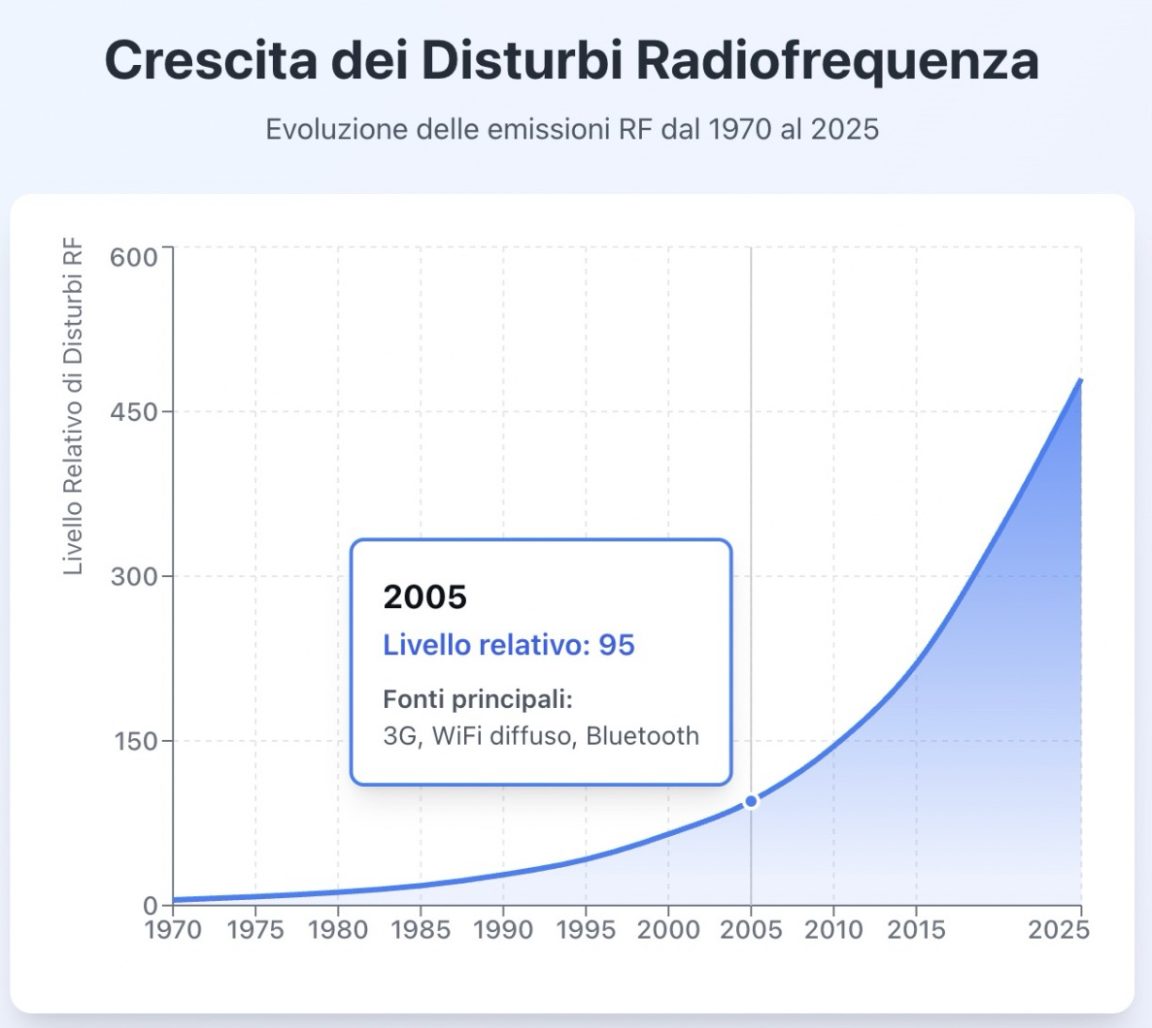
Today we live immersed in a sea of radio frequencies and electrical disturbances that the designers of that time could never have imagined. Smartphones are constantly transmitting 4G and 5G data, WiFi routers saturate the 2.4 and 5 GHz spectrum, Bluetooth devices proliferate, and high-frequency switching power supplies are everywhere, thanks in part to European legislation that -rightly- mandates st-by power consumption below 0.5W, a value very difficult to achieve with a traditional transformer. Every USB charger, every dimmable LED, every screen generates harmonics and noise that propagates both overhead and through power cables.
The degradation of the power grid
But perhaps the most insidious aspect concerns precisely the quality of the power supply. The 230V grid that reaches our homes is no longer the “clean” grid of a few decades ago. The massive introduction of photovoltaic inverters, electric vehicle chargers has literally disfigured the waveform of the sine wave that should power our devices. And it didn’t end there. Surdevolvers (the inverters) for photovoltaic systems, while technologically advanced, feed high-frequency harmonics into the grid that overlap with the 50 Hz fundamental. These disturbances travel through power cables and can easily couple capacitively or inductively with unbalanced audio cables, turning into audible noise, hum and interference. And it is here that the balanced XLR link demonstrates all its engineering superiority since its Common Mode Rejection Ratio(CMRR ), which we have already seen, can reach values of 80-100 dB in the best preamplifiers, making disturbances that would be unbearable with an unbalanced link virtually inaudible. Today, therefore, in an environment saturated with RF interference and with a compromised power grid, the XLR connection is no longer just a professional choice but a necessity for anyone who wants to preserve the integrity of their audio signal. It would be paradoxical to thwart one’s financial sacrifices by letting avoidable disturbances compromise the quality of our sound. The XLR connection, although designed decades ago, proves to be more relevant and indispensable today than ever before.
How far can they go ?

The issue of runable distances represents one of the most significant differences. RCA cables maintain acceptable performance for relatively short runs, typically within two to three meters in domestic environments with moderate levels of interference. Beyond this threshold, the signal-to-noise ratio tends to degrade progressively, with the introduction of hum and hiss. XLRs, thanks to their balanced architecture, can cover much greater distances without appreciable loss of quality, making connections of tens or even hundreds of meters possible in professional installations such as recording studios, theaters and live sound systems, but also, for example, to reach two mono power amplifiers to be placed close to the speakers, or in active configurations where speakers must be reached via under-track passes.
It is also a matter of level
Another distinguishing aspect concerns the signal levels typically handled by the two standards. RCAs are commonly used to carry line-level signals, generally between about half a volt and two volts RMS. This makes them ideal for connecting sources such as CD players, turntables with or without built-in preamplifiers, tuners and other devices to amplifiers and receivers. XLRs, while also used for line-level signals in many professional applications, particularly excel at carrying very low-level microphone signals in the millivolt range or less. The ability to preserve the integrity of these extremely weak signals across long distances and in hostile environments is a major reason why professional microphones universally use XLR connections and is also why many turntable manufacturers are turning to that connection. Mechanical robustness is another major difference between the two standards. XLR connectors incorporate a snap-lock mechanism that ensures a stable connection that is resistant to accidental tearing. This retention system is crucial in professional environments where cables may be subject to mechanical strain during installations, concerts, or recording sessions. The robust metal housing of XLR connectors also offers superior protection against shock and wear and tear compared to RCA connectors, which with their more delicate construction are more vulnerable to mechanical damage over time.
A matter of contact
RCAs, on the other hand, rely solely on friction between the center pin and the internal contact to maintain the connection. Although this system works adequately in fixed installations such as domestic ones, it has obvious limitations in contexts where cables are frequently connected and disconnected or where there is a risk of accidental pulling. With repeated use, RCA contacts tend to lose elasticity, generating less reliable connections that can introduce intermittent noise or contact loss.
The specifications and shielding
From the perspective of impedance and matching, the two standards operate to different specifications. RCA cables are designed for a characteristic impedance of about 75Ω in video applications or varying impedances in audio applications, usually 50Ω, typically non-critical. Professional XLRs generally follow a standard of 110Ω, adopted from the digital AES/EBU standard for balanced lines, although in analog audio applications precise impedance matching is less critical than in RF applications. What matters for audio are parameters such as capacitance per meter (typically 100-150 pF/m), conductor resistance, and shielding quality. No microphone cable manufacturer specifies characteristic impedance in data sheets precisely because it is not needed.


Shielding is another differentiating parameter. Quality RCA cables use braid or foil shielding around the center conductor to minimize interference, but this protection has inherent limitations in unbalanced design. XLR cables combine the physical shielding of the cable with the advantages of balanced transmission, creating a multilevel defense against interference that is significantly more effective.
The ground loop in the RCA connection
One aspect that is often overlooked is the management of ground loops, a phenomenon that can cause hum and noise when multiple audio devices are connected together and share multiple ground paths. In RCA-based systems, these loops can be problematic and require corrective solutions such as ground isolators or wiring modifications. Practical applications of the two standards reflect technical differences. RCAs dominate in consumer audio, connecting home hi-fi components, home theater systems, and entertainment equipment where distances are limited and the environment is relatively controlled. Their simplicity, low cost, and ease of use make them ideal for these contexts. XLRs, on the other hand, are the undisputed standard in professional recording studios, concert sound reinforcement systems, broadcast productions, and wherever audio quality, reliability, and flexibility are top priorities over economic considerations. The perceived sound quality between the two standards depends strongly on the context of use. In a quiet home environment with short cables and well-designed equipment, the difference between a good RCA cable and an XLR cable may be minimal to the ear, but in more demanding situations characterized by long distances, high levels of electromagnetic interference-now the norm in any apartment-or the need to preserve extremely weak signals-those from the turntable for example-the technical advantages of XLRs translate into tangible improvements: lower noise floor, greater dynamics, and absence of interference-induced artifacts.

With all this we certainly do not mean to say that RCA connections are now “old” and “unusable,” we would miss it, but only to focus well on what differences there are and how much in today’s contaminated environment it is, XLR, to be taken into much greater consideration than in the past. Then there is another aspect that is no less important, namely, whether this or that Hi Fi equipment is actually inherently balanced, that is, it generates (in the case of sources) or treats (in the case of preamplifiers, integrated amplifiers, power amplifiers) the signal as differential or not. But for this aspect we refer you to another specific article that you can read here





GIPHY App Key not set. Please check settings