



 Audio 2G
Accuphase is the brand that probably more than any other embodies the Japanese tradition in Hi-Fi. In fact, we have dedicated a specific article to it telling its story, starting from its early days, which you can find here. The E-700 replaces the E-650 bringing with it, according to the manufacturer, substantial improvements in every aspect and inherits many solutions developed for the 50th anniversary celebratory model, E-800 top of the manufacturer’s range of class A integrated amplifiers. We had the great honor of meeting the legendary president Mark M. Suzuki, technical manager Takaya Inokuma, and sales manager Tatsuki Tozuka, who told us many interesting things about the products, the company, and the brand’s philosophy. Find the interview here.

At the heart of the E-700’s design philosophy is Accuphase’s determination to reduce noise even more than its predecessor. After all, this aim has always distinguished all of the brand’s products-remember E-2800, just to give one example, the first preamplifier where AAVA volume control was implemented and which recorded the lowest noise at the time, twice as low. The preamplifier section, of course, uses AAVA volume control, a radically different solution from traditional systems based on variable resistors and of which you can find more here. Integrated on the E-700 is the ANCC, Accuphase Noise and Distortion Canceling Circuit, a proprietary technology that uses a principle that is as elegant as it is effective: a secondary amplifier is employed to eliminate the noise and distortion generated by the main amplifier. The process is done by detecting unwanted components in the input phase of the converter and injecting a cancellation current with reversed polarity.

Maniacal attention to detail also extends to the mechanical aspects of the volume control. The sensor mechanism is machined from a single block of aluminum through precision machining, ensuring smooth operation and a quality tactile feel during use and with the classic beautiful “honey spoon” tactile sensation.
Beautiful aesthetics, always the same
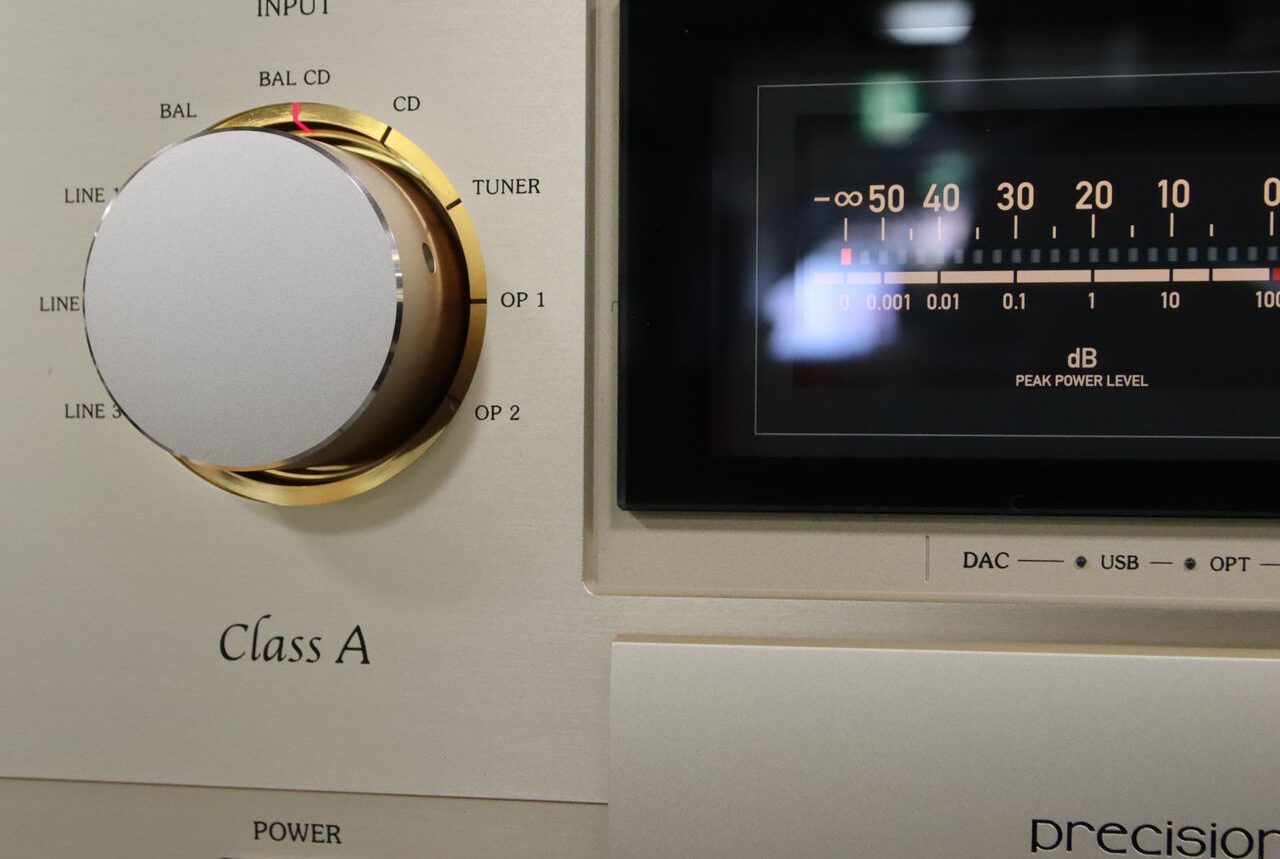
Accuphase electronics, perhaps more than others, are recognizable at first glance, and this E-700 is certainly no exception. It follows all the classic styles and shows how for the manufacturer time does not seem to have moved on. The front panel elegantly brings together all the main controls of the amplifier. In the center dominates the large display with Accuphase VU-meters, this time with LEDs, showing the power output in real time. On the sides are the two main controls: the volume control, which is large and smooth, and the input selection control where coaxial LEDs are located at the markings. At the bottom, behind the retractable flap, are the tone controls, balance, mode selector, mono/stereo button, activation of the compensation circuit (loudness), and a few other buttons that work only in the presence of the phono or DAC expansion cards. Completing the front panel are the power button and headphone output, arranged with typical Accuphase symmetry and aesthetic cleanliness.

The final sections
The E-700 represents a significant evolution from the previous model, using four (not three) MOS-FETs in parallel push-pull further reducing the output impedance. This four-stage configuration operates entirely in Class A up to a power output of 35 watts on 8Ω, more than the E-650’s 30, extending the operating range into pure Class A. The power doubles on 4Ω, 70W, 140W on 2 ohms, thus able to offer wide dynamic margins to reproduce even the most complex and energy-rich musical passages, thanks in part to the incredible damping factor, as high as 1000, when any amplifier does not normally exceed 500, but more on that later.
The final sections
The E-700 represents a significant evolution from the previous model, using four (not three) MOS-FETs in parallel push-pull further reducing the output impedance. This four-stage configuration operates entirely in Class A up to a power output of 35 watts on 8Ω, more than the E-650’s 30, extending the operating range into pure Class A. The power doubles on 4Ω, 70W, 140W on 2 ohms, thus able to offer wide dynamic margins to reproduce even the most complex and energy-rich musical passages, thanks in part to the incredible damping factor, as high as 1000, when any amplifier does not normally exceed 500, but more on that later.

Robust power supply
The power supply circuit was generously sized, BANDO toroidal transformer, already seen in many Nipponese realizations, Yamaha first and foremost, and immediately after two 56,000µF filter capacitors, an indication that the configuration is dual mono from immediately after these two elements, which then supply both power banks. The internal architecture follows the traditional monoblock structure that characterizes high-end Accuphase amplifiers. The large power transformer and filter capacitors are centrally located between the left and right channels, creating complete physical separation while minimizing interference between channels. One of the most impressive aspects of the E-700 is the guaranteed damping factor of 1000, superior to E-650 and the same as the Class A-80 stereo amplifier. This parameter, represents the index of the driver capability of the speakers, and was achieved through the coordinated use of several technologies. First of all the 8 Mosfets per channel, then signal paths designed to be as short and thick as possible, further reducing any parasitic resistance.

The negative feedback signal is then picked up near the speaker terminals, compensating for cable and connection resistances, and there are no protection realys, but rather MOSFETs with a resistance of 0.96mΩ; this solution simultaneously improves the damping factor, long-term reliability, and sound quality by eliminating the weakness represented by conventional relays. The protection system is designed with a focus on safety without compromising sound performance. The circuit can detect short circuits at the speaker terminals, while temperature sensors installed on the heat sinks constantly monitor the thermal condition of the power section. Information about detected short circuits is transmitted through photocouplers, ensuring complete isolation from the music signal path and minimizing any potential negative effect on sound quality. When the protection circuits kick in, the E-700 interrupts the supply and flashes the power meters to visually signal the abnormal condition. The noise performance according to the manufacturer is significantly better than the E-650. And we have no reason not to believe them given the absolute rigor that the company has always demonstrated with a signal-to-noise ratio of 103 dB (!!!! It’s an integrated !! Hats off to them!!) It is so important that the noise is as low as possible because it increases real dynamics, tangibly improving listening.
Versatility of yesteryear
First of all, a due mention to the protective caps on the input connectors, branded Accuphase. To many they will seem like an unnecessary affectation, but they are not, they serve in fact to preserve the goodness of the contact over the years, and it is a care that really says a lot. Five RCA inputs, 2 XLRs, an RCA-only recording bar, a pre-out/main-in for both XLR and RCA, two pairs of speakers that can be connected through large proprietary binding-posts, and finally 2 slots, Option 1 and Option 2, that can accommodate three different cards, the AD-60 phono, the DAC-60, and the Line 10 that adds a line input. AD-60 with MC differential amplification stage with 4 bipolar transistors driven in parallel in class A, MM differential amplification stage with pair of JFETs, MC 66 dB / MM 40 dB gain level, and load impedance adjustable to 30, 100, 200, 300 Ohm MC and MM 47 kOhm. Sensitivity is 0.126 mV MC and 2.5 mV MM. Possibility of subsonic filtering 25 Hz -12 dB/oct. The DAC-60 is a digital-to-analog converter with DSD capabilities 2.8224 MHz, 5.6448, MHz, 11.2896 MHz and PCM up to 32 bit / 384 kHZ.
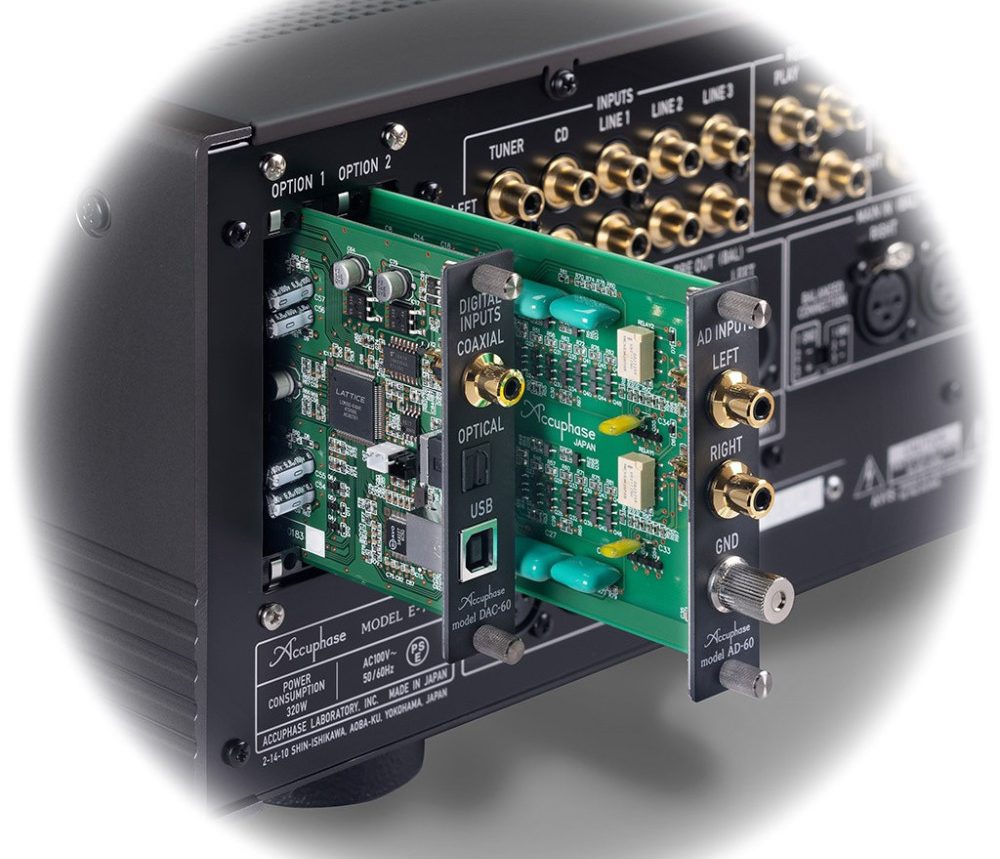
Conversion is by a 2MDS+ (Multiple Delta-Sigma) stage, with a pair of ESS 9016K2M chip DACs in parallel with USB B digital inputs, 1 S/PDIF coaxial and one Toslink. Parameters can be managed via front panel, the E-700’s management electronics notices the presence of the interfaces and makes setting functions available as well as being able to view the input signal sampling rate on the front display and select the desired source via the selector on the panel.
Listening
The Accuphase E-700 is a silent and impeccable companion that does not need to impress with striking gestures because it lets the music speak through a rare, almost unique grace. From the first moments there is a sense of naturalness that is not mere technical balance, but a kind of organic breathing of sound, as if the amplifier knows how to interpret each passage with the intelligence and sensitivity of a musician. The stage opens wide, unforced, with an almost architectural but never rigid order: everything appears suspended in a soft, controlled luminosity that allows the musical texture to be followed with an almost contemplative calm. The voices emerge with a sweetness that does not mellow but reveals. It is a subtle quality, made up of microdetails that do not impose themselves but arrive at the right moment, as if there were no veils. The words, the breaths, the emotional inflections seem to be carved in intangible material, present and tangible without ever crossing boundaries. The instruments, in turn, take on a body and three-dimensionality that need not be ostentatious. The E-700 restores the weight and physical texture of each timbre with exemplary composure, in which nothing is ever excessive or restrained: simply corrected in the most elegant way possible. The bass range descends with exemplary control, but not with the severity of an imposing amplifier; it accompanies the music with a quiet confidence, a depth that sustains and never overpowers. The hits of a bass drum, the notes of a double bass, the round warmth of a piano reveal a velvety density whose strength is always channeled toward the fluidity of the whole. The midrange is the beating heart of the device, a place where everything breathes with understated warmth and a transparency that is never clinical. Finally, the treble opens into a fine, illuminated extension, devoid of any grain: it does not sparkle to amaze, but to clarify, to bring out the air and light that surround the music.
Perhaps the most striking aspect of the E-700 is its ability to disappear behind what it reproduces. There is never the feeling that it is interpreting or coloring: if anything, there is the perception of a kind of superior calm, a stable and reassuring presence that allows the music to express itself in its most accomplished form. One gets the impression that everything is in its place not by chance, but by a precise and thoughtful choice. It is a listening that does not seek to impress immediately; it captivates with the same delicacy with which a great performer knows how to make a musical phrase flow, letting time and space shape itself around the notes.
The E-700 does not impose emotions, but reveals them slowly, like a storyteller who knows the value of silence between words. The more one listens to it, the more one realizes how its exceptionality lies not in a single parameter, but in an overall harmony that shapes an unexpectedly serene and engaging experience. There is a sense of mastery in the way it combines grace, control, depth and a certain spiritual lightness that makes the music truer, more alive and, above all, closer to the listener. Over time, the E-700 becomes an unobtrusive and valuable listening companion, capable of transforming even familiar tunes into moments of discovery. It is an amplifier in which class and refinement are not outward qualities, but a way of being: a sonic signature that is not to be forgotten, because it leaves an imprint of having experienced music not only with hearing, but with everything beyond. We wait in pre and final rehearsal, hoping.
Technical characteristics:
- Power per channel 1/2/4/8Ω: 160/140/70/35
- Total harmonic distortion: 0.03%
- Frequency response: 20Hz-20Khz 0/-0.2dB
- Damping factor: 1000
- Input sensitivity: 14.2 mV for maximum power
- XLR/RCA input impedance: 40kΩ/20kΩ
- Gain: 28dB
- Tone controls 300Hz/3kHz: +/- 10dB
- Signal-to-noise ratio: 117dB
- Headphone output: impedance >8 ohms
- Power supply: 120/230 VAC, 50/60Hz
- Consumption stby/on/max: 0.3/178/220W (IEC62368-1)
- Dimensions: 46.5X19.1X42.8
- Weight: 24.9 kg
Price: 16,000
Expansion boards:
- AD-60: 1350€.
- DAC-60: 1650€.
Manufacturer: Accuphase Japan
Distributor: High Fidelity Italy




GIPHY App Key not set. Please check settings