



 Audio 2G
Eversolo
Before describing the Eversolo DMP-A10 I think it is useful to provide some background information about the company that makes it. So, Eversolo is a Chinese company that in recent years has attracted the attention of audiophiles and the trade press thanks to an interesting range of products, all of which feature sophisticated technology, accurate manufacturing, and an excellent price/performance ratio. Unlike other competing Asian companies, Eversolo has not attacked the Entry Level sector of the market, but has positioned itself in the mid-range while making products with distinct High End characterization. The catalog is extensive and includes streamers, DACs, headphone DAC dongles, and a couple of power amplifiers. The little information we were able to find about Eversolo comes from the “About Us” section of the website:
Eversolo Audio Technology Co.Ltd is funded by Zidoo Technology Co. Ltd. The main members of the founding team have been engaged in development and management in the HiFi industry for many years. The research and development team has expertise in audio decoding, analog audio, acoustic optimization, amplifiers, system integration, user experience, and so on. The core business includes audio playback devices, DACs and amplifiers, etc. Eversolo is a registered trademark of Eversolo Audio.
It is not much, however what we had previously read about their products had us strongly intrigued, and this was the reason for our enthusiasm in welcoming the top-of-the-line model, namely the Eversolo DMP-A10 DAC/Streamer.
Eversolo DMP-A10
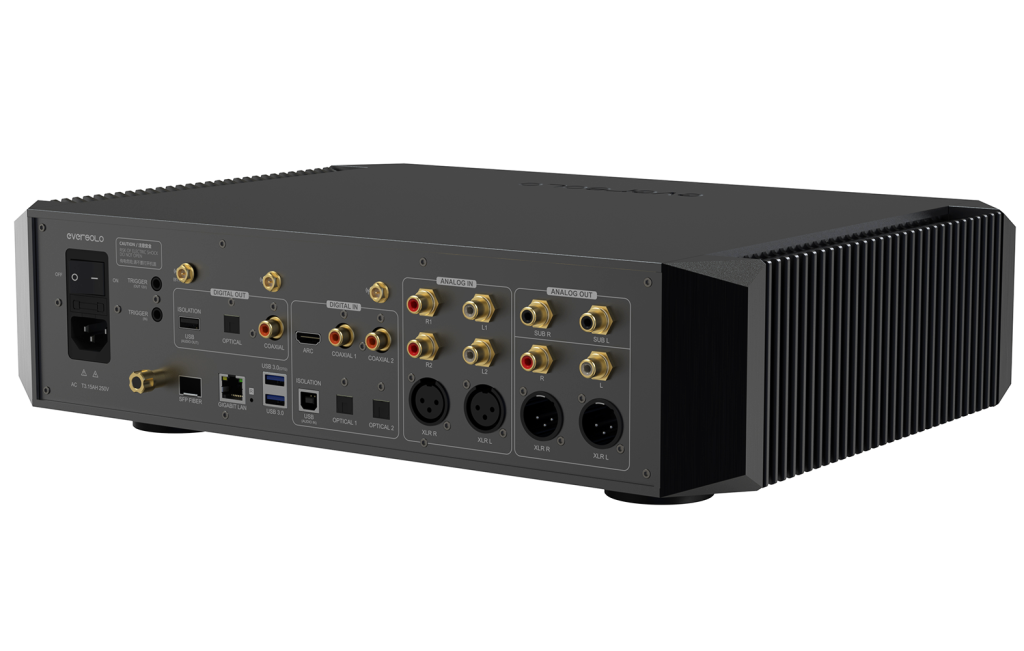
The analysis of the data sheet of this Eversolo leaves one dazed as to the completeness of the equipment. This complicates the task of the reviewer, who must be able to tell everything in a timely manner, without overextending himself. So let us begin by describing its wide selection of digital inputs and outputs. We have a USB, an HDMI-ARC, as well as two coaxial and optical inputs. Particularly well taken care of is the network input section, which can be via Ethernet cable (RJ45), WiFi (2.4 and 5 Ghz) and SFP fiber for which there is a transciever module to be purchased separately. Inevitable is the Bluetooth 5.0 input. Next to the digital inputs, we find two analog RCA inputs and an XLR input for external sources that will be digitized by the AKM AK7739 ADC processor on board. It will then be possible to send this digital signal to an external DAC using the digital outputs since it is not possible to send this analog signal to the Eversolo’s internal preamplifier.
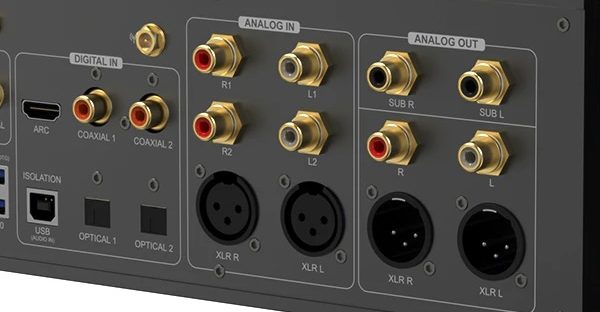
As for the digital outputs we have USB A, optical and coaxial. For the analog side we have one balanced output on XLR, one unbalanced output on RCA, and no less than two Subwoofer (R&L) outputs. If we really want to find a deficiency that is the absence Of a digital output in I²S format over HDMI. Frankly, I would say this is a negligible detail, although I note that on the smaller DMP-A8 this type of output is present. There is no shortage of 12V triggers to control the on/off of a possible amplifier.
Now to Storage: up to two USB 3.0 drives can be connected and two M.2 SSDs can be installed in a special compartment cut out in the bottom of the drive. The supported capacity is up to 4 TB each, which would provide a total theoretical storage space of 8 TB plus the internal 64 GB.
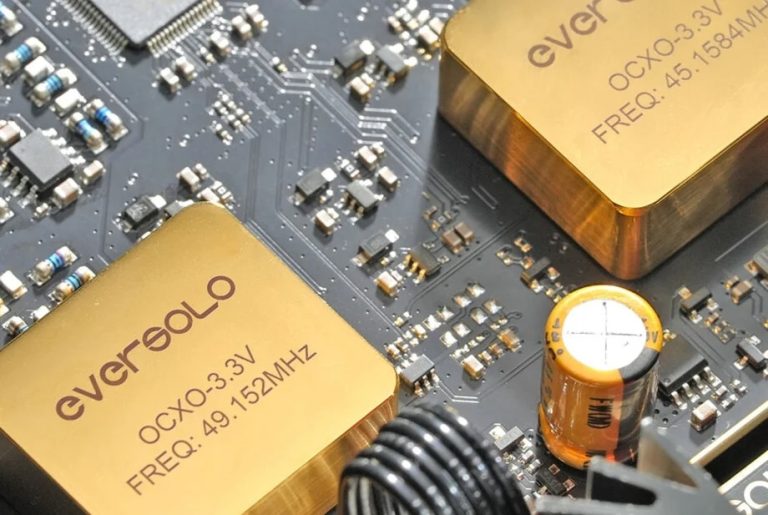
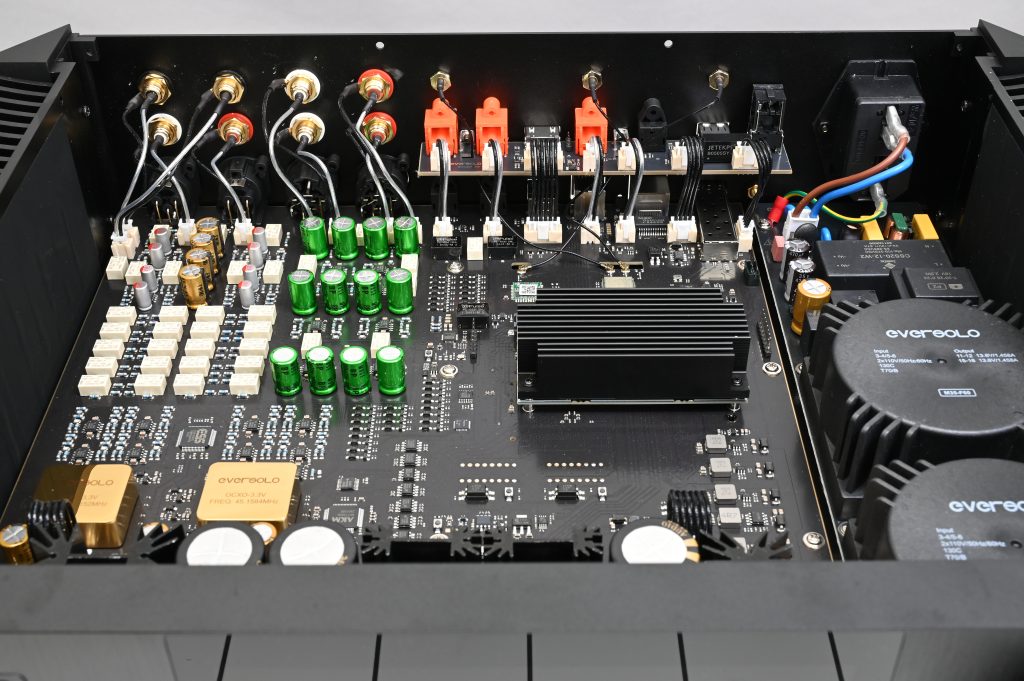
Now to an issue dear to many readers and on which the Eversolo DMP-A10 does not lend itself to criticism: the DAC chip is the recent ESS9039Pro with HyperStream IV architecture; the audio processor is the XMOS XU316 supporting up to DSD512 Native and PCM768kHz@32bit. The optical and coaxial ports support DOP64, PCM192kHz@24Bit. As for the amplification stage we find OPA1612 op-amps, while a sophisticated R2R analog solution has been chosen for the volume control, which ensures that the DAC can operate continuously as if it were in the bypass state. The power supply section makes use of two large, high-quality, low-noise shielded toroidals, plus two more of the switching type for complementary services and standby mode. The passive components used are of excellent quality: WIMA, Texas Instruments, muRata or Nichicon just to name the brands that populate the three PCBs of the DMP-A10. Of particular note are the two OCXO units of the company’s in-house developed clock system. Temperature control technology ensures that both oscillators (45.1584 MHz and 49.152 MHz) consistently operate in the optimal range, thus eliminating frequency fluctuations caused by temperature changes while offering very low phase noise. Each oscillator undergoes a rigorous testing process that results in jitter values of less than 50fs.
Through the incorporation of proprietary APIs(Application Programming Interfaces) the DMP-A10 supports TIDAL and Spotify Connect and is Roon Ready. In addition, Qobuz, Highresaudio, Amazon Music, Deezer, Apple Music, Soundcloud and many other services are integrated into its Android-based operating system.
Remote control
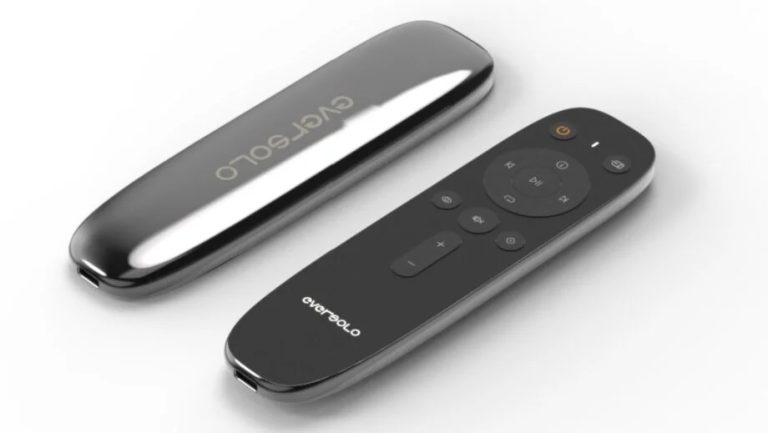
Inside the packaging of the Eversolo DMP-A10 we find a box of accessories, which contains a power cable, three antennas, a 12 V trigger cable, a quick start guide, and a splendid Bluetooth + infrared remote control for the operation of which the dedicated antenna is required. Given my idiosyncrasy towards antennas I had, as is my wont, omitted to install them and this caused some problems in properly configuring the remote control. After installing the antenna everything worked without hesitation. The remote control is very nice, especially since its lower half is made of polished aluminum that nevertheless tends to get dirty when you touch it with your hands. The internal battery is rechargeable via a USB C port.
Construction quality
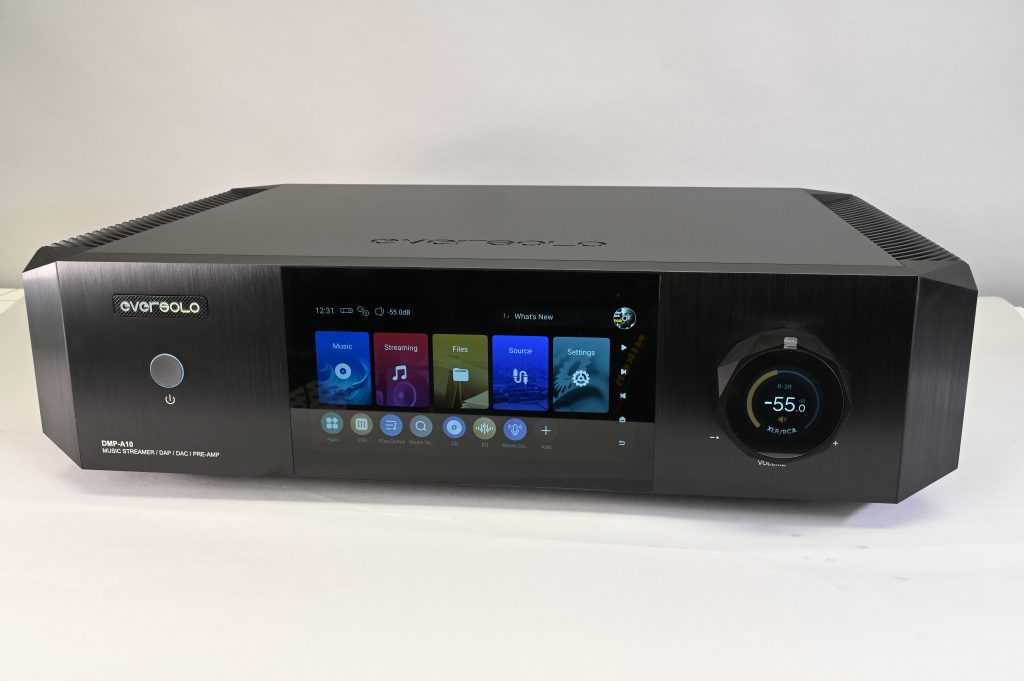
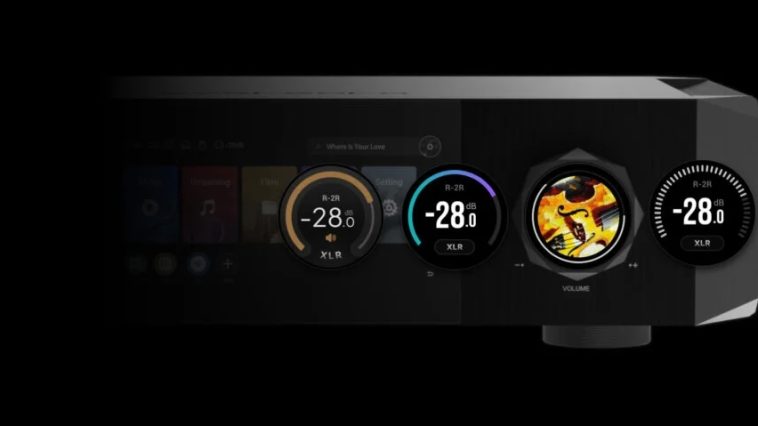
The images of the DMP-A10 seen on the net had caught my fancy and therefore I expected to receive a fine component. Reality, however, far exceeded expectations, as this DAC/Streamer is built as a higher-end machine than its selling price. This is clearly perceptible on the outside, in the “important” dimensions (430 x 310 x 117 mm (WxDxH)), in the workmanship of the metal parts, in their painting, and in their well-crafted design. As can be seen from the flooded images, the dominant aesthetic motif is the large side fins, which, however, have no dissipating function with respect to heat, since internally no active components are connected to them. The other element that plays an important role in the machine’s look is the large 6.5-inch LCD touchscreen display that occupies the central part of the unit’s front panel. Its size is large enough to read all the information from the listening position, this is also because the layout and size of the lettering is widely configurable. Another element of definite aesthetic appeal is the prissy secondary screen located inside the volume knob, which, in addition to giving an account of the level set, shows an indication of the input selected.
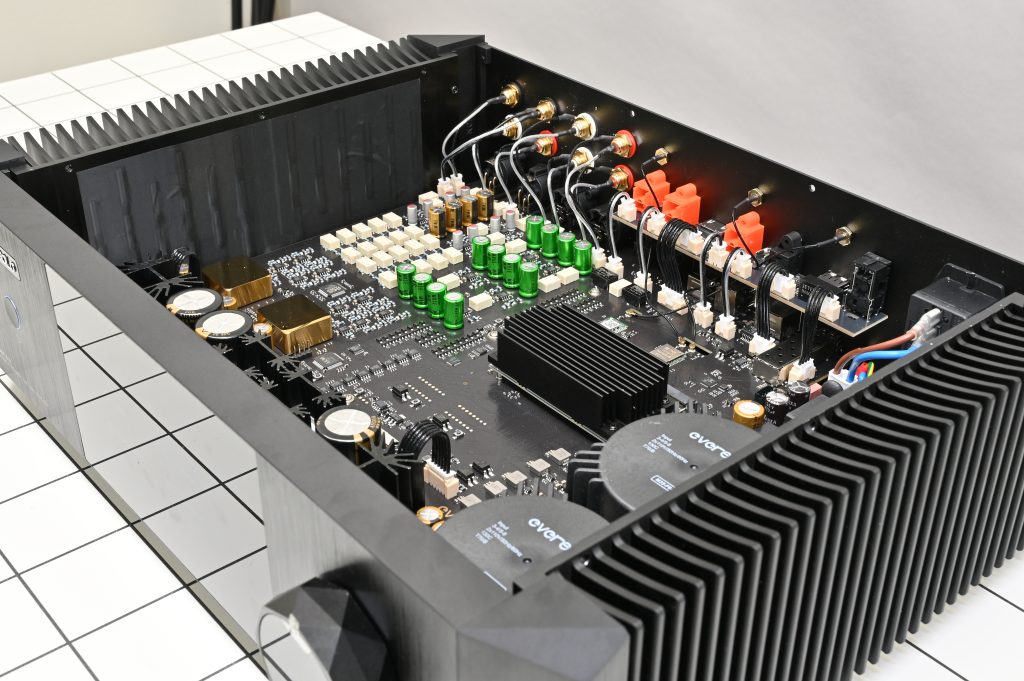
In selecting the components that equip the DMP-A10 at Eversolo, they must have decided to spare no expense: looking at the interior with a critical eye, one realizes that it is built with audiophile-grade components from the best suppliers. Red WIMA capacitors from Germany, Texas Instruments operational amplifiers from the United States, NICHICON audiophile capacitors, and SMT Murata components from Japan-every detail is designed to ensure superior audio quality.
If I can make a remark this concerns the excessive amount of graphic themes that can be set on the two displays. For example, it is possible to have VU Meters appear on the large one, which can also be nice. But what was the need to put an exorbitant number of them to choose from? The same goes for the spectroscope: a perhaps useful function in some circumstances, but certainly the amount of graphical themes offered from which to choose seemed to me to be overabundant. And what about the volume knob that can go so far as to give an indication of the current time by transforming itself into a clock, even of the analog hand type, or show the thumbnail of the cover of the track being played spinning on itself as if it were a vinyl record resting on a turntable? In short, perhaps the Eversolo designers got a little carried away here.
Ripping and Room Correction
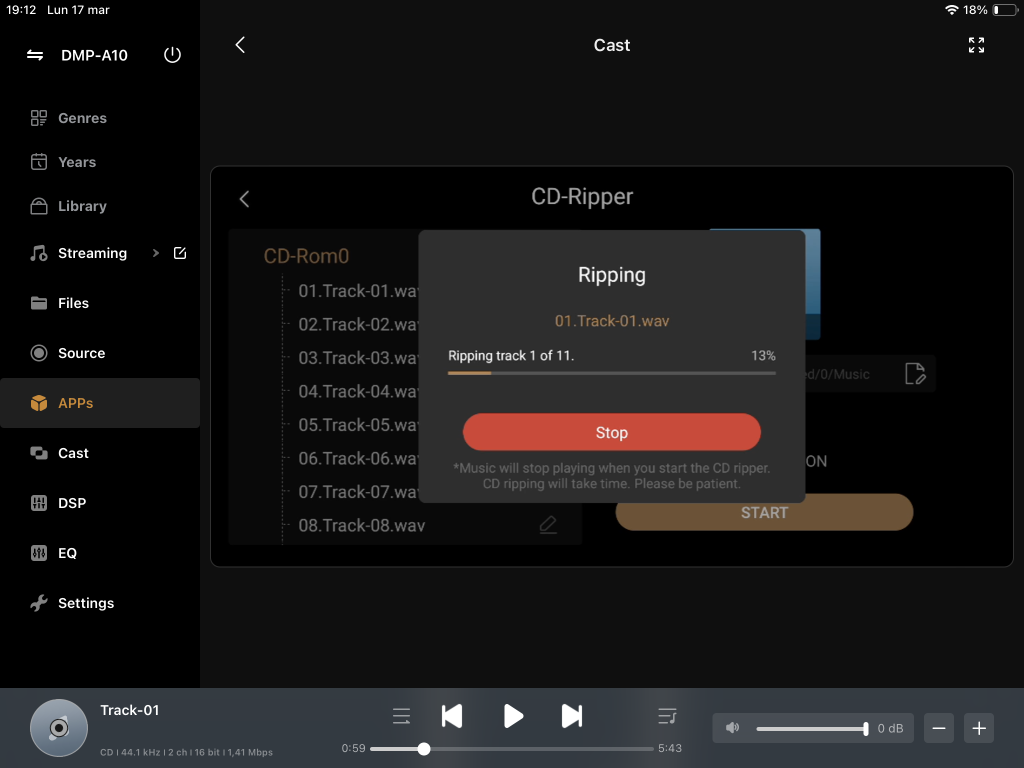
The Eversolo DMP-A10 employs an operating system based on a “closed” Android. This implies that one cannot install any app one wants but only those included in a kind of White List, prepared by the manufacturer. Among this there are two of particular interest: the one for ripping a Compact Disc and the one dedicated to Room Correction. Regarding the former there is not much to say: just connect a reading mechanism to one of the USB ports and the DMP-A10 will be able to read the contents of the inserted CD, send it to play or rip it in the format you prefer (.wav, .flac) on the machine’s internal memories or, if they are installed, on the optional SSDs.
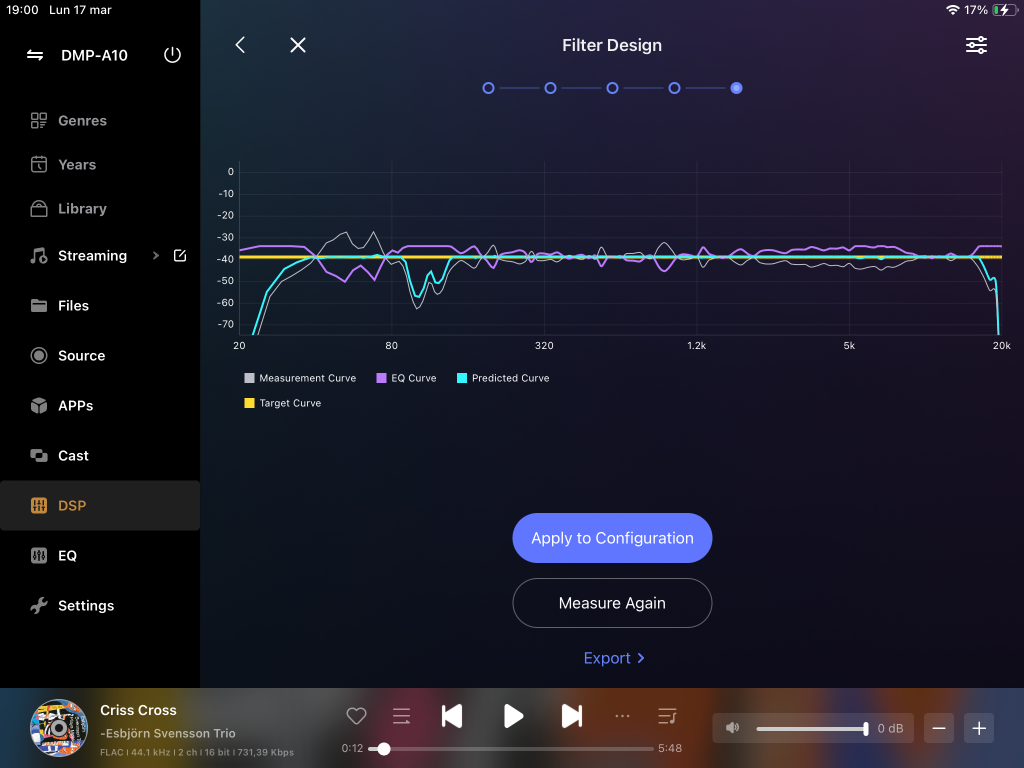
Far more interesting to yours truly is the discussion related to room correction: as many of you know, the acoustics of the listening room plays a decisive role in achieving a satisfactory overall performance, yet for various reasons it is an aspect that is often overlooked. Performing room treatment using specific passive components such as bass traps, diffractor panels, etc. is not always a viable option, either because of a question of cost or because those elements have a visual impact that in most cases is incompatible with domestic needs. In these cases, that is, when the listening environment cannot be treated passively by installing hardware on the walls, there is the possibility of doing so through software. Normally you need to equip yourself with a PC equipped with specific software-I have been using the excellent Audiolense from Juice Hifi for years-and a microphone. With the Eversolo DMP-A10 the necessary to perform this sound optimization option is already on board minus the microphone. The process is definitely simple since the software will guide you step by step with clear and self-explanatory instructions and graphs. The only thing you need is a microphone that will be used to measure the frequency response of the room. In fact, the program would also allow you to use your smartphone to perform this task, however it is quite obvious that to get a reliable result it is better to use an external microphone. I used a Umik 1 Mini DSP, while Eversolo offers an omnidirectional microphone called EM-01, of which you can download the calibration file by selecting “Automatic retrieval from the cloud” in the appropriate section of the app. If, as in my case, you are using a different one, you can have the app read the relevant calibration file (.txt) that will be used in the next steps. At this point it is essential to mute all possible sources of noise (e.g., the air conditioner) and avoid moving in order to avoid unwanted noise that would alter the measurement. In the next step, you are asked to “set the level,” that is, adjust the output volume in a range of -60 to -20 dB read by the measuring instrument. With this done, one can start the next step of the actual measurement, which takes about 20 seconds, in which the Eversol will cause the system to emit sweeps that will be measured and analyzed. This done, the software will calculate FIR(Finite Impulse Response) filters, which can be applied to the internal DSP settings. I did not like the fact that one cannot manually intervene on the Target Curve, that is, the frequency response that is to be obtained after the filter intervention. In fact, the Eversolo software provides only one type of target curve, which is basically a flat line.
User interface
the Eversolo DMP-A10 can be used in three ways: with the supplied remote control I wrote about earlier, with the large touchscreen on the front panel, or with the “EverSolo Control” app. Personally, I have used it almost exclusively in the latter way, either because sitting on the couch is the most convenient solution, or because the app – downloadable for free from the Play or App Store – is very well made. The most important streaming services are integrated into the DMP-A10 at the API level, which allows it to use Roon (Ready), Tidal Connect, DLNA, and Squeezelite natively. Likewise, thanks to the selection of pre-installed streaming services, I had no difficulty using Qobuz, Highreaudio, Amazon Music and Apple Music, among others. Taking into account that we mainly use Roon and DLNA in our studio, these were the modes with which we conducted the bulk of our tests and proved to be entirely free of defects.
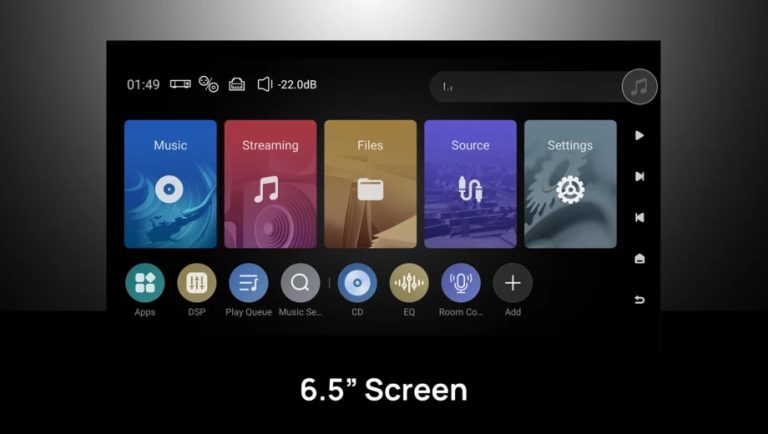
The DMP-A10 offers so many options in the settings menu that it would be difficult, as well as tedious, to list them all. Among those with the greatest impact on sound I recall access to the various digital filters, the ability to change the polarity of the outputs, and to set the maximum sample rate for the digital outputs. The DSP menu, already mentioned in the section on room correction, also offers other interesting options. For example, one can enable a Parametric Equalizer to shape the frequency response to one’s desires, and one can even specify different settings for each individual input. This means that the PC connected via USB, the TV connected via HDMI ARC, and the CD player can each have their own dedicated equalization.
In general, I can say that Eversolo’s software is one of the best I have come across. It is complete, it is well organized, it is responsive, and most importantly it has never shown any hesitation in operation.
Listening
The system with which the Eversolo DMP-A10 was tested initially consisted of the Marantz Model 10 integrated amplifier, connected to Opera Prima V2 speakers or ATOHM Sirocco 2.24 – floorstanding speakers. As a digital reference and comparison source we used the Aqua La Scala MKII DAC connected via USB to an Audiolinux-based Audio PC, with JCAT USB XE card, JCAT NET XE network card both with dedicated power supply. Both analog and digital signal, power and power supply wiring was Neutral Cable from the Reference series. Aware of the fact that this DAC/Streamer is doctored with an excellent volume control we also decided to make a “risky” match, at least from a commercial point of view, replacing the Marantz integrated amplifier with an Esoteric S-05 solid-state Class A amplifier.
From the very first bars, the Eversolo DMP-A10 made clear its standing as a high-end machine. The sound is presented with great authority, articulation and extension towards the extremes of the reproducible band. The overall balance is geared toward maximum neutrality accompanied by a pleasant feeling of body and precision. The other thing that, regardless of the type of speakers used, leaps to the listener’s attention is the breadth and stability of the proposed virtual soundstage, as well as the ability to exploit the dynamic gifts of the reproduction chain placed downstream.
Wanting to stick to the classic analysis based on the tripartitioning of the reproduced range, I can send with saying that the bass offered by this unit is deep, energetic and endowed with good articulation. I also liked the feeling of speed that it manages to convey, making the transitions from piano to fortissimo appear emotional and participatory, as we expect they should be. Of course, here we are referring to a source, which therefore must transmit the signal to an amplification chain consisting of an amplifier and speakers. It would therefore be almost superfluous to point out that if the chain components placed downstream of the DMP-A10 are not up to the task these potentials risk being irretrievably lost. In our case, fortunately, we had outstanding partners at our disposal. Indeed, I must emphasize how the Eversolo DMP-A10 was able to bring out the different “interpretative souls” of the two amplifiers that were paired with it. Particularly with Esoteric’s Class A, I was able to appreciate that sense of warmth that the Chinese DAC/Streamer knows how to instill in the transition between the mid-bass and mid-range that contributes to “humanizing” – pass me the term, please – the reproduction, keeping away that annoying sense of a “mechanical” or artificial event, as you like. Exemplary in this regard were the low string sections, which, provided they had a good recording, were warm, smooth, transparent and harmonically reliable. The midrange stands out for its cleanliness and ability to focus, something that helps greatly in the sometimes arduous task of placing the various instruments in space. Voices are reproduced realistically and with due body without, however, reaching that epiphany effect proper to machines more properly rooted in the High End segment. Mind you, this is not meant to be a criticism aimed at belittling the talents of the Eversolo DMP-A10. The mere fact that I thought about this particular aspect highlights how much this machine was able to raise the bar on my evaluation grid. Put another way: it never occurred to me that my Playback Designs MPD-8 or the Aqua La Scala MKII were too challenging references against which to compare. The high range was appreciated for its aforementioned ability to focus and for never being overly penetrating. Violins sounded with just the right amount of silkiness but, if required, could also be harsh and hard. Drum cymbals are bright just the right amount-perhaps not bright at times-but credible nonetheless. I would say in general that the high range of the Eversolo DMP-A10 fits organically into a well-structured continuum that gives rise to a precise, natural and relaxed sound.
Here, perhaps at this point I should report what can only be described as an impression. And that is that the line output at fixed level sounds a little more detailed and energetic than when using it through the volume control. Clearly, there is a change of amplifier involved in the comparison, and the two we used could not have been further apart in terms of sonic footprint. Nevertheless, I would repeat that the volume control gives the sound a sense of softness and relaxation that alters, if only slightly, the overall character of the machine.
Conclusions
The Eversolo DMP-A10 certainly lived up to the high expectations I had. It is a superbly crafted machine that conveys a sense of concreteness and robustness worthy of much higher cost realizations. At the software level, frankly, I don’t think it is possible to ask for more. In fact, if I could I would ask the company’s graphics department to limit their creative verve by avoiding overly garish graphic themes. Sonically, the machine is capable of giving great satisfaction to those who take it home. It certainly deserves consideration if you are in the market for a high-end but still affordable DAC/Streamer. I am left with the curiosity to try the “little brother,” namely the DMP-A8.
Giulio Salvioni
Distributor for Italy: Polaris Audio
Price: €4,199.00




GIPHY App Key not set. Please check settings